Amazon.com Widgets

As featured on p. 218 of "Bloggers on the Bus," under the name "a MyDD blogger."

Wednesday, January 21, 2009

A New Era Of Comity And Bipartisanship

It's hardly worth pointing out that conservatives like Jim DeMint think they're noble freedom fighters saving the world from the grip of socialism. Incidentally that's verbatim.

"We have to have a remnant of the Republican Party who are recognizable as freedom fighters," Mr. DeMint said. "What I'm looking to do as a conservative leader in the Senate is to identify those Republicans, and even some Democrats, and put together a consensus of people who can help stop this slide toward socialism."


DeMint is out of his gourd, but he's not really the problem. The problem is that Barack Obama remains committed to securing the votes of people like this and will weaken his own legislation in an effort to do so.

President-elect Obama and his advisers are resisting attempts to include a provision in the economic stimulus bill backed by congressional Democrats that would allow bankruptcy judges to shrink mortgages.

In a hastily convened Democratic Caucus meeting last week, Obama economics adviser Jason Furman made it clear to lawmakers that Obama thinks the so-called “cramdown” provision would cost GOP votes and endanger bipartisan support in the Senate.

He committed to dealing with the issue after the bill passes, as did House Speaker Nancy Pelosi (D-Calif.).

Lead supporters of the cramdown provision say the time to deal with the issue is now. Rep. Jerrold Nadler (D-N.Y.) said it’s worth losing some Republican support to help homeowners.

“I would take that risk,” Nadler said. “I don’t think you’re going to get a lot of Republican votes anyway.”


Exactly. "Cramdown" would allow bankruptcy judges to restructure the amount owed on a home in a way that would give lenders and homeowners the impetus to modify terms of the loan. The lenders take a haircut but it's a better situation for them than a foreclosure, and those who get to keep their homes can continue to contribute to the economy. It's a great idea and a major step toward reforming the hideous 2005 bankruptcy bill.

The reason Obama wants it out of the recovery seems purely ideological. He has made a fetish of bipartisan support, and will not risk a few votes on the margins to limit foreclosures now. And what buy-in on this "grand bargain" has he received from the business community? Surprise, calls for more tax cuts.

And anyone who thought K Street would stop seeking its share of the stimulus pie after convincing Democrats to add the mysteriously named "net operating loss carryback" to the stimulus ... well, you'd be wrong. K Street wants more tax breaks for businesses -- and the latest one is called the "cancellation of indebtedness (COI) waiver."

The second half of this Journal article explains the COI tax break well. Essentially, any company buying up its own outstanding debt at a discount price -- which usually means a private equity firm that has taken over a struggling corporation -- the purchaser of debt has to pay taxes on the amount of debt it forgives. If I buy up your $100 debt at a discount of $40, leaving you on the hook to me for $60, the cancelled $40 of debt is still taxable.

The Chamber of Commerce, and 35 other trade associations in the home building and retail sectors, are seeking a COI waiver that would allow cancelled debt to be tax-free.


Here's some more recommendations from those nice fellows at the Chamber of Commerce (who essentially have their hands up the asses of half the Republicans in Washington, if not more). They're concerned about the "balance" of tax and spending provisions and would like it awfully so much if the businesses they represent could be handed bagfuls of money. Isn't the era of comity grand?

The Chamber believes that a truly effective stimulus package must have the proper balance of tax and spending provisions to trigger near-term economic growth while underpinning long-term economic growth. The Chamber supports the tax relief provisions in H.R. 598 [...] However, in sum, the Chamber believes that the tax provisions in H.R. 598 are simply too small to have the desired impact.

In addition to tax relief for debt repurchase, the Chamber believes other provisions could also ease the liquidity problems plaguing the economy. Notably, the Chamber supports:

Temporarily allowing foreign subsidiary earnings of U.S. companies to be repatriated at a reduced tax rate would ease liquidity challenges, relieve stress on the commercial paper market, help companies meet funding requirements in employee pension plans, and generally increase available funds. This could be achieved while generating revenue for the Treasury.

Making TARP funds available to expand access to the Commercial Paper Funding Facility (CPFF) for "Tier 2" commercial paper would ease liquidity problems, thereby thwarting unnecessary job loss and enabling companies to better meet their working capital needs.
Making TARP funds available to capitalize a Federal Reserve liquidity facility for new commercial mortgages and unsecured commercial real estate loans to permit commercial real estate credit markets to restart and clear in an orderly fashion.

Lease newly-available offshore oil and gas resources on the Outer Continental Shelf (OCS), which could yield as much as $1.3 trillion in new royalty income to the federal government, create more than 75,000 new jobs, and reduce the cost of H.R. 598.

Reduce the corporate capital gains rate to 15% to encourage unlocking of appreciated assets held by companies. This would generate substantial tax revenues for the government and provide much needed capital that would be redeployed more efficiently into the economy.


Oh, and they think that all environmental laws should be eliminated so that infrastructure projects can begin "without delay." And they aren't much into expanding health care eligibility for COBRA because it would "impose significant administrative burden on and economic costs to employers."

Other than that, you know, great stimulus.

And here's what the House GOP is up to, using Obama's words against him to create a perception of their own victimhood:

Wednesday, a group of House Republicans will argue that Obama’s Hill colleagues haven’t embraced his vision of shared sacrifice, arguing that Democratic leaders cut the GOP out of negotiations over the new administration’s first big bill.

Some members of the group, organized by Minority Whip Eric Cantor of Virginia and Rep. Dave Camp of Michigan, the top Republican on the Ways and Means Committee, are upset that Democrats abruptly canceled a meeting last week with Republicans before unveiling the $800 billion stimulus. The GOP group has requested to meet with Obama later this week.

Republicans, led by Minority Leader John A. Boehner, complained that Democrats were refusing to work with the GOP on a package that focuses more heavily on tax cuts for middle-class households and small businesses.

Republicans would love Democrats to “sacrifice” some of their power and negotiate.


See, the President said he would bring people together and yet nobody's working with us to eliminate taxes and destroy government.

Obama would be right not to listen to any of this, but he clearly wants to open with a big bipartisan victory. There's a case to be made that giving Republicans and Blue Dogs some ownership of the stimulus would make it easier to go back to them for other important legislation, like re-regulation of the financial sector. But that assumes that Republicans would take that ownership seriously, that they would even allow themselves to vote for this if they didn't get essentially the bill George Bush would sign, and that they care about consistency or coherence. They don't. They care about trench warfare.

Labels: , , , , , , , , , ,

|

Thursday, July 10, 2008

Obama Wants To Overhaul The Bankruptcy Bill

There's obviously a lot of noise about Barack Obama's "shift to the center" inside the blogosphere, and today it bubbles up into the mainstream. The LA Times thinks that most Democrats don't care (based on nothing but anecdotes from insiders), while the Washington Post thinks his ideology is problematic, saying that liberals are calling him a centrist and Republicans are calling him a liberal, so who knows???

I think these kind of thumbsucker pieces offer little in the way of identifiable information. Then again, so does the blogosphere, increasingly. That herd mentality we've all noticed in the traditional media has definitely migrated over, and the narrative has definitely hardened. There is perhaps no bigger critic of Obama's vote on the FISA bill than I. I have been indirectly and, often, directly warned that I'm wasting energy and hurting efforts to elect him. At the same time, I can't believe that this wasn't a far bigger story, particularly in the blogosphere.

Democratic presidential candidate Barack Obama proposed overhauling bankruptcy laws on Tuesday to ease the impact on people unable to pay their bills because of medical expenses or military service.

Obama, an Illinois senator, took aim at a 2005 overhaul of bankruptcy laws, which was strongly supported by credit card companies and other consumer lenders, that made it tougher for people facing personal bankruptcy to discharge debt.

"I'll reform our bankruptcy laws to give Americans who find themselves trapped in debt a second chance," Obama said at a town hall event in Powder Springs, Georgia, outside of Atlanta.

"While Americans should pay what they owe and we should be fair to those creditors who were fair to their borrowers, we also have to do more for the struggling families who need help the most," he added [...]

In addition, he would make it easier for people over 62 to keep their homes if they are facing bankruptcy and give some relief to people burdened by bills because of a natural disaster.


OK, I don't know if any of you remember, but the 2005 bankruptcy bill was kind of a big deal. Much like FISA, it had no public constituency, was written largely by lobbyists (this time in the credit card and banking industries), and it was an unnecessary ripping of the social safety net at a time when rising health care costs were bankrupting increasing numbers of people. Now, with the mortgage crisis and higher prices on commodities, that number is increasing. Personal bankruptcy filings were up 30% in the first six months of 2007. Paul Krugman called it the beginnings of the debt peonage society, a major advance in the privatization of risk that has contributed to the stratification of income inequality. Free Republic was against it at the time. So was Glenn Reynolds. Joe Biden received the moniker (D-MBNA) for his efforts shepherding through the bill, and it's why he was hated throughout the blogosphere from 2005-2008. This was one of the major betrayals of the last decade, and it loomed large in the creation of the larger blogosphere.

Now Barack Obama becomes one of the only Senators ever to even talk about reforming the bill, and... CRICKETS?

Really?

FISA is terribly important, because core Constitutional rights cannot be trampled upon in a supposedly free society. But the heinous bankruptcy bill is also important, and while not diminishing the importance of the 4th Amendment, it's more visceral to people's lives. People who are finding it impossible to pay their bills, whether because of a catastrophic health issue (1/2 of all personal bankruptcies) or a bad mortgage or an extended stop-loss in Iraq, have almost no recourse but to climb on an endless treadmill of payments to their creditors. We have locked in place a permanent underclass of people working for their debt. Now we have a Presidential candidate making the repeal of this nonsense a plank of his agenda.

I don't know if I'd go as far as Nathan Newman and call Obama a populist, but he makes a pretty compelling argument.

We've been seeing in the blogs and otherwise a lot of beating up on Obama for "moving to the center", which is odd statement about a candidate who in the last few weeks has:

• Come out against the California gay marriage amendment
• Promoted details of a tax plan which would taxes for the working poor and middle class by thousands of dollars each, while massively increasing taxes on the wealthy
• Condemned bad trade deals, enough to raise the ire of the news pages of the Wall Street Journal (which under Murdoch are morphing into as rightwing as the old editorial pages) which characterized his stance as "likely to rile allies."
• And just yesterday called for overhaul of the 2005 bankruptcy bill and denounced McCain for his support of the bill and the banking industry "at the expense of hardworking Americans.''

This is all pretty straight up populist positioning, something I argued Obama should have done more of in the primary earlier, which might have shortened that race considerably, something I think David Sirota would probably agree on in thinking about the economic anger rising across the country.


You can absolutely say that this is Obama's fault, that he is offering conflicting messages and not doing the necessary outreach to reassure his supporters. Of course, he did directly address those who see a "move to the center" in his recent statements, and while I didn't like the entirety of his remarks, he did self-identify as a progressive.

I think there's a lot of merit to the dissent against some of his recent moves, particularly on FISA and his rhetorical sellout to the far right by bringing up mental illness and late-term abortion practices. But there has to be a balance. There's a tunnel vision in the blogs right now, a real sense that everyone is wedded to the "betrayal" narrative with respect to Obama. I can understand why, in this age of Democratic betrayal, people would think that. But if you can recognize those places where Obama has fallen down, you can also recognize those where he stood up, in fact taller than any leading Democrat, on an issue that was part of the progressive core not but three years ago.

I'm not going to like everything Obama does (if he's truly abandoning coordinated campaigns, that's a problem, although I've heard there's less there than meets the eye), and I won't stop putting pressure on him to enact a progressive agenda that meets with my values. But I'm also not going to refuse to acknowledge those places where Obama is being bold, and I'm going to reward him for that. It's this little thing called intellectual honesty that I can't seem to get away from.

Labels: , , , , , , , , , , ,

|

Friday, February 29, 2008

Murmurs of a Cave on FISA

I was just about to write a post about how the Democrats were getting some backbone. This week we've had Nancy Pelosi pursuing contempt of Congress citations for Josh Bolten and Harriet Miers strenuously, Democrats in the Senate holding firm on a proposal to reverse bankruptcy laws to protect homeowners subject to foreclosure, and House oversight investigators even forcing John Ashcroft to testify over no-bid contracts awarded to the US Attorney for New Jersey Chris Christie. And in the face of a ridiculous series of attacks by the White House and right-wing groups over FISA, the Democrats appeared to be unafraid.

Except:

To break an impasse over legislation overhauling the Foreign Intelligence Surveillance Act, House Democratic leaders are considering the option of taking up a Senate-passed FISA bill in stages, congressional sources said today. Under the plan, the House would vote separately on the first title of the bill, which authorizes surveillance activities, and then on the bill's second title, which grants retroactive legal immunity to telecommunications companies that aided the Bush administration's warrantless electronic surveillance activities. The two would be recombined, assuming passage of both titles. In this way, Democratic leaders believe they can give an out to lawmakers opposed to the retroactive immunity provision. Republican leadership sources said their caucus would back such a plan because not only would it give Democratic leaders the out they need, it would provide a political win for the GOP. It remains to be seen if such a move will placate liberal Democrats who adamantly oppose giving in to the Bush administration on the immunity issue.

House Speaker Pelosi said that Democrats hope to have a solution worked out by March 8. But she also indicated that Democrats want language included in the bill that would clarify that FISA is the exclusive means under which the government can conduct electronic surveillance. The White House and some congressional Republicans have argued that the 2001 authorization of military force to launch the war on terrorism gave Bush the authority to conduct warrantless electronic surveillance. They also say the president has inherent constitutional authority to do what is necessary to protect the country. Senators have battled over whether to include so-called exclusivity language in their FISA bill. In the end, an amendment from Sen. Dianne Feinstein, D-Calif., that states FISA is the exclusive means for conducting electronic surveillance failed to win a needed 60 votes in a roll call that split mainly along party lines.


This has all the makings of a trial balloon, being floated to see what the membership and the outside issue groups think. The ACLU is, um, not pleased.

We vehemently oppose the Senate’s Title 1 that allows mass, untargeted surveillance of every communication coming into and going out of the United States . If the House is to take up the measure, we greatly hope that important safeguards are built back in far above and beyond “exclusivity.” There really is no benefit to declaring FISA the exclusive foreign intelligence surveillance law if it allows the AG and DNI to singlehandedly decide when tap innocent Americans on American soil.


This should be really simple. The telecoms knowingly broke the law. They shouldn't be taken off the hook for doing so. And FISA is perfectly fine to protect the country from terrorists while respecting civil liberties. The President is a reviled figure and his bleatings have produced little or no momentum in the public. There's simply no reason to do this.

Peter Sussman, a plaintiff in two of the lawsuits against phone companies, writes in the Sacramento Bee about how this deal would be un-American.

After Saddam Hussein was executed, President Bush reassured the world that the Iraqi dictator received "a fair trial – the kind of justice he denied victims of his brutal regime."

The Bush administration has similarly promoted "the rule of law" and "an independent judiciary" for countries such as Cuba, Burma and Iran.

Yet that same president is pressuring Congress to deny Americans our day in court before an independent judiciary by repealing the rules of law that guarantee the right to sue a private company for illegal infringements on our privacy rights.

Before Congress is sucked into this rhetorical swamp, consider that AT&T and other phone companies that buckled to secret administration demands for our records had a legal alternative: They could have insisted that the administration first obtain the court order that they – or their corporate attorneys – knew was necessary. That's what another large phone company apparently did, demonstrating more respect for the rule of law than AT&T apparently has. AT&T would have been legally obligated to respond to a valid warrant, saving "millions of lives" at that "very moment."

Instead, AT&T chose to violate federal and state law.

I and my fellow plaintiffs don't stand to win any money through our lawsuit, much less billions of dollars, but we do hope to assure governmental accountability, to open to public scrutiny the actions of corporations and government that have teamed up to deny citizens the rights guaranteed by law.


Your House member needs a phone call. There is no public constituency demanding that the phone companies get amnesty. The "rule of law," pro-Constitution constituency must rule the day.

Labels: , , , , , , , , , ,

|

Wednesday, February 27, 2008

The Republican Economic Plan: I'm Sorry, There's A Problem?

OK, we're back to normal now. Thank you, resetting of PRAM!

Now that I'm cheered by this return to form, let me dive right into the collapse of the US economy. Consumer confidence is in the toilet and prices are continuing to rise. New home sales are dropping like a rock, reducing the equity in people's houses. This leads them to put all their spending on credit cards, where debt is up 315% and nobody's paying their bills on time. Real wages, after finally rising year-over-year for the first time in the Bush Administration, are now falling again. The federal debt is now the same percentage of GDP that it was in 1992. In short, it's like the Clinton years, the dot-com boom, the housing boom, fiscal responsibility, it's like of that never happened.

What's worse is that Republicans remain committed to doing nothing about this, even as the serious structural economic problems already hidding the lower and middle classes threaten the bankers and high-wage earners you'd think they'd care about.

Congressional leaders yesterday gathered support for aggressive changes to bankruptcy laws that would help troubled homeowners, even as the Bush administration threatened to veto the plan and emphasized its opposition to any program that would risk tax dollars.

Democrats are calling for the government to do more than what the administration has done to date. They propose a range of initiatives that include the purchase of troubled mortgage securities by a federal agency and the empowering of bankruptcy judges to change the terms of high-interest loans held by homeowners facing foreclosure.

But the administration said that changing mortgage terms retroactively for a select group of troubled borrowers would only add to lenders' woes and lead to higher mortgage rates for everyone.


The bottom line is that they want to save their precious tax cuts, continue to hollow out the revenue base and destroy the social safety net. They literally have no plan for the economy other than riding the same policies that drove us into this ditch.

Labels: , , , , ,

|

Friday, November 30, 2007

Taking The Crisis Seriously

The Bush Administration is actually recognizing this major crisis in the housing market, albeit a little late. But this would help some people:

WASHINGTON -- The Bush administration and major financial institutions are close to agreeing on a plan that would temporarily freeze interest rates on certain troubled subprime home loans, according to people familiar with the negotiations.

An accord could reassure investors and strapped homeowners, both of whom are anxious as interest rates on more than two million adjustable mortgages are scheduled to jump over the next two years. It could also give a boost to the Bush administration, which is facing criticism for inaction amid the recent housing turmoil.

The plan is being negotiated between regulators including the Treasury Department and a coalition of mortgage-related companies including Citigroup Inc., Wells Fargo & Co., Washington Mutual Inc. and Countrywide Financial Corp. People familiar with the talks say the individual members have agreed to follow any agreement reached by the coalition, which is called the Hope Now Alliance.


The early reaction is generally positive, although it's about a year late. Clearly, as the mortgage mess began to threaten economic growth by tightening credit markets, something had to be done. The big issue here, of course, is that the problem is not limited to "subprime mortgages," which has become code for any mortgage that goes into foreclosure. Actually the problem is irresponsibility in the lending markets, and this deal would force the bankers to bite the bullet.

Now, the next step is getting the Bush Dogs to understand what the Administration understands, that something must be done immediately at the federal level.

In the midst of the housing crisis, a cadre of self-described "conservative" Democrats called the Blue Dog Coalition is demanding congressional leaders delay legislation designed to help people trapped in high-interest loans stay in their homes and avoid foreclosure. The bill, House Resolution 3609, allows judges to ameliorate the terms of abusive "subprime" mortgages. Rep. Brad Miller, D-N.C., is championing it -- a gutsy move for a lawmaker whose state domiciles major lenders.

The Blue Dogs say they oppose Miller's initiative out of concern for the integrity of the 2005 Bankruptcy Bill -- a telling justification. Under that odious law, millionaires can shield their mansions from creditors, and corporate executives (think: Enron guys) can prevent ripped-off shareholders and employees from seizing their holdings. Harvard's Elizabeth Warren notes that the law also "permits people with vacation homes and investment property to rework their mortgages in bankruptcy."

But regular homeowners? Sorry -- without Miller's legislation, judges are barred from defending you against the vultures.


This is just the fruits of expansive lobbying by the banking industry, and is a textbook example of Bush Dogs prioritizing lobby money over the concerns of their districts, which are some of the hardest hit by the mortgage crisis. The concern for protecting the bankruptcy bill, too, is charming. Fortunately Chris Dodd is stepping up and offering a real reform of that horrible bill, which I hope he will push in the Congress as well as on his campaign platform, especially since he chairs the committee that would have jurisdiction.

In a Dodd Administration, hardworking people who have fallen on hard times will be afforded a new beginning that re-establishes a safety net and helps families get back on their feet. As President, he will:

• Modify the means test to ensure families have sufficient resources to live on

• Protect children, not creditors

• Ensure all medical debts are dischargeable

• Permit bankruptcy courts to restructure mortgages so families can stay in their homes

• Allow private student loans to be dischargeable


I do think there's a commitment to take this seriously. Eventually the banks will probably be bailed out in the most horrific way imaginable, either through fishy means like the Countrywide situation or foreign capital. But for now, there is at least a small commitment on the people who are losing their homes.

Labels: , , , , , , ,

|

Thursday, November 08, 2007

The Bush Dogs: Conservative, Corporate, AND Stupid

The core of all the economic anxieties in the country, whether on Wall Street or on Main Street, is the mortgage crisis. You can look at increased foreclosures, difficulties in obtaining credit, the spillover into decreased consumer spending, but it all comes back to the bursting of the housing bubble. (Thanks, Alan Greenspan!) This is really impacting those exurban, aspirational-class areas that voted Republican in 2004.

Democrats are interested in doing something about this before 2 million families are out on the street and deprived of their life savings, but the Bush Dogs in their caucus are resisting.

The reason the subprime mortgage meltdown is so problematic is because homeowners can't renegotiate mortgages for primary residences in bankruptcy court. If you declare bankruptcy, you still can't get out from under your mortgage debt, which essentially enslaves people whose home value has dropped lower than their debt amount.

The good news is that Brad Miller, Linda T. Sánchez, Barney Frank, and Mel Watt have a bill in Congress that empowers bankruptcy courts to restructure mortgages for primary residences. You can find out more here and here. It's a very sane and reasonable approach that lets people declare bankruptcy and get our from under horrific levels of debt.

The interesting news is that 16 fellow Democrats are opposing this bill because it will impact the Bankruptcy Bill provisions they passed in 2005. Who are these lovely people? If you guessed 'Blue Dogs', you'd be right.


Not only is this completely counter to the interests of their constituents, who are suffering from this mortgage crisis, it's counter to the interests of banks, who are suffering from the draconian elements of the Bankruptcy bill.

Washington Mutual Inc. got what it wanted in 2005: A revised bankruptcy code that no longer lets people walk away from credit card bills.

The largest U.S. savings and loan didn't count on a housing recession. The new bankruptcy laws are helping drive foreclosures to a record as homeowners default on mortgages and struggle to pay credit card debts that might have been wiped out under the old code, said Jay Westbrook, a professor of business law at the University of Texas Law School in Austin and a former adviser to the International Monetary Fund and the World Bank.

"Be careful what you wish for,'' Westbrook said. "They wanted to make sure that people kept paying their credit cards, and what they're getting is more foreclosures.''


If you keep offloading more and more risk onto working Americans, before long they're going to crack. I think the Bush Dogs are voting their assumptions that anything that helps consumers will obviously hurt their real constituencies, the corporate interests. But actually, the banks are getting KILLED by all the foreclosures, leading to billions of dollars in writedowns. These guys are such slaves to corporate power that they don't even know what would help their masters.

Labels: , , , , , ,

|

Tuesday, February 20, 2007

Sen. Durbin to introduce Congressional Election public financing bill


(I'm to the left of the real-life Senator!)

This morning several of your favorite Kossacks, along with yours truly and additional bloggers, met for about an hour with Sen. Dick Durbin in Los Angeles for a wide-ranging discussion on a host of issues.

Next month, Sen. Durbin will introduce a bill calling for public financing of Congressional elections. He anounced this on the floor of the Senate in January, and the bill should be ready by March, the culmination of a years-long effort to address the problem. This is long overdue and it's something progressives should be fighting for, as it cuts to the core of all the negatives that flow from politics. And with the #2 man in the Senate pushing for it, with bipartisan co-sponsors according to him, then it's not only a fight worth fighting but one that we can achieve.

The meeting was held in a hotel restaurant in Century City, and oddly enough, the only other time I was there was to interview Peter Frampton. And it was in the same room! (no vocoder available this time out, unfortunately)

Sen. Durbin led off by discussing his Fair Elections bill (working title). Obviously, money is probably the most impossible thing to get out of politics, especially if you buy the legal argument that money equals speech. But if you can level the playing field and make it so that the impact of money is not as great, at least you give everyone a fighting chance. The way to do this, in Durbin's view, is to offer an opt-out, so that critics cannot claim that this violates the First Amendment; however, that opt-out would immediately impact the amount of money any Clean Money opponent would receive. In other words, if you're a publicly-financed candidate and your opponent opts out of the system, you immediately receive DOUBLE the money you would normally be entitled to.

(NOTE: this is not related to the Presidential public financing bill of Russ Feingold's, to which Barack Obama co-signed as a sponsor last week. This is about public financing for elections in the Senate and the House.)

There would be language regulating 527s and IEs in the bill as well, but again, no details yet. Sen. Durbin said it would be closely modeled on the Clean Money laws that govern elections in Arizona and Maine. Under those systems, a candidate who shows viability by collecting a certain number of $5 contributions then qualifies for public financing. This allows for a more diverse set of candidates and not simply ones who can self-fund; frees up those candidates to spend time with constituents instead of constantly being on the phone asking for money (which the Senator described as "all-consuming"); and gets us closer to a system where lobbying money doesn't drive the agenda in Congress.

What's interesting about this is that Sen. Durbin is fairly new to this issue. His pat line before, he said, was that "I don't want to give one cent of my tax money to fund David Duke's campaign." But he has come to understand the corrosive power of money in politics, and how the current system is irreparably broken. Campaign ads are "the biggest cash cow the TV networks have ever seen," so expect them to be the chief detractors of this bill. One positive sign is that the Senator is close to lining up union support for the measure. This is enormous. The unions actively opposed the Clean Money initiative in California, sending it cascading to defeat. Durbin was right when he noted that unions simply cannot keep up with Big Business over the long haul in terms of the money race. Indeed, it's not what they're designed to do. In 2005 unions led the fight against Gov. Schwarzenegger's Special Election in California, and emerged victorious. But it took tens of millions of dollars, forced many unions to ask for extra dues from their members, and took such an effort that there was no way they could repeat the trick for the 2006 gubernatorial election. And they didn't. And we still have a Governor Schwarzenegger. It's unsustainable to expect unions to fight our battles monetarily. We need to pull in the reins and give candidates the option of public financing.

This will not be an easy fight, but the key will come in laying the groundwork with the public. People intuitively understand the influence of money in politics. If they would just be given the facts, that we lose more in tax dollars on quid pro quo corporate welfare than we would ever need to publicly finance elections, I think common sense would dictate that this way is preferable. But right now, the education on the subject is not there. I consider myself fairly well-informed, and didn't know about Sen. Durbin's proposal until today, despite the fact that he mentioned it on the Senate floor a month ago. We need to apply pressure on this. The relevant Senate Committee is the Rules Committee chaired by Dianne Feinstein. She has agreed to give the bill a hearing, but she is not exactly a champion of this measure. She needs to hear from her constituents on this one, and to understand why this is so very important.

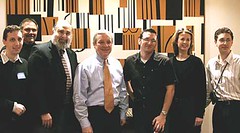
There were plenty of other highlights in the meeting. Martini Republic has a good roundup with a pic. I'll add some bullet points:

• Yes, it was amusing when Durbin boasted that Obama has thousands of friends on "MyFace." But give him a break, he's 62.

• Sen. Durbin was eloquent on the subject of Darfur, and went out of his way to mention it. He's got a four-pronged strategy that includes a "Plan B" sanctions-based effort by the Administration; trying to shut down the Sudanese oil market by using financial institutions (they do their oil business in dollars, and at some point we could possibly head that off); divestiture at the state, local, and personal level; and changing US law to allow us to arrest foreign nationals suspected of genocide on foreign soil (as we can currently do with regard to tortue, a la Charles Taylor of Liberia, who Durbin did actually call "Chuckie Taylor"). A lot of this is going through the newly-created Human Rights Subcommittee created by Sen. Leahy in the Judiciary Committee.

• Durbin supports the Dodd-Menendez bill to restore habeas corpus, and called those who ramrodded the bankruptcy bill through the Senate "heartless bastards." You read that right. He did seem willing to put together bills that may fail for the purposes of getting vulnerable Republicans on the record about various issues. This is how habeas and bankruptcy may go, trying to throw wedges in to split the Republicans (and certain Democrats as well, on those bills).

• On Iraq, the Senate appears to be trying to craft a consensus on next steps. They want a consensus Amendment that can get all 49 available Democratic votes. Durbin seemed supportive of Rep. Murtha's readiness strategy, but stressed the importance of the vote count (as you would expect any former Minority Whip to do).

There was more, but I want to re-stress how important it is that the #2 man in the Senate is on board with full public financing of Congressional elections. This could revolutionize the way politics is undertaken in this country. With corruption on people's minds, there's never been a better environment to introduce something like this. But it has to be explained smartly and honestly to the public in order to succeed.

Labels: , , , , , ,

|