Amazon.com Widgets

As featured on p. 218 of "Bloggers on the Bus," under the name "a MyDD blogger."

Wednesday, October 07, 2009

Obama's Up, But The Jobs Still Must Come Back

The President is slowly moving back up the ladder.

President Barack Obama's approval ratings are starting to rise after declining ever since his inauguration, new poll figures show as the country's mood begins to brighten. But concerns about the economy, health care and war persist, and support for the war in Afghanistan is falling.

An Associated Press-GfK poll says 56 percent of those surveyed in the past week approve of Obama's job performance, up from 50 percent in September. It's the first time since he took office in January that his rating has gone up.

People also feel better about his handling of the economy and his proposed health care overhaul.


The tea parties of August appeared to be a dead cat bounce. Obama still has problems on the war in Afghanistan, but otherwise he's slowly starting to come back. Perhaps it was his assumption of authority in the Congressional speech. Perhaps it's that things are moving forward, however glacially, on health care. Perhaps it's a recognition that he's one of the few adults in the room, as the right descends into madness and begins to scuffle amongst themselves. For whatever reason, he's getting some goodwill.

Again, I still believe that ultimately, his fate is inextricably tied to the economy. Perhaps we will see some job creation efforts, although I'm still wary of the job creation tax credit because it can be so easily gamed. I trust EPI to come up with a decent version, though.

One version of the approach, to be unveiled next week by the Economic Policy Institute, a labor-oriented research organization, would give employers a two-year tax credit if they increased the size of their work force or added significant hours of work (for example, making a part-time worker full time). Employers would receive a credit worth twice the first-year payroll tax for each new hire, amounting to several thousand dollars, depending on the new worker’s salary [...]

States have dabbled with similar tax credits in recent years, with mixed results. The federal government last tried this measure in 1977-78. During that period, employment — which had been soft from the 1973-75 recession — climbed at a record pace. The creation of one out of three jobs that was awarded the credit then was attributed directly to the policy. But the permanence of those jobs was less clear, and some dispute how many of those positions would have been created eventually anyway.

Supporters say that improvements upon the 1970s policy would increase its potency. These include better publicizing the credit; making it available even to concerns that are not making money, in the form of a direct payout to nonprofits and companies in the red; and distributing the credit quarterly so that companies see it sooner.


One thing this will do is just freeze the job market until the moment it passes. If you're a business and you're going to get a tax credit for hiring workers, of course you would lower your workforce as much as possible to qualify for the maximum credit. In that sense, it really is corporate welfare. Not to mention that corporations just aren't as likely to hire people they feel they don't need if there's no work for them to do.

You know what could really help hiring? Fixing the credit markets for small business in particular. Those markets are still tight, and just returning to the 2007 system of shadow banking, instead of having banks just make loans out of their capital, won't work. If that doesn't get done, this small Obama bounce won't last long.

Labels: , , , , , , ,

|

Tuesday, October 06, 2009

Coming Around On The Jobs Crisis

Bob Herbert wonders today if the Obama Administration understands the nature of the jobs crisis. He says that millions of Americans need to get back to work, and if the private sector is unwilling or unable to produce those jobs, then the government must step in. This was the most crucial passage:

The survey for the Economic Policy Institute was conducted in September by Hart Research Associates. Respondents said that they had more faith in President Obama’s ability to handle the economy than Congressional Republicans. The tally was 43 percent to 32 percent. But when asked who had been helped most by government stimulus efforts, substantial majorities said “large banks” and “Wall Street investment companies.”

When asked how “average working people” or “you and your family” had benefited, very small percentages, in a range of 10 percent to 13 percent, said they had fared well.


I think the White House got an advanced copy of Herbert's column, because their message today has a lot to do with jobs. Peter Orszag reiterated that the President is "exploring additional options to promote job creation." Bloomberg covers it as well:

President Barack Obama is considering a mix of spending programs and tax cuts to respond to widening job losses that would amount to an additional economic stimulus without carrying that label.

The discussion of the initiatives, including a boost in transportation spending and an extension of an expiring tax credit for first-time homebuyers, comes as the White House is balancing rising concern about unemployment and a budget deficit the Congressional Budget Office estimates will total $1.6 trillion for 2009, and $1.4 trillion in 2010.

Administration officials have told allies in Congress that a broader transportation bill, and extensions of a homebuyer tax credit and unemployment benefits are all on the table, a Senate aide said.


As well as Herbert's paper, The New York Times:

President Obama’s economic team discussed a wide range of ideas at a meeting on Monday, following his Saturday radio address in which he said it would “explore additional options to promote job creation.” But officials emphasized that a decision was still far off and that in any event the effort would not add up to a second economic stimulus package, only an extension of the first [...]

Among the options for additional steps is some variation on Mr. Obama’s proposal during the stimulus debate to give employers a $3,000 tax credit for each new hire, which Congress rejected last winter partly out of concern that businesses would manipulate their payrolls to claim the credit. Another option would allow more businesses to deduct their net operating losses going back five years instead of the usual two; Congress limited the break to small businesses as part of the economic stimulus law.


Not to mention the WSJ and a separate Times article.

Calculated Risk worked through some of the safety net options the other day. Extending unemployment benefits and COBRA reductions sounds fine, but I don't see exactly how they create jobs - though added consumer spending may save some. The homebuyer tax credit, while popular, is a complete waste of money, costing tens of thousands per new home sold, and it isn't boosting housing and construction to any great degree.

As for the rest, infrastructure spending through the transportation bill would be great, but is the Administration willing to waive paygo rules, or do they have some idea to pay for it? The business tax credit for new hires seems ripe for abuse, as does the "carry-back" provision allowing major tax breaks for corporations. That just sounds like trickle-down economics to me, and thus far it hasn't worked.

Robert Reich has some much better ideas, though he does side with the new jobs tax credit.

Use existing authority under both the stimulus package enacted earlier this year and the nefarious TARP bailout fund -- extending and combining them into a fund to make up for state and local cuts in public school budgets, childrens' health, public health (we need workers to administer swine flu vaccine) and public transportation. Instead of bailing out banks and giant automakers, we should switch to bailing out public services that average people need.

Propose a one-year payroll tax holiday on the first 20,000 of income. Republicans as well as Blue Dog Dems could go along with this, and it would be a highly progressive tax cut since 80 percent of Americans pay more in payroll taxes than they do in income taxes.

Give small businesses a "new jobs tax credit" for every net new job created over the next year. Granted, under normal circumstances this sort of jobs credit doesn't have much effect, and it's difficult to separate hires that would have happened anyway from net new ones. But we're not in normal circumstances; small businesses, which are responsible for most new jobs, still aren't hiring. They need a boost.

Dramatically expand the Small Business Administration's lending programs and have the Fed buy up the SBA's debt. Big banks are not lending to small businesses. TARP has been an utter failure in this regard. The SBA and the Fed should circumvent them and help small businesses get the capital they need, so they can start hiring again.


These might work in separate bills instead of one big stimulus bill that would have a target on its back. There's no question that state aid should be on the top of the list, and I think accelerating infrastructure spending is vital enough that deficit spending makes sense; government interest rates remain low, after all.

More than anything, the Obama Administration has to show through their actions a concern for those struggling right now. The jobs picture is intimately tied to their economic fortunes, so they have every incentive to do so.

Labels: , , , , , , , , ,

|

Thursday, October 01, 2009

Too Bold? How About "Too Absurd"?

At first I thought that the headline writer was confused. "California tax reform plan much too bold for Capitol," it said above George Skelton's column today. "Too bold" could maybe have more than one meaning. Surely Skelton wasn't throwing in with the idea that massively shifting the tax burden to the lowest income levels in society was too good an idea. But I think that is, in fact, what he's saying.

"I would sign it immediately" if it were a bill, Schwarzenegger told reporters. "Without any doubt."

Of course, this is a governor who constantly seeks out things new and bold. And the tax proposal was all of that -- much too new and bold for most Capitol denizens, especially those representing special interests.

As Genest told me: "It shouldn't come as any surprise that lobbyists in Sacramento are in favor of maintaining the status quo unless they are confident that the change will serve their interests. That's why they're called 'special interests.' "


Nowhere in Skelton's article does he quote any figures or statistics citing the practical effect of the Parsky Commission's plans. He doesn't mention that, under the plan, taxpayers making over $1 million dollars a year would save $109,000 annually on average, while taxpayers making between $40,000 and $50,000 would save four bucks. He doesn't mention that the proposal would result in a net loss of revenue to the state, causing wider budget deficits. He does manage to mention critiques of the business net receipt tax from the side of business and industry, but offers no critiques from the opposite end, a la Jean Ross' statement that “You could not say, ‘We’re going to tax child care so we can lower the income tax on millionaires.’ But that’s what this does." The fact that the BNRT would hit business payrolls and disproportionately tax companies in the knowledge economy rather than the service economy also doesn't make it in. Skelton never mentions that, by taxing all businesses in the state, the BNRT would effectively tax rents.

He just says it's "too bold."

The Parsky Commission was practically designed to shift wealth upward. It should surprise nobody that this is what it ended up doing. That is bold, but not in the way that Skelton means it, I don't think.

He does give voice to where Karen Bass may steer the debate:

Bass was holding her tongue, trying not to express disappointment in the commission. When she first proposed its creation, the speaker envisioned the panel proposing something more practical and simple: reducing the sales tax rate and spreading it to currently untaxed services.

She promised a "thorough and objective public review" of the panel's recommendations.

Good idea, but don't stop there.

"My biggest message to dysfunctional Sacramento is to get something done," Parsky says. "If you've got a better idea, get it done."


There's no question that flattening and broadening the sales tax base is a decent enough idea. Under the constraints of minority rule, it may be the best one lawmakers can get, and it would prove popular if enacted. We'll see if the Parksy Commission report is dumped in favor of that.

Labels: , , , , , ,

|

Tuesday, September 29, 2009

Will The Spotlight Ever Fall On Jerry Brown's Ideas, Not His Image?

With the Rasmussen poll numbers filtering through the traditional media, the idea of Jerry Brown being the favorite at this moment to return to the Governor's mansion is taking hold outside of California. Talking Points Memo has a piece marveling at how strange it is to see the "colorful" Brown back in this position, recalling the time-worn stories about Linda Ronstadt and "Governor Moonbeam," although they do acknowledge that "this all contributed to a somewhat inaccurate caricature of him as a left-winger." Indeed, the TPM profile notes that Brown was a fiscal conservative in office and ran on the flat tax in 1992. Clearly, the author was informed by Joe Mathews' cover story in this month's American Prospect, which delves further into Brown's un-campaign for Governor and the puzzling question of what in the heck he's planning to do once he gets there:

But a little talk about the big picture is in order. Outside Brown's news conferences, California is coming undone. This summer, unemployment reached 11.9 percent. Tens of billions of dollars have been cut from the budget in the past year. Thousands of teachers have been laid off. State offices are now closed three Fridays a month. University tuition has been hiked. Thousands of elderly and disabled people are losing their state-provided health insurance.

The crisis is so profound that it may present an opportunity for California to fix its badly broken government. Coalitions on the left and in the center (the right is sitting on the sidelines, enjoying the Armageddon) are drafting plans to change the way the state is governed. They hope to get several measures on the 2010 ballot that would reshape the state budget, call a state constitutional convention, and perhaps unwind much of Proposition 13, the 1978 initiative that severely limited the government's ability to raise taxes -- a major contributing factor to the budget hole California finds itself in today.

If any candidate should be talking about this, it's Jerry Brown. After all, Prop. 13 passed during his governorship. But Brown has yet to engage the would-be reformers. In the rare moments when he's asked how the state might be fixed, he talks vaguely of the need to forge compromise and invokes older, better times in California, when he and his father, former Gov. Pat Brown, were in power. "We can talk about 'restoring the dream,'" he told a union conference in Palo Alto during an explicitly political appearance this summer. "Well, I was around when the dream was here."

This is a dodge -- not only of the present questions about what he might do as governor but also of lasting concerns about Brown's own role in diminishing the California dream. Pat Brown was a great builder of the highways and waterways and schools that made the state prosperous, but his son Jerry announced "an era of limits." Since that declaration 33 years ago, the state's population has grown from 22 million to more than 38 million. The state government has not kept up. If Brown has specific ideas on what to do about all of this, he is keeping them to himself.


Brown clearly has a blueprint for winning the election - say as little as humanly possible about the problems that grip the state, and hope that tangerine dreams of the halcyon 70s push him to victory. You cannot blame him - it's a winning formula. With a pathetically thin state political media, it's fairly difficult to run on any issues to begin with, at least ones beyond the bumper-sticker variety. Arnold Schwarzenegger got elected by saying pretty much nothing that wouldn't fit as a movie slogan, and a celebrity-obsessed media let him get away with it. So I don't begrudge Brown the lack of specifics. That's the way the game has been played in recent years.

Indeed, I don't worry about what we don't know about Brown, but what we do know.

Progressives, both then and now, argue that Brown's brand of anti-government liberalism fueled the Prop. 13 fire. If government isn't all that important, what does it matter if you cut taxes? Brown had frozen highway construction, criticized funding for adult education and food stamps, and slashed social services. "I am going to starve the schools financially until I get some educational reforms," he said in one encounter with reporters.

What reforms, governor?

"I don't know yet." [...]

Brown, in the midst of running for re-election, called himself a "born-again tax cutter" and immediately reinvented himself as Prop. 13's champion. (He maintains now that he had to support 13 after its victory because of his oath to defend the state constitution.) Brown went so far as to befriend the legislation's co-sponsor, the anti-tax crusader Howard Jarvis. "It seemed like he went over to Jarvis' house frequently," says Joel Fox, who would later serve as an aide to Jarvis. "Mrs. Jarvis would tell stories about serving lunch to the governor with Howard in his pajamas. Howard voted for him for re-election because Jerry convinced him he would implement Prop. 13 in the right spirit."

As it happens, the only thing worse than Prop. 13 itself was its implementation. Brown and the legislature bailed out cities and counties that lost revenues under the law -- and thus established the dysfunctional system of budgeting that plagues California to this day. Tax and spending decisions once made by city councils and school boards were centralized in Sacramento. The state Capitol became a giant piggy bank, with interests on the right and left using lobbying muscle -- and the initiative process -- to carve out special protections for their funds, leaving less for broad public investments. At the rare moments when Democrats tried to make such investments, Prop. 13's two-thirds requirement for taxes allowed Republicans, even when they were in the minority, to block them.


Indeed, the Jerry Brown of recent public comments shows no sign of understanding the present state of the state. He has supported the current Governor in various accounting tricks and tough-on-crime stances that have blown a hole in the deficit. He has stated an unwillingness to take a leadership position on any even remotely controversial issue. He hasn't strayed from that "born-again tax-cutter" mantra. As our own Robert Cruickshank says in this very good article:

"The problem with Brown is that I'm not convinced he's moved past 1978," says Robert Cruickshank, who works for the progressive 700,000-member network Courage Campaign and is a frequent contributor to the blog Calitics. "The lesson he drew from that is that he has to adapt to a more conservative reality. ... I'm concerned that it's not going to be the kind of governorship where you see significant changes in the way California operates."


If this is the Jerry Brown we can expect to "lead" in 2010, I know that progressives will have far better outlets for their advocacy, be it the Lakoff Initiative or the Constitutional convention. As I've said many times, you could elect Noam Chomsky governor and he would still be constrained by the same structural factors that resist true democracy and responsible governance. And Jerry Brown is most certainly no Noam Chomsky.

Labels: , , , , , ,

|

Wednesday, September 23, 2009

Better By Inches

I should note that Max Baucus modified his chairman's mark to include some key elements sought mainly by Democrats, making the bill a bit better. The highlights:

• He increased the tax credits, as expected, so that they slide up to 12% of income instead of 13%, up to 400% of the poverty level. This makes the coverage subsidies a bit more generous and makes health insurance a bit more affordable. Emphasis on "bit". He also lowered maximum out-of-pocket costs.

• He reduced the "age band," lowering the difference between the cheapest policy and the most expensive based on age from 5:1 to 4:1. In other words, insurers will only be able to charge someone 4 times as high a price based on age, not 5 times as high. Again, this is a minor improvement, but an improvement nonetheless.

• He accepted Olympia Snowe's amendment lowering the threshold for affordability for employer-based insurance. If that costs someone more than 10% of their income, they can go to the exchange.

• He indexed the threshold where the insurance company excise tax comes in to the Consumer Price Index. This will limit the damage from average insurance policies getting hit with the tax as the years go on, but not completely. He also raised the initial threshold number up to $22,000 for a family plan, which isn't likely to satisfy the unions.

• The penalty for not getting insurance is now much smaller, down to $1,900 per family from $3,800.

• Anyone exempt from the individual mandate because of affordability can now buy the bare-bones catastrophic policy designed for "young invincibles."

Baucus did something sneaky, too. He delayed the coverage subsidies by six months:

Effective date of Health Care Affordability Tax Credits - The modified Chairman's Mark would set the effective date of the Health Care Affordability Tax Credits at July 1, 2013.


That's one way to save money in the overall bill - turn a ten-year bill down to 5 1/2, although Igor Volsky estimates that the cost has increased to $900 billion.

There are some other minor improvements outlined by Jon Walker.

Labels: , , , , ,

|

Monday, September 21, 2009

Health Care Update

Looks like lawmakers are gradually expanding the puny subsidies in the Baucus health care bill:

The chairman of the Senate Finance Committee, Max Baucus, said Monday that he would modify his health care bill to provide more generous assistance to moderate-income Americans, to help them buy insurance.

In addition, Mr. Baucus said he would make changes to reduce the impact of a proposed tax on high-end health insurance policies.

Mr. Baucus, Democrat of Montana, disclosed his plans in an interview a day before the committee is to begin meeting to debate and vote on the sweeping legislation, which is intended to remake the nation’s health care system and guarantee insurance for millions of Americans.

Mr. Baucus said the changes showed that he had heard the criticism of his bill from colleagues, who asserted that many people would be required to buy insurance who could not afford it — even with federal subsidies to help defray the cost of premiums.

“Affordability — that, I think, is the primary concern,” Mr. Baucus said. “We want to make sure that if Americans have to buy insurance, it’s affordable.”


Affordability to Baucus means reducing the limit of policies from 13% of total income to 12% of total income, through subsidies up to 400% of the poverty level. That's at least a start, though still short of what's in the House bills.

As it says above, responding to changes Baucus will reduce the impact of taxing insurance companies, basically by raising the threshold when plans start to hit the tax. But this is paradoxical. Raising the subsidy levels costs money. Raising the tax threshold takes away money. Lawmakers want the bill to protect more people on affordability while taking away some of the money that would pay for those protections. There is a late and familiar entry here, however, and that's Jay Rockefeller's idea to add back in a variation of what the Obama Administration sought all along:

In fairness to Rockefeller, he's got some ideas along those lines.

He's said many times he would be perfectly happy with the sort of financing they have in the House--i.e., a straight-up tax on the rich. And while such a scheme might have trouble in the Senate, Rockefeller is trying gamely to intorduce a more scaled-down version.

Among the amendments he's introduced for this week's Finance Committee hearings is a proposal to cap the deductability of charitable contributions at 35 percent--which would, in effect, reduce the deductability of contributions that very, very wealthy people make to charities. It seems to be a version of what President Obama proposed at the beginning of this process, an idea that still has a lot of merit even though many Senators rejected it out of hand.

Would they reject it again? Maybe not in scaled-back form, which might be enough. In the end, the most likely solution to the funding problem is some sort of combination strategy--a tax that hits expensive health benefits, a tax that hits the wealthy, and, maybe, some sort of tax sugary drinks or tobacco. The new Rockefeller proposal, according to Capitol Hill sources familiar with it, will probably raise about $90 to $100 billion--which is a decent chunk of change and could pay for a lot of new subsidies.


The President wanted to roll the charitable deduction credit back to 28% - exactly where it was during the Reagan Administration, at a savings to the government that could easily top $300 billion over ten years, enough to make the subsidies big enough to make health care truly affordable for everyone. And it would only hit those who make enough money to take advantage of the charitable deduction to begin with. It's really a no-brainer.

Of course, there are more areas of conflict in the bill beyond affordability and financing. There are various amendments in the Senate Finance Committee to add a public option, as well as Olympia Snowe's amendment to add a trigger, and a weak trigger to boot. Obama went on the record saying “I absolutely do not believe that (the public option is) dead," although his close colleague Dick Durbin said today that only a "variation" of it could make it through the Senate. Nancy Pelosi continued her public statements that the public option must be included to pass the House, though House liberals, wary of a bait and switch, asked the Speaker to stand with them when the bill reaches a conference committee. Jerry Nadler reiterated the seriousness of the threat from the progressive side:

Rep. Jerrold Nadler (D-N.Y.) said Monday he is optimistic that any healthcare bill from the House will include a public (or "government-run") option, and are undertaking a whip count to test lawmakers' commitment to that measure.

"The public option is still very much alive only because the progressives have stood together and held our ground and said that, regardless of what the President or Leadership says, we won't vote for any bill [without] a public option," Nadler said in a chat online hosted by the liberal AMERICAblog.

Nadler told the blog that 60 lawmakers had pledged to vote against any healthcare bill lacking the public plan, and that liberal Democrats are "undertaking a whip count now to see how firm these pledges are."


While affordability and financing may come to some compromise position that is at least passable, the statements above show that there's no such middle ground for the public option. This may vex the White House, but they will eventually have to show their cards.

Labels: , , , , , , , , , , , , ,

|

Friday, September 18, 2009

Affordability Changes On The Way?

A bunch of Senate moderates praised Max Baucus for his health care bill yesterday, leading many to believe that Baucus-care wasn't totally dead. But there was an important caveat - the letter says, "While we each have outstanding concerns we wish to see addressed, Senator Baucus has taken an important and critical step forward with this legislation." It looks like the major concern is affordability. Olympia Snowe, one of those moderates, expressed as much in today's New York Times as well as the Washington Post.

Senator Olympia J. Snowe, Republican of Maine, voiced the same concern. In an interview with The New York Times and CNBC, Ms. Snowe said that for her to support the bill, “there would have to be more subsidies” for low- and middle-income people and that she was trying to figure out how to pay for them.

Ms. Snowe said “the time has come” to pass comprehensive health legislation. But she added that it was important to get the policy and the details right, because they would affect every American.


Max Baucus has signaled an openness to work on the affordability issue.

Specifically, Baucus is talking to Democratic members of his committee about addressing one of their chief complaints about the bill — that it won't do enough to make insurance affordable to the middle class. That's a crucial question, because the legislation would, for the first time, impose a requirement that virtually everyone have some kind of coverage or face a fine. Under Baucus' bill, the government would provide some help-giving subsidies to help those earning up to three times the poverty level (in other words, a family of four making as much as $66,000 a year) buy insurance and setting caps on their out-of-pocket expenses.

But many in his party say that help doesn't go far enough — especially in comparison with the version that the House is working on, which would provide assistance for those earning up to 400% of the poverty level (or a family of four making $88,000). "We're working to address that concern," Baucus said, adding that one idea "very much on the table" is to increase the refundable tax credits for those purchasing insurance. That, however, would likely increase the overall price tax for the measure, which in its current form would cost $774 billion over the next decade, according to estimates by the Congressional Budget Office.


Karen Tumulty gets at the main point here. Snowe has talked a lot about affordability, and wants to expand coverage subsidies. But she doesn't want to spend any more money on the bill, which in order to raise the subsidies, you would have to do. From the other side of this, Democrats and Republicans want to shrink the tax on high-end insurance policies which, under current health inflation, would quickly hit more average-sized policies. But of course, that's how the bill is paid for in the Baucus plan.

Senators of both parties said Thursday that they would seek significant changes in a Democratic proposal to tax generous high-cost health insurance policies.

The tax, proposed as a way to help finance coverage of the uninsured, would be levied on insurance companies. But the senators said they worried that it would be passed on to individual policyholders, families and employers who buy insurance for their workers.

Senator John Kerry, Democrat of Massachusetts, who first proposed the insurance tax, said Mr. Baucus had set the thresholds too low. As a result, Mr. Kerry said, “working folks with a lower level of income will get dragged in,” and the tax could affect union members who have sacrificed pay raises to get health benefits.

Mr. Kerry said the threshold for family coverage should be at least $24,000.


So those inclined to vote for health care want more subsidies in the bill and less taxes on insurers. And I want a pony. But the President laid down a marker of not adding to the deficit, and so in order to do both those things, you need to find another revenue source.

Fortunately, there are several. Just repealing the Bush tax cuts a year early and applying that to health care would save $135 billion dollars. Or using the initial Obama Administration idea of lowering the charitable deduction rate to 28% from 35% would capture something like $300 billion. Or the House's surtax on the wealthy would add even more. There are plenty of options; but will there be the political will?

There's definitely the will to increase the subsidies. The White House is assuring liberal members of that, although not about the public option. The question is, will that be enough to satisfy progressives, particularly in the House? Paul Krugman asks that today.

It would be disastrous if health care goes the way of the economic stimulus plan, earlier this year. As you may recall, that plan — which was clearly too weak even as originally proposed — was made even weaker to win the support of three Republican senators. If the same thing happens to health reform, progressives should and will walk away.

But maybe things will go the other way, and Mr. Baucus (and the White House) will, for once, actually listen to progressive concerns, making the bill stronger.

Even if the Baucus plan gets better, rather than worse, what emerges won’t be legislation reformers can love. Will it nonetheless be legislation that passes the threshold of acceptability, legislation they can vote for? We’ll see.


Indeed.

Labels: , , , , , , , ,

|

Thursday, September 17, 2009

More Transit Funding For Anti-Government Protests!

This really is truly hysterical.

Protesters who attended Saturday’s Tea Party rally in Washington found a new reason to be upset: Apparently they are unhappy with the level of service provided by the subway system.

Rep. Kevin Brady asked for an explanation of why the government-run subway system didn’t, in his view, adequately prepare for this past weekend’s rally to protest government spending and government services.

Seriously.


I hate to be a bother, but, why take the government-run subway system if you don't like government spending?

Some seriously great lines in this, such as:

Brady wrote. “These participants, whose tax dollars were used to create and maintain this public transit system, were frustrated and disappointed that our nation’s capital did not make a great effort to simply provide a basic level of transit for them.”


Steve Benen put it best: "Replace 'transit' with 'health care'."

There's also this:

Brady says in his letter to Metro that overcrowding forced an 80-year-old woman and elderly veterans in wheelchairs to pay for cabs. He concludes that it “appears that Metro added no additional capacity to its regular weekend schedule.”


Isn't this the free enterprise system at work? If people use their own money to pay for cabs, shouldn't we celebrate that kind of entrepreneurial spirit where everyone is a Dagny Taggart and John Galt boldly determining their own fate through the market?

Of course, when these whiny protesters don't get what they want from government, they appeal to government to take care of the problem. And the federal government has not provided a dedicated source of revenue for Metro, forcing cutbacks. Do you think Kevin Brady will sponsor a bill now to provide funding for Metro so the trains can run on time? In other words, is his answer to expand government?

No. He's a selfish crank who wants to complain about things when he and his pals want to use them, but demonize them otherwise.

...as predicted, Kevin Brady previously voted against funding for Metro.

Labels: , , , ,

|

Wednesday, September 16, 2009

The Baucus Circus

The votes are in! Everybody's talking about Max Baucus' plan for health care!

Mostly, people don't like it!

Republicans don't like it because... it's a health care bill. Democrats don't like it because... it's a bad health care bill designed to kowtow to Republicans who won't even vote for it. Health care advocacy groups don't like it because it "would give a government-subsidized monopoly to the private insurance industry to sell their most profitable plans - high-deductible insurance - without having to face competition from a public health insurer." A good reason not to like it! And unions don't like it because there's no employer mandate and it would "tax health plans."

A bill of particulars:

• The bill spends too little on coverage subsidies. While putting a price tag on something that is paid for inside the budget window is misleading, the fact is that Baucus artificially lowered that price tag to meet some conception of centrism, and the lowered subsidies have a direct impact on affordability.


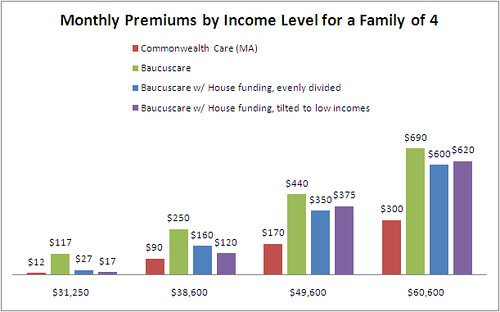
People in Massaschusetts are by and large satisfied with the Connector. It's toughest on the fairly small number of families earning just over 300% of FPL (of which there aren't that many), and on the larger number of young individuals who make just over 300% of FPL (which is $32,320 for an individual, so there are a decent number of those folks). Working class families earning up to 200% of FPL have fairly low premiums. $90 per month is going to pinch, but for uninsured households, they'll get some real value out of that: Commonwealth Care plans include dental insurance, wellness checkups have low co-payments; chronic disease care is especially well covered, and so forth. Likewise, three hundred pre-tax dollars a month for a family with a gross income of $60,000 per year is Real Money, but it's not going to break the bank. It's less than what they should be saving for college, for instance.

But as you can see from the graph, the Baucus bill doesn't fare as well. It's not even close to faring as well. The eight million individuals without insurance who earn between 200% and 300% of FPL will pay more than twice what similar households in Massachusetts currently pay. And working class families will feel a real pinch; $250 per month ($3,000 per year) for a family of four with an income of $38,000 is going to hurt.


• The community rating provision, mandating that insurers offer the same price to everyone regardless of medical history, comes with a tremendous loophole that will allow them to change five times as much for a policy based on age, which is just another way to discriminate against the sick.

• The employer "free rider" problem, called "one of the worst policy ideas I've ever seen" by Ezra Klein, would penalize employers for hiring anyone who qualifies for subsidies, encouraging them to find people who get coverage through a spouse or illegal immigrants. It also gives large employers like Wal-Mart a competitive advantage for paying crappy wages. And you can't opt out of the garbage insurance that giant employer - let's call them Ball Bart - might offer you.

• The excise tax for violating the individual mandate could cost up to $3,800 but wouldn't kick in if the individual could not find coverage that costs more than 10% of his income. In which case, you've built a robust architecture for a useless plan, because if millions opt out the coverage gets less universal and insurers want to stop come-as-you-are guaranteed issue.

• The co-ops are even weaker than imaginable:

The co-ops can only compete in the small group and individual markets. That is to say, if the co-ops prove effective, and The Washington Post would like to offer co-op coverage as an option to its workers, it can't. The co-ops are not allowed to contract with large employers, which is to say, they can't compete with private insurers in the largest market, and they can't get the purchasing power that would come from a serious foothold among corporate customers.

Not only is their size restricted, so too is what they can do with their size. The co-ops can band together to increase their purchasing power, but they can't set national payment rates for their members, a la Medicare. As I understand it, they have to bargain with each provider and drug manufacturer and hospital and so forth separately, meaning they're denied one of the main advantages of size. The insurance industry is, in other words, being protected from not just public competition, but co-op competition.


Jay Rockefeller today sent a letter proving, based on tons of research, that co-ops were a complete sham that have failed in the marketplace on a number of occasions, saying that "I believe it is irresponsible to invest over $6 billion in a concept that has not proven to provide quality, affordable health care, when we know that a public health insurance option will rein in costs and save taxpayers billions of dollars."

Marcy Wheeler has a lot more. There's one promising sign that the exchanges look expandable and available to all businesses, a neat way to gradually wean the system off of exclusive employer-based insurance, but that's about the only silver lining. Kent Conrad's gambit of increasing the budget window to make the Senate Finance bill look better did work, as the deficit reduction aspects look improved for the bill over the House bill. But crucially, that's a function of the funding, not the outlay in subsidies. Those will be too stingy to make the bill work for people, only for the bean-counters. In fact, the bill will start taking more and more from the middle class, much like the alternative minimum tax, and political reality will force scalebacks, so the budget picture doesn't look as rosy as advertised.

But it also suggests some real dangers in the bill's second decade. The unpopular elements of the bill become a lot bigger and more onerous. The excise tax on high-cost insurance plans begins affecting insurance plans that aren't particularly high-cost. The Medicare and Medicaid savings begin to tighten. That said, there are a lot of potential savings that the CBO isn't taking into account here, so that might ease the pain. Plus, at some point, we are going to have to start cutting costs in the system, and you can't escape some eventual hurt in that. But you can be sure the GOP is going to run these numbers aggressively and spin them viciously.


The good news is that this is in no way "the bill" that will get signed by the President. It has to go through a significant amount of changes, and key Democrats are already balking at it. In fact, lil' ol' Roland Burris said he wouldn't vote for anything without a public option, and with the numbers so tight, every Senator is in a bargaining position. Baucuscare is an abomination. But it doesn't have to be the endpoint, only the beginning.

I should say that one group really, really likes the Baucus bill - insurance companies.

Labels: , , , , , , , , , , ,

|

Tuesday, September 15, 2009

Parsky Commission To Introduce Their Shock Doctrine Document

We heard last week about outlines of the Parsky Commission report that would radically shift the tax burden in California. We even heard that offshore drilling may have been snuck into the draft at the last minute. Last week, the commission held a public meeting which featured more details, including the intimation that 3% of the population would see half of the tax break under the Parsky plan. They made the public wait for seven hours and then gave one individual a minute to make a comment. Yesterday, the final public meeting was held, and right before it, Jean Ross offered some facts and figures showing how the commission's recommendation would amount to the Latvia-ization of the state of California, with a massive transfer of wealth to the upper classes at the expense of working families.

The biggest winners would be the state’s millionaires, who would receive personal income tax breaks averaging $109,000 per year. The biggest losers would be middle-income families who would receive a tiny, if any, reduction in their personal income taxes and who would pay substantially more for goods and services due to the new “value-added” tax the Commission proposes to replace revenues lost due to the tax cuts for the wealthy and repeal of the corporate income tax.

The magnitude of the shift proposed by the Commission is nothing short of stunning. The changes to the personal income tax structure alone would reduce income taxes paid by the poorest 62 percent of California taxpayers by $4 per year, on average, while providing six-figure breaks to the millionaires. The bottom 81 percent of the income distribution – the vast majority of all Californians – would receive 10 percent of the personal income tax cut, while the top 0.2 percent would receive 27 percent of the benefits.

And that’s the “good news.” The Commission would repeal the corporate income tax and the state’s portion of the sales tax and replace it with a new tax on business net receipts – a tax that has never been tried anywhere in the US – that the Commission’s own consultant notes would raise prices of goods and services, while exerting downward pressure on wages and benefits [...]

Some might be willing to support these changes if they ended California’s persistent budget crises. But again, the Commission’s own estimates predict that revenues raised by the new tax system would grow more slowly over time than those raised by the state’s current tax system. Thus, the Commission’s recommendations would lead to larger, not smaller, budget shortfalls in the future.


At the committee hearing yesterday, commissioners requested an analysis of the impact of the recommendation for taxpayers, and it came out precisely as Ross stated - "The 10 million taxpayers making less than $50,000 would pay $100 million more in taxes while the 7 million taxpayers who make more than $50,000 would get $6.8 billion in tax cuts."

This will not be a consensus document, most of the liberals on the panel won't sign it. And even the news reports today acknowledge that the changes would "largely benefit the wealthy." Clearly the Governor will put his weight behind it, but that's meant nothing in Sacramento for several years. The question is whether the Democratic Legislature would dare to massively reward the rich so nakedly by accepting these recommendations. Because the business community is actually against it, worried about the effect of the net receipts tax, I'd still guess no, but people should be letting their Representatives know that they will not get away with a transparent shift in wealth from the middle class to the super-rich.

Labels: , , , , ,

|

Thursday, September 10, 2009

Legislature Home Stretch Update

There's lots of significant news in the Legislature's last week regarding various bills, and it's extremely difficult to keep up with it all, probably by design. I should point out that, while the legislative calendar has an end date, there's no actual reason for some of the forced bottlenecks that result in hundreds of bills being passed at the last minute. It creates a shroud of secrecy in which special interests rule, and saps the public trust. A Democratic leadership actually interested in positioning government as somewhat decent would remove these forced bottlenecks from the internal legislative rules and allow bills to be approved on a rolling basis. That said, this is the system we have now, and here's a bunch of news about various bills:

• A new bill would exempt non-General Fund workers from furloughs. This would reverse one of the dumbest provisions in the budget bill, the practice of forcing furloughs on workers not paid by state government, saving almost no money and depriving people of needed services. Of course, the Governor will probably veto this one, because he hates admitting how wrong he is.

• Democrats on that vaunted water committee have decided against floating a bond to pay for any restoration or overhaul of the Delta. This means Republicans won't vote for it, and very little will come of this very important committee thrown together at the last minute. Some conference committee reports are here, but a deal looks remote, as it would need votes from some of the empty chairs in the Yacht Party.

• One bill that has cleared both chambers would set up "Education Finance Districts", "in which three or more contiguous school districts can band together to try to increase local taxes." This is a small step to make it easier for districts to pass parcel taxes to fund schools, but at this point every little bit helps. The 2/3 rule for approving such taxes would remain.

• With all the talk of health care reform, it's notable that an anti-rescission bill has once again passed the legislature. The bill would also simplify insurance forms. Last session, Arnold Schwarzenegger vetoed it. There's something you don't hear much about from the Democratic leadership - Arnold Schwarzenegger vetoed a bill that would have banned insurance companies from dropping patients after they get sick. He sided with the forces of insurer-assisted suicide. This is your modern Yacht Party on this issue:

"Any of those who have read the various exposés in the Los Angeles Times and others . . . is aware that health insurers have admitted and acknowledged they engaged in a form of post-claims underwriting," said Sen. Mark Wyland (R-Escondido). "It is unethical and, considering what some of these people have endured, it really borders on the immoral."

However, Wyland said he would not vote for the bill because the Department of Insurance has proposed new rules to solve the problem, and he wants to see how they work.


Hey, give 'em a chance to see if the immorality stops! If not, we can think it over.

• The Legislature may extend a homebuyer's tax credit passed in a previous budget agreement that was nothing but a bailout for developers. It only credited new construction, and was structured only to benefit high-income households who could afford new construction. By the way, sales of new units have fell since this was enacted, so it's not even meeting its intended purpose. But it's a giveaway to a special interest, so off the money may go, even though we cannot afford it at this time.

• A bill to ban bisphenol A (BPA) from children's products was delayed after the Assembly couldn't muster 41 votes. The debate in the Assembly last night was pretty fierce.

• Cities and counties reacted angrily to a proposed bill to slow local government bankruptcies until vetted by the California Debt and Investment Advisory Commission. On the merits this looks to be a bill that would install more control on locals from Sacramento, although there are arguments on both sides. But mainly it's about the fate of union contracts in local bankruptcies, I don't think either side would deny that.

• A roundup of other bills passed yesterday can be found here.

Labels: , , , , , , , , , ,

|

Wednesday, September 09, 2009

Parsky Commission Looking To Spring A Surprise On California?

When business groups began to object to various provisions in the Parsky Commission effort to upend the tax structure in California, including anything that even smelled like an increase (even though the plan had to be revenue-neutral to clear the Legislature), I figured the effort was dead and buried. It appeared that the entire effort was a complete waste of time, and the effort to Latvia-ize the state by shifting the tax burden from the upper class to the lower class had been sniffed out and extinguished. However, the recent secrecy on the part of the commission, after a pledge of transparency, has many wondering if the shock doctrine is alive and well.

The plan is that, just about 24 hours from now — or 11 a.m. Thursday, to be precise — a state commission will consider and potentially adopt a proposal for an entirely new tax system for the state of California.

It would be a radical undertaking, slashing some taxes, eliminating others and establishing a new tax about which no one in California is familiar. No one can say with anything approaching certainty how much it would cost businesses and consumers or how much revenue it would generate to finance state services.

Yet, despite the significance of the task, despite all the unanswered questions and despite the imminence of a decision, as of this writing — midafternoon Tuesday — the details of the proposed new tax plan have not been made available for public review.

A spokeswoman told me a little after 3 p.m. there was still hope that the detailed proposal would be posted on the commission’s Web site before the day was out.


The Legislature has made no indication that they would take up whatever plan the Parsky Commission votes out, even after the Governor orders a special session to deal with it. And with both sides of the aisle condemning aspects of the plan, liberals for the tax burden shift, and conservatives for the unknown tax increases that may be part of any deal, I wouldn't call the prospects likely for a Parsky Commission plan to become law. But the secrecy is certainly troubling, as well as the revival of provisions voted down by the people on multiple occasions.

But members of the tax commission are reviving the rainy-day fund idea once again. Most notably, the idea has had some of its strongest support from Democratic-appointed commissioners.

Former Assemblyman Fred Keeley said recently that while many commissioners believe the state can reduce its budget volatility through changes in the tax system, he believes the tax system isn't so much the problem.

"My belief is that volatility of the general fund, to the degree it's a problem, is due to the governor and Legislature with regard to spending," Keeley said. "That can be solved by way of an appropriately designed rainy-day fund or lockbox."

Another Democratic appointee, University of Connecticut law professor Richard D. Pomp, reminded the commission this month that he has long believed the reduction of volatility was a spending issue.

"From the outset, I have argued, and continue to believe, that volatility, which is a feature of every state's tax system, is a spending problem and not a tax problem," Pomp wrote. (That comes awfully close to the oft-used GOP line that California's budget problems are "a spending problem, not a revenue problem.")


I think these Democrats are trying to argue that volatility in the tax structure is a good thing, which it is. But the leap from that to a spending cap doesn't follow. There's a difference between spending wisely in good years and a third-party mechanism that limits the ability to restore chronic budget cuts from bad years, which is what a cap would inevitably do. (A rainy-day fund without a cap would be different, but may end up serving the same purpose.)

I stick with my prediction that the commission is doomed, but it still bears watching.

...Kevin Yamamura has more.

Labels: , , , , ,

|

Friday, September 04, 2009

Patrick Gilbert And The Danger Of Insufficient Reform

This remarkable viral campaign on Facebook has a very simple message. It happens to be the one that Harris Wofford rode to a Senate victory over a well-funded Republican opponent prior to the 1992 elections. It's what Bill Clinton pretty much ran on during those 1992 elections. It's an appeal to basic American fairness, and it's worked over and over again.

No one should die because they cannot afford healthcare. No one should go broke because they get sick, and no one should be tied to a job because of pre-existing condition. If you agree, please post this as your status for the rest of the day.


Before the day was out yesterday, Barack Obama had posted this message on his Facebook page, along with tens of thousands of others. It distills the entire debate about health care into something simple. An individual's health care should not be based on an individual's available funds. It's a winning message.

Except this message is exactly what's being bargained away, if reports are correct, in the latest round of capitulations.

Patrick Gilbert, an uninsured lumber company worker in upstate New York, is in a predicament that President Barack Obama and congressional Democrats believe they can solve. Gilbert and his wife have two children, but he says that on his family's $50,000 annual income, he can't afford the $600 monthly premiums for his employer's coverage.

"If I could find some reasonable insurance for about $100 a month, then I would do that," says Gilbert, 38, a lymphoma survivor who lives near Lake Placid. "Something reasonable, not with high deductibles. Something fair."

The House's health overhaul proposal would allow Gilbert to obtain family coverage for $250 a month, with the government picking up the rest of the premium costs. While that subsidy would make insurance more affordable for Gilbert, he could still be stuck with huge medical bills if he or his family members got seriously ill. In the worst case scenario, Gilbert could end up paying $4,400 in co-insurance and deductibles on top of $3,000 in annual premiums — adding up to 15 percent of his family's income.

Concern about the legislation's cost has overshadowed a major worry among some policy experts: Whether the Democrats' plans would protect low- and moderate-income earners from excess financial burdens, as backers have promised.

Under the House proposal, people receiving government subsidies could still end up spending 20 percent or more of their annual incomes on premiums, deductibles and co-insurance, according to estimates prepared by the House Committee on Ways and Means and obtained by Kaiser Health News. That financial load could grow substantially if the proposal's financing — $1 trillion over a decade — is pared back as congressional leaders come under pressure to reduce the legislation's costs.


The number now being put out there for the cost of the bill is $700 billion over 10 years. That may save rich people from a surtax, but it's impossible to provide affordable health coverage to everyone with those numbers. It probably needs to be twice that much. And so people will still die because they cannot afford health care. And people will still go broke because they get sick.

The problem is completely a lack of political will. There are plenty of savings that could be gathered from inside the health care system. But the White House wanted to protect industry profits and make deals to keep them from running attack ads. And unions don't want to go after the employer deduction, which keeps in place an inefficient system of employer-based health care that keeps costs high (because employers take them out of your wage increases, so they have little or no incentive to shop for good premium prices). By protecting most of the current system, the costs inside the system cannot possibly go down to the degree to make health care affordable. And as far as going outside the system, Democrats haven't made an argument about tax fairness since 1933, I think, and couldn't even pull off something as simple as lowering deductions for charitable donations back to where they were during the Reagan Administration.

A $700 billion dollar bill will have practically useless subsidies. And people just won't be able to afford insurance. So they'll remain out of compliance with the mandate. In fact, they'll probably qualify for exemptions from the mandate because insurance will be too expensive for them. And then insurers will complain that people aren't joining their system, making it unable for them to spread risk and lower costs. So they will raise premiums as a result, or maybe even go back to discriminating against people for medical history.

The subsidies and coverage expansion is crucial to the entire jury-rigged project here. You cannot take the subsidies away and expect the architecture to remain standing. Politically speaking, if the Congress accepts a $700 billion dollar spending bill and coverage remains unaffordable for those who need it, and prices continue to rise, it will be an unmitigated disaster just begging for repeal.

Labels: , , , ,

|

Thursday, September 03, 2009

Insurance Companies Make Out Like Bandits In CA Healthy Families Legislation

Last week I discussed the legislative fixes being made to save half a million kids from being dropped from the Healthy Families rolls. This fix would push more costs onto the families, making the program less affordable and the coverage stingier, and would extend a gross premiums tax on insurance companies, which was set to phase out in October, at a lower rate than they are now paying. Keeping that tax at the same rate would have spared families from increased premiums and co-pays.

But saving the program is saving the program, and yesterday the State Senate took the first step.

State lawmakers pushed forward Wednesday with a $196-million plan to keep nearly 700,000 children from being yanked off a government health insurance program for the working poor.

The state Senate passed a measure to create a new tax on insurance companies and bring in federal money to rescue the decade-old Healthy Families program, which had been cut deeply in recent months as lawmakers scrambled to balance the state budget.

Assembly officials expressed confidence that they would garner the needed two-thirds vote in the lower house, where the bill is expected to be taken up today. Administration officials said Gov. Arnold Schwarzenegger would sign the measure.


Again, not quite right. The "new tax" on insurance companies is an extension of an existing tax at a lower rate than before. This is why the insurance companies support the bill; they're getting taxed at a lower rate, keeping 600,000 kids on their insurance rolls, getting the families to pay more, and being credited with saving the system. It's a neat trick. Not only that:

The new tax would replace an existing 5.5% levy set to expire in October, prompting some lawmakers to quip that the new levy is actually a tax reduction. It would expire at the end of next year, and the insurers would be reimbursed for most of their cost.

"Of course the insurance companies want this -- it won't cost them a penny," Aanestad said.


Keeping the premiums tax in place does net $97 million in federal matching funds, which certainly helps matters. And keeping the program alive helps children in tangible ways. But this is a very strange conception of "shared responsibility," when the families participating in the program will have to pay more for premiums and co-pays, with less coverage overall, and the insurance companies get a lowered tax, which they will get reimbursement for down the road.

And the craziest part of all of this is that Sam Aanestad of the Yacht Party, while admitting this is a lowered tax and that insurers will not pay anything in the final analysis, voted against the bill because it "raises taxes on California business."

"Who pays is the bottom line here," said state Sen. Sam Aanestad (R-Grass Valley), who voted against the bill.


Sam Aanestad in this paragraph should read Sam Aanestad from the other paragraph.

Labels: , , , , ,

|

Monday, August 24, 2009

And... That's Over

The California Chamber of Commerce and 33 other business groups have basically stuck a knife in the Parsky Commission with a coalition letter opposing most of the tax reforms proposed. I'm sure they'd still love to see a flat income tax and the elimination of corporate taxes, but since they have basically refused all revenue-raisers in this document, that won't happen.

The coalition doesn't like removing Proposition 13's property tax limits from business property and a proposed new "carbon tax," both of which have been promoted by the tax commission's liberal bloc. But it also is warning about the potentially negative effects of a "net business receipts tax," similar to a European-style value-added tax, that commission chairman Gerald Parsky champions [...]

"The California business community has consistently stated that the solution to California's revenue problems will only come from robust economic growth and job creation," said today's letter to Parsky. "We believe the proposed split roll property tax and the energy tax would be extremely detrimental to California's economy. As for the business net receipts tax, we believe it is risky and inappropriate to move forward with dramatic changes to the tax structure without first fully vetting their impact on California jobs and the economy."


The only way for the Parsky Commission to get an up-or-down vote for its recommendations is by making the package revenue-neutral. The CalChamber document opposes all of the tax hikes while saying nothing about the reductions. California Democrats can be squishy, but not squishy enough to eliminate corporate taxes in exchange for nothing. Sen. Steinberg never agreed to bring the commission recommendations to a vote in the first place. And without an offset, they will never see the light of day.

Arnold Schwarzenegger is a wholly owned subsidiary of the Chamber of Commerce. Even in the unlikely even that the legislature ignores this letter and passes some plan including split-roll or a carbon tax or a business net receipts tax, there's no way the Governor signs it. The Parsky Commission is dead.

And I'm not really shedding a tear for it. Forcing a revenue-neutral standard on how to fix the tax structure inevitably was going to shift the tax burden from the rich, who have the clout to shield themselves from the predations of lawmakers, to the middle and lower classes, who don't. The very structure was flawed, and the reforms sought of a lesser order than being able to properly fund government according to the wishes of the majority.

So we can move on to the next challenge. Calbuzz has a good scene-setter on that, referring to something that Jean Ross mentioned in our Netroots Nation panel last week. California Forward's reform package may include, as a condition of repealing the 2/3 rule for passing a budget (and only the budget), a raising of the threshold to 2/3 for mitigation fees on businesses, which may extend to fees on alcohol, oil production and "anything else that carries a nexus to a public problem." In other words, while the budget would require a majority vote, revenue (which is 1/2 of a budget) would be subject to an even higher standard than it is now, and the legislature would be constrained in their ability to respond to the impact of corporate actions that harm the public good. Actually it could go even further than that:

But Chairman Bob (Hertzberg) insists it would be a mistake to focus only on Sinclair as the key to business support for CF reforms. The only way some of the conservatives and business people on CF would “even consider” allowing 50% to pass the budget is if there’s a whole panoply of budget reforms – pay-as-you-go provisions, controls on one-time expenditures, two-year budgeting, performance reviews, sunset provisions AND limits on what can pass with 50% as a “fee,” he said.

But will liberals – on CF and in the Legislature – agree to circumscribe their current authority to impost fees with a majority vote? Will they agree that there has to be a “clear nexus” between charges allocated to a polluter or manufacturer of polluty stuff?


As Jean Ross puts it, ever so succinctly, "California Forward?" I concur.

So while we appear to have sidestepped the Parsky Commission (for now), California Backward's set of "reforms" still lurk in the distance.

Labels: , , , , ,

|

Friday, August 21, 2009

The Charge Of The Hack Brigade

If the Capitol Weekly is going to have a right-wing corporate shill on their editorial pages, the least they could do is get a good one. Because I don't know where anyone, even John Kabateck of the National Federation of Independent Business, gets the cajones, after the legislature just passed a cuts-only budget completely on the backs of poor people, to fret about the plight of possible taxes for the business community.

"Get the monkey off your back and relocate to Las Vegas", barks a new ad trying to lure hard-working small businesses away from California. If legislators don't listen, small businesses that have already been hit hard by the effects of a fragile economy and the billions in taxes that were passed earlier this year will go under.


Um, right, this "rich people and businesses are leaving California" Galt-ism is not true and has never been true. But do go on.

The Legislature is back and up to its old tricks. The budget that was passed in February and revised in July will need to be "fixed" again this fall. If history is our guide, we all know that it will be an uphill battle and an unpleasant environment for small businesses. There are currently $2 billion in tax hikes being proposed, including taxes on everything from gas, internet purchases and vehicle license fees.


Oh noes! Oil companies might have to pay for the natural resources they take out of California's ground for the first time in a century of drilling! Get the smelling salts! The vehicle license fee might return to still-well-below-the-average-percentage relative to every state in the nation! This is terrible!

You'll notice that Kabateck fails to mention the $2.5 billion annually in corporate tax cuts passed in the previous two budget agreements, which miraculously exceed the tax hikes - beaten back by the Yacht Party and the Governor in July - about which he is fretting so. These massive corporate tax cuts do nothing to keep the largest corporations in America doing business in California - they would hardly abandon a market of 38 million people. It's nothing more than a kickback for services rendered. And if that's a transaction of prostitution, then John Kabateck is the guy who cleans up the courtesan's antechamber afterward, eager to grab a buck for himself for the privilege of working for whores.

It's amazing how little the California office of the National Federation of Independent Business speaks for independent business. He could have written a nice little article about how corporate behemoths are screwing small businesses when it comes to state purchasing, which currently favors out-of-state multinationals. Instead, he offers the party line that the structural revenue gap is fine and leaving citizens out on the street to die is a small price to pay for protecting oil and cigarette companies. Kabateck doesn't seem to understand that this mentality is destroying the California economy, and with it all of those small businesses he claims to represent.

Hacktackular job, CapWeekly! With any luck, you'll get Jon Coupal or Joel Fox to offer a rebuttal.

Labels: , , , , ,

|

Wednesday, August 19, 2009

Florida's High-Tax Population Flight?

Via Joe Mathews, here's yet another powerful piece of evidence that the Yacht Party scaremongering over how high taxes force people to leave California is a load of fertilizer.

TALLAHASSEE -- For the first time since the end of World War II, the growth state of Florida lost population, researchers say, in a sign that the economic recession is even worse than many had feared.

In all, the state lost about 58,000 people from April 2008 to April 2009, according to a new estimate from the University of Florida's Bureau of Economic and Business Research.

"It's such a dramatic shift from what we've seen in the past,'' said Stan Smith, the bureau's director.

"Florida's economy is, in a lot of ways, driven by population growth,'' he said. "Perhaps more importantly, population growth is a reflection of how the economy is doing both in Florida and in the nation.''


It goes without saying here that Florida has no state income tax.

Attributing population shifts to taxes is about as rational as attributing student test scores to rain. If you want to correlate populations and the economy, the Occam's razor explanation would be that people go where the jobs are. And I would add that people who cannot find a job probably won't stay around a place long if the social safety net is vaporized.

The lack of political media in the state allows urban legends like this to take hold through the only outlets left, right-wing radio and persistent rumor. You get the falsehoods you pay for listening to such garbage. If we had 100 Peter Schrags in the media and twice that in the Democratic Party leadership forcefully rebutting such misinformation and making the value-based case for the kind of progressive government they'd like to see, at least there would be a counterweight. But it's hard to argue something with nothing.

Labels: , , , ,

|

Monday, August 03, 2009

Limiting The Employer Deduction

I don't know what the hell Max Baucus is up to, particularly because he's trying to reach compromise with a group of conservative Republicans whose goal is to talk any bill to death. But in a world without Republican obstructionism for its own sake, you could actually see a compromise position, where the bill expands coverage while paying for the expansion through reducing internal costs, regulating insurers and capping the deduction on health care benefits. Obviously the public option would remain a sticking point, but in a world where Republicans would allow a bill, you could see some compromise take shape.

But there's a problem with, as those who aren't disposed to the idea call it, taxing health benefits. In reality we're talking about capping or limiting a deduction, one which encourages an inefficient employer-based health care system where costs are not controlled. The problem is that the unions don't want it. They've put together very nice health care plans for themselves, sometimes at the expense of wage increases, and want to hold on to those benefits, or at least not get taxed on them at the high end. And politically, this makes the employer deduction dicey, particularly because unions are running and bankrolling a lot of the pro-reform groups. J. Lester Feder asks unions to relent on this point in the name of getting reform through. He has credibility from being a former steward of the United Auto Workers:

At first glance, this tax break, known as the "employer exclusion," is a great idea. Under the exclusion, a worker who earns an annual salary of $100,000 and receives $5,000 in benefits pays income tax only on the $100,000, not the full amount she receives from her employer. This effectively makes benefit dollars worth more than salary dollars, encouraging businesses to offer benefits. The problem, however, is that only 70 percent of workers have employer benefits, and they tend to be wealthier than workers without employer benefits. The employer exclusion also gives the greatest payoff to the wealthiest people: A worker in the 35 percent tax bracket with a $5,000 benefit package gets a $1,750 tax windfall, but if a low-income worker in the 15 percent bracket were lucky enough to get the same package, he would only save $750 on his taxes. The employer exclusion is a backdoor health insurance subsidy that gives the most help to the wealthiest workers with the best benefits while fully taxing the income of uninsured low-wage workers.

Unions fought hard for health benefits, and they fear employers will stop offering benefits if this tax advantage is taken away. And they're right: Wholesale removal of the employer exclusion without other reforms could cause the complete collapse of the employer insurance system. But only a partial rollback of the exclusion is under consideration as a part of comprehensive health reform. It is hard to argue against taxing a portion of the benefits of higher earners in order to make the tax code fairer and expand coverage for the uninsured. Yes, some unionized workers with benefits would see their taxes go up, but I was taught that we organize to make life better for all workers, not just those in our bargaining units [...]

Unions' fears are not unreasonable, but they are compromising what's best for all workers in order to protect unionized workers. And I'd like to believe that Walter Reuther, the legendary head of the United Auto Workers, would endorse this modest change in order to achieve universal coverage. When most unions had abandoned the fight for health reform in the 1960s because they had already won employer benefits for their members, Reuther launched his own effort to revive national health legislation. Announcing this campaign in 1969, he declared, "The call to greatness must be commensurate with the amount of change that is needed."


Listen to Walter Reuther. There's a reasonable debate to be had about whether taxing benefits will rein in health care spending. But there is no debate that the current system of subsidizing employer health care sustains an inefficient system that privileges high-earners over low-wage workers. If we can get a bill that gets at the employer deduction - even through this idea of taxing of insurance companies on their policies over $25,000 a year - while working to expand coverage to everyone and creating systems like the public option that change incentives around insurance and health care delivery, we'd be a lot better off. Even the unions.

Labels: , , , , , ,

|

Department Of National Pundits Who Know Nothing About California, Aug. 3 Edition

We've already seen a trend of national columnists using California's budget woes to conveniently push whatever obsession they want. Two more of these land on the nation's most august op-ed pages today, both of them inaccurate and out of touch with the nature of the situation here in the Golden State.

First we have fiscal scold Robert Samuelson trying to use California's budget crisis to make a larger point about a national "fiscal reckoning." He claims that California has "made more promises than its economy can easily support," as has the nation, and only fiscal austerity can remedy the problem.

On paper, the state could solve its budget problems by raising taxes further. But in practice, that might backfire by weakening the economy and tax base. California scores poorly in state ratings of business climate. In a CNBC survey, it ranked 32nd overall but last in "cost of business" and 49th in "business friendliness." Information technology (Intel, Google, Hewlett Packard) and biotechnology remain strengths, but some traditional industries are struggling. High costs, as well as tax breaks from other states, have caused movie studios to shift production from Southern California. In 1996, feature films involved 14,500 production days in the Los Angeles area, says FilmL.A.; in 2008, the figure was half that.

So California is stretched between a precarious economy and a strong popular desire for government. The state's wrenching experience suggests that, as a nation, we should begin to pare back government's future commitments to avoid a similar fate. But California's experience also suggests we'll remain in denial, prisoners of wishful thinking, until the fateful reckoning arrives in the unimagined future.


Ezra Klein does a pretty good job with this column, noting it provides a lesson for the difference between fiscal responsibility and fiscal conservatism. Samuelson, of course, is the latter, wanting a low-tax, low-spending country. Rather than arguing for a balanced solution, Samuelson eschews taxes due to the "business climate," even though many businesses cite the lack of investment in education and infrastructure that Samuelson is CALLING for as a reason for their concern about their future in the state. In addition, the "businesses are leaving California" argument is a myth applied to all states by fiscal scolds as a means for them to race to the bottom and provide as many corporate tax breaks as possible. Which California has done, to the tune of $2 billion a year, at a time when funding for state parks and domestic violence shelters and poison control units gets slashed. Ezra adds:

Samuelson implies otherwise, but California isn't a particularly high-taxing state. Total state and local taxes take up 11.73 percent of the average Californian's income. The national average is 11.23 percent. And it's been like that for many years [...]

Nor is California's spending on education somehow out of the ordinary. The state ranks 29th in the country on education spending (much lower per pupil; try 47th -ed.). And recent tax cuts haven't been helping the Golden State out. This graph from the California Budget Project shows the contribution that decades of tax cuts have made to the state's current fiscal crisis. It's a pretty depressing story [...] The budget deal that Arnold Schwarzenegger just accepted contained $15 billion in spending reductions. Absent the tax cuts of the last few decades, most of those reductions wouldn't be needed (add the vehicle license fee increase and you're talking about a surplus -ed.).


Samuelson is essentially making an argument about the kind of government he likes, using the California situation to illustrate it, the facts be damned.

Next up is Ross Douthat, who uses the California mess and contrasts it with Texas to create some notion of red states faring better in the recession, also at odds with the facts:

Consider Texas and California. In the Bush years, liberal polemicists turned the president’s home state — pious, lightly regulated, stingy with public services and mad for sprawl — into a symbol of everything that was barbaric about Republican America. Meanwhile, California, always liberalism’s favorite laboratory, was passing global-warming legislation, pouring billions into stem-cell research, and seemed to be negotiating its way toward universal health care.

But flash forward to the current recession, and suddenly Texas looks like a model citizen. The Lone Star kept growing well after the country had dipped into recession. Its unemployment rate and foreclosure rate are both well below the national average. It’s one of only six states that didn’t run budget deficits in 2009.

Meanwhile, California, long a paradise for regulators and public-sector unions, has become a fiscal disaster area.


Douthat also throws in the "rich businesses and rich people are fleeing California" canard, which as stated above is untrue about businesses and even less true about rich individuals.

Steve Benen deconstructs the argument about Texas being a great economic steward and California a basket case, and the reasons why. As Benen says, Texas is the worst state in America for the uninsured and the second-worst state for poverty rates. To conservatives who judge the progress of a state by the budgetary balance sheet and not the prosperity of the citizenry, I'm sure they are a model citizen.

Meanwhile, calling California a "liberal laboratory" and not recognizing the source of the crisis, namely the conservative veto on the budget process, speaks to Douthat's complete ignorance about the nature of the state. In addition, as Paul Krugman notes, there is no correlation between a state's perceived ideology and their economic performance (two of the highest-unemployed states are South Carolina and Tennessee), nor is there any correlation between the level of taxation and the current unemployment rate.

I know that the dysfunction of what is seen on the national level as a blue state is an inviting target for conservative columnists to spin some wider tale about liberal failure and conservative ascendancy. If only they had any knowledge of the actual facts involved.

Labels: , , , , , , , ,

|

Friday, July 31, 2009

One Ha'penny, Please

Since the New York Times' story dropped last week about high-frequency trading, lots of people have been trying to wrap their heads around it. To me it just sounds like straight-up theft. Information is currency in the market, and Goldman Sachs and the other high-frequency traders are simply buying information low and cashing in high. It's a money machine, as K-Drum notes.

Fortunately, there's a simple and elegant fix that would allow Goldman or whoever to keep with their HFT while improving the federal budget situation and maybe, just maybe, voluntarily curbing the practice. Just tax individual financial transactions.

Dean Baker is probably the most aggressive advocate of this approach. But Larry Summers has promoted it in the past. And Britain actually has a version of it on the books. At base, it's simply a microtax on financial transactions. Say, one-half of one percent on stock transactions. The average investor would hardly notice it. Most investors would hardly notice it. But high-volume traders would notice it quite a bit. Baker estimates that the tax could raise more than $100 billion annually, even taking into account the resulting drop-off in high-volume trading. That's money the federal treasury desperately needs.

And it's money that's coming from something that the financial sector does not particularly need. I've not heard many analysts say that the problem with the financial market is that it's just too slow. Rather the opposite, in fact. If high-frequency trading is really worth something to these firms, they can pay the transactions tax, and the rest of us can have the guarantee that this financial innovation is actually helping the country. If it's not even worth a half of one percent, it's probably not something the market -- or the rest of us -- need all that much.


'Xactly. Free market in action and all that. We can try to site mainframe computers and come up with all sorts of regulatory hoops that HFTs can jump through (and over), or we can take half a penny on every trade. If the stock market is oh-so-valuable and important to our economic future, then they can gladly afford half a penny.

I even like this better than restricting CEO compensation, because the latter smacks of intervention in the marketplace and can also be easily subverted, while a simple tax on transactions, which are widely available as data, just cannot. To put this in context, a half-penny on every trade would, over the course of ten years, pay for the entire health care bill. If giant investment firms are going to gamble with our money, they can at least ensure that some of it returns to the taxpayer.

Labels: , , , ,

|