Amazon.com Widgets

As featured on p. 218 of "Bloggers on the Bus," under the name "a MyDD blogger."

Thursday, September 24, 2009

Stooge (D-ND)

Sherrod Brown sez that, contra Rahm Emanuel, no Democrat will vote with Republicans on a filibuster to kill the health care bill, even if it includes a public option.

Brown should go have a talk with Kent Conrad (D-ND). Ezra Klein just did, and I don't know how he got through it without banging the telephone against his ear until it hurt. That Conrad displayed an unconscionable ignorance, as well as an arrogant belief in his own falsehoods, would be normal if he were a teabagger attending a town hall. That he's a Democratic United States Senator fills me with nothing so much as fear.

Conrad raised eyebrows this week when he told the Senate Finance Committee that the health care systems of countries like France, Japan and Germany should be models for the United States because they aren't "government-run systems," even though the government intrusion into those systems is far greater than anything this country is contemplating, even with a public option. Conrad got this from a book he read over the weekend, T.R. Reid's "The Healing of America". That's right, the chair of the Senate Budget Committee, a leading voice on the Finance Committee and a member of the Gang of Six, who has been working on health care for months if not years, JUST DECIDED to look into how other countries around the world manage their health care systems.

Klein started by asking Conrad what he was talking about with respect to France and Germany:

But that runs over some fairly large variations. In France, for instance, the insurance really is government-run. The vast majority of people are on public insurance, and there's private supplementary insurance atop that. So too with Japan. They're not confined to simply subsidizing the poor.

But it's not government-run. The doctors and hospitals are private. You're right that in France there's more of a government involvement beyond providing money for those who can't afford coverage. There's a regulatory involvement in terms of what's required by the plans. But the plans themselves, the mutuals, are not government.*

You're talking about France here? Not Germany?

Both of them. The intermediaries are not-for-profits. The model is universal. Employers contribute. Reid says we are in part a Bismarck model, where employers contribute. Part which is that Beveridge model, like the Indian Health Service and the Veterans Health Service. We have a national health insurance model with Medicare. And then out-of-pocket for people with no coverage. We have a real mixed system. We really don't have a system. That's kind of what you get down to.


Klein puts an asterisk there, kindly not telling Conrad on the phone that he's totally full of it. Basic insurance in France is provided through a government program called Social Security. The mutuals only deal with supplementary private insurance.

Conrad segues into the "innocent bystander" approach to policymaking, renouncing his status as a US Senator and just marveling at how the universal "we" balk at changing the health care system:

But we decided not to change that much. The real lesson from Reid's book is that we do this badly. If the French came up with a great new medical procedure, we wouldn't say that's just some French procedure. We'd adopt it. But when they come up with a better way to do health care, we dismiss it as French, and inapplicable.

Yeah. We don't want anything to do with it. He talks about that in the book. It's an odd thing.


Sure is! If there were only a US Senator who praised T.R. Reid's book, who could draw a lesson from it about acting boldly and not getting caught up in nonsensical American exceptionalism! Wherever could we find someone?

After some talk about Medicare and the Clinton 1994 plan and the Gang of Six ("We had 61 meetings!"), Klein moves to the public option, and here Conrad reveals his true grievance:

Do you support the public option?

No.

Why?

I go back to the T.R. Reid book. I don't think a government-run plan best fits this culture. A plan that's not government-run has the best chance of succeeding in being passed into law.

Second, and this is very important to my thinking, the public option as defined by the committee of jurisdiction in the House, the Ways and Means Committee, is tied to Medicare levels of reimbursement. My state has the second-lowest level of Medicare reimbursement in the country. If my state is tied to that reimbursement, every hospital goes broke.

People say, "Just fix it." I've been on the Finance Committee more than 15 years. I've been trying to fix the unfair aspects of Medicare reimbursement all the time. We run into the House. Membership is determined by population, and the big population states write levels of reimbursement that unfairly treat hospitals in states like mine. My hospitals get one-half as much as urban hospitals to treat the same illnesses.

What about a public plan that can't use Medicare rates?

There are discussions going on about that. Obviously, it would be very important that it would be clear that it's not tied to Medicare levels of reimbursement. Those of us in low-reimbursement states would have our health infrastructure put at risk.


For all of Conrad's talk about "uniquely American systems" and "not fitting the culture," what Conrad wants is a full-on handout for providers in his state. He wants the Medicare reimbursements to go higher for North Dakota. There's probably a point where they get high enough that he can tolerate the government intrusion. He's essentially calling for a bribe.

And mind you, this is the deficit hawk chair of the Budget Committee, whose entire goal in health care reform is to "bend the cost curve." Now, raising reimbursement rates for rural areas would, of course, INCREASE HEALTH CARE COSTS across the system. But Conrad thinks it's terribly unfair to his doctors to get less than urban hospitals to treat the same illnesses. Has anyone asked Conrad about the cost of living in North Dakota as opposed to New York City?

Then, Conrad whines about that damn House of Representatives where "membership is determined by population," as if the majority should be allowed to rule or something!

Conrad, of course, is also protecting his boomer baby idea of co-ops, which he pulled out of thin air after meeting with the CEO of UnitedHealth Group. Blue Cross of North Dakota, which covers 90% of the market in Conrad's home state, would qualify as a non-profit to be a co-op and receive millions in seed money. Again, payouts are the goal here. Klein asks Conrad why the co-ops in the Finance Committee bill are so weak, leading to this incredible exchange:

I was also struck when I read the chairman's mark that the co-op option seemed shackled. It couldn't sell to large employers. It couldn't set payment rates. The co-ops are not public. But they were being prevented from competing with insurers on a level playing field. It seemed like private insurers were being protected from competition.

I think there are things I would like to see that would make certain co-ops be given the full ability to compete that others are.

So you would like to see those restrictions lifted.

I would.

Why are they there?

Because that came out of the Group of Six discussions.


I have no words.

OK, I have a couple. The Group of Six discussions FELL APART, and yet the useless co-op plan, which Conrad admits he does not like, still comes out of the language from those meetings. Why? I'd have to guess that Conrad doesn't care that the co-ops won't work, as long as Blue Cross of North Dakota gets their seed money.

This guy is CENTRAL TO HEALTH CARE REFORM.

Weep for America.

Labels: , , , , , ,

|

Showdown In The House

There's an important meeting today in the House of Representatives, where progressives and Blue Dogs will likely show their cards on health care reform.

The Blue Dog Coalition is engaged in a member-to-member whip operation in the House, beginning with a survey of its 52 lawmakers, to find out where they stand on critical health care issues. The principal focus is the public insurance option, but the canvass also touches on various tax and revenue increase proposals to pay for reform.

For the first time since they formed in 1995, the Blue Dogs have been out-organized by their liberal counterparts. The Congressional Progressive Caucus completed its first survey and began whipping back in the spring. They launched a final whip count last week that will be finished by Wednesday evening.

The whip count builds on an earlier letter that 60 members of the progressive caucus signed, pledging to oppose any health care bill without a "robust public option."

"We're going back to those people and saying, 'Hey, are you still with the letter?'" said Rep. Raul Grijalva (D-Ariz.), co-chair of the CPC. "And if there's been slippage, how much? And if we have a committed core, how many?"

Grijalva is asking members to back the public option all the way through the process, not simply on the first vote on the House floor.

The count comes in advance of a critical House Democratic caucus meeting Thursday morning in the Capitol, where leadership will take their own whip count. The fate of the public option in the House will be largely determined by the parallel whip efforts -- and how aggressive each bloc is in pushing for its priorities. In other words, it comes down to which pack wants it more, the Blue Dogs or the progressives.


So far, Grijalva has intimated that he still has the votes, although he hasn't delivered an exact count. Blue Dogs are trying to bait Pelosi by claiming she doesn't have the votes for the bill as currently constructed, but we'll probably know that by tonight. For Pelosi's part, she has a plan to start finalizing the bill after the meeting, with a possible floor debate on the public option. However, she shot down the trigger today as "an excuse for not doing anything."

The Blue Dogs are also whining about not being protected from tough votes, because the mission of public service is to come up with the most bland, inoffensive legislation possible and not to do anything that might make anyone mad. That's the picture of leadership. These ConservaDems either don't understand politics very well or are just being opaque about their true feelings.

Politically vulnerable Democrats say Speaker Nancy Pelosi and other House leaders aren’t offering them the protection from tough votes that they did in the last Congress.

Conservative Democrats fear that dozens of members could be swept out of their districts in the midterm election next year, and that fear has been intensifying in recent weeks.

Between a tough vote on a climate change bill that many don’t expect to become law and a leftward push on healthcare legislation, Pelosi’s (D-Calif.) critics within her caucus say she’s left the so-called “majority makers” exposed.

“She keeps trying to push an unpopular package,” said Rep. Gene Taylor (D-Miss.), a centrist Blue Dog Democrat, referring to healthcare. “I think it’s fair to say they were better at it before.”

Another Blue Dog lawmaker put it more bluntly.

“They’re seriously endangering their majority,” said the Blue Dog, who requested anonymity. “With the increased margin and a [Democratic] president, there seems to be a different feeling.”


What would endanger the majority are two things - no health care bill, or a health care package without a public option, which translates into a health care package that nobody in the country would like. What you would have left is an individual mandate to force people to shell out money to private insurers only, without the price controls to make that insurance affordable, a recipe for a continued skyrocketing of premiums. People interface the health care market primarily through those premiums as long as they remain healthy, and without competition in the insurance market it's going to be hard to dial them downward. There is currently no provision forcing insurers to lower premiums as a function of lowered overall health care delivery system costs. Only competition will provide that.

As I've said, the insistence on the public option is a self-preservation strategy. Rahm Emanuel might want to throw up his hands and pretend that only Congress decides on it, but he may want to get involved. As someone who claims to have brought the Democrats the House and Senate, he should know a thing or two about losing a majority. He could also recall 1994, when he worked in the Clinton White House and pushed NAFTA on the Congress, and watched as conservative Democrats from rural districts, who lost the trust of the people through selling out their jobs, were the first in line to fall from the Gingrichites. Failure to energize the base and provide something tangible for people could produce a similar result.

Labels: , , , , , , , ,

|

Wednesday, September 23, 2009

Kent Conrad's Sneak Attack

Kent Conrad wants things his way. He's turning out to be as devious as anyone in the Senate. Brian Beutler reports on his effort to get the health care bill outside the window for reconciliation, which is the clear intent of this stalling tactic:

Sen. Kent Conrad (D-ND) indicated today that there may be major delays in the health care process going forward. During today's health care hearing, he told CBO chief Doug Elmendorf today that the Senate Finance Committee must be provided with a complete CBO score of the final package before the panel can hold a vote on it.

"With respect to the issue of when scoring might be available, because...it is critically important that we have scoring before a final vote is cast in the committee," Conrad said, "it is important for us to know, once there is a package, after the amendment process here, can you give us some rough estimate, in days to have a CBO score."

How long will that scoring take?

Elmendorf estimated that the full reporting could take two weeks:

"I think we can update our preliminary analysis...within a few days of the package actually being set. A formal cost estimate would require...two weeks of work by us, once the package is settled."

Conrad ultimately suggested that the committee could hold its vote on the basis of the preliminary analysis, but that two week window would presumably still apply to progress beyond the committee's vote. It would, after all, take a similar amount of time to complete a final cost estimate of the package that ultimately comes to the Senate floor.


Kate Pickert has more on this, though she curiously removes Conrad's name from it. He does appear to be the prime mover. He never agreed with the option of reconciliation, and if he can push the bill past October 15, a sort of deadline for that process, he can assure that all the legislation would have to move through a 60-vote process. Since nobody is suggesting that a public option has 60 votes in the Senate, it would essentially doom that measure, and boost Conrad's preferred co-op option, which would give millions in seed money to Blue Cross of North Dakota, which has 90% of the state market, because they could conceivably as a non-profit pass for a co-op.

It's not that Conrad really cares about the score of every item in the health care bill - after all, when the CBO produces a score he doesn't like, he's happy to ignore it.

When the Star Tribune asked Conrad if he agreed with CBO director Doug Elmendorf's conclusion that, "They seem unlikely to establish a significant market presence in many areas of the country," Conrad answered:

I do not agree with the Mr. Elmendorf's assessment on co-ops. Based on the advice of leading actuaries, we are providing enough federal seed money for these co-ops to insure 12 million Americans.


If Conrad doesn't care what the CBO assigns to his own preferred policies, why should it matter to get a complete score before voting the bill out of committee?

Conrad laid it on thick yesterday, trying to use the experience of countries like France, Germany and Japan - which do things like guarantee a baseline level of coverage for all citizens and ban insurance companies from making a profit - as proof that no government-run program is needed. But of course, Conrad's conception of health care reform bears no resemblance to those systems at all, and a public option offering baseline care at an affordable price actually does.

Harry Reid's still out there talking about reconciliation if 60 votes cannot be attained. Is it worse if he doesn't know that Conrad is pulling out the rug from him, or if he knows?

...Olympia Snowe supports this delay as well. Amazing that the two Senators with lots at stake in their own non-public option alternatives would want to delay the bill past the reconciliation window! Ezra notes that this kind of delay would be unprecedented in the history of the Finance Committee.

...This amendment was defeated. Blanche Lincoln voted with the minority, but Conrad didn't.

Labels: , , , , , ,

|

Thursday, September 17, 2009

Everyone Hates Baucus

Boy, Max Baucus (R-MT) sure knows how to make friends and influence people, doesn't he? He bends over backwards to please Republicans and they spurn his bill. In the process he alienates Democrats, who now... hate the concessions made in his bill and don't understand their purpose, given that it brought no Republicans along. He had to stand alone to announce his bill because nobody wants to be associated with him. Not even Kent Conrad, his best bud because he included his industry-sponsored weak co-op plan, wouldn't take the dais with him. He's become such the public face for Democratic incompetence that his very name leads to boos at Democratic events:


Workers are chanting "bullshit!" at the mere mention of Baucus' name at labor events. Health care advocacy groups use his name as a punchline, if not an obscenity. He's literally gone from the most important man in the room on health care to a potentially irrelevant one.

A dealmaker needs credibility and respect on both sides, and Baucus has lost it. The Democrats on his committee don't trust his instincts or his core commitments or his legislative skill. Nor do the Democrats outside his committee. They feel he gave away too much in return for not just too little, but nothing at all. That means the Republicans on his committee have further reason to distrust his ability to make a deal, because restive Democrats are going to want to change his bill. Meanwhile, House Democrats are enraged that he left them to suffer through August, and have little interest in passing a bipartisan compromise that doesn't come with any Republican votes [...]

Even within his committee, it's not obvious he can secure the votes of the liberals, and if he does, he almost certainly sacrifices Snowe. That means the White House and the Senate leadership are going to play the primary role in both offering concessions and guaranteeing their preservation in the process. The bill remains in Max Baucus's committee, but at this point, it's largely out of his hands.


That's a good thing, on balance, for supporters of real health reform. The media still acts as if Baucus' bill is the final bill, but that's not quite the case. His bill would require substantial changes before he could even get a majority of the vote in the Senate. And there are plenty of areas for improvement:

Subsidies. The Baucus bill is simply not affordable. Forget everything else about health care - if the coverage isn't affordable for Americans to buy into it, the reforms won't work. It won't be universal, shrinking the risk pool, and insurers will want to deny coverage or care to maximize profits in that lower risk pool. The Center for Budget and Policy Priorities tells you pretty much what you need to know. This amounts to a $140 billion dollar tax on the middle class.

One reason the Baucus bill is “cheaper” than the House bill is that it has lower subsidies. For illustration, let’s assume that the whole $140 billion difference is due to lower subsidies. Relative to the House bill, then, the Baucus bill costs the government $140 billion less; but it costs middle-income people exactly $140 billion more, since they have to buy health insurance. The difference is that in the House bill, the money comes from taxes on the very rich; in the Baucus bill, it comes out of the pockets of the middle-class people who are getting smaller subsidies. Put another way, the Baucus bill is the House bill, plus a $140 billion tax on people making around $40-80,000 per year. That’ s not only stupid policy; it’s stupid politics.


Bad Employer Incentives. The lack of an employer mandate, replaced with a terrible "free rider" policy, is completely unacceptable. Whether you believe that it incentivizes employers to not hire low-income workers, or that it incentivizes large employers to keep wages down so they can push their employees off onto Medicaid, employers have clear, giant loopholes that they can exploit to make life for their workers objectively worse.

No public option. The co-ops are crap. Almost worse than useless. Everyone knows it. The CBO admits it and they've been practically writing the bill with Baucus.

"Liberal Democrats fumed that Baucus had dropped the idea of a government-run insurance plan to compete with private insurance companies in favor of a national network of member-run cooperatives -- an alternative the CBO said seems "unlikely to establish a significant market presence in many areas of the country."


There is no mechanism for competition with the private insurance industry, which the President has viewed as a fundamental principle.

Now, the Baucus bill does do a couple OK things. It raises a decent amount of revenue through excise taxes on industry, a back-door way to cap the employer deduction. It reduces the deficit. And it provides for a gradual shift away from employer coverage and toward the exchanges, although that shift could happen quicker, similar to what Ron Wyden is proposing.

The fact that the President spoke with Jay Rockefeller, the leading critic of the Baucus bill and its co-ops, as well as Wyden and Bob Bennett, who hold the bill that would move away from the employer-based system, tells me that he's actually looking to improve the Baucus draft down the road in the process. As Matt Yglesias said today, this is tailor-made for the conference committee process:

Viewed optimistically, this is what conference committee is for. Each version of the legislation is audacious along one axis—committing major funds to affordability in the House, trying to take a serious whack at cost growth in Baucus—and a conference committee could meld them into a bill that does both. You could imagine a productive meeting that produces the kind of result I’m talking about that lets Mike Ross walk out and say he added tough cost controls to the bill, while Jay Rockefeller gets to walk out and say he beefed up affordability, and then Max Baucus and Henry Waxman get to congratulate each other on being masters of legislative compromise. Alternatively, of course, the whole thing could fall apart. But ultimately my point would be that both version of the legislation have strong points that could be combined into some very good legislation indeed.


Absolutely, though admittedly we don't live in a perfect world. For example, you could add back in the President's shift on charitable deductions from 35% to the 28% it was in the Reagan Administration, which would impact pretty much nobody and save $350 billion over 10 years, plow that into subsidies, and call it a day. The bill would remain fully paid for and everybody would be happy.

Ezra has some further thoughts on this. I would just add that the President knows he owns this bill, so regardless of whether or not it would make the insurance industry mad, he needs to get this right so it works for people.

Labels: , , , , , , , , , ,

|

Wednesday, September 16, 2009

The Baucus Circus

The votes are in! Everybody's talking about Max Baucus' plan for health care!

Mostly, people don't like it!

Republicans don't like it because... it's a health care bill. Democrats don't like it because... it's a bad health care bill designed to kowtow to Republicans who won't even vote for it. Health care advocacy groups don't like it because it "would give a government-subsidized monopoly to the private insurance industry to sell their most profitable plans - high-deductible insurance - without having to face competition from a public health insurer." A good reason not to like it! And unions don't like it because there's no employer mandate and it would "tax health plans."

A bill of particulars:

• The bill spends too little on coverage subsidies. While putting a price tag on something that is paid for inside the budget window is misleading, the fact is that Baucus artificially lowered that price tag to meet some conception of centrism, and the lowered subsidies have a direct impact on affordability.


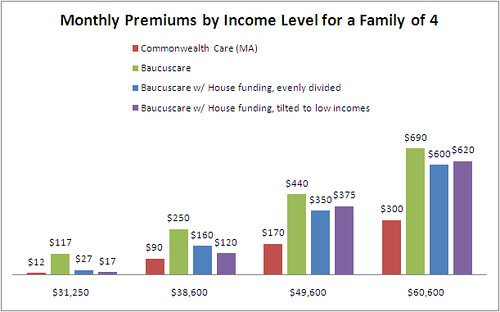
People in Massaschusetts are by and large satisfied with the Connector. It's toughest on the fairly small number of families earning just over 300% of FPL (of which there aren't that many), and on the larger number of young individuals who make just over 300% of FPL (which is $32,320 for an individual, so there are a decent number of those folks). Working class families earning up to 200% of FPL have fairly low premiums. $90 per month is going to pinch, but for uninsured households, they'll get some real value out of that: Commonwealth Care plans include dental insurance, wellness checkups have low co-payments; chronic disease care is especially well covered, and so forth. Likewise, three hundred pre-tax dollars a month for a family with a gross income of $60,000 per year is Real Money, but it's not going to break the bank. It's less than what they should be saving for college, for instance.

But as you can see from the graph, the Baucus bill doesn't fare as well. It's not even close to faring as well. The eight million individuals without insurance who earn between 200% and 300% of FPL will pay more than twice what similar households in Massachusetts currently pay. And working class families will feel a real pinch; $250 per month ($3,000 per year) for a family of four with an income of $38,000 is going to hurt.


• The community rating provision, mandating that insurers offer the same price to everyone regardless of medical history, comes with a tremendous loophole that will allow them to change five times as much for a policy based on age, which is just another way to discriminate against the sick.

• The employer "free rider" problem, called "one of the worst policy ideas I've ever seen" by Ezra Klein, would penalize employers for hiring anyone who qualifies for subsidies, encouraging them to find people who get coverage through a spouse or illegal immigrants. It also gives large employers like Wal-Mart a competitive advantage for paying crappy wages. And you can't opt out of the garbage insurance that giant employer - let's call them Ball Bart - might offer you.

• The excise tax for violating the individual mandate could cost up to $3,800 but wouldn't kick in if the individual could not find coverage that costs more than 10% of his income. In which case, you've built a robust architecture for a useless plan, because if millions opt out the coverage gets less universal and insurers want to stop come-as-you-are guaranteed issue.

• The co-ops are even weaker than imaginable:

The co-ops can only compete in the small group and individual markets. That is to say, if the co-ops prove effective, and The Washington Post would like to offer co-op coverage as an option to its workers, it can't. The co-ops are not allowed to contract with large employers, which is to say, they can't compete with private insurers in the largest market, and they can't get the purchasing power that would come from a serious foothold among corporate customers.

Not only is their size restricted, so too is what they can do with their size. The co-ops can band together to increase their purchasing power, but they can't set national payment rates for their members, a la Medicare. As I understand it, they have to bargain with each provider and drug manufacturer and hospital and so forth separately, meaning they're denied one of the main advantages of size. The insurance industry is, in other words, being protected from not just public competition, but co-op competition.


Jay Rockefeller today sent a letter proving, based on tons of research, that co-ops were a complete sham that have failed in the marketplace on a number of occasions, saying that "I believe it is irresponsible to invest over $6 billion in a concept that has not proven to provide quality, affordable health care, when we know that a public health insurance option will rein in costs and save taxpayers billions of dollars."

Marcy Wheeler has a lot more. There's one promising sign that the exchanges look expandable and available to all businesses, a neat way to gradually wean the system off of exclusive employer-based insurance, but that's about the only silver lining. Kent Conrad's gambit of increasing the budget window to make the Senate Finance bill look better did work, as the deficit reduction aspects look improved for the bill over the House bill. But crucially, that's a function of the funding, not the outlay in subsidies. Those will be too stingy to make the bill work for people, only for the bean-counters. In fact, the bill will start taking more and more from the middle class, much like the alternative minimum tax, and political reality will force scalebacks, so the budget picture doesn't look as rosy as advertised.

But it also suggests some real dangers in the bill's second decade. The unpopular elements of the bill become a lot bigger and more onerous. The excise tax on high-cost insurance plans begins affecting insurance plans that aren't particularly high-cost. The Medicare and Medicaid savings begin to tighten. That said, there are a lot of potential savings that the CBO isn't taking into account here, so that might ease the pain. Plus, at some point, we are going to have to start cutting costs in the system, and you can't escape some eventual hurt in that. But you can be sure the GOP is going to run these numbers aggressively and spin them viciously.


The good news is that this is in no way "the bill" that will get signed by the President. It has to go through a significant amount of changes, and key Democrats are already balking at it. In fact, lil' ol' Roland Burris said he wouldn't vote for anything without a public option, and with the numbers so tight, every Senator is in a bargaining position. Baucuscare is an abomination. But it doesn't have to be the endpoint, only the beginning.

I should say that one group really, really likes the Baucus bill - insurance companies.

Labels: , , , , , , , , , , ,

|

Wednesday, September 09, 2009

When Industry VPs Write Laws

Max Baucus' plan had the name of Liz Fowler, a former WellPoint VP who now works for the Finance Committee, in the metadata. When you have WellPoint personnel instrumental in writing the laws, you get little provisions like this:

Interstate Sale of Insurance. Starting in 2015, states may form “health care choice compacts” to allow for the purchase of non-group health insurance across state lines. Such compacts may exist between two or more states. Once compacts have been formed, insurers would be allowed to sell policies in any state participating in the compact. Insurers selling policies through a compact would only be subject to the laws and regulations of the state where the policy is written or issued.


This is something that conservatives have been begging to do for years. Even the most outgunned conservative on a talking head debate can vomit up "let people take their insurance across state lines to increase competition!" It sounds reasonable. But there's a very good reason why it would quickly turn into a nightmare, and you can see it in the examples of Delaware and South Dakota.

Both of those states have essentially no regulations on credit card companies. When legislation passed allowing banks to issue credit cards across state lines, some states started wildly deregulating their credit card markets in a race to the bottom. South Dakota and Delaware won. And now practically all credit cards are issued from those two states.

This would be precisely what would happen to the health insurance market under these "health care choice compacts," which could go national, based on this language. Right now, insurance companies can sell their coverage "across state lines," they just have to be accountable to the laws of the state where they sell it. Under this plan, insurers would be allowed to ignore the regulations in the state where individuals purchase insurance, and only subject to the laws where they issue it. Insurance regulations vary widely in the states, and would do so more under this compact. Anti-government legislatures could gut insurance regulation to entice insurers into setting up their corporate HQs there. States with regulations in place might prefer to lighten their regulatory case load, in this era of budget struggles, and let some other state deal with it. The insurance exchanges would presumably put a stop to this practice, but crucially, they only have a state-level framework and not a national one.

Consumer Watchdog jumped on this today, claiming that this race to the bottom could be expanded.

Washington, D.C. -- The consumer group that pioneered the most successful insurance premium regulation law in the nation, which has saved California drivers $62 billion on auto insurance rates since 1988, released a report today outlining the deep flaws in the proposed Senate Finance Committee health reforms. The report calls on Congress to adopt "prior approval" health insurance rate regulation and block insurance industry efforts to gut state consumer protection laws.

A "framework plan" released today by the so-called "Group of Six" Senators negotiating a health reform bill headed by Senator Max Baucus (D-MT) would open the door to gutting state laws. The plan would result in a "race to the bottom" in health care regulation by allowing insurance companies that participate in "health care compacts" to choose the weakest state law to govern all their policies, regardless of which state the policies are sold in. Currently, insurance companies must abide by the state laws of any state where they sell insurance. The Baucus plan resembles an industry proposal carried by Mike Enzi (R-WY) in 2006 discussed below [...]

** Loss of state benefit mandates would allow exclusion of preventive treatments and exams, prevent early diagnosis of disease and evade Patient Bill of Rights laws passed in nearly every state. Denying access to such basic preventive care makes treatment more costly to the policyholder and ultimately to taxpayers, who pick up the bill when individuals cannot pay outrageous out-of-pocket costs.

** State laws providing consumers the right to appeal a coverage denial to an independent panel of physicians, a right to a second opinion, and assistance from state regulators when coverage is denied would all be lost under the Enzi approach.

** Individual patients who currently have the ability to hold insurers financially accountable for injuries caused by the denial or delay of necessary care would lose those rights if they joined the Enzi co-op.


This is what you get when industry VPs write your laws.

Labels: , , , , , ,

|

Sunday, September 06, 2009

How The Insurance Industry Is Destroying The Economy

I can't think of a state less equipped to deal with major health insurance rate hikes than Michigan, currently mired with - this will not be a typo - 15.6% unemployment. But that's exactly what they're getting.

In the past few days, 114,000 Michigan households have received bad-news letters from Blue Cross Blue Shield of Michigan, socking individual health insurance subscribers with premium increases averaging 22%, effective Oct. 1.

Blue Cross could have said, "Hey, things could have been worse. We asked for a 56% rate hike first and dialed it back to 22%" -- but that probably would have just made folks angrier.

Instead, the Blue Cross letters simply stated, "We know every Michigan resident faces financial challenges, and we thank you for your business and loyalty to the Blues."


The two numbers, unemployment and rate hikes, have a correlation. Individual insurance has expanded by 96% at Blue Cross of Michigan in the past two years. That's because they act like a non-profit state "co-op" would in a private sector allowed to discriminate against their customers:

In just the past two years, the number of under-65 individual subscribers has grown by 59,000, or 96%, at Blue Cross, the nonprofit "insurer of last resort" in Michigan. Private for-profit insurers tend to cherry-pick younger, healthier consumers, driving older and less-healthy people to Blue Cross if they have no employer-provided group coverage.

State law requires Blue Cross to offer insurance to anyone, but it also demands that the company not lose money on its insurance products. Therein lies the rub: Blue Cross lost $133 million last year on individual subscribers.


This is that "perfect market" that conservatives like to talk about. Given the ability to discriminate over its customers, private insurers dump the sick on to Blue Cross. And because the state requires Blue Cross to break even, they must raise their premiums basically at the rate of the cost of health inflation year-over-year, often on the poorest and most vulnerable members of society.

Michigan is not the only state seeing large rate hikes in its health insurance market. Oregon small businesses are seeing double-digit rate increases this year. In California, policies have gone up 9% since 2007, three times higher than the overall cost of living. Blue Cross and Blue Shield of Rhode Island has proposed a 16% rate hike, with UnitedHealth of New England up 11.6%. Washington state consumers will see large increases as well. Overall, increases by double digits are expected nationwide.

We hear from conservatives that businesses may drop their plans under health insurance reform. Actually, that's virtually assured if nothing is done. Companies, especially small businesses, will have no chance keeping up with these ever-increasing rates and hope to compete in the global marketplace. And ultimately, those businesses who do pay for these rate hikes do so out of potential wage increases for their employees. Wage growth stagnates and people wind up with less disposable income. The money funneled to health insurance companies could be used to reverse the recession and pull us into economic recovery. In this sense, insurance companies are acting like a siphon, reducing the fuel that can be used to drive the engine of growth.

And that siphon will take more and more money out of your pocket, unless we do something now.

Labels: , , , , ,

|

Tuesday, August 18, 2009

Co-Op'd

If you're going to create a substitute for the public option, it would be a good idea to know what it actually does before presenting it to the nation as the substitute.

The White House has indicated that it could accept a nonprofit health care cooperative as an alternative to a new government insurance plan, originally favored by President Obama. But the co-op idea is so ill defined that no one knows exactly what it would look like or how effectively it would compete with commercial insurers [...]

As the debate rages, lawmakers are learning that creating cooperatives — loosely defined as private, nonprofit, consumer-owned providers of health care, much like the co-ops that offer telephone, electric and other utility service in rural areas — will not be easy.

The history of health insurance in the United States is full of largely unsuccessful efforts to introduce new models of insurance that would lower costs. And the health insurance markets of many states suggest that any new entrant would face many difficulties in getting established.


Here's some more good news: Kent Conrad, the brainchild of this idea, admitted today that co-ops won't bring down the cost of premiums for individuals, unlike the public option. Which would be the point.

ROBERTS: What would they do to reduce costs? Because that is one of the central issues of health care reform.

CONRAD: Well, the important thing is they’d provide more competition. … Beyond that, I think it’s very important not to over-promise here. [...]

ROBERTS: So nothing really in driving down the costs of service then?

CONRAD: Uhhh, no. If you believe competition helps drive down costs, then they would certainly contribute to holding down costs.


A note on how these would affect "competition" - in Conrad's home state of North Dakota, Blue Cross Blue Shield emcompasses almost 90% of the health insurance market. And they're a non-profit that thinks they can qualify as a co-op, under Conrad's rules, making them eligible for some of the $6 billion in seed money, I presume. Amazing that Conrad's plan and the dominant insurer in his state match up almost perfectly, ain't it?

The co-op model should be seen for what it is, protection of the insurance industry. Which makes sense, considering how many Senators are in bed with those interests, in some cases quite literally. And given that the industry and their Republican representatives in Congress will STILL oppose co-ops, learning from the lesson that making a ruckus will cause Democrats like Kent Conrad to give up whatever benefit to the people can be managed in exchange for nothing, you can pretty easily see an outcome where even the weak co-ops are given no ability to come into existence, the way it happened in Iowa:

In the 1990s, Iowa adopted a law to encourage the development of health care co-ops. One was created, and it died within two years. Although the law is still on the books, the state does not have a co-op now, said Susan E. Voss, the Iowa insurance commissioner.

Wellmark Blue Cross and Blue Shield collects about 70 percent of the premiums paid in the private insurance market in Iowa and South Dakota.


Conrad keeps saying that there aren't the votes for anything but his favored idea, but no Senator has come out and said they would join a Republican filibuster of health care reform under any circumstances. Until we reach that point, 60 votes - and maybe some combination of the Maine two - remain in play. Sounds like a better scenario to me than one where 60 House progressives have already said they won't vote for anything without a public option. Mr. Emanuel, are you paying attention? Are you doing the math? Or are you reading the LA Times?

...By the way, here's a GAO report saying that co-ops wouldn't lower costs. And here are several experts saying how difficult it would be to start them up. And here's my favorite headline of the day:

Co-Ops Are the Single Dumbest Idea I Have Heard in the Health Care Debate in Twenty Years

OK, let’s start with the notion that a co-op can do a better job of negotiating prices and protocols. But wait, on day one how many members does the co-op have? Well it has no members on day one. So, the co-op's provider relations guy goes to the doctor and hospital administrator and demands better prices and protocols. My guess is the provider’s response would go something like this, “So you are here because your stated objective is to screw my reimbursement down more than it is, you have no members now, and if I give you the rates to take members away from the existing health plans you are going to make life even more difficult for me than those existing health plans have?" My guess is that when the provider stops laughing…

Labels: , , , , , , ,

|

Friday, July 31, 2009

Democrats Behaving Badly - For Good, Not Evil!

It's so rare when Democrats push back and show some sturdiness, that it's worth noting when it happens. First, here's Jello Jay Rockefeller eviscerating the "co-op" idea floated by Kent Conrad:

Ed: It's not going to work. There's really no successful model out there to support the basis of signing on to a co-op. Would you sign on to a co-op or is that unacceptable?

Rockefeller: That's unacceptable and I can almost prove it. We've been in touch with all the folks that oversee, represent all the co-ops in the country on all subjects and they point out that there are probably less than twenty health co-ops in the country. There are only two that really work that well. One in Puget Sound, one in Minnesota, except for those two, they are all unlicensed. All present health co-ops are all unlicensed, they're unregulated. Nobody knows anything about them, nobody has any control over them and nobody has ever said, which is stunning to me, no government organization or private organization has ever done a study to what effect they might have in terms of bringing down the insurance prices.

They are untested, they are unlicensed, they are unregulated, they are unstudied. Why would we even think about putting them in as a control on this massive insurance industry instead of the public option?


Rockefeller actually knows what he's talking about because he's been studying the issue for decades, unlike Conrad, who threw a dart at a board and hit the magical Broderist middle with the co-op brainstorm. Rockefeller does not seem like he'll play along on this bait and switch.

Then there's Anthony Weiner forcing the "no government takeover of health care" Republicans to be as good as their word.

Yesterday, Rep. Anthony Weiner (D-NY) decided that it was “put-up or shut-up time for the phonies who deride the so-called ‘public option.’” He offered an amendment that would eliminate government-run Medicare:

Not a single member of Congress voted for the amendment, and Republicans were blasting it as a “political farce.” Last night, Weiner went on MSNBC and explained the GOP’s hypocrisy:

WEINER: Well, for some reason, I guess Republicans don’t like publicly funded, publicly administered health plans except for Medicare, and, I guess, except for the Veterans Administration and except for the health care that our military gets from the Department of Defense. The fact of the matter is, what we’ve learned is that government administered health care works pretty darn well. It’s got lower overhead and people like it.

So, when my Republican colleagues pound the drum and pound the podium about how they hate government-run health care, I guess they haven’t looked at what they get.


Sometimes this spine-stiffening happens for about a week, but I like this week's Democrats.

Labels: , , , , , ,

|

Wednesday, July 29, 2009

Same Old Song And Dance

Here comes the part of the health care debate where people start to talk themselves into half a loaf instead of fighting for a full one.

There are many themes in the sad and frustrating history of health-care reform. But one of the central ones is that there were many points when Democrats could have accepted a compromise and did not. Richard Nixon, for instance, proposed a plan that could have passed Congress but that liberals thought comically inadequate. It was more comprehensive than anything we will get this year. George H.W. Bush also offered a pretty good proposal but got no support among Democrats.

Opportunities at health-care reform do not happen frequently. The average between major attempts is 19.5 years. That's 19.5 years in which the uninsured stay uninsured and their ranks grow. Where a situation that is already bad gets a lot worse. This year, Barack Obama is popular, and there are 60 Democrats in the Senate and huge majorities in the House. There is no reason to believe that Democrats will be in a stronger position anytime soon. It is not like when a weakened Nixon, or a fading Bush, offered a compromise.

If reformers cannot pass a strong health-care reform bill now, there is no reason to believe they will be able to do it later. The question is whether the knowledge that the system will not let you solve this problem should prevent you from doing what you can to improve it. Put more sharply, the question should be whether this bill is better or worse than another 19.5 years of the deteriorating status quo.


Ezra Klein is not an activist. He's a health care policy wonk. And he knows that we have a very broken political system and a media that gives wide berth to out and out lies from conservatives. So he reasons that health insurance reform that gives access to coverage to 40 million Americans who don't have it will be a major improvement for many Americans, and even if that's seen as a loss in the political world, it's worth achieving. Heck, if we get community rating, forcing insurers to cover everyone with the same coverage at the same basic rate, even a jury-rigged system can be universal.

This hardly solves every problem. In particular, it doesn't do much to rein in costs. But if you combine (a) Medicare, (b) our current employer-based insurance regime, and (c) community rating along with subsidies for low-income families, you've essentially institutionalized universal healthcare insurance. Not everyone will take advantage of it — there will always be a few people who go without coverage even if it's affordable — and you still a need a few other things like out-of-pocket caps. Still, it's basically a statement that everyone in the country can and should be covered. And once that becomes a cultural norm, it will never go away.


If we end up with health insurance reform, where you have to be covered, cannot be dropped, and must pay the same rate regardless of prior conditions, and you have an exchange to buy insurance instead of being forced into a regional monopoly, people in the individual market will see the difference. Of course, problems will remain. Employers, without a mandate, will still drop coverage. The costs will continue to soar, especially without a public option that can gain a big enough following to force competition in that individual marketplace, particularly on price. The smaller tweaks of health IT and prevention and comparative effectiveness are important but may end up compromised. And without getting the real savings from stakeholders necessary to drive down costs, people will still see their premiums rise. Not to mention the fact that we're going to need millions more doctors.

The reason that liberals want to enshrine a public option, not the weak co-op alternative, is that the history of the few victories in health care and social safety net reform in this country have started with an incomplete toehold that gets expanded over time. Medicare wasn't perfect at the start. Or SCHIP. Or even Social Security. They needed to be tweaked and improved and made useful for all. I don't think it's possible for co-ops to scale up in this way. We've seen the history of them taking decades to have any measurable effect.

But Democratic leaders appear to want to give in on this one.

"We think the public option is very important," said House Majority Leader Steny Hoyer, D-Md., but "we have to see what the Senate does on co-ops, and see how it's formulated, to see whether or not it would have a similar effect."

"It's really premature for me to lay out what should be in this bill," said Senate Majority Leader Harry Reid, D-Nev., when he was asked about the public option [...]

Liberals shudder at the idea of removing a public option.

"There are rumors that the leadership is getting squishy" on the public option, said Rep. Eliot Engel, D-N.Y., a member of the House Energy and Commerce Committee, which also is trying to write a version of health care legislation.

"Some of us have pushed back hard and said we will not support a bill if it doesn't have a public option," he warned. "There comes a point where some of us will say getting a bill out at any cost is not a panacea if it's a bad bill."


When Harry Reid comes out and says what can get 60 votes beats what I want, you understand that he's laying the groundwork. This is why health insurance stocks shot up yesterday. They're on the verge of getting a forced market, lowering their administrative costs (no rescission department) and adding tens of millions to the rolls.

14 House members are so far on the record saying they'll vote against any health care reform bill that doesn't include a legitimate public option, not something that Harry Reid and the gang will try to pass off as one. And yes, at some point, the President needs to weigh in and pick a side. He sounded wobbly on this yesterday.

And the other thing that we do want to do -- now, this is controversial, and I understand some people are worried about this -- we do think that it makes sense to have a public option alongside the private option. So you could still choose a private insurer, but we'd also have a public plan that you could choose from that would be non-for-profit, wouldn't have, hopefully, some of the same high administrative costs, and would be potentially more responsive to your needs at a lower cost. I think that helps keep the insurance companies honest because now they have somebody to compete with.

And I have to say, the reason this has been controversial is a lot of people have heard this phrase "socialized medicine" and they say, we don't want government-run health care; we don't want a Canadian-style plan. Nobody is talking about that. We're saying, let's give you a choice. You can choose the private marketplace, or this other approach.

And I got a letter the other day from a woman; she said, I don't want government-run health care, I don't want socialized medicine, and don't touch my Medicare. (Laughter.) And I wanted to say, well, I mean, that's what Medicare is, is it's a government-run health care plan that people are very happy with. But I think that we've been so accustomed to hearing those phrases that sometimes we can't sort out the myth from the reality.


Nothing abut co-ops yesterday, but the move, one assumes, would be to sell co-ops as the public plan. Obama's strategy has been to get to conference and make the necessary adjustments at that time.

We'll see.

Labels: , , , , , , , ,

|

Monday, July 27, 2009

Mad Max

Sen. Baucus emerges from the bipartisan crypt and comes up with a health care bill that cannot possibly work.

After weeks of secretive talks, a bipartisan group in the Senate edged closer Monday to a health care compromise that omits a requirement for businesses to offer coverage to their workers and lacks a government insurance option that President Barack Obama favors, according to numerous officials.

Like bills drafted by Democrats, the proposal under discussion by six members on the Senate Finance Committee would bar insurance companies from denying coverage to any applicant. Nor could insurers charge higher premiums on the basis of pre-existing medical conditions.

But it jettisons other core Democratic provisions in a reach for bipartisanship on an issue that has so far produced little.


Amusingly, at this moment the Chamber of Commerce and PhRMA jumped in to call for passage of health care reform. Probably because this bill wouldn't touch their profits or do anything for the consumer.

We expected Baucus' bill to have co-ops substituted for the public option. It's one of the three bills out there, and was always going to be the worst. But they jettisoned the employer mandate, taking the "shared" out of the shared responsibility that most reform bills have offered. Even WAL-MART supports an employer mandate. They did include the MedPAC proposal and the excise tax on insurance companies offering expensive plans and even a potential fee on medical device manufacturers and drugmakers.

This is precisely the kind of proposal you would expect from Baucus, some Republicans, and the head budget guy in Congress sitting in the room:

They have met for hours in recent weeks in Baucus' office, joined by aides and outside advisers such as actuaries summoned to explain arcane details of insurance. Douglas Elmendorf, head of the Congressional Budget Office, has also attended.


It's all driven by costs and not people, so the coverage subsidies are lower (300% FPL). And yet, the money that would be gained from an employer mandate is foregone because Baucus doesn't want to upset corporations. The money that would be saved from a robust public option is foregone because he doesn't want to upset the insurance companies. As long as the arbitrary $1 trillion dollar number is reached and the special interests made happy, Baucus can live with a forced mandate to the people to buy unaffordable insurance with crappy benefits without the choice of a government-run option. And of course, we're not even coming close to talking about the kinds of real savings that would come with health industry providers accepting less in reimbursement payments. Nor are we talking about radical change to achieve savings, like ditching the fee-for-service model.

Even when doctors order costly treatments with serious side effects and little evidence of their being effective, as studies find is common, patients are loath to question the decision. Instead of blaming such treatments for the rising cost of medicine, many people are inclined to blame forces that health economists say are far less important, like greedy insurance companies or onerous malpractice laws [...]

Medicare data shows that (the Mayo Clinic and the Cleveland Clinic) generally provide less expensive care and appear to deliver better results. Armed with this data, the doctors who run the groups have been lobbying Congress to make their model a bigger part of health reform. Two weeks ago, 13 such groups released a letter saying that recent versions of proposed legislation did not control costs enough.

Their goal is to weaken the fee-for-service system. In its place, doctors might receive a lump-sum payment to treat a patient with a certain condition, based on average costs elsewhere and on what scientific evidence had found to be effective. Hospitals with especially good outcomes might earn bonuses.

Advocates say such a system could ultimately give doctors more control. Rather than having to organize their schedules around the tests and procedures that insurers agree to reimburse, doctors could opt for the treatments they deem most effective. “It’s a lot more accountability, which is why it’s scary for physicians,” said Dr. Mark McClellan, a former head of Medicare under George W. Bush. “But in some ways it’s also more autonomy.”


If Max Baucus and his compatriots were intellectually honest about controlling costs, they would offer this. Instead, he neglects elements that would cut costs, unless they have to do with restricting access and making ordinary Americans suffer, in which case he enacts them gladly.

I hope that, once this bill is out of Baucus' hands, that we can understand he doesn't run national health care policy. The Senate can actually vote for better alternatives if they choose.

Labels: , , , , , , , , , ,

|

Tuesday, July 21, 2009

The Blue Dog Ransom Note

Politico Pulse published the "list of demands" from the Blue Dogs on health care. Here they are:


--Effectively bend the cost curve 

--Realign incentives to reward high quality, efficient health care; include value-based purchasing, value index, innovation center for Medicare and Medicaid, and other delivery system reforms

--Increase small business exemption and adjust for inflation 

--Address end-of-life care

--Adjust the value and cost of subsidy levels

-- Provide affordability credits on a sliding scale from 100-300 percent FPL 

-- Public option must negotiate rates with providers, provide greater clarity on opt out, compete on a level playing field, and be available as a fallback 

--Establish consumer-driven, state-based co-ops 

--Create state-based exchanges with a federal fallback 

--Maintain current state-federal partnership with Medicaid, while implementing reforms that increase its value and effectiveness


"Bend the cost curve" is a buzzword and not a negotiating point. Realigning incentives is great - I think that cost controls should be taken up by the bill. But as Jon Cohn says, the rest of these are not serious proposals.

Politico this morning published a list of their demands. It included more aggressive efforts to control costs, which is great. But it also included cuts to the subsidies that would help people afford insurance, which is the opposite of great.

I suspect the House leadership will discuss the former request, but not the latter. Nor should they. They are committed to passing a bill that makes sure everybody can get affordable insurance. They've written a bill that, although not perfect, accomplishes that. That is a good thing.


Increasing the small business exemption will drain the system of funds. Lowering subsidies will do nothing but make the bill less popular to the public in order to achieve some arbitrary cost. It will not lower costs to the individual, which in the end they care about more than costs to the government. Making the insurance exchanges state-based reduces competition, and the same with making the public option a fallback. That will increase costs. As Obama said yesterday in his conference call with bloggers, there's no evidence that a co-op plan will work at all to keep insurance companies honest. In order to change incentives for insurers, you need scale and resources. The Blue Dogs want to strip those and also change incentives?

One reform you do not see on the Blue Dog's list is capping the employer deduction. Harold Pollack and Nate Silver have compelling pieces today making the case for the employer deduction as a way to curb spending, move away from an inefficient system of providing insurance, and improve the possibility of joining the civilized world in guaranteeing not-for-profit health care for all. There are ways to cap this deduction, and not eliminate it, that would satisfy unions who don't want to see their generous benefits go away (I'd prefer paying them out, actually) and start to reduce costs. The Blue Dogs aren't all that concerned with it.

Which shows me that they're simply not serious about this effort. They want to either delay reform indefinitely or come up with something that they can bring to their districts and tell independents and conservatives that they got for them, probably in the form of a direct payoff. They have been so incoherent about costs that they cannot be operating from any position of principle. They just don't want to do this bill.

Labels: , , , , ,

|

Monday, July 20, 2009

Obama Blogger Conference Call On Health Care

I had a chance to participate in a conference call with President Barack Obama and some bloggers today about the health care debate. Clearly the very fact of this conference call's existence shows that the White House is leaving no stone unturned in searching for allies to help sell reform, and that the President is ready to step forward in this debate. That's a good thing. He still has enough political capital to manage the process where he wants it to go, and if he wants certain elements of the policy included in the final bill, provided that there is a final bill, I wouldn't bet against them getting in there. And the result of the conference call was interesting.

The President spoke for a few minutes, then took about 15 minutes of direct questions. In his opening remarks, he said that now was a critical time for the bill, and that we're closer to passage than we've been in the last 50 years. Those who are opposing have offered no credible alternative but the status quo, which he termed "unacceptable". He hoped that the blogs would help him in "debunking myths," for example the notion that this bill, which is entirely paid for as a package, would spread record deficits. He said that the default position in Washington is one of inertia, and that pressure must be kept on members of Congress - not Republicans, but members of Congress - to move the process forward. He made sure to highlight - as did David Axelrod in a short Q&A afterwards - the words of Sen. Jim DeMint, calling health care Obama's "Waterloo." Clearly that will be used by the White Hosue as a badge of honor and a rallying cry in the weeks ahead, because it evokes the same concept as the leader of the GOP Rush Limbaugh saying he hopes Obama fails.

With that, the President took questions, and it was truly unlike most press conferences you'd see by the heavily pancaked White House press corps. Bloggers wanted to know about two things - the tactics for getting a bill through, and the substance of that bill. For example, John Amato from C&L asked if the President would call on Congress to forego the August recess if they didn't reach a floor vote by the deadline, which the President pretty much dodged. He acknowledged that we cannot delay any further and that we've been debating this for 50 years, and that those who are calling for delay are doing so deliberately in order to kill any hope of passage, but he would only commit himself to working as hard as we can to see "serious forward motion" by the recess, and never fully answered what I think could be a good tactic Amato brought up, to ask the Congress to finish their work and keep reform on track. In a similar kind of question about reconciliation, Jonathan Singer from MyDD asked at what point we move to using budget reconciliation if a Senate bill stalls, and the President kept that stick of reconciliation in his back pocket, saying that they expect a bill by mid-October, but failing that, "we'd look at all options including reconciliation." He admitted that reconciliation wasn't the preferred option but that the status quo cannot continue. That speaks very well to the probability that something will pass this year.

What I wanted to ask about was something that Robert Reich wrote about today. The White House and Congress have made all these deals with key stakeholders, which do provide for hospitals, drug companies and doctors to give back some profits, but preserve additional costs that could be wrung from the system. And these "legacy costs" are making it very hard to provide the kind of controls that reformers seek and Blue Dogs pay lip service to.

Big Pharma, for example, is in line to get just what it wants. The Senate health panel’s bill protects biotech companies from generic competition for 12 years after their drugs go to market, which is guaranteed to keep prices sky high. Meanwhile, legislation expected from the Senate Finance committee won't allow cheaper drugs to be imported from Canada and won't give the federal government the right to negotiate Medicare drug prices directly with pharmaceutical companies. Last month Big Pharma agreed to what the White House touted as $80 billion in givebacks to help pay for expanded health insurance, but so far there's been no mechanism to force the industry to keep its promise. No wonder Big Pharma is now running "Harry and Louise" ads -- the same couple who fifteen years ago scared Americans into thinking the Clinton plan would take away their choice of doctor -- now supportive of Obamacare. Private insurers, for their part, have become convinced they'll make more money with a universal mandate accompanied by generous subsidies for families with earnings up to 400 percent of poverty (in excess of $80,000 of income) than they might stand to lose. Although still strongly opposed to a public option, the insurance industry is lining up behind much of the legislation. The biggest surprise is the AMA, which has also now come out in favor -- but only after being assurred that Medicare reimbursements won't be cut nearly as much as doctors first feared.

But all these industry giveaways are obviously causing the healthcare tab to grow. And as these long-term costs rise, the locus of opposition to universal health care is shifting away from industry and toward Blue Dog and moderate Democrats who are increasingly worried about future deficits.


I asked the President about this tension between these buyoffs to stakeholders and his goal to "bend the cost curve" and make health care cheaper and more effective in this country, and here's a paraphrased version of his answer.

I cannot expect the hospital association, for example, to sign up for something they don't think is right for hospitals and exepct them to back reform. So I understand what they're doing to protect their interests. I think we can negotiate and find a good way to go about this. In theory we could cram down additional savings, but to have the American Medical Association, the American Nurses Association, the drugmakers, the insurance companies, all of them on our team, that does help us move the process forward. Theoretically, there should be enormous savings inside the system. We all know that we pay more for health care than we should, and we shouldn't need additional revenue. But that's harder to do in practice, because all these powerful interests block the efforts. What I think is that we can get a framework where reform begins, one with an insurance exchange, and a robust public option, concrete reductions in cost, prevention, health IT, comparative effectiveness research, and it will be possible to achieve greater savings with a more efficient system down the road. And we can revisit the policy 10 years from now and possibly see even more savings than what was scored and anticipated.


I found that to be both a decent and a deeply unsatisfying answer. I understand that you don't want the stakeholders bringing in the Howitzers and seeding massive attacks against any reform, so keeping them on the same side is important. At the same time, with these groups bought off, and indeed knowing that they will get an ultimately good deal from Washington, the transition from the broken system we have to that theoretical one that Obama discussed gets delayed. I agree about getting a framework in place, something to tweak down the road. But we spend so much time in our politics bowing to powerful interests that it's very frustrating to concede that as a political reality. Especially when drugmakers and insurance companies are pretty reviled in the populace (though doctors really are not). Obama seems to know that there's an easy path for real reform, but it's complicated by a real control from special interests of the levers of the political debate. So we keep the dogs at bay, but in the process, we don't reform health care to the extent that we could. That animates the "if you like what you have, you can keep it" mantra (even if what you have is ultimately inefficient), and these deals with stakeholders. Then the fiscal scolds can talk about how the bill costs too much even while resisting those cost control methods because they would hurt these same stakeholders! It's maddening.

There is a bright spot, however. Obama went pretty far in support of a public option, a fairly tangible reform effort, on the call. He doubted the evidence that a co-op plan like that pushed by Kent Conrad would work, citing past experience that showed them having trouble getting off the ground. And he then said that the House and Senate bills would not be identical, that a conference committee would certainly be required. And at that point, the White House would engage in serious negotiations, with the President's fundamental principles and benchmarks in place. The House and Senate bills would not match up exactly, but that would not mean that the final bill wouldn't include certain elements, he essentially said. The President was basically saying: get it to conference, and we'll straighten it out. That probably doesn't mean that the President gets everything he wants, but it means that the big issues will be at his determination and discretion, almost certainly.

I think that's an important reminder. Past White Houses have used the conference committee very effectively to make sure bills matched preferences. Obama signaled his willingness to do that. Which means that, while we can have a role in getting this bill through each chamber, the White House will be able to make their presence felt to a degree at the finish line. In effect, he will take ownership of the policy and ensure it beats the status quo.

(UPDATE: C&L has the audio.)

Labels: , , , , , , , , ,

|

Monday, June 29, 2009

More Than The Public Option

The battle over including a public insurance option in health care reform has become a proxy fight between progressives and moderates over how best to use the popular mandate of the 2008 election. That alone is an important fight. Jon Cohn has an interesting column questioning the primacy of that public option in health care reform generally.

In many respects, this is a good thing. I happen to be a strong public plan supporter myself, for reasons this magazine laid out in a staff editorial several weeks ago: It will guarantee the possibility of affordable, reliable coverage to everybody; it will promote cost control, by leading the way on reforms of how we pay for medical care; and it will promote a healthy competition with private insurers, keeping them in line and--hopefully--prodding them to perform better. (For a more detailed explanation, please read the actual editorial.)

And yet I confess to a certain ambivalence when I hear, as I frequently do, statements like the one Dean made at the rally. Yes, the public plan is a key element of reform. But it is not the only one.

Just consider what was going on inside Capitol Hill meeting rooms as Dean was speaking. Over the past week, leaders of the Senate Finance Committee have been busy hacking away at their proposed legislation, in order to bring the total price tag in at under $1 trillion over ten years. To accomplish this, the committee leaders have proposed cutting the subsidies that reform will make available to people who have trouble paying for insurance on their own.

If those cuts end up in the final legislation, fewer people would get assistance and, quite possibly, those that still got assistance wouldn’t get as much. The result would be more uninsured and more underinsured.


I would add that the "public plan" has become a catch-all phrase for any health insurance option managed by the government. While progressives have distinguished between Kent Conrad's co-ops and the public plan, the former being a poor substitute for the latter (and while Kathleen Sebelius is not totally wrong that a co-op could mimic a public plan, the nomenclature will sink such a compromise, IMO), they have not distinguished between a public option that would use Medicare bargaining rates to drop premiums as much as 30%, and Chuck Schumer's vision of a "level playing field" public option that would not use that bargaining power and would essentially become another non-profit competing for insurance, with little benefit on cost and a danger of becoming "a dumping ground for sicker and older patients."

There's a certain appeal to the notion that the public plan would be an enduring feature of the future of health care, and while other areas of reform could get tweaked, we either enact competition for the insurance companies now, or we get the forced monopoly that's coming to us. And the right word really is monopoly; there is virtually no competitive marketplace for health insurance right now.

The report, released by Health Care for America Now (HCAN), uses data compiled by the American Medical Association to show that 94 percent of the country's insurance markets are defined as "highly concentrated," according to Justice Department guidelines. Predictably, that's led to skyrocketing costs for patients, and monster profits for the big health insurers. Premiums have gone up over the past six years by more than 87 percent, on average, while profits at ten of the largest publicly traded health insurance companies rose 428 percent from 2000 to 2007.

Far from healthy market competition, HCAN describes the situation as "a market failure where a small number of large companies use their concentrated power to control premium levels, benefit packages, and provider payments in the markets they dominate."

So extreme is the level of consolidation, in fact, that one former top Federal Trade Commission official working with HCAN has sent a letter to the Justice Department's Antitrust Division, asking for an investigation into the health insurance marketplace.

The problem is most acute in small rural states, according to the report. In Shelby's own state of Alabama, the biggest insurer, Blue Cross Blue Shield, controls 83 percent of the statewide market. There, and in nine other states -- Hawaii, Rhode Island, Alaska, Vermont, Maine, Montana, Wyoming, Arkansas and Iowa -- the two largest health insurers control at least 80 percent of the market. So much for Shelby's "marketplace for health care."


Predictably, small-state Senators in states with virtually no competition in the health insurance marketplace are also those most opposed to a public insurance option to foster that competition. The resulting effect hits the pocketbook of Americans in a very real way - a monopoly can set their own prices. So including a public option is also the most tangible element of health care reform that the electorate can touch and feel.

So I guess I'm on both sides of this. I understand the highlighting of the public option, on political grounds, and even on the policy grounds. But I understand Cohn's complaint, that a bill with a public option and also failures to reform the system in other crucial ways will not succeed, and also that health insurance is not health care, and plans must provide a minimum level of that at an affordable price. Cohn lists several important elements of reform that have not received nearly the same level of attention as the public plan. In particular, I would highlight this questionfrom Cohn: "How aggressively will the government try to change the way medicine is practiced, to improve quality and reduce waste?"

That's a key question I've been looking at ever since Atul Gawande's article of the moment comparing health care costs in McAllen and El Paso, Texas. Gawande agrees that the incentives for doctors need to change if we really want to change the effectiveness of care in this country relative to cost:

I had a hard time connecting the dots. My vantage point on the world is the operating room where I see my patients. And trying to think about whether a public option would change anything didn't connect. I order more than $50,000 worth of health care in a day. Would a public or private option change that?

People say that the most expensive piece of medical equipment is the doctor's pen. It's not that we make all the money. It's that we order all the money. We're hoping that Medicare versus Aetna will be more effective at making me do my operations differently? I don't get that. Neither one has been very effective thus far [...]

The Washington debate -- there are smart reasons to think about including a public option in the mix, but we have not been thinking hard enough about how we control costs and make a better system. I think it's achievable in about 10 to15 years, and maybe even faster. I can tell you three things that will transform McAllen overnight. But CBO doesn't score them.


This gets to the question of how we pay doctors. Do we continue the fee-for-service model that incentivizes more service, and more ordering of tests and treatments without looking at effectiveness? Or do we try to build a new model, looking at what works in some cities, where the costs and the effectiveness line up better, and encourage that? It's an important question, and lots of smart people are debating it. Some feel we can slow cost growth and improve care at the same time by paying for episodes of care rather than specific procedures, paying a single price per patient for their health care, and other innovative methods. But the point is that this debate, fun for academic circles, has no antecedent in the debates of activists and even politicians when it comes to health care. We're focused on this public plan, and we may miss the opportunity to truly reform how we manage, receive and pay for medical care, to bring it in line with most of the industrialized world.

I tend to think that there is more of a gestalt at work here than Cohn and others recognize, that a profit-based insurance industry begets a profit-focused industry of doctors and hospitals. But it's a point worth making that, on the same level, activists must look at every part of the health care debate, and not narrow their focus.

Labels: , , , , , ,

|