Amazon.com Widgets

As featured on p. 218 of "Bloggers on the Bus," under the name "a MyDD blogger."

Wednesday, September 23, 2009

Better By Inches

I should note that Max Baucus modified his chairman's mark to include some key elements sought mainly by Democrats, making the bill a bit better. The highlights:

• He increased the tax credits, as expected, so that they slide up to 12% of income instead of 13%, up to 400% of the poverty level. This makes the coverage subsidies a bit more generous and makes health insurance a bit more affordable. Emphasis on "bit". He also lowered maximum out-of-pocket costs.

• He reduced the "age band," lowering the difference between the cheapest policy and the most expensive based on age from 5:1 to 4:1. In other words, insurers will only be able to charge someone 4 times as high a price based on age, not 5 times as high. Again, this is a minor improvement, but an improvement nonetheless.

• He accepted Olympia Snowe's amendment lowering the threshold for affordability for employer-based insurance. If that costs someone more than 10% of their income, they can go to the exchange.

• He indexed the threshold where the insurance company excise tax comes in to the Consumer Price Index. This will limit the damage from average insurance policies getting hit with the tax as the years go on, but not completely. He also raised the initial threshold number up to $22,000 for a family plan, which isn't likely to satisfy the unions.

• The penalty for not getting insurance is now much smaller, down to $1,900 per family from $3,800.

• Anyone exempt from the individual mandate because of affordability can now buy the bare-bones catastrophic policy designed for "young invincibles."

Baucus did something sneaky, too. He delayed the coverage subsidies by six months:

Effective date of Health Care Affordability Tax Credits - The modified Chairman's Mark would set the effective date of the Health Care Affordability Tax Credits at July 1, 2013.


That's one way to save money in the overall bill - turn a ten-year bill down to 5 1/2, although Igor Volsky estimates that the cost has increased to $900 billion.

There are some other minor improvements outlined by Jon Walker.

Labels: , , , , ,

|

Thursday, September 17, 2009

Everyone Hates Baucus

Boy, Max Baucus (R-MT) sure knows how to make friends and influence people, doesn't he? He bends over backwards to please Republicans and they spurn his bill. In the process he alienates Democrats, who now... hate the concessions made in his bill and don't understand their purpose, given that it brought no Republicans along. He had to stand alone to announce his bill because nobody wants to be associated with him. Not even Kent Conrad, his best bud because he included his industry-sponsored weak co-op plan, wouldn't take the dais with him. He's become such the public face for Democratic incompetence that his very name leads to boos at Democratic events:


Workers are chanting "bullshit!" at the mere mention of Baucus' name at labor events. Health care advocacy groups use his name as a punchline, if not an obscenity. He's literally gone from the most important man in the room on health care to a potentially irrelevant one.

A dealmaker needs credibility and respect on both sides, and Baucus has lost it. The Democrats on his committee don't trust his instincts or his core commitments or his legislative skill. Nor do the Democrats outside his committee. They feel he gave away too much in return for not just too little, but nothing at all. That means the Republicans on his committee have further reason to distrust his ability to make a deal, because restive Democrats are going to want to change his bill. Meanwhile, House Democrats are enraged that he left them to suffer through August, and have little interest in passing a bipartisan compromise that doesn't come with any Republican votes [...]

Even within his committee, it's not obvious he can secure the votes of the liberals, and if he does, he almost certainly sacrifices Snowe. That means the White House and the Senate leadership are going to play the primary role in both offering concessions and guaranteeing their preservation in the process. The bill remains in Max Baucus's committee, but at this point, it's largely out of his hands.


That's a good thing, on balance, for supporters of real health reform. The media still acts as if Baucus' bill is the final bill, but that's not quite the case. His bill would require substantial changes before he could even get a majority of the vote in the Senate. And there are plenty of areas for improvement:

Subsidies. The Baucus bill is simply not affordable. Forget everything else about health care - if the coverage isn't affordable for Americans to buy into it, the reforms won't work. It won't be universal, shrinking the risk pool, and insurers will want to deny coverage or care to maximize profits in that lower risk pool. The Center for Budget and Policy Priorities tells you pretty much what you need to know. This amounts to a $140 billion dollar tax on the middle class.

One reason the Baucus bill is “cheaper” than the House bill is that it has lower subsidies. For illustration, let’s assume that the whole $140 billion difference is due to lower subsidies. Relative to the House bill, then, the Baucus bill costs the government $140 billion less; but it costs middle-income people exactly $140 billion more, since they have to buy health insurance. The difference is that in the House bill, the money comes from taxes on the very rich; in the Baucus bill, it comes out of the pockets of the middle-class people who are getting smaller subsidies. Put another way, the Baucus bill is the House bill, plus a $140 billion tax on people making around $40-80,000 per year. That’ s not only stupid policy; it’s stupid politics.


Bad Employer Incentives. The lack of an employer mandate, replaced with a terrible "free rider" policy, is completely unacceptable. Whether you believe that it incentivizes employers to not hire low-income workers, or that it incentivizes large employers to keep wages down so they can push their employees off onto Medicaid, employers have clear, giant loopholes that they can exploit to make life for their workers objectively worse.

No public option. The co-ops are crap. Almost worse than useless. Everyone knows it. The CBO admits it and they've been practically writing the bill with Baucus.

"Liberal Democrats fumed that Baucus had dropped the idea of a government-run insurance plan to compete with private insurance companies in favor of a national network of member-run cooperatives -- an alternative the CBO said seems "unlikely to establish a significant market presence in many areas of the country."


There is no mechanism for competition with the private insurance industry, which the President has viewed as a fundamental principle.

Now, the Baucus bill does do a couple OK things. It raises a decent amount of revenue through excise taxes on industry, a back-door way to cap the employer deduction. It reduces the deficit. And it provides for a gradual shift away from employer coverage and toward the exchanges, although that shift could happen quicker, similar to what Ron Wyden is proposing.

The fact that the President spoke with Jay Rockefeller, the leading critic of the Baucus bill and its co-ops, as well as Wyden and Bob Bennett, who hold the bill that would move away from the employer-based system, tells me that he's actually looking to improve the Baucus draft down the road in the process. As Matt Yglesias said today, this is tailor-made for the conference committee process:

Viewed optimistically, this is what conference committee is for. Each version of the legislation is audacious along one axis—committing major funds to affordability in the House, trying to take a serious whack at cost growth in Baucus—and a conference committee could meld them into a bill that does both. You could imagine a productive meeting that produces the kind of result I’m talking about that lets Mike Ross walk out and say he added tough cost controls to the bill, while Jay Rockefeller gets to walk out and say he beefed up affordability, and then Max Baucus and Henry Waxman get to congratulate each other on being masters of legislative compromise. Alternatively, of course, the whole thing could fall apart. But ultimately my point would be that both version of the legislation have strong points that could be combined into some very good legislation indeed.


Absolutely, though admittedly we don't live in a perfect world. For example, you could add back in the President's shift on charitable deductions from 35% to the 28% it was in the Reagan Administration, which would impact pretty much nobody and save $350 billion over 10 years, plow that into subsidies, and call it a day. The bill would remain fully paid for and everybody would be happy.

Ezra has some further thoughts on this. I would just add that the President knows he owns this bill, so regardless of whether or not it would make the insurance industry mad, he needs to get this right so it works for people.

Labels: , , , , , , , , , ,

|

Wednesday, September 16, 2009

The Baucus Circus

The votes are in! Everybody's talking about Max Baucus' plan for health care!

Mostly, people don't like it!

Republicans don't like it because... it's a health care bill. Democrats don't like it because... it's a bad health care bill designed to kowtow to Republicans who won't even vote for it. Health care advocacy groups don't like it because it "would give a government-subsidized monopoly to the private insurance industry to sell their most profitable plans - high-deductible insurance - without having to face competition from a public health insurer." A good reason not to like it! And unions don't like it because there's no employer mandate and it would "tax health plans."

A bill of particulars:

• The bill spends too little on coverage subsidies. While putting a price tag on something that is paid for inside the budget window is misleading, the fact is that Baucus artificially lowered that price tag to meet some conception of centrism, and the lowered subsidies have a direct impact on affordability.
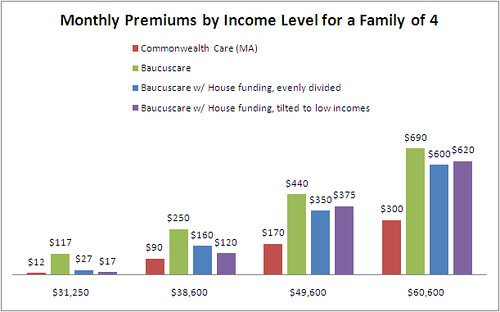


People in Massaschusetts are by and large satisfied with the Connector. It's toughest on the fairly small number of families earning just over 300% of FPL (of which there aren't that many), and on the larger number of young individuals who make just over 300% of FPL (which is $32,320 for an individual, so there are a decent number of those folks). Working class families earning up to 200% of FPL have fairly low premiums. $90 per month is going to pinch, but for uninsured households, they'll get some real value out of that: Commonwealth Care plans include dental insurance, wellness checkups have low co-payments; chronic disease care is especially well covered, and so forth. Likewise, three hundred pre-tax dollars a month for a family with a gross income of $60,000 per year is Real Money, but it's not going to break the bank. It's less than what they should be saving for college, for instance.

But as you can see from the graph, the Baucus bill doesn't fare as well. It's not even close to faring as well. The eight million individuals without insurance who earn between 200% and 300% of FPL will pay more than twice what similar households in Massachusetts currently pay. And working class families will feel a real pinch; $250 per month ($3,000 per year) for a family of four with an income of $38,000 is going to hurt.


• The community rating provision, mandating that insurers offer the same price to everyone regardless of medical history, comes with a tremendous loophole that will allow them to change five times as much for a policy based on age, which is just another way to discriminate against the sick.

• The employer "free rider" problem, called "one of the worst policy ideas I've ever seen" by Ezra Klein, would penalize employers for hiring anyone who qualifies for subsidies, encouraging them to find people who get coverage through a spouse or illegal immigrants. It also gives large employers like Wal-Mart a competitive advantage for paying crappy wages. And you can't opt out of the garbage insurance that giant employer - let's call them Ball Bart - might offer you.

• The excise tax for violating the individual mandate could cost up to $3,800 but wouldn't kick in if the individual could not find coverage that costs more than 10% of his income. In which case, you've built a robust architecture for a useless plan, because if millions opt out the coverage gets less universal and insurers want to stop come-as-you-are guaranteed issue.

• The co-ops are even weaker than imaginable:

The co-ops can only compete in the small group and individual markets. That is to say, if the co-ops prove effective, and The Washington Post would like to offer co-op coverage as an option to its workers, it can't. The co-ops are not allowed to contract with large employers, which is to say, they can't compete with private insurers in the largest market, and they can't get the purchasing power that would come from a serious foothold among corporate customers.

Not only is their size restricted, so too is what they can do with their size. The co-ops can band together to increase their purchasing power, but they can't set national payment rates for their members, a la Medicare. As I understand it, they have to bargain with each provider and drug manufacturer and hospital and so forth separately, meaning they're denied one of the main advantages of size. The insurance industry is, in other words, being protected from not just public competition, but co-op competition.


Jay Rockefeller today sent a letter proving, based on tons of research, that co-ops were a complete sham that have failed in the marketplace on a number of occasions, saying that "I believe it is irresponsible to invest over $6 billion in a concept that has not proven to provide quality, affordable health care, when we know that a public health insurance option will rein in costs and save taxpayers billions of dollars."

Marcy Wheeler has a lot more. There's one promising sign that the exchanges look expandable and available to all businesses, a neat way to gradually wean the system off of exclusive employer-based insurance, but that's about the only silver lining. Kent Conrad's gambit of increasing the budget window to make the Senate Finance bill look better did work, as the deficit reduction aspects look improved for the bill over the House bill. But crucially, that's a function of the funding, not the outlay in subsidies. Those will be too stingy to make the bill work for people, only for the bean-counters. In fact, the bill will start taking more and more from the middle class, much like the alternative minimum tax, and political reality will force scalebacks, so the budget picture doesn't look as rosy as advertised.

But it also suggests some real dangers in the bill's second decade. The unpopular elements of the bill become a lot bigger and more onerous. The excise tax on high-cost insurance plans begins affecting insurance plans that aren't particularly high-cost. The Medicare and Medicaid savings begin to tighten. That said, there are a lot of potential savings that the CBO isn't taking into account here, so that might ease the pain. Plus, at some point, we are going to have to start cutting costs in the system, and you can't escape some eventual hurt in that. But you can be sure the GOP is going to run these numbers aggressively and spin them viciously.


The good news is that this is in no way "the bill" that will get signed by the President. It has to go through a significant amount of changes, and key Democrats are already balking at it. In fact, lil' ol' Roland Burris said he wouldn't vote for anything without a public option, and with the numbers so tight, every Senator is in a bargaining position. Baucuscare is an abomination. But it doesn't have to be the endpoint, only the beginning.

I should say that one group really, really likes the Baucus bill - insurance companies.

Labels: , , , , , , , , , , ,

|

Tuesday, September 08, 2009

The Dope On The Baucus Plan

I alluded to it before, but here's the draft framework for Max Baucus' plan from the Senate Finance Committee. If you don't have the time to read all 16 pages, Ezra Klein has posted a summary.

I'm trying to figure out who, if anyone, gets better health care coverage from this plan. So far I can only come up with one class: people making 100-133% of federal poverty level who can now qualify for Medicaid. For everybody else, the quality of coverage looks to my eye to be worse, though I could be missing something.

Folks in Medicare get 50% off of any prescription drugs that fall in the donut hole, but the grants of patents well beyond current law will cost them more for drugs they could be getting generically in the long run. We don't know the effects of making Medicare more efficient, but they're designed to be invisible, i.e. offering the same care at a lower cost to the government. So I'd call that a wash.

Those in the exchanges will get subsidies, of dubious affordability, up to 300%, and between 300-400% the cost of premiums will be capped. However, the coverage itself can be crappier than current law, and almost certainly will be. The out-of-pocket limits are good, but that only exists for "covered services" - for anything else you're on your own. Those covered services have to include the following:

...preventive and primary care, physician services, outpatient services, emergency services, hospitalization, day surgery and related anesthesia, diagnostic imaging/screenings (including X-rays), maternity and newborn care, pediatric services (including dental and vision), medical/surgical care, prescription drugs, radiation and chemotherapy, and mental health and substance abuse services that meet minimum standards set by federal and state laws.


They also would restrict caps on lifetime benefits. Which is fine. But there will now be a whole insurance industry sector in how to properly define what falls inside and outside primary care, surgical care, hospitalization, etc. And remember, the entire regulatory apparatus for these major insurance reforms, which will be fought in court by multi-billion dollar companies, is a state-level ombudsman's office. And even with those credits, the coverage doesn't appear to be affordable.

If you get insurance through an employer, your health care coverage is about to get a whole lot worse.

Employer Responsibility. Employers would not be required to offer health insurance coverage. However, employers with more than 50 full-time employees (30 hours and above) that do not offer health coverage must pay a fee for each employee who receives the tax credit for health insurance through an exchange. The assessment is based on the amount of the tax credit received by the employee(s), but would be capped at an amount equal to $400 multiplied by the total number of employees at the firm (regardless of how many receive a credit in the exchange). Employees participating in a welfare-to-work program, children in foster care and workers with a disability are exempted from this calculation.

As a general matter, if an employee is offered employer-provided health insurance coverage, the individual is ineligible for the tax credit for health insurance purchased through an exchange. An employee who is offered unaffordable coverage by their employer, however, can be eligible for the tax credit. Unaffordable is defined as 13% of the employee’s income. The employee would seek an affordability waiver from the exchange and would have to demonstrate family income and the premium of the lowest cost employer option offered to them. Employees would then present the waiver to the employer. The employer assessment would apply for any employee(s) receiving an affordability waiver. Within five years of implementation, the Secretary must conduct a study to determine if the definition of affordable could be lowered without significantly increasing costs or decreasing employer coverage.

A Medicaid-eligible individual can always choose to leave the employer’s coverage and enroll in Medicaid. In this circumstance, the employer is not required to pay a fee.

Coverage offered by an employer of any size, including fully insured and self insured plans, is not required to comply with the list of benefits required of plans in the non-group and small group markets. Employers must provide first dollar coverage for prevention services (except where value-based insurance design is used), however, and cannot have a maximum out-of-pocket limit greater than that provided by the standards established for Health Savings Accounts (HSAs).


So small businesses can opt out of giving their employees health insurance and pay a fraction of the cost, about $20,000 for 50 employees. That will become the chic thing to do. If the employees aren't paid more than the requirement for Medicaid, employers can scrap coverage and let their employees take Medicaid and pay no fee. They are incented not to give their employees a living wage, in other words. And if they make coverage available for those above 133% FPL, they are bound by no standards like that coverage on the exchange, and their employees couldn't reject that coverage for something half-decent. Assuming regression to the mean, virtually every employer will immediately move to offering the shittiest coverage imaginable. They could only get to the exchange if the employer coverage is unaffordable, or 13% of their total income. So an employer, "AlmartWay" in Marcy Wheeler's construction, could conceivably take 12.9% of an employer's income for offering a plan that probably wouldn't cost that much.

Hell, if I were a rapacious manager like AlmartWay's completely hypothetical managers were, I'd turn employee health care into a profit center because (if I read this right) you could require employees to pay back 12.9% of their income for health care, and the only thing you'd really have to promise in return is preventative care. So I predict, if this bill passes in anywhere near this form, that AlmartWay will start making its own employee health care a big profit center because they will be stuck.

By golly. This is even a health care plan Blanche Lincoln and Mark Pryor and their biggest constituent could love!! Though frankly, Bad Max's plan is even worse than Wal-Mart itself--with a call for part time mandates and no disability discrimination--called for (though maybe Wal-Mart was thinking of the free subsidy for its Medicaid eligible employees all along).


And... there is no employer mandate, but the "free rider" aspect of the coverage will, in all likelihood, incentivize employers not to hire anyone who doesn't have family money.

Under the proposal, employers who do not offer health coverage would have to pay the full cost of the subsidies provided to employees who purchase coverage through the new health insurance exchange and qualify for a subsidy because their family income is below 300 percent of the poverty line. [1] But employers would not have to contribute to the health insurance costs of employees with higher family incomes. The new requirement would apply to firms with 50 or fewer employees.

The proposal would make it considerably more expensive for employers to hire workers from lower-income families than workers from higher-income backgrounds to do the same job. As a result, it would distort hiring decisions. Employers would have strong incentives to tilt hiring toward people who have a spouse with a good income (or have health coverage through a family member), teenagers whose parents make a decent living, and people without children (since the eligibility limit for the subsidies in the new health insurance exchanges will increase with family size). Low-income women with children in one-earner families would be particularly disadvantaged [...]

While language could be included to try to ban such discriminatory effects, it would be virtually impossible to enforce effectively. It would be extremely difficult to prove in court that an employer has passed over one applicant and hired another because of the health surcharge that employers would face if they hired people receiving health insurance subsidies.

Moreover, most low-income job applicants who do not get hired could not afford to hire attorneys to initiate legal proceedings. For the tiny number that might be able to institute proceedings, the legal complaint likely would take months and, more likely, years to adjudicate. In short, the fact that low-income workers would cost an employer up to several thousand dollars more to perform the same job could not easily be overcome.

This differential treatment of workers based on their family income also would likely influence employer decisions about which of their employees to let go when they trim their workforces to cut costs, such as during a recession. Workers from low-income families would cost the firm significantly more to retain than other workers who are paid the same wage to do the same job.

Although this clearly is not intended, the proposal likely would have discriminatory racial effects on hiring and firing. As noted, it would discourage the hiring of lower-income people. And since minorities are more likely to have low family incomes than non-minorities, a larger share of prospective minority workers would likely be harmed.


This is essentially legalized class-based discrimination.

So, worse coverage for employers, arguably worse coverage for individuals and small businesses, same for Medicare patients, probably better for a sliver of Medicaid patients. And it criminalizes people for not giving 13% or so of their paycheck to private health insurers. The affordability credits are nice, but don't look sufficient. Here's a contrary view.

The legislation really would protect millions of Americans from medical bankruptcy. It really would insure tens of millions of people. It really will curb the worst practices of the private insurance industry. It really will expand Medicaid and transform it from a mish-mash of state regulation into a dependable benefit. It really will lay down out-of-pocket caps which are a lot better than anything people have today. It really will help primary care providers, and it really will make hospitals more transparent, and it really will be a step towards paying for quality rather than volume.

To put it more starkly, it really will be the most important progressive policy passed since Lyndon Johnson. The subsidies should probably sit at 400 percent of poverty, and the employer mandate should be reworked, but such failures are relatively easy to fix, and may well be patched over by the time the legislation arrives on the Senate floor. The fact that a bill of this size and scope can still be considered disappointing is evidence that the doors of the possible have been thrown wide open.


This ignores the reality that most insurers, like now, won't abide by the rules because there's no policeman to enforce them (an ombudsman? Really?). As well as the reality that the subsidies don't make health care affordable. And it will be hard to expand on this reform, considering that there's no public option, a weak insurance exchange and useless co-ops. In fact, considering that it cements in the broken system we already have and just fills in the cracks, it looks basically like it was written by the industry itself. That's because it was.

Labels: , , , , , , , , , ,

|

Monday, August 17, 2009

Weathervane

In almost a real-time correction to today's column, Paul Krugman explains the view from 5,000 feet on the public option:

Look, it is possible to have universal care without a public option; Switzerland does. But there are some good reasons for the prominence of the public option in our debate.

One is substantive: to have a workable system without the public option, you need to have effective regulation of the insurers. Given the realities of our money-dominated politics, you really have to worry whether that can be done — which is a reason to have a more or less automatic mechanism for disciplining the industry.

The second is what the option debate says about Obama.

If progressives had real trust in Obama’s commitment to doing the right thing, the administration would have broad leeway to do deals. But the president doesn’t command that kind of trust [...]

So progressives have their backs up over one provision in health care reform that’s easy to monitor. The public option has become not so much a symbol as a signal, a test of whether Obama is really the progressive activists thought they were backing.


And I don't think he is a progressive. Nor did I at the time. But on health care, where he has positioned himself in the debate is with the most broadly popular provisions. He didn't support capping the employer deduction because people didn't want to see that happen. He put the focus on the insurance companies because they were hated more than anyone in health care reform. And he talked up the public option because it had 76% support.

Now that's waning because of the political pressure to pass a bill, and also because support of reform is waning generally. The popularity factor is coming up against the reality factor. But as long as a public option remains popular, I think Obama will support it. Therefore, progressives wanting to keep the public option in the bill really have to marshal that popular support.

The problem with this is the uncomfortable reality that the public option, as designed in pretty much every bill and as supported by House progressives, which would only impact the individual market and certain small businesses, and wouldn't have the bargaining power necessary to lower its own costs significantly, is indeed inessential in the larger scope of things. Look at this flowchart created to describe how people would get health insurance coverage in the framework offered, and notice the very minor role for the public option:


You can argue that a more robust public option would do better on the cost side, or that people making 4x of poverty should have access to subsidies. But that's what's basically on the table. It maintains a fairly efficient delivery system in the employer market, and might not provide the kind of subsidies needed to expand access to individuals or those without employer coverage. So I agree that the public option has become a weathervane for Barack Obama, to see which way he will blow. However, he knows - and even the people pushing the plan know - that the public option's existence doesn't really change much to the overall structure of reform that has been put out, therefore making it much easier for him to drop it.

Any public option can be improved down the road, of course, and access to it can be expanded. But it's hard for a lot of people to go to the mat over something that doesn't really need to fundamentally exist in the current reform.

Labels: , , , , ,

|

Tuesday, July 28, 2009

Smiles On A Summer Night


Meet the men and women determined to deny you quality health care:

The fate of the health care overhaul largely rests on the shoulders of six senators who since June 17 have gathered — often twice a day, and for many hours at a stretch — in a conference room with burnt sienna walls, in the office of the Senate Finance Committee chairman, Max Baucus, Democrat of Montana.

Mr. Baucus says his group will produce the bill that best meets Mr. Obama’s top priorities, broadly expanding coverage to the uninsured and curtailing the steep rise in health care spending over the long term, what policy makers call “bending the cost curve.”

Still, if the three Democrats and three Republicans can pull off a grand bargain, it will have to be more conservative than the measures proposed by the House or the left-leaning Senate health committee. And that could force Mr. Obama to choose between backing the bipartisan deal or rank-and-file Democrats who want a bill that more closely reflects their liberal ideals.

Already, the group of six has tossed aside the idea of a government-run insurance plan that would compete with private insurers, which the president supports but Republicans said was a deal-breaker.

Instead, they are proposing a network of private, nonprofit cooperatives.

They have also dismissed the House Democratic plan to pay for the bill’s roughly $1 trillion, 10-year cost partly with an income surtax on high earners.

The three Republicans have insisted that any new taxes come from within the health care arena. As one option, Democrats have proposed taxing high-end insurance plans with values exceeding $25,000.

The Senate group also seems prepared to drop a requirement, included in other versions of the legislation, that employers offer coverage to their workers. “We don’t mandate employer coverage,” Senator Olympia J. Snowe, Republican of Maine and one of the six, said Monday. Employers that do not offer coverage may instead have to pay the cost of any government subsidies for which their workers qualify. In the House, centrist Democrats have temporarily stalled the health care bill, many lawmakers want to see what Mr. Baucus’s group produces before voting on tax increases in the House bill.


I'd just like to dial everybody back for a second and note that this is the Senate Finance Committee. In practice this hasn't been honored, but in theory the group has jurisdiction over the financing of Medicare and setting up the revenue stream for a health care bill. Since pretty much everything costs something, that mandate has expanded into writing an entire bill. But in an ideal world, the Health, Education, Labor and Pensions Committee would write the health care bill, and the Finance Committee would direct how to pay for it.

But that wouldn't sit well with Presidents Baucus and Grassley and their kitchen cabinet.

As for the merits of the policy, Jacob Hacker is talking about House Blue Dogs in this op-ed today, but the points are largely the same:

The main worry expressed by the Blue Dogs is that the Congressional Budget Office has predicted that leading bills on Capitol Hill won't bring down medical inflation. The irony is that the Blue Dogs' argument -- that a new public insurance plan designed to compete with private insurers should be smaller and less powerful, and that Medicare and this new plan should pay more generous rates to rural providers -- would make reform more expensive, not less. The further irony is that the federal premium assistance that the Blue Dogs worry is too costly is the reform that would make health-care affordable for a large share of their constituents.

The Blue Dogs are right to hold Obama and Democratic leaders to their commitment to real cost control. But they are wrong to see this goal as conflicting with a new national public health insurance plan for Americans younger than 65. In fact, such a plan, empowered to work with Medicare, is Congress's single most powerful lever for reforming the way care is paid for and delivered. With appropriate authority, it can encourage private plans to develop innovations in payment and care coordination that could spread through the private sector, as have past public-sector innovations [...]

Many Blue Dogs fret that a new public health insurance plan will become too large, despite the CBO's projection that the overwhelming majority of working people will have employer coverage and that the public plan will enroll less than 5 percent of the population. Their concern should be that a public plan will be too weak. A public health plan will be particularly vital for Americans in the rural areas that many Blue Dogs represent. These areas feature both limited insurance competition and shockingly large numbers of residents without adequate coverage. By providing a backup plan that competes with private insurers, the public plan will broaden coverage and encourage private plans to reduce their premiums. Perhaps that's why support for a public plan is virtually as high in generally conservative rural areas as it is nationwide, with 71 percent of voters expressing enthusiasm.


What's funny is that chucking the employer mandate will probably lead to employers dropping coverage if the costs become prohibitive, sending workers into the insurance exchange and, if it exists, the public plan. Under the Senate Finance proposal, however, the public plan is eliminated, and private markets make out like bandits. They force everyone to buy their insurance, and they get more individuals buying coverage, who have less bargaining power than group employers. And because of the obsession that the bill cost no more than $100 billion annually over ten years, that coverage may lack proper subsidies, have lower benefits or increased out-of-pocket costs for the individual.

It's good to see these Senators so happy, however.

...Angry Bear:

"Officials also said a bipartisan compromise would not subject companies to a penalty if they declined to offer coverage to their workers. Instead, these businesses would be required to reimburse the government for part or all of any federal subsidies designed to help lower-income employees obtain insurance on their own."

This would be the most regressive tax ever. If I am an employer and I don't provide health insurance then my tax liability is higher if the family income of my employee is lower. More regressive than a poll tax (Baroness Thatcher must be put out that she didn't think of it). What's worse it depends on family income.

Let's say I don't provide insurance and have two job applicants, one who is a single mother and the other a man with a low salary but a high income wife (say Bill Clinton when he was working as governor of Arkansas for $30,000 per year). I hire the guy, because he can't get subsidized health insurance, so I don't have to give him insurance or pay him a dime.

This is the Baucus Grassley jobs only for people who don't need jobs preliminary draft bill of 2009.


...This is also worth noting:

[I]t does strike me as worth noting that when you read a puff piece in The New York Times about the Gang of Six bipartisan dealmakers in the Senate that vast power is being wielded by people who, in a democratic system of government, would have almost no power. We’re talking, after all, about Max Baucus of Montana, Kent Conrad of North Dakota, Jeff Bingaman of New Mexico, Susan Collins of Maine, Mike Enzi of Wyoming, and Chuck Grassley of Iowa. Collectively those six states contain about 2.74 percent of the population, less than New Jersey, or about one fifth the population of California. The six largest states, by contrast, contain about 40 percent of Americans.

Labels: , , , , ,

|

Monday, July 27, 2009

Mad Max

Sen. Baucus emerges from the bipartisan crypt and comes up with a health care bill that cannot possibly work.

After weeks of secretive talks, a bipartisan group in the Senate edged closer Monday to a health care compromise that omits a requirement for businesses to offer coverage to their workers and lacks a government insurance option that President Barack Obama favors, according to numerous officials.

Like bills drafted by Democrats, the proposal under discussion by six members on the Senate Finance Committee would bar insurance companies from denying coverage to any applicant. Nor could insurers charge higher premiums on the basis of pre-existing medical conditions.

But it jettisons other core Democratic provisions in a reach for bipartisanship on an issue that has so far produced little.


Amusingly, at this moment the Chamber of Commerce and PhRMA jumped in to call for passage of health care reform. Probably because this bill wouldn't touch their profits or do anything for the consumer.

We expected Baucus' bill to have co-ops substituted for the public option. It's one of the three bills out there, and was always going to be the worst. But they jettisoned the employer mandate, taking the "shared" out of the shared responsibility that most reform bills have offered. Even WAL-MART supports an employer mandate. They did include the MedPAC proposal and the excise tax on insurance companies offering expensive plans and even a potential fee on medical device manufacturers and drugmakers.

This is precisely the kind of proposal you would expect from Baucus, some Republicans, and the head budget guy in Congress sitting in the room:

They have met for hours in recent weeks in Baucus' office, joined by aides and outside advisers such as actuaries summoned to explain arcane details of insurance. Douglas Elmendorf, head of the Congressional Budget Office, has also attended.


It's all driven by costs and not people, so the coverage subsidies are lower (300% FPL). And yet, the money that would be gained from an employer mandate is foregone because Baucus doesn't want to upset corporations. The money that would be saved from a robust public option is foregone because he doesn't want to upset the insurance companies. As long as the arbitrary $1 trillion dollar number is reached and the special interests made happy, Baucus can live with a forced mandate to the people to buy unaffordable insurance with crappy benefits without the choice of a government-run option. And of course, we're not even coming close to talking about the kinds of real savings that would come with health industry providers accepting less in reimbursement payments. Nor are we talking about radical change to achieve savings, like ditching the fee-for-service model.

Even when doctors order costly treatments with serious side effects and little evidence of their being effective, as studies find is common, patients are loath to question the decision. Instead of blaming such treatments for the rising cost of medicine, many people are inclined to blame forces that health economists say are far less important, like greedy insurance companies or onerous malpractice laws [...]

Medicare data shows that (the Mayo Clinic and the Cleveland Clinic) generally provide less expensive care and appear to deliver better results. Armed with this data, the doctors who run the groups have been lobbying Congress to make their model a bigger part of health reform. Two weeks ago, 13 such groups released a letter saying that recent versions of proposed legislation did not control costs enough.

Their goal is to weaken the fee-for-service system. In its place, doctors might receive a lump-sum payment to treat a patient with a certain condition, based on average costs elsewhere and on what scientific evidence had found to be effective. Hospitals with especially good outcomes might earn bonuses.

Advocates say such a system could ultimately give doctors more control. Rather than having to organize their schedules around the tests and procedures that insurers agree to reimburse, doctors could opt for the treatments they deem most effective. “It’s a lot more accountability, which is why it’s scary for physicians,” said Dr. Mark McClellan, a former head of Medicare under George W. Bush. “But in some ways it’s also more autonomy.”


If Max Baucus and his compatriots were intellectually honest about controlling costs, they would offer this. Instead, he neglects elements that would cut costs, unless they have to do with restricting access and making ordinary Americans suffer, in which case he enacts them gladly.

I hope that, once this bill is out of Baucus' hands, that we can understand he doesn't run national health care policy. The Senate can actually vote for better alternatives if they choose.

Labels: , , , , , , , , , ,

|

Thursday, July 16, 2009

Wanted: More Reform In This Reform

For liberals, the public option has become a line in the sand. Given that the public option is carefully circumscribed and not open to everyone who may want to choose it, I find that more curious than ever.

President Obama and leading Democrats have stressed that people who like their employer-sponsored insurance would be able to keep it, under a health care overhaul. But they haven't emphasized the flip side: That people who don't like their coverage might have to keep it.

Under the main health bills being debated in Congress, many people with job-based insurance could find it difficult to impossible to switch to health plans on a new insurance exchange, even if the plans there were cheaper or offered better coverage. The restrictions extend to any government-run plan, which would be offered on the exchange [...]

Democratic lawmakers and administration officials say the restrictions are critical to maintaining a strong employer-based insurance system, which covers 158 million Americans.

But critics argue that the rules run counter to suggestions from health care reform advocates that an overhaul could provide people with a broader choice of insurance options. The rules, they say, could be especially unfair to some lower-income workers who are enrolled in costly job-based insurance. Also, they argue, the restrictions would hurt the proposed public plan by limiting enrollment.


Why are the Democrats putting up these firewalls? For years now, they have professed to have learned the lessons of 1994 by stating that "if you like what you have, you can keep it." That's been called the "beauty" of the current plan by people like Howard Dean. But what it means on a practical level is that the employer-based system, with all its inefficiency, must be sustained, in this case through forcing workers to accept their employer-based coverage. There are other reasons, too, which Ezra Klein lays out.

The political reason is that people like what they have, or are at least scared of what they don't know, and are thus skeptical of any health-care reform plan that would change their current arrangements. One of the goals of health-care reform, in fact, is to maximize employer-based coverage, which will be accomplished through the employer mandate. If employers could simply move over to the exchange -- which would probably be quite a bit cheaper for them -- then a lot of people will find their current insurance changing, and reformers don't want that.

The economic reason is that the exchange is where the subsidies live. If you make $30,000 but you work full-time for The Washington Post, The Washington Post pays for the bulk of your health-care coverage. If you were moved over to the exchange, you'd be eligible for pretty significant subsidies. That would make health-care reform costlier to the government, which would in turn make it tougher to pass. Another way of putting this is that the fewer people on the exchange and using subsidies, the cheaper health-care reform will be.

And the policy reason is that if the exchange is open to all employers in the first year, it's likely that the employers having trouble affording health-care insurance -- that is to say, the employers with sicker and older workforces -- will quickly buy in, while the young, cheaper employers won't. That could leave the exchange with a bad risk pool and thus high costs.


It's important to note that Ron Wyden is trying to change this. He's trying to allow individuals who get coverage through employers the choice to buy coverage through the insurance exchange. It's technical, but something that progressives ought to get behind.

But this issue with the insurance exchange firewalls is symptomatic of a lot of the moving parts of the health care debate. Reformers want to cut the internal costs from the current system, and are making deals with providers to do so. But in so doing they're giving up even bigger potential cost savings.

If only that were true. Far from being "game-changers," those agreements are the same old Washington game of bribes, backroom deals, profiteering and protectionism -- and a harbinger of what health care will look like if the president’s reforms succeed.

In June, the pharmaceutical lobby PhRMA agreed to give 50 percent discounts to seniors in Medicare's "doughnut hole," where enrollees now pay 100 percent of their drug costs. President Obama hailed the agreement as a "significant breakthrough," while PhRMA spun it as their $80 billion contribution toward health care reform.

Yet the PhRMA agreement would not save taxpayers $80 billion. It would cost them $80 billion, and then some.

Under the agreement, the full price of each drug would continue to count toward seniors' catastrophic deductible. As a result, even more seniors would exceed that deductible, after which taxpayers would pay 95 percent of their drug costs. Obama also agreed to oppose stricter price controls for government purchases. PhRMA members agreed to cut their prices for seniors only because Obama agreed that taxpayers would buy more drugs at higher prices.


I know, it's from Cato, but the guy's not totally wrong. For instance, in the Senate HELP Committee markup, biologic drugs were given 12 years of patent protection before competition from generics kicks in. This was a defeat for the Obama Administration, but even the victories have strings attached.

Even the revenue mechanism in the House, a surtax for the wealthy, is the result of a political concession, albeit one that Republicans walked into and ought to own (Republicans demonized sensible taxes for so many years that wealth taxes are really all that's left). The truth is that we have this fundamental paradox in the health care debate.

And that's pretty much where we are now. Democrats are making a lot of bad policy compromises because doing so is good politics. They're trying to fund the bill in the way pollsters would advise rather than policy wonks would choose. They're leaving the employer-based system alone. They're letting everyone keep what they have, even though what everyone has is expensive and inefficient, and is in fact the reason we need health-care reform.

Is it worth being disappointed about that? Sure. But legislation cannot be understood in a vacuum. The place to change the tax argument isn't in final days of health-care reform. It's in the intervening years when Republicans are attacking the very idea of taxation. Any given piece of legislation is only as good as the political culture that's produced it. Right now, our political culture isn't that good. The question is whether legislators are getting the best plausible outcomes out of a badly compromised process.


As Ezra says, we have a terrible political culture, and you're starting to see the results. If 30 million Americans get health insurance and you don't add a penny to the debt, you make that deal. And cementing something like a public insurance option into policy, given that it can only expand, which is an easier lift politically, is a good bargain as well. But the counter-intuitive compromises are a bit hard to take.

Labels: , , , , , , ,

|

Tuesday, July 14, 2009

Tri-Committee Bill Released

I should mention that the Tri-Committee health care reform bill from the House has been released, and rather than bend to the dictates of marginalized Blue Dogs who value their relationships with the health care industry over their constituents, they created a pretty darn good bill. It's not perfect, of course, but it represents a far better bill on the left flank than, say, the Waxman-Markey bill did.

I'll post the brief on what the reform bill does for consumers:

LOWER COSTS
• No more co-pays or deductibles for preventive care
• No more rate increases for pre-existing conditions, gender, or occupation
• An annual cap on your out-of-pocket expenses
• Group rates of a national pool if you buy your own plan
• Guaranteed, affordable oral, hearing, and vision care for your kids

GREATER CHOICE
• Keep your doctor, and your current plan, if you like them
• More choice, with a high quality public health insurance option competing with private insurers

HIGHER QUALITY
• You and your doctors make health care decisions — not insurance companies
• More family doctors and nurses will enter the workforce, helping guarantee access
• Mental health care must be covered

STABILITY & PEACE OF MIND
• No more coverage denials for pre-existing conditions
• No more lifetime limits on how much insurance companies will pay
• No reason to ever make a job or life decision again based on health care coverage


The "national pool" refers to the insurance exchange, which is a hard concept to put into bullet points, but this is a pretty good list of how the average Americans would benefit from this plan.

As to the specifics, here's Ezra Klein, Scarecrow, Mcjoan and Jon Cohn. You'll notice a consensus. 97% of the population would get covered in 10 years. The subsidies are 400% of poverty and Medicaid gets expanded to 133% of poverty - both more generous subsidies than the Senate bills. Insurers are regulated against denying coverage for pre-existing condition or rescission, and the benefits floor is pretty decent. There are caps on out-of-pocket expenses, and efforts at controlling costs. It includes an individual mandate and an employer mandate that gets exempted for certain-sized small businesses. About the worst thing you can say about the bill is that some of the good stuff doesn't happen fast enough (to keep the size of the cost down):

I do have one, not minor concern: It will be a while before people see the best stuff. Most of the major elements--the insurance exchange, the subsidies, the insurance regulations, the public plan--won't come online until 2013 or later. This is, I believe, also true of counterpart bills in the Senate.

There's a sound policy rationale for going slow; it takes a lot of work to set up exchanges, regulations, and the like. But four years is a long time. And I suspect money has a lot to do with the pace. Slower implementation makes it possible to keep the price tag to around $1 trillion.

On the bright side, some provisions--filling in the Medicare drug donut hole, bolsteirng the primary care workforce, among others--would start in the next two years.


The cost of the bill, scored by the CBO at around $1 trillion dollars over 10 years, gets paid with $500 billion in internal cost savings and around $500 billion in new revenues, mostly with a surtax on the wealthy. I prefer other methods, but let's get real about this:


The details haven't been released yet, but most (if not all) of the families that fall under Rangel's tax plan will also be in this 1% range.

These are families that paid a lower rate in 2006 (the last date of available data) than they did 15 years ago. That's not an argument for upping the taxes, of course. But it puts it in perspective. (Confession: If you go back to the Reagan years, the top effective rate is lower. But the current rate is still below the historical average.)

News reports have anticipated Rangel proposing a 1-3% surtax. Even a 3% increase across the board will leave an effective rate lower than it was in 1995.


The President approves of the general approach of the House bill, and the Education and Labor Committee will start markup this week. The bill text is here and a summary is here.

We're off and running.

...more on the surtax from Tim Foley.

Labels: , , , , , , , ,

|

Wednesday, July 08, 2009

Pressure Works

Several weeks ago Digby and Blue America noticed that Blanche Lincoln, one of the few centrist Democrats facing re-election in 2010, was taking the side of the insurance companies over her constituents in the health care debate. She claimed that "if all Congress comes up with is a government-backed plan, then there will be very little incentive for the private industry to be able to be competitive perhaps in the plans they will be offering and the individuals they will be offering,” showing exactly where her sympathies lie - with those poor, henpecked insurance industry CEOs who scrape by on $14.9 billion dollars over five years.

So we decided to do something about it. Blue America kicked off the Campaign for Health Care Choice and produced three advertisements to press Lincoln on supporting a quality public insurance option to compete with private companies. Digby write the spots, John Amato helped with locations and logistics, I directed and edited them, Howie Klein managed the fundraising. Blue America held a contest to pick the best spot, and after raising $23,740, voters chose their favorite:


Today, we can announce that, before the spots even fully hit the airwaves in Arkansas, Blanche Lincoln is already hedging on her rejection of a public insurance option.

Lincoln, who’s getting hammered by ads demanding she commit to the public option, has now shifted towards supporting one, at least in rhetorical terms. In a piece for today’s Arkansas Democrat-Gazette, she says health care reform should include a public plan or a non-profit substitute.

Here’s the key graf from Lincoln (the piece is subscription only):

Health care reform must build upon what works and improve inefficiencies. Individuals should be able to choose from a range of quality health insurance plans. Options should include private plans as well as a quality, affordable public plan or non-profit plan that can accomplish the same goals as those of a public plan.

The assertion that reform “should” have a public plan or non-profit substitute is a shift from her previous position, which was only that she was “evaluating” a public plan or a substitute.


In this op-ed, Lincoln makes absolutely no mention of an employer mandate to provide coverage to their workers, which Wal-Mart, America's largest employer and a virtual kingmaker in Arkansas, signed onto this week. Instead, Lincoln goes out of her way to support a public insurance option in competition with private insurance. There are weasel words there, of course - note the "non-profit plan that can accomplish the same goals." And I don't doubt that Wal-Mart's general support of something called health care reform played a role. But in the final analysis, two events happened to Blanche Lincoln in health care recently - Wal-Mart's sign-on to the employer mandate and the prospect of Blue America running ads in her state ($25,000 can go a fairly long way on cable in Arkansas, by the way). She chose to specifically align herself with the element of health care policy that Blue America endorses.

But she's not all the way there, so we plan to keep pushing. But this should be a valuable lesson - every small thing you do to advance solutions to the health care crisis can make a difference. The political animals in the Senate know that on this high-profile vote, defying the public on a popular plank will cause them some difficulty. It's up to us to make sure of that.

Please support the Campaign for Health Care Choice so we can continue to raise the pressure on the ConservaDems who want to hijack this crucial policy goal.

Labels: , , , , , , ,

|

Thursday, July 02, 2009

The Change We Need?

The President held a health care town hall yesterday, and reporters are cooing about the staged nature of the questions, but the President was asked why we can't have a single-payer system, why Congress wants to "tax health care benefits," why the whole thing isn't just about tort reform, and a pretty broad cross-section of the full debate. I didn't rally see the press corps get much deeper than that in all of their queries on this subject.

On the single-payer question, the President basically announced the triumph of politics over policy in the health care debate.

THE PRESIDENT: Sure. Well, it's a terrific question. I'm not sure if everybody could hear it, but the gist of the question is, why have we not been looking at a single-payer plan as the way to go?

As many of you know, in many countries, most industrialized advanced countries, they have some version of what's called a single-payer plan. And what that means is essentially that the government is the insurer. The government may not necessarily hire the doctors or the hospitals -- a lot of those may still be privately operated -- but the government is the insurer for everybody. And Medicare is actually a single-payer plan that we have in place, but we only have it in place for our older Americans.

Now, in a lot of those countries, a single-payer plan works pretty well and you eliminate, as Scott, I think it was, said, you eliminate private insurers, you don't have the administrative costs and the bureaucracy and so forth.

Here's the problem, is that the way our health care system evolved in the United States, it evolved based on employers providing health insurance to their employees through private insurers. And so that's still the way that the vast majority of you get your insurance. And for us to transition completely from an employer-based system of private insurance to a single-payer system could be hugely disruptive. And my attitude has been that we should be able to find a way to create a uniquely American solution to this problem that controls costs but preserves the innovation that is introduced in part with a free market system.

I think that we can regulate the insurance companies effectively; make sure that they're not playing games with people because of preexisting conditions; that they're not charging wildly different rates to people based on where they live or what their age is; that they're not dropping people for coverage unnecessarily; that we have a public option that's available to provide competition and choice to the American people, and to keep the insurers honest; and that we can provide a system in which we are, over the long term, driving down administrative costs, and making sure that people are getting the best possible care at a lower price.

But I recognize that there are lot of people who are passionate -- they look at France or some of these other systems and they say, well, why can't we just do that? Well, the answer is, is that this is one-sixth of our economy, and we're not suddenly just going to completely upend the system. We want to build on what works about the system and fix what's broken about the system. And that's what I think Congress is committed to doing, and I'm committed to working with them to make it happen. Okay?


I'm not saying that the President is wrong - except about France, where 86% of the public actually has supplementary insurance, mostly through employers. But it's true that upending the employer-based system would be disruptive and politically unpalatable, and firing everyone in the insurance industry en masse would be chaotic, and so on. The problem is that this further entrenches a fairly inefficient way of delivering health care, namely the employer-based system. In fact the goal of a reform with an employer mandate would be to get more people covered by their employers. So we move forward with a comprehensive incrementalism, building on the historical accident that is the present system, and trying to plug every leak in it, by encouraging employers to cover their workers, providing a health insurance exchange for those who don't, adding an individual mandate, forcing insurers to accept everyone, using a public plan to bring down costs, instituting reforms to Medicare and Medicaid, trying to get doctors to stop ordering up so much treatments that are unnecessary, etc. You're doing forty things at once to band-aid the current system instead of adopting a new one.

I agree, that approach IS uniquely American. But that doesn't make it terribly bright. I do understand the rationale - large majorities like the health care they get, so they perpetuate the system, and it's easy to demonize reform by saying "you'll get kicked off your current coverage." But the politics and the policy are not well-aligned. And the result is an uneasy compromise.

I do think that the President and the DNC are doing the right thing on the politics - highlighting the health care horror stories that bring this home and make it real, and demanding change. It's just a question of whether the change that ultimately will result is significant enough.

Labels: , , , ,

|

HELP Committee Gets A Good Score

Reformers in the health care debate have a right to be pleased by the latest release of the CBO score for the bill coming out of the Senate Health, Education, Labor and Pensions (HELP) Committee. The baseline numbers are that 97% of the population would be covered for a total cost of $611 billion over 10 years. That sounds too good to be true! A better plan than the Senate Finance Committee's, including a public option, at a fraction of the cost! Only this number, like the previous HELP Committee score, is a bit incomplete. The news remains good, however.

The short version is this: CBO estimates that by 2019 the bill will cover 21 million people at a cost of $597 billion. But -- and this is important -- the HELP Committee's bill doesn't include the Medicaid expansion, because Medicaid is under the sole jurisdiction of the Finance Committee. But if Medicaid is expanded to 150 percent, it will cover an additional 20 million at a cost of about $1 trillion. Add in the savings that Finance is expected to get from reforming Medicare and you're looking at a bill that will cost $1 trillion to $1.3 trillion and cover 42 million people (which would mean 97 percent of the legal population in 2019 would have health insurance) by 2019.


Jon Cohn has a fuller explanation. But this gets us back to basically where reformers expected the score to be in the first place - a successful plan with a cost that remains a fraction of overall health care spending and, if offset properly, would not raise the deficit at all. The "down payment" of funding that the President put down previously would get you 50%-65% of the way there, which is much better than expected considering that this covers practically everyone.

The question then becomes, why did the HELP Committee write such a better bill? I think the working assumption has always been that the HELP Committee is more liberal than the Finance Committee, and that health care is one of those issues where more reform aligns with cheaper overall costs and better effectiveness. Think Progress attributes the new score to the inclusion of a public option, but Ezra says it's because of the employer mandate:

The June 15th proposal didn't include an employer mandate. And without one, the news was grim: Employers would drop coverage for 15 million employees and send them to the Health Insurance Exchange where they would need government subsidies to afford health insurance. That meant costs exploded and coverage contracted. Health reform looked like a bum deal.

But oh, what a difference a mandate makes: The new version of the HELP bill includes an employer mandate for firms with more than 25 workers. Every full-time worker who isn't given health-care coverage triggers a penalty of $750. Every part-time employee not given coverage costs $375. Doesn't seem like very much, does it? But it's enough. In Massachusetts, the employer mandate has been a success with a piddling $295 penalty. Indeed, the evidence we have suggests that the small penalty creates a massive change in behavior.

And you see the result in CBO's latest score. The June 15 report estimated that 15 million Americans would lose their employer-based coverage under HELP's bill. Today's report estimates that a mere 150,000 will lose their coverage. That's nothing. And it means that a lot more Americans end up insured and the government spends a lot less in subsidies.


The HELP Committee document highlights both the public insurance option and the employer mandate, so they obviously feel comfortable that both elements explain the more favorable score.

I personally think the employer-based system has flaws (and I'd think employers would want out of it), but a mandate combined with generous subsidies for those who have no job could combine to jury-rig a decent system, especially with cost controls.

For a few reasons, this really helps those supporting a public plan in the debate. Even if you understand the CBO scoring mechanism, it's a cheaper solution that covers more people than the Finance Committee's. And the baseline numbers will be distorted IN THE DIRECTION of reform, rather than away from it, which happened with the first HELP Committee bill. The point is that we now know what a comprehensive health care reform would look like and cost, based on best estimates. And since this public plan is more akin to Chuck Schumer's and somewhat weaker than, say, the House Tri-Committee version, potentially even more savings could arise from THAT CBO score. At that point, the public option becomes the fiscally responsible option. And while that hasn't stopped the fiscal scolds before, the momentum for inclusion would be hard to stop.

...This, from a WaPo chat with Ezra, sums up my feelings:

Ezra Klein: I think the real problem with a system built around an employer mandate is that it's still a system built around employers, which means that it's still crazily inefficient and patchwork. What you're basically seeing here is tension between the politics and policy of health reform. The politics say leave what everyone has alone. The policy says change everything because what we have now doesn't work. And the politics are winning.


...worth posting the President's reaction:

For decades, Washington has failed to act as health care costs continued to rise, crushing businesses, families and placing an unsustainable burden on governments. Today the Senate HELP committee has produced legislation that lowers costs, protects choice of doctors and plans and assures quality and affordable health care for Americans. The Congressional Budget Office has now issued a more complete review of this bill, concluding that it will cost less and cover more Americans than originally estimated. It also contains provisions that will protect the coverage Americans get at work. When merged with the Senate Finance Committee’s companion pieces, the Senate will be prepared to vote for health reform legislation that does not add to the deficit, reduces health care costs and covers 97% of Americans.

The HELP Committee legislation reflects many of the principles I’ve laid out, such as reforms that will prohibit insurance companies from refusing coverage for people with pre-existing conditions and the concept of insurance exchanges where individuals can find affordable coverage if they lose their jobs, move or get sick. Such a marketplace would allow families and some small businesses the benefit of one-stop-shopping for their health care coverage and enable them to compare price and quality and pick the plan that best suits their needs.

Among the choices that would be available in the exchange would be a public health insurance option. The public option would make health care affordable by increasing competition, providing more choices and keeping the insurance companies honest.

The legislation also improves the quality of patient care, improves safety for patients and strengthens the commitment to preventive health care – preventing people from getting sick in the first place.

I thank chairman Kennedy, Senator Dodd, and all the members of the HELP Committee for their hard work on health reform.

Labels: , , , ,

|

Wednesday, July 01, 2009

Not Feeling Wal-Mart's New Concern Over Health Care Reform

I'm apparently supposed to be excited that Wal-Mart has come out for health care reform. And yes, some of the principles they announced as part of their support - like cost controls, such as a trigger for cuts in provider rates once spending reaches past a level of growth, or use of MedPAC to bring down costs (I'm warming to that) - look good. But in the main, they signed on because of the employer mandate. This is an area where Wal-Mart and the unions come to a point of convergence.

Wal-Mart, the nation’s largest private employer, joined hands with a major labor union Tuesday to endorse the idea of requiring large companies to provide health insurance to their workers, a move that gives a boost to President Obama as he is pushing for health legislation on Capitol Hill.

“Not every business can make the same contribution, but everyone must make some contribution,” Wal-Mart’s chief executive, Michael T. Duke, wrote in a letter to White House and Congressional officials, adding that he favored “an employer mandate which is fair and broad in its coverage.”


What an employer mandate does, of course, is entrench the employer-based health care system, a system that does not provide portable, affordable coverage for all Americans. I agree that, as long as we have an employer-based system, we should charge companies who do not provide health care for their employees and thusly put themselves at a competitive advantage. But the employer-based system does not necessarily provide the most efficient system. If the employer mandate becomes law, I don't see how we get out of it.

In addition, Wal-Mart has their own reasons for endorsing this:

I don't want to make too much of this: Wal-Mart may chicken out once the specifics of an employer mandate end up on the table. Even if they don't, they may not lift a finger to help. And, make no mistake, Wal-Mart is acting--as it always does--out of pure self-interest.

My undestanding is that, after all of these years, Wal-Mart has suddenly found itself in the same situation its competitors once did: Dealing with unpredictable health costs and facing new competition from businesses that have found ways to spend even less on employee health benefits. Is there some justice there? You bet.


Wal-Mart, after using their size to squeeze out competition for years, now wants a so-called "level playing field." But of course, it's not all that level. Maintaining equity on health care costs would simply allow them to benefit from their size again.

I'm OK with that if it brings down overall costs for consumers of health care. And this deal may help reach that goal. But an employer-based system of health care is an artifact that shouldn't necessarily be celebrated.

...I actually think it's a bigger deal that major medical groups are backing comparative effectiveness research, which could truly align treatments and costs instead of having doctors proscribe expensive care that isn't any more useful in curing patients.

Labels: , , , , ,

|

Tuesday, October 28, 2008

Good Time For An Enormous Gaffe On Health Care

Douglas Holtz-Eakin earned a reputation in the Congressional Budget Office as a fairly honest conservative economist. Today he told the truth about John McCain's health care plan.

Experts, however, fear that eliminating the tax advantage of employer-based coverage would prompt younger, healthier workers to leave their office plans. If that happened, costs for the remaining workers could skyrocket. Companies may drop coverage altogether.

"If companies know their employees have the tax credit, it relieves them of the burden of providing coverage," said Sara Collins, who directs a health insurance program at the Commonwealth Fund. McCain's plan "moves people out of the employer system and to the individual market." [...]

McCain advisers counter these concerns. Changing the tax treatment wouldn't hurt the employer-sponsored system and would allow more of the uninsured to buy their own coverage, they say. Also, his advisers say a McCain administration would keep an eye on the credit to make sure it didn't lag behind the cost of coverage, while also working to lower the rate of medical inflation.

Younger, healthier workers likely wouldn't abandon their company-sponsored plans, said Douglas Holtz-Eakin, McCain's senior economic policy adviser.

"Why would they leave?" said Holtz-Eakin. "What they are getting from their employer is way better than what they could get with the credit."


Ay caramba.

Holtz-Eakin is basically saying that the individual health insurance market is crap and the employer market is more preferable because it provides more. That's elementary, since it pools resources to get a better deal. But of course the entire McCain health care plan seeks to get people AWAY from the employer system and into the individual market. Jason Rosenbaum explains:

Of course, tying health care to employment is the way we've done things in America for generations, and it turns out it's also pretty popular. (Not to mention that insurance companies have to cover you through an employer health care plan, while they can deny you for pre-existing conditions on the individual market.) And so, in the face of political pressure, you have Douglas Holtz-Eakin admitting the truth.

Faced with the fact that destroying our employer-based health care system isn't exactly a priority for most Americans, he argues that the McCain plan wouldn't actually destroy the employer-based system. Why? Because the tax credit McCain is offering wouldn't buy a decent health care plan, even for the young and healthy!

Let's unpack this a little bit more. According to Holtz-Eakin, John McCain doesn't actually want to dismantle the employer-based health care system. But, McCain's plan would tax any health benefits you'd get through work. So, if Holtz-Eakin is right in saying you'd get better coverage through work than you'd get with the tax credit on the individual market (and he probably is), and if he's right in saying most workers won't drop their employer-based insurance for the individual market because they're getting a better deal at work, then John McCain is simply proposing a tax on your current health care benefits without giving you anything in return. That's the worst kind of tax increase.


There's also the issue of employers cutting out of the system because of the loss of incentives to provide health care, too.

The best part of this is how the Obama campaign is going after it:

"This morning, the McCain campaign's top economic policy advisor unleashed an October Surprise of straight talk when he finally admitted that the health insurance people currently get from their employer is 'way better' than the health care they would get if John McCain becomes President. Independent studies have shown that under John McCain's health care plan, at least 20 million Americans will lose the insurance they rely on and be forced to buy health care coverage on the individual market that costs more than $12,000 with a tax credit of just $5,000. Senator McCain has been trying to cover this up for months, but his advisor's brutal honesty today is certainly better late than never, and it should give every American pause about electing a candidate who has proposed such radical and dangerous changes to our health care system," said Obama-Biden Spokesman Bill Burton.


Obama has put a significant amount of money into talking about health care, with a whopping 68% of his TV ads devoted at least in part to the issue, including 86% in October. That shows you that the potential is there to make reform an urgent priority. Our health care crisis is tied to the economic woes of the country - US companies are less competitive than their counterparts abroad because they have to also be a giant HMO, skyrocketing costs are putting a giant hole in the federal budget, and treating the uninsured costs everyone in increased premiums.

So far Obama's spent lots of time defining McCain's dangerous health care plan but less on his own. After the election, there needs to be massive education around this issue. McCain has steered the election to ground where it really has become a referendum on progressive policies - progressive taxation, government investment in energy and infrastructure, diplomacy versus militarism, and the need to rein in the free market. This mandate needs to carry into health care policy as well. The Republicans know that a Democratic Party giving Americans universal health care would be strong for decades, and will stop at nothing to block it. Even some employers are willing to fight against it even though it's not in their economic interest. We have a responsibility on many fronts, but especially on health care, to steer the argument and make sure that we meet progressive policy goals and not just cheer because our home team makes it into the White House.

Labels: , , , , , , ,

|

Friday, October 03, 2008

I Want My Consultant Check, Obama Campaign

Last night I said that Joe Biden's answer about John McCain's health care plan should be an ad. Today, it's an ad:


"The McCain Health Tax" is a good name for it. It's a $3.6 trillion dollar tax, by the McCain campaign's own estimates. And the goal of it is to eliminate the employer-based health benefit system, to tax it so much that employers won't want to provide it anymore.

Now, some might say that is something we ought to do. But it's replaced with the wilds of the individual health insurance market. Which is prohibitively more expensive than the $5,000 refundable tax credit McCain's going to offer. Businesses pay less for health care because they pool their employees for a better bargaining position. McCain's plan is the insurance industry's version of union-busting.

McCain's philosophy on health care is that Americans have too much of it, and if they only knew the costs, they would purchase less. So, 47 million luckie-duckies without health insurance, and the other 40 million who are underinsured, take note - John McCain wants you to be more frugal. Comparison shop for that leg surgery. Maybe find a discount MRI. (Not that McCain's ever done this - he's been on government-run health care his entire life and hasn't complained too much about it.)

Until now, I don't think it's been made clear how truly radical McCain's health care plan really is. Bush just ignored the problem. McCain wants to actively make it worse.

Labels: , , , , , , ,

|

Thursday, April 17, 2008

Health Care and the Creative Class

Frontline did an excellent health care documentary exploring systems around the world. It made the case for single-payer, or at least a comprehensive system that's far preferable to the patchwork quilt we have in America, parts of which already exist here (Medicare, the VA, even the employer-based system). But I think that this ad touting Sen. Ron Wyden's Healthy Americans Act has the potential to make a far more lasting impact, simply because... it's funny, and that humor is a Trojan horse to lucidly explaining the idea that you are a slave to a job you can't leave for fear of losing your health insurance.


Other than the fact that the latte dispenser might not have health insurance from her employer to begin with, this is a key concept that Americans can grasp. Ezra Klein explains further:

What Wyden's video does is take aim at the weaknesses of employer-based health care: You may have it now, but if you lose your job, you can't keep it. in other words, your boss owns your health care. Which means you may have to stay in a job you hate, sucking up to managers you loathe, doing work you despise, all because Jenny needs braces. Far better, says Wyden, to have a world in which you own your insurance, a world in which you can keep it no matter the professional path you choose, and a world in which a fool supervisor doesn't control your access to your medical care. That's a world where employees have a whole lot more bargaining power, and can focus their energies on bettering their job rather than keeping their insurance. But it's also a world that's different than this one, and that scares people. The fight Wyden's picking isn't an easy one, but it's very worthy. And the video, I have to say, is surprisingly funny.


As the creative class matures and works on all of these separate issues, there is a lot of potential there to upset assumptions and really look at issues like this in a different way. Severing the employer-based system and replacing it with a model like Wyden's, which regulates markets so that individuals (who get the money that flowed into health benefits into their paychecks) can choose a plan with basic coverage at a set price, is going to take a lot of idea formation like this. Kudos to Wyden for moving the ball forward.

Labels: , , , ,

|