Amazon.com Widgets

As featured on p. 218 of "Bloggers on the Bus," under the name "a MyDD blogger."

Friday, October 09, 2009

Against Comprehensive Incrementalism

Nancy Pelosi understands that her place is in the home in the health care reform debate is to position her caucus at the left edge of what is possible to get 218 votes. Everything she has been doing recently has moved toward that goal.

Speaker Nancy Pelosi is not among those praising Sen. Max Baucus (D-Mont.) for bringing his healthcare bill in well under President Barack Obama’s $900 billion limit.

Pelosi (D-Calif.), an advocate of the government-run health insurance option left out of the Senate Finance Committee chairman’s bill, criticized the means by which Baucus kept costs down.

“The savings come off the backs of the middle class,” Pelosi told a closed-door caucus meeting. “This is why we need a strong public option going into conference with the Senate.”


By contrast, Blue Dogs want to "pre-conference" the bill, so they don't have to take a tough vote. That's ridiculous and a corruption of the legislative process. The House reflects to a far greater degree the concerns of the American people; there's absolutely no reason that it cannot stake out its priorities with a vote.

The problem with simply accepting and rubber-stamping the Senate Finance Committee bill is not only that it isn't generous and doesn't cover as many people as needed. The real problem is that it's not going to feel different to the vast majority of people. Maybe that's a virtue, in some respects, but in the sense that health inflation will continue to ascend, costs will still rise, medical bankruptcies will still not be avoided, and the whole thing will be a "comprehensive incrementalism" rather than a sweeping change, I think people might look back and say, "what was the fuss about?" Now, I think Ezra is right here:

Which is only to say that this is not the end. That's true also for the House and HELP bills. All these proposals are major improvements for the uninsured and those left out of the employer-based market. That means they're major improvements for those who are hurting the worst. And in constructing exchanges and beginning the hard work of delivery system reform and creating a system of subsidies and an individual mandate, they're building the foundation of a better health-care system. But as they embark on that project, they're leaving most of our current health-care system virtually untouched, which means most of the systemic problems will remain unsolved.


I think that project can start now, particularly in the area of competition with the insurance industry in the form of a public option. Until we discover that this is all that is possible - and I don't think we're they're yet - Pelosi is absolutely right to engage and strategically position herself at the left edge.

The House still doesn't seem to grasp how to pay for the bill, knowing simply that they don't want to piss off labor with the tax on high-end insurance plans. A tax on "windfall insurance profits" would have a similar effect, however. And a public option that could lower costs would decrease the amount of people hit by the high-end insurance plan tax.

The real danger here is that the comprehensive incrementalism is so incremental that the industry decides the plan doesn't cover enough people, and they start breaking their own promises. This is what's intimated here. While I do subscribe to the "if the health industry hates it, well it must be good" theory, I think there's a real danger of not controlling rising costs because of the thinner risk pool. And that could incentivize insurers to continue their worst practices. More reform is really a cumulative answer to these problems, and we should not stop halfway.

Labels: , , , , ,

|

Wednesday, October 07, 2009

That All-Important CBO Score

The CBO score for the newest version of the Senate Finance Committee bill is in, and the word incrementalism comes to mind.

According to CBO and JCT’s assessment, enacting the Chairman’s mark, as amended, would result in a net reduction in federal budget deficits of $81 billion over the 2010–2019 period (see Table 1). The estimate includes a projected net cost of $518 billion over 10 years for the proposed expansions in insurance coverage. That net cost itself reflects a gross total of $829 billion in credits and subsidies provided through the exchanges, increased net outlays for Medicaid and the Children’s Health Insurance Program (CHIP), and tax credits for small employers; those costs are partly offset by $201 billion in revenues from the excise tax on high-premium insurance plans and $110 billion in net savings from other sources. The net cost of the coverage expansions would be more than offset by the combination of other spending changes that CBO estimates would save $404 billion over the 10 years and other provisions that JCT and CBO estimate would increase federal revenues by $196 billion over the same period [...]

By 2019, CBO and JCT estimate, the number of nonelderly people who are uninsured would be reduced by about 29 million, leaving about 25 million nonelderly residents uninsured (about one-third of whom would be unauthorized immigrants). Under the proposal, the share of legal nonelderly residents with insurance coverage would rise from about 83 percent currently to about 94 percent.


We have an $829 billion dollar paid-for bill that lowers the deficit over time, but leaves 25 million residents uninsured, 2/3 of them American citizens. The bill doesn't cover as many people because Senate amendments reduced the penalties for non-compliance with the mandate and increased the hardship exemption. Without a public option, I actually agree with that, but it narrows the risk pool, and insurance companies don't want that because they'll be forced to cover a higher ratio of sick people, in their opinion. They could all handle this by increasing the subsidies, but Obama basically put a cap on the bill at $900 billion, and the more conservative Finance Committee went even lower than that. There's also a "trigger" of sorts that will reduce subsidies to people by a fairly large amount:

In the aggregate, the Senate finance bill reduces the deficit. But there are a couple individual years when it increases it. The CBO thus estimates that "the failsafe provisions would require a reduction in exchange subsidies averaging about 15 percent during the years 2015 through 2018." That's a very bad thing, particularly in the first years of the plan. It means that, with no warning, subsidies will be cut by 15 percent, and insurance that families were able to afford the year before will become totally unaffordable. That needs to be changed.


That's not the only problem with the exchanges. An amendment in the Finance Committee basically eliminated all policy benefits to them:

In the bills that passed three House committees and the Senate Health, Education, Labor, and Pensions (HELP) Committee, the exchange would be a "prudent purchaser." In other words, it would have a staff that bargained with insurers to bring down premiums--and that made sure all plans lived up to strict guidelines for coverage and customer service. In effect, any insurer that wants to offer coverage through the exchanges has to get the equivalent of a "Good Housekeeping Seal of Approval" from the administrators. This is precisely how it works in Massachusetts.

By contrast, the Senate Finance bill envisions much weaker exchanges. Instead of choosing which plans to make available, the exchange administrators would, by law, have to accept any plan that meets a relatively minimal set of standards.

Jon Kingsdale, who runs the Massachusetts exchange, calls that a recipe for "policy disaster," as consumers faced a dizzying array of more expensive, less regulated choices. "It would be like telling your grocery store they have to offer every single kind of bread baked by every single bakery. ... The exchanges would be nothing more than an automated Yellow Pages."


Cappy McGarr, who ran an exchange that failed in Texas, says that the exchanges will fail if they don't attract a considerable market share. Making them user-unfriendly like this is a sure way to have people just run in the other direction. And firewalling them from employees of bigger businesses is another. Insurers outside the exchanges will only need to use good marketing to entice consumers into their web, especially if the exchanges are not designed well.

If Congress now creates new exchanges, as seems increasingly likely, it must prevent this phenomenon by setting two national rules: Insurers have to accept everyone and have to charge everyone the same rates regardless of health status.

Such rules would force insurers to spread risk. But enforcement would also be difficult. Every aspect of health insurance — from the rules for underwriting and setting premiums to the marketing of policies — would need to be monitored stringently to prevent companies from steering all bad risks to the exchanges.

It would be smarter for Congress to revisit the idea of creating a public plan that could provide an attractive choice for consumers and real competition for private insurers, to give them the incentive to offer good coverage at affordable prices.


Max Baucus trashed Ron Wyden's effort to design the exchanges better (there's now documented proof of this), significantly weakening them.

Igor Volsky has more. To me, it's no wonder that Republicans are starting to concede on this health care bill. Aside from the fact that they can't stop it, they know that Baucus-care isn't all that likely to work, which will help them in the long run.

...is this a good starting place? Maybe. I'm worried about its survivability. We've seen a lot of exchanges die off over the years, and while there will be some default position toward making this viable in the short-term, if for example Obama loses in 2012 I could easily see a repeal, given that the exchanges wouldn't even be in place by then.

Labels: , , , , , , ,

|

Monday, October 05, 2009

Senate Finance Committee Final Vote Delayed

Any guesses as to why this is happening?

Early in the amendment process, the panel agreed not to hold a vote until a preliminary analysis on the legislation's cost-saving potential was available, and it appears as if the CBO will not complete its work until later in the week. That would touch off yet another delay--one that's likely to frustrate Democrats and liberal activists, who've grown impatient over the glacial pace of reform efforts.


Maybe everyone's waiting for the final CBO score. But I have a couple other theories. One is that the Committee needs some time for the White House to twist the arms of Democrats wary of approving the bill for various reasons. Jay Rockefeller and Ron Wyden are particularly upset about the fate of some of their amendments in the markup, and could take it out on the bill. If both of them refuse to support the bill, it won't pass, in all likelihood, unless Olympia Snowe votes for it.

Although Chairman Max Baucus (D-Mont.) said he has the votes to pass the 10-year, $900 billion bill out of the committee, Sens. Ron Wyden (D-Ore.) and John D. Rockefeller IV (D-W.Va.) remained undecided Sunday. If all 10 Republicans on the panel vote no, two Democratic defections would be enough to send Baucus and the Obama White House scrambling to regroup.

"More needs to be done to hold insurance companies accountable, to hold premiums down for the American people," Wyden said in an interview Sunday. "I want to continue these discussions."

Committee defeat of the bill is an unlikely scenario, but one that highlights the power every Senate Democrat -- and perhaps a few Republicans -- holds going forward in a process that could stretch beyond Thanksgiving.


I think Wyden and Rockefeller think they can improve the bill down the road. But the maximum leverage is right now, before the committee vote. So they're withholding their support until they can wring some concessions. Ultimately, Baucus will probably get his votes, but he'll need a little more time. Jon Cohn looks at the five key swing votes on the Committee - Rockefeller and Wyden, plus Bill Nelson, Blanche Lincoln and Olympia Snowe.

I have a guess that there may be another factor, however. Kent Conrad has made no secret of his disdain for the reconciliation possibility. If it did go that route, requiring only 50 votes, we may end up with a bill that, in some key parts, wouldn't even get Conrad's vote. So he's been trying to sabotage it for some time. The more the delays continue, the more that the deadline of October 15 for reconciliation comes into play. Before long, the Senate committees would have to begin that process. Conrad doesn't want that to happen. Neither does Baucus, in all likelihood, since it would lessen the power of his more centrist bill. And they've been delaying ever since. Given that there are so many issues that will need to be decided by the leadership when they merge the bills, the Finance Committee has probably already delayed the vote long enough to make reconciliation an impossibility. Mission accomplished.

Labels: , , , , , ,

|

Thursday, October 01, 2009

Finance Committee Follies

So how's that Finance Committee doing on health care?

Well, they did manage to beat back a requirement that people show a photo ID to use the exchanges or access subsidies, though the enforcement requirements in the bill still deny undocumented immigrants the ability to but insurance on the exchanges, which is pitiful, and restrict LEGAL immigrants from doing the same for five years. So it's a win without a victory.

In better news, Max Baucus continues to be pushed to the left on affordability.

In a push to lock down votes, Senator Max Baucus, the Montana Democrat and chairman of the Senate Finance Committee, is pulling together a last-minute package of changes to his health care legislation aimed at addressing the chief concern among his fellow Democrats: that health insurance be made as affordable as possible for moderate-income Americans.

“There’s an effort to solve people’s problems,” said Senator John D. Rockefeller IV, Democrat of West Virginia, who has been a critic of the bill. “How far that’ll go, we’ll see.”

Among the proposals under consideration is an amendment by Senator Maria Cantwell, Democrat of Washington, that would create a “basic health plan” for Americans earning less than 200 percent of the federal poverty level, or $44,100 for a family of four. The proposal would let states develop or expand various existing insurance programs that now typically cover people who qualify for Medicaid. Small states could develop plans jointly.

The Baucus bill would already expand Medicaid to Americans earning up to 133 percent of poverty, and Ms. Cantwell’s proposal would effectively expand it further. But because her plan is expected to be cheaper than providing subsidies to those low-income people to buy their own insurance, it could save money that could be used to make other provisions of the bill more generous.


The Cantwell Amendment sounds pretty good at first blush. While not a public option, it's a proven idea (Washington state has this) that would reduce costs up to 200% FPL that can be used to increase subsidies above that level. UPDATE: Ezra Klein has a good interview with Cantwell about her proposal. She claims it would hit 75% of the total uninsured.

But I really like what Jay Rockefeller's cooking up - a legitimate floor for what insurance companies must spend on treatment and care.

This is delectable politics. Fresh off a meeting with Ob-Rahma, Jay Rock has come back to the Senate and demanded 90% loss ratio for any coverage the subsidies pay for. "Loss ratio" is insurance-speak for what they actually have to spend providing actual health care. That means the insurance companies can't steal 20% of our tax dollars to pay for executive salaries. They get 10%.

They're peeing their pants right now.

But I suspect Jay Rock has offered this as an outcome of his meeting with Ob-Rahma. I'm sure at that meeting they said, "Jello Jay, We'd like you to pitch other ways to save money. We'd like to come up with a way to keep costs down."

And voila!!! 90%!!! Insurance companies have to actually provide health care without gobs of executive subsidies. We're actually going to demand a certain amount of health care in exchange for the half trillion MaxTax!!!


There's no way to vote against this and still claim that you are on the side of the people instead of the insurance companies. With the cost savings in the bill, not to mention the ease of using the exchange to advertise services, insurers should easily be able to spend 90% of all premiums and still make a health profit. The only problem with this is enforcement, and how you get compliance from insurers who lie about loss ratios currently.

The Finance Committee will consider all these amendments and have a final vote on the bill next week, with Harry Reid bringing a merged bill to the floor the following week. We now know the schedule - time to make sure the best bill gets out.

Labels: , , , , , , , , ,

|

Monday, September 28, 2009

Turning Over The Hen House To The Foxes

One thing I've been tracking in the health care debate is what would be the mechanism for enforcing insurance company regulations. Right now we have a loose state-based framework for overseeing health insurers, with no federal oversight. Under the reform bills, the feds set down some pretty strong mandates on insurers - no rescission, no denying coverage for pre-existing conditions, rates set within a certain range. But who will enforce that? Will there be a new federal bureaucracy created? Or will the states continue to dominate. In Max Baucus' Senate Finance Committee bill, at least, the answer is the latter.

Healthcare overhaul legislation moving through the Senate Finance Committee would put crucial rule-making authority in the hands of a private association of state insurance commissioners that consumer advocates fear is too closely tied to the industry.

The National Assn. of Insurance Commissioners currently writes model laws and regulations that individual states are free to accept or discard. Under the bill by Sen. Max Baucus (D-Mont.), it would craft a model rule governing "health insurance rating, issuance and marketing requirements" that would become "the new federal minimum standard without any further congressional action." States would be permitted to deviate from the standards only by appealing to the Department of Health and Human Services.

In effect, the bill would allow the group to write many of the new rules on issuing and marketing insurance to millions of uninsured Americans who would be required to purchase policies.

"The NAIC is clearly an organization that is dominated by the insurance industry," said California Lt. Gov. John Garamendi, a former state insurance commissioner.

"I think the NAIC has an important role to play. They have a lot of knowledge, but I would be concerned about giving them authority to set the rules."


The NAIC is composed of 56 public officials, insurance commissioners variously elected or appointed to their positions. They hold no open meetings. Their records do not have to be made public. They have no federal accountability and are not vulnerable to any federal sanction. And there's also this:

Much of the criticism, particularly from consumer groups, stems from the departure of top association officials for plum industry jobs.

In 2004, the president of the National Assn. of Insurance Commissioners quit midterm to head the Property & Casualty Insurers Assn. of America.

Last year, one official left to become chairman of Swiss Re America Holding Corp., a division of global reinsurance giant Swiss Re. Another left to lead the Insured Retirement Institute, a Washington-based trade group that promotes the use of insurance in retirement portfolios.


It seems really bizarre to hand off these important rulemaking functions to a closed body often criticized of being influenced by the insurance lobby, many of whose members go through the revolving door back to the industry as executives and lobbyists. This looks like regulatory capture to me. Henry Waxman's bill creates an independent rulemaking panel accountable to Congress. Sounds like a far better solution. I know these details aren't as sexy as the public option, but they are quite important. If the NAIC builds insurance regulations with giant loopholes that the industry practically writes to their advantage, we have done virtually nothing to expand access and ensure affordable health care for everyone.

Labels: , , , , ,

|

Friday, September 25, 2009

The Art Of The Deal

The Senate Finance Committee preserved the White House deal with Big Pharma yesterday, but the vote was extremely close. So much so that I'm not convinced they'll be able to hold that deal on the Senate floor.

During the third day of the committee’s markup of the legislation, the vote on the Medicare amendment introduced by Sen. Bill Nelson (D-Fla.) provided the most awkward political moment yet for committee Chairman Max Baucus (D-Mont.) — not to mention the White House, which made a deal with drug makers to limit their exposure.

Baucus and Democratic Sens. Tom Carper (Del.) and Robert Menendez (N.J.) joined the panel’s Republicans in beating back the amendment on a 10-13 vote.

Despite Nelson’s failure to attach the language to the committee’s bill, the argument among Democrats is far from over. Senate Majority Leader Harry Reid (D-Nev.) promised to support the amendment when the bill reaches the Senate floor, Nelson said. The House’s healthcare reform bill includes similar provisions.


Maybe Ben Nelson or Evan Bayh or Mary Landrieu agree with these three - Delaware and New Jersey are big pharma states, but I don't see Ted Kaufman (who's a short-timer and who voted for cramdown in bank-heavy Delaware) or Frank Lautenberg giving in on this. I'm just not seeing 10 votes among Democrats against this policy. Blanche Lincoln voted for this in committee. So did Kent Conrad. It was Bill Nelson's amendment. Who are the conservaDems left?

I wouldn't be surprised if the White House twisted enough arms to get their deal, but I don't see a whip count that gets them there. We'll see.

Labels: , , , , ,

|

Wednesday, September 23, 2009

Who Could Have Anticipated?

Republicans decided to attack the individual mandate today, specifically hitting the notion of penalties for not buying insurance.

WASHINGTON -- Senior Republicans challenged Democratic plans to require nearly all people to carry health insurance, sharpening attacks on the first day of Senate Finance Committee debate over legislation to overhaul the nation's health-care system.

The criticism underscored Republican concerns that the legislation represents unwarranted government intrusion into private matters, and highlighted the partisan divide over the White House's top domestic priority. Put on the defensive, the committee's chairman, Sen. Max Baucus (D., Mont.), cut in half the maximum penalty for families that don't have health coverage to $1,900 from $3,800 per year.

Advocates of a coverage mandate say it is needed to ensure that young, healthy people get insurance and contribute to the system. They say this will ease costs associated with an influx of less-healthy people who are expected to get coverage under the Baucus legislation.

Republicans, who are trying to slow Democratic efforts to pass a health overhaul by the end of the year, rushed to criticize the proposal.

Iowa Sen. Charles Grassley, the Finance Committee's senior Republican, said the mandate is among the reasons that he couldn't support the bill despite months of negotiations with Mr. Baucus. "Individuals should maintain their freedom to chose health-care coverage, or not," he said.

"This bill is a stunning assault on liberty," said Sen. Jon Kyl of Arizona, the Senate's second-ranking Republican.


Now of course, Chuck Grassley is full of it. And the Republicans did agree to mandates months ago. But any Democratic official surprised by the intensity of this complaint needs to leave Washington permanently. These are the people who call the repeal of tax breaks a tax increase. They call a reduction in growth of defense spending a spending cut. Their logic has never had to subject itself to the rigors of consistency.

What's more, Obama argued against mandates in the primary campaign. And without a public option, there's a compelling argument to be made that mandates for private insurance is a forced monopoly. Furthermore, it was always going to be the case that criminalizing someone for not having insurance would be unpopular. As Richard Kirsch says, the public option makes mandates popular.

Baucus (D-Mont.) has tried to remedy the situation by halving the penalty on families who decline to buy coverage and increasing the subsidies to those middle-class families purchasing insurance. But Kirsch insists that, without the ability to choose a government run option, consumers - and by extension the politicians who represent them - will turn sour on the mandate.

"We did a poll in Maine and in 91 swing House districts," said Kirsch. "We found that if we asked people if they supported a requirement to buy health insurance they said no. But if we said, 'Do you support a requirement coverage between private and public?' they said yes."

"Conservative democrats are going to be attacked from the right on the mandates but what makes the mandates popular is the public option."


This is especially true if the coverage subsidies are too low.

So really, this is a problem of the Democrats' own making.

...to be clear, I believe in mandates because the system won't really work without them. But from a political standpoint, mandates on just private coverage are a loser.

Labels: , , , , , , ,

|

Better By Inches

I should note that Max Baucus modified his chairman's mark to include some key elements sought mainly by Democrats, making the bill a bit better. The highlights:

• He increased the tax credits, as expected, so that they slide up to 12% of income instead of 13%, up to 400% of the poverty level. This makes the coverage subsidies a bit more generous and makes health insurance a bit more affordable. Emphasis on "bit". He also lowered maximum out-of-pocket costs.

• He reduced the "age band," lowering the difference between the cheapest policy and the most expensive based on age from 5:1 to 4:1. In other words, insurers will only be able to charge someone 4 times as high a price based on age, not 5 times as high. Again, this is a minor improvement, but an improvement nonetheless.

• He accepted Olympia Snowe's amendment lowering the threshold for affordability for employer-based insurance. If that costs someone more than 10% of their income, they can go to the exchange.

• He indexed the threshold where the insurance company excise tax comes in to the Consumer Price Index. This will limit the damage from average insurance policies getting hit with the tax as the years go on, but not completely. He also raised the initial threshold number up to $22,000 for a family plan, which isn't likely to satisfy the unions.

• The penalty for not getting insurance is now much smaller, down to $1,900 per family from $3,800.

• Anyone exempt from the individual mandate because of affordability can now buy the bare-bones catastrophic policy designed for "young invincibles."

Baucus did something sneaky, too. He delayed the coverage subsidies by six months:

Effective date of Health Care Affordability Tax Credits - The modified Chairman's Mark would set the effective date of the Health Care Affordability Tax Credits at July 1, 2013.


That's one way to save money in the overall bill - turn a ten-year bill down to 5 1/2, although Igor Volsky estimates that the cost has increased to $900 billion.

There are some other minor improvements outlined by Jon Walker.

Labels: , , , , ,

|

Tuesday, September 22, 2009

The Will Ferrell Video - Actually Not A Parody

The video I linked earlier with Hollywood celebrities coming out to defend those poor insurance companies has gone viral, with hundreds of thousands of views today. What's a little less-known is that prominent Republicans are basically engaging in a note-for-note remake of that video, leaping to the defense of that industry which has turned in record profits, raising premiums even during the Great Recession and saving money by denying Americans care.

Here's the story so far: yesterday the Department of Health and Human Services launched an investigation into Humana for sending its elderly customers a mailer warning that they would lose benefits under the new health insurance reform plan. Interestingly, Max Baucus, yes that Max Baucus, registered the complaint that triggered the investigation. The whole thing concerns Medicare Advantage payments:

Humana is one of the largest private carriers serving seniors under a program called Medicare Advantage. About one-fourth of the elderly and disabled people covered under Medicare participate in the Advantage program, which offers a choice of private plans that usually deliver added benefits.

Humana has about 1.4 million Medicare Advantage enrollees, and the program accounts for about half the company's revenue, Noland said.

Government experts say the private plans are being paid too much — about 14 percent more than it costs to care for seniors in traditional Medicare. The Baucus plan — and other proposals — would reduce payments to the plans, and the health insurance industry is fighting back.

The Humana mailer focused squarely on the Medicare Advantage program.


Actually the Medicare Advantage plans cost the government about 14% more and deliver less than traditional Medicare, according to the Government Accountability Office. We are subsidizing private industry billions of dollars so they can perform the exact same task as Medicare, and with lower quality.

The mailer that Humana sent to beneficiaries, designed to look like official communication with customers and not naked lobbying documents, wasn't all; a website which generated automatic emails to members of Congress, claiming to be from customers (despite the fact that anyone could generate an email), is also being probed. And of course, this is not the only example of insurance companies filling their customers' heads with misinformation and turning them into citizen lobbyists.

Of course, the industry went into full-on whine mode as a response, with Republican leaders right behind them.

A spokesman for America's Health Insurance Plans, the industry's main lobbying group, issued a statement Tuesday criticizing what he described as the government's "gag order."

"Seniors have a right to know how the current reform proposals will affect the coverage they currently like and rely on," AHIP spokesman Robert Zirkelbach said.

Sen. Mitch McConnell of Kentucky, the Senate's Republican leader, denounced the HHS order as an attempt to squelch free speech.

"We cannot allow government officials to target individuals or companies because they do not like what they have to say," McConnell said.

"Is this what we believe as a Senate -- that this body should debate a trillion-dollar health care bill that affects every American while using the powerful arm of government to shut down speech?" McConnell said.

McConnell noted that Humana, an insurer at the center of the controversy, is based in his home state. The company has been a large contributor to McConnell, donating $112,452 over his career, according to Eric Schultz, communications director for the Democratic Senatorial Campaign Committee. (emphasis mine)


Shocking that Mitch McConnell would leap to the defense, Will Ferrell-style, of a health insurer based in his state which has feathered his nest to the tune of six figures, no?

There is a difference between free speech issues and what Humana and others are doing, namely violating federal law. Medicare Advantage providers are contracted employees of the federal government, and under the terms of Medicare Advantage, providers have strict limits on what they can communicate to beneficiaries. This lobbying effort would appear to violate those guidelines, and those customers receiving this letter could be excused for believing it to be an official document warning of loss of benefits if they failed to take action.

In short, Medicare Advantage is a wasteful corporate welfare program providing no benefit to individual subscribers and actually worse quality of care to seniors, at a cost of around $150 billion over 10 years to the taxpayer. The government has no imperative to keep such a scheme going, and they certainly shouldn't be paying providers to send misleading letters to their customers so they can keep the gravy train going.

But the real amusement here is watching Republicans like Mitch McConnell read from the Will Ferrell script and crying to "leave health insurance CEOs alone," as if they don't get enough help from the taxpayers to fund their lavish lifestyles.

Labels: , , , , , ,

|

Amendment Day

The Senate Finance Committee began marking up the Baucus health care bill this morning, and Part II of that hearing begins in just an hour or so. While the markup session is more a theater show than an actual horse trading session, lots of what has been going on behind the scenes will be revealed publicly over the next few days, in front of the White House and all the industry big hitters.

We know that the Republicans on the committee have given up trying to govern and are solely interested in scoring political points. Among their amendments are measures to reduce the excise tax “for any state with a name that begins with the letter ‘U’”. They have compiled 27 amendments designed to reduce affordability for regular Americans, dozens of amendments to protect industry from fees, one to change every instance of the word "fee" in the bill to "tax", and added the usual amendments around ACORN and czars. They are thoroughly unserious and have marginalized themselves from this debate.

That's proven by the fact that, based on the leaks so far, the movement is toward making the bill better from a liberal perspective than a conservative one. The affordability credits are expanding, new financing schemes are being debated, and Ron Wyden's Free Choice Act is picking up support amidst a decent CBO score:

Relative to the Chairman’s mark, the amendment as modeled would reduce the net impact on federal deficits by about $1 billion over 10 years. There would not be substantial effects on the total number of people with insurance coverage or the sources of that coverage, relative to the Chairman’s mark.


The CBO doesn't think lots of people would use Wyden's alternative, which would allow anyone to go into the exchange even if their employer offered health care. But this gives people an option, and sets the stage for an eventual move away from the employer system without a firewall propping it up. If it can show itself to be able to survive, it can prosper. If not, if the premiums go up and the employer-offered insurance gets worse, people have a safety valve. Max Baucus said this morning to Wyden, "I especially appreciate your comments about choice and competition if you don't want to be stuck with what your employer gives you. We're going to get into some ideas for how to do that."

I would like to see more counter-attacks along the lines of removing the anti-trust exemption for health insurers, to keep them in line with the policy. Dallasdoc has some great ideas. But the cantankerous nature of Republicans has actually moved the ball toward the only ones on the playing field, and Baucus-care is slowly, but surely, improving. Hopefully that will continue down the line.

Labels: , , , , , , , ,

|

Monday, September 21, 2009

Health Care Update

Looks like lawmakers are gradually expanding the puny subsidies in the Baucus health care bill:

The chairman of the Senate Finance Committee, Max Baucus, said Monday that he would modify his health care bill to provide more generous assistance to moderate-income Americans, to help them buy insurance.

In addition, Mr. Baucus said he would make changes to reduce the impact of a proposed tax on high-end health insurance policies.

Mr. Baucus, Democrat of Montana, disclosed his plans in an interview a day before the committee is to begin meeting to debate and vote on the sweeping legislation, which is intended to remake the nation’s health care system and guarantee insurance for millions of Americans.

Mr. Baucus said the changes showed that he had heard the criticism of his bill from colleagues, who asserted that many people would be required to buy insurance who could not afford it — even with federal subsidies to help defray the cost of premiums.

“Affordability — that, I think, is the primary concern,” Mr. Baucus said. “We want to make sure that if Americans have to buy insurance, it’s affordable.”


Affordability to Baucus means reducing the limit of policies from 13% of total income to 12% of total income, through subsidies up to 400% of the poverty level. That's at least a start, though still short of what's in the House bills.

As it says above, responding to changes Baucus will reduce the impact of taxing insurance companies, basically by raising the threshold when plans start to hit the tax. But this is paradoxical. Raising the subsidy levels costs money. Raising the tax threshold takes away money. Lawmakers want the bill to protect more people on affordability while taking away some of the money that would pay for those protections. There is a late and familiar entry here, however, and that's Jay Rockefeller's idea to add back in a variation of what the Obama Administration sought all along:

In fairness to Rockefeller, he's got some ideas along those lines.

He's said many times he would be perfectly happy with the sort of financing they have in the House--i.e., a straight-up tax on the rich. And while such a scheme might have trouble in the Senate, Rockefeller is trying gamely to intorduce a more scaled-down version.

Among the amendments he's introduced for this week's Finance Committee hearings is a proposal to cap the deductability of charitable contributions at 35 percent--which would, in effect, reduce the deductability of contributions that very, very wealthy people make to charities. It seems to be a version of what President Obama proposed at the beginning of this process, an idea that still has a lot of merit even though many Senators rejected it out of hand.

Would they reject it again? Maybe not in scaled-back form, which might be enough. In the end, the most likely solution to the funding problem is some sort of combination strategy--a tax that hits expensive health benefits, a tax that hits the wealthy, and, maybe, some sort of tax sugary drinks or tobacco. The new Rockefeller proposal, according to Capitol Hill sources familiar with it, will probably raise about $90 to $100 billion--which is a decent chunk of change and could pay for a lot of new subsidies.


The President wanted to roll the charitable deduction credit back to 28% - exactly where it was during the Reagan Administration, at a savings to the government that could easily top $300 billion over ten years, enough to make the subsidies big enough to make health care truly affordable for everyone. And it would only hit those who make enough money to take advantage of the charitable deduction to begin with. It's really a no-brainer.

Of course, there are more areas of conflict in the bill beyond affordability and financing. There are various amendments in the Senate Finance Committee to add a public option, as well as Olympia Snowe's amendment to add a trigger, and a weak trigger to boot. Obama went on the record saying “I absolutely do not believe that (the public option is) dead," although his close colleague Dick Durbin said today that only a "variation" of it could make it through the Senate. Nancy Pelosi continued her public statements that the public option must be included to pass the House, though House liberals, wary of a bait and switch, asked the Speaker to stand with them when the bill reaches a conference committee. Jerry Nadler reiterated the seriousness of the threat from the progressive side:

Rep. Jerrold Nadler (D-N.Y.) said Monday he is optimistic that any healthcare bill from the House will include a public (or "government-run") option, and are undertaking a whip count to test lawmakers' commitment to that measure.

"The public option is still very much alive only because the progressives have stood together and held our ground and said that, regardless of what the President or Leadership says, we won't vote for any bill [without] a public option," Nadler said in a chat online hosted by the liberal AMERICAblog.

Nadler told the blog that 60 lawmakers had pledged to vote against any healthcare bill lacking the public plan, and that liberal Democrats are "undertaking a whip count now to see how firm these pledges are."


While affordability and financing may come to some compromise position that is at least passable, the statements above show that there's no such middle ground for the public option. This may vex the White House, but they will eventually have to show their cards.

Labels: , , , , , , , , , , , , ,

|

Friday, September 18, 2009

Rockefeller And Wyden: Senate Finance Holdouts

Ezra Klein had two very good interviews today, with Sen. Jay Rockefeller and Sen. Ron Wyden, detailing their concerns with the Senate Finance bill and how they hope to change it. I know that people are getting bent out of shape about the emphasis on the Finance Committee bill when four other committees have jurisdiction, but right now, it's the only committee left to report something out, Wyden and Rockefeller sit on the committee so they represent the best hope for improving that version, and let's be honest, the White House is certainly using Baucus' bill as a framework, with the hope to at least just get it out of there. So it's important to take a look at their concerns.

Wyden, who like Rockefeller spent time at the White House this week, emphasized affordability concerns, like most other Democrats have. But Wyden also wants his proposal for Free Choice in the bill, allowing anyone to buy insurance off the exchange, not just those who don't get coverage through an employer. I thought he answered the concerns about the "end of the employer-based system" (you say that like it's a bad thing) pretty well:

Let me ask you about some of the concerns people have on this bill. One is that it will hasten the decline of the employer-based system. Young workers will leave quickly for cheap, catastrophic plans on the exchange. Workplaces will be left with older, sicker workers, and they won’t be able to continue offering health-care insurance.

That just doesn’t make sense, either from an economic standpoint or the nature of American life. First, companies will continue to see good benefits as a recruitment tool. It remains a primary way to attract young, talented workers. Second, as we look at this in terms of who would leave, I don’t get the sense that young, healthy workers will be the first to traipse off. Are they really going to be the ones to fill out the forms and contact the exchanges and all that? I think the most likely to go shopping are middle-class people who are pinched right now. We’ve also put into the bill safety valves for any worst-case scenario: after-the-fact risk adjustment that will review who stayed and who left and make adjustments based on that fact.

If what we’re saying is that we can’t find a sweet spot between blowing everything up in 15 minutes and telling people that you can’t improve your situation and have more choices, we’re not doing our job. And I think this is that sweet spot.


Wyden also spoke strongly against the "free rider" position, and said he is working with the Center for Budget and Policy Priorities to improve it.

Rockefeller, who has become the stand-in for liberals on health care in the Senate, has a whole different set of concerns, while still keying on affordability.

There are a number of big things. The Children's Health Insurance Program is put into the exchange. That's like putting it into a farmer's market. It loses its defined benefits. And children need defined benefits.

Obviously the public option. I feel very strongly about that as a discipline on the private health insurance market. The public health insurance option doesn't have to make a dime. It doesn't have to make Wall Street happy or shareholders happy. It just has to sell a product at cost. That will put pressure on private insurance companies to bring down their premiums. What's the alternative? My staff has done extensive research on co-ops and everyone says they can't do health insurance. The best health care co-op exists in the state of Washington, and both of Washington's senators are adamantly for a public option. That ought to tell you something.

Another issue is that 46 percent of the American people have health insurance from fairly large companies that self-insure. And they're not included in the regulations. They have to have protection from preexisting conditions and lifetime caps and rescissions too. People hear that the regulations in the bill don't apply to these companies and they think it's not possible. But it's true. And it's almost half of the insurance market!

Another piece is the MedPAC proposal. if you really want to be honest about it, eight to 10 percent of the members of Congress understand health care. At maximum. I chaired the intelligence committee, and health care makes it look like riding on a tricycle it's so complicated. So what you have is lobbyists picking on congressmen who don't know health-care reform, and they say, you know what, you could get a lot more jobs in your state if you only put more money into oxygen or a certain medical device. If you're going to do Medicare right, understanding that the trust fund is going to go downhill in 2016, you can't have Congress making these decisions. You need professionals.


My understanding is that MedPAC is in the Baucus bill, but I could be wrong. The self-insurance thing is something I discovered only recently. Large conglomerates like Disney and GE run their own insurance companies, essentially, contracting out to a health insurer to do the billing, at a fixed rate. So the profit that an insurance company could make off of insuring the employees of a large company is actually going to that large company themselves. They are running a small profit center off of their own employees. And that seems insane to me. So Rockefeller is right to bring this up.

Rockefeller did offer this bit of optimism, though.

What's the mood in the Democratic Caucus like right now?

There's very hot discussion. At the second-to-last meeting with Baucus, Democrats really let loose at Baucus. When you're getting close to the time you need to vote, public policy takes on a new type of intensity. Baucus, to his credit, had another meeting last night, and it was the best meeting we've ever had with the chairman. He told me they'd make sure CHIP is preserved. He knows he needs our votes. That's why I said I wouldn't vote for the bill. Democrats need leverage.


Rockefeller added that Olympia Snowe is getting hammered by Republican leadership for her dalliances with supporting the bill. Maybe that's why she laid down a subtle hint that "the party left me" and maybe she'd be better off elsewhere.

The fact that some Democrats are getting louder about what they would and would not accept is extremely healthy for this process. Maria Cantwell said yesterday that she wouldn't vote for a bill without a public option, and like Rockefeller and Wyden she's on the Finance Committee. Ultimately, progressives should encourage those who want to bring the bill back to the center of the Democratic caucus and away from being a Republican-lite bill.

Labels: , , , , , , , , , , ,

|

Coinkydink

Ryan Grim has been all over the story of Big Pharma's deal with the White House and Max Baucus, and despite the denials from everyone, Grim notes that the language in Baucus' draft matches the terms of the deal.

In August, the Huffington Post published a memo that outlined exactly what each side was going to do for the other. And Big Pharma was getting a lot more than they were giving up.

Pharmaceutical Research and Manufacturers of America senior vice president Ken Johnson said that the outline "is simply not accurate." White House spokesman Reid Cherlin concurred: "This memo isn't accurate and does not reflect the agreement with the drug companies."

But now that the bill is out, let's fact check those denials.

1) The memo said that PhRMA would "[a]gree to increase of Medicaid rebate from 15.1 - 23.1%".
The finance bill, on page 56, increases the Medicaid rebates for patented drugs from 15.1 to 23.1 percent.
Check.

2) The memo said that the parties had agreed "to get FOBs done." FOBs refer to follow-on biologic drugs - vaccines and other drugs made from living cells that are the fastest growing field of pharmaceutical research.

PhRMA wants extended patent protections from generic biologic drug makers. A finance committee aide said that the Baucus bill doesn't address biologics, leaving that to the Senate health committee's bill. The health committee bill gives drug makers 12 years of market exclusivity -- five more than the White House proposed -- and allows a 12-year extension with a minor tweak to the drug. The protection is worth billions to drug makers and is entirely unnecessary to encourage research, according to the Federal Trade Commission, which recommended zero years of market exclusivity.

"Already biologics take up at least 30% of Medicare part B spending and this proposal has been rolled into the overall health care reform bill, which is meant create cost savings, which it will not do," Jane Andrews, a medical student at the Johns Hopkins University and a member of Universities Allied for Essential Medicines, wrote in an e-mail to HuffPost. "It's simply a giveaway to BIO/PhRMA from Congress supported by the American Association of Universities."

Check (more or less.)


There are more, just go read. Baucus actually doubled the fee on the industry, from $1.2 billion a year to $2.3 billion, but the rest pretty much matches up. No importation of drugs from Canada, no negotiating with drugmakers for cheaper prices on prescription drugs, no shift of drugs into Medicare Part D.

There's no denying that this deal has been made, and the consequences are also clear. Right now, Democrats are worried about the coverage subsidies in the bill, believing they don't make health care affordable enough. One reason for the constraint is that these deals artificially limit the amount of money that can be wrung from inside the system. Because it's an article of faith that you cannot say the word "taxes" in Washington, as a result poor people who can't afford health insurance may pay the price for deals with Big Pharma, a kind of tax on the lower classes.

I hope avoiding the Harry and Louise ads were worth it. Fortunately, no groups on the right managed to make any headway attacking the overall plan.

I'm sorry, "death panels"? Never heard of it.

Labels: , , , , ,

|

Affordability Changes On The Way?

A bunch of Senate moderates praised Max Baucus for his health care bill yesterday, leading many to believe that Baucus-care wasn't totally dead. But there was an important caveat - the letter says, "While we each have outstanding concerns we wish to see addressed, Senator Baucus has taken an important and critical step forward with this legislation." It looks like the major concern is affordability. Olympia Snowe, one of those moderates, expressed as much in today's New York Times as well as the Washington Post.

Senator Olympia J. Snowe, Republican of Maine, voiced the same concern. In an interview with The New York Times and CNBC, Ms. Snowe said that for her to support the bill, “there would have to be more subsidies” for low- and middle-income people and that she was trying to figure out how to pay for them.

Ms. Snowe said “the time has come” to pass comprehensive health legislation. But she added that it was important to get the policy and the details right, because they would affect every American.


Max Baucus has signaled an openness to work on the affordability issue.

Specifically, Baucus is talking to Democratic members of his committee about addressing one of their chief complaints about the bill — that it won't do enough to make insurance affordable to the middle class. That's a crucial question, because the legislation would, for the first time, impose a requirement that virtually everyone have some kind of coverage or face a fine. Under Baucus' bill, the government would provide some help-giving subsidies to help those earning up to three times the poverty level (in other words, a family of four making as much as $66,000 a year) buy insurance and setting caps on their out-of-pocket expenses.

But many in his party say that help doesn't go far enough — especially in comparison with the version that the House is working on, which would provide assistance for those earning up to 400% of the poverty level (or a family of four making $88,000). "We're working to address that concern," Baucus said, adding that one idea "very much on the table" is to increase the refundable tax credits for those purchasing insurance. That, however, would likely increase the overall price tax for the measure, which in its current form would cost $774 billion over the next decade, according to estimates by the Congressional Budget Office.


Karen Tumulty gets at the main point here. Snowe has talked a lot about affordability, and wants to expand coverage subsidies. But she doesn't want to spend any more money on the bill, which in order to raise the subsidies, you would have to do. From the other side of this, Democrats and Republicans want to shrink the tax on high-end insurance policies which, under current health inflation, would quickly hit more average-sized policies. But of course, that's how the bill is paid for in the Baucus plan.

Senators of both parties said Thursday that they would seek significant changes in a Democratic proposal to tax generous high-cost health insurance policies.

The tax, proposed as a way to help finance coverage of the uninsured, would be levied on insurance companies. But the senators said they worried that it would be passed on to individual policyholders, families and employers who buy insurance for their workers.

Senator John Kerry, Democrat of Massachusetts, who first proposed the insurance tax, said Mr. Baucus had set the thresholds too low. As a result, Mr. Kerry said, “working folks with a lower level of income will get dragged in,” and the tax could affect union members who have sacrificed pay raises to get health benefits.

Mr. Kerry said the threshold for family coverage should be at least $24,000.


So those inclined to vote for health care want more subsidies in the bill and less taxes on insurers. And I want a pony. But the President laid down a marker of not adding to the deficit, and so in order to do both those things, you need to find another revenue source.

Fortunately, there are several. Just repealing the Bush tax cuts a year early and applying that to health care would save $135 billion dollars. Or using the initial Obama Administration idea of lowering the charitable deduction rate to 28% from 35% would capture something like $300 billion. Or the House's surtax on the wealthy would add even more. There are plenty of options; but will there be the political will?

There's definitely the will to increase the subsidies. The White House is assuring liberal members of that, although not about the public option. The question is, will that be enough to satisfy progressives, particularly in the House? Paul Krugman asks that today.

It would be disastrous if health care goes the way of the economic stimulus plan, earlier this year. As you may recall, that plan — which was clearly too weak even as originally proposed — was made even weaker to win the support of three Republican senators. If the same thing happens to health reform, progressives should and will walk away.

But maybe things will go the other way, and Mr. Baucus (and the White House) will, for once, actually listen to progressive concerns, making the bill stronger.

Even if the Baucus plan gets better, rather than worse, what emerges won’t be legislation reformers can love. Will it nonetheless be legislation that passes the threshold of acceptability, legislation they can vote for? We’ll see.


Indeed.

Labels: , , , , , , , ,

|

Thursday, September 17, 2009

Everyone Hates Baucus

Boy, Max Baucus (R-MT) sure knows how to make friends and influence people, doesn't he? He bends over backwards to please Republicans and they spurn his bill. In the process he alienates Democrats, who now... hate the concessions made in his bill and don't understand their purpose, given that it brought no Republicans along. He had to stand alone to announce his bill because nobody wants to be associated with him. Not even Kent Conrad, his best bud because he included his industry-sponsored weak co-op plan, wouldn't take the dais with him. He's become such the public face for Democratic incompetence that his very name leads to boos at Democratic events:


Workers are chanting "bullshit!" at the mere mention of Baucus' name at labor events. Health care advocacy groups use his name as a punchline, if not an obscenity. He's literally gone from the most important man in the room on health care to a potentially irrelevant one.

A dealmaker needs credibility and respect on both sides, and Baucus has lost it. The Democrats on his committee don't trust his instincts or his core commitments or his legislative skill. Nor do the Democrats outside his committee. They feel he gave away too much in return for not just too little, but nothing at all. That means the Republicans on his committee have further reason to distrust his ability to make a deal, because restive Democrats are going to want to change his bill. Meanwhile, House Democrats are enraged that he left them to suffer through August, and have little interest in passing a bipartisan compromise that doesn't come with any Republican votes [...]

Even within his committee, it's not obvious he can secure the votes of the liberals, and if he does, he almost certainly sacrifices Snowe. That means the White House and the Senate leadership are going to play the primary role in both offering concessions and guaranteeing their preservation in the process. The bill remains in Max Baucus's committee, but at this point, it's largely out of his hands.


That's a good thing, on balance, for supporters of real health reform. The media still acts as if Baucus' bill is the final bill, but that's not quite the case. His bill would require substantial changes before he could even get a majority of the vote in the Senate. And there are plenty of areas for improvement:

Subsidies. The Baucus bill is simply not affordable. Forget everything else about health care - if the coverage isn't affordable for Americans to buy into it, the reforms won't work. It won't be universal, shrinking the risk pool, and insurers will want to deny coverage or care to maximize profits in that lower risk pool. The Center for Budget and Policy Priorities tells you pretty much what you need to know. This amounts to a $140 billion dollar tax on the middle class.

One reason the Baucus bill is “cheaper” than the House bill is that it has lower subsidies. For illustration, let’s assume that the whole $140 billion difference is due to lower subsidies. Relative to the House bill, then, the Baucus bill costs the government $140 billion less; but it costs middle-income people exactly $140 billion more, since they have to buy health insurance. The difference is that in the House bill, the money comes from taxes on the very rich; in the Baucus bill, it comes out of the pockets of the middle-class people who are getting smaller subsidies. Put another way, the Baucus bill is the House bill, plus a $140 billion tax on people making around $40-80,000 per year. That’ s not only stupid policy; it’s stupid politics.


Bad Employer Incentives. The lack of an employer mandate, replaced with a terrible "free rider" policy, is completely unacceptable. Whether you believe that it incentivizes employers to not hire low-income workers, or that it incentivizes large employers to keep wages down so they can push their employees off onto Medicaid, employers have clear, giant loopholes that they can exploit to make life for their workers objectively worse.

No public option. The co-ops are crap. Almost worse than useless. Everyone knows it. The CBO admits it and they've been practically writing the bill with Baucus.

"Liberal Democrats fumed that Baucus had dropped the idea of a government-run insurance plan to compete with private insurance companies in favor of a national network of member-run cooperatives -- an alternative the CBO said seems "unlikely to establish a significant market presence in many areas of the country."


There is no mechanism for competition with the private insurance industry, which the President has viewed as a fundamental principle.

Now, the Baucus bill does do a couple OK things. It raises a decent amount of revenue through excise taxes on industry, a back-door way to cap the employer deduction. It reduces the deficit. And it provides for a gradual shift away from employer coverage and toward the exchanges, although that shift could happen quicker, similar to what Ron Wyden is proposing.

The fact that the President spoke with Jay Rockefeller, the leading critic of the Baucus bill and its co-ops, as well as Wyden and Bob Bennett, who hold the bill that would move away from the employer-based system, tells me that he's actually looking to improve the Baucus draft down the road in the process. As Matt Yglesias said today, this is tailor-made for the conference committee process:

Viewed optimistically, this is what conference committee is for. Each version of the legislation is audacious along one axis—committing major funds to affordability in the House, trying to take a serious whack at cost growth in Baucus—and a conference committee could meld them into a bill that does both. You could imagine a productive meeting that produces the kind of result I’m talking about that lets Mike Ross walk out and say he added tough cost controls to the bill, while Jay Rockefeller gets to walk out and say he beefed up affordability, and then Max Baucus and Henry Waxman get to congratulate each other on being masters of legislative compromise. Alternatively, of course, the whole thing could fall apart. But ultimately my point would be that both version of the legislation have strong points that could be combined into some very good legislation indeed.


Absolutely, though admittedly we don't live in a perfect world. For example, you could add back in the President's shift on charitable deductions from 35% to the 28% it was in the Reagan Administration, which would impact pretty much nobody and save $350 billion over 10 years, plow that into subsidies, and call it a day. The bill would remain fully paid for and everybody would be happy.

Ezra has some further thoughts on this. I would just add that the President knows he owns this bill, so regardless of whether or not it would make the insurance industry mad, he needs to get this right so it works for people.

Labels: , , , , , , , , , ,

|

Wednesday, September 16, 2009

The Baucus Circus

The votes are in! Everybody's talking about Max Baucus' plan for health care!

Mostly, people don't like it!

Republicans don't like it because... it's a health care bill. Democrats don't like it because... it's a bad health care bill designed to kowtow to Republicans who won't even vote for it. Health care advocacy groups don't like it because it "would give a government-subsidized monopoly to the private insurance industry to sell their most profitable plans - high-deductible insurance - without having to face competition from a public health insurer." A good reason not to like it! And unions don't like it because there's no employer mandate and it would "tax health plans."

A bill of particulars:

• The bill spends too little on coverage subsidies. While putting a price tag on something that is paid for inside the budget window is misleading, the fact is that Baucus artificially lowered that price tag to meet some conception of centrism, and the lowered subsidies have a direct impact on affordability.


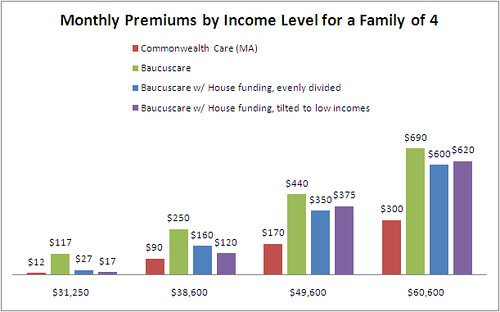
People in Massaschusetts are by and large satisfied with the Connector. It's toughest on the fairly small number of families earning just over 300% of FPL (of which there aren't that many), and on the larger number of young individuals who make just over 300% of FPL (which is $32,320 for an individual, so there are a decent number of those folks). Working class families earning up to 200% of FPL have fairly low premiums. $90 per month is going to pinch, but for uninsured households, they'll get some real value out of that: Commonwealth Care plans include dental insurance, wellness checkups have low co-payments; chronic disease care is especially well covered, and so forth. Likewise, three hundred pre-tax dollars a month for a family with a gross income of $60,000 per year is Real Money, but it's not going to break the bank. It's less than what they should be saving for college, for instance.

But as you can see from the graph, the Baucus bill doesn't fare as well. It's not even close to faring as well. The eight million individuals without insurance who earn between 200% and 300% of FPL will pay more than twice what similar households in Massachusetts currently pay. And working class families will feel a real pinch; $250 per month ($3,000 per year) for a family of four with an income of $38,000 is going to hurt.


• The community rating provision, mandating that insurers offer the same price to everyone regardless of medical history, comes with a tremendous loophole that will allow them to change five times as much for a policy based on age, which is just another way to discriminate against the sick.

• The employer "free rider" problem, called "one of the worst policy ideas I've ever seen" by Ezra Klein, would penalize employers for hiring anyone who qualifies for subsidies, encouraging them to find people who get coverage through a spouse or illegal immigrants. It also gives large employers like Wal-Mart a competitive advantage for paying crappy wages. And you can't opt out of the garbage insurance that giant employer - let's call them Ball Bart - might offer you.

• The excise tax for violating the individual mandate could cost up to $3,800 but wouldn't kick in if the individual could not find coverage that costs more than 10% of his income. In which case, you've built a robust architecture for a useless plan, because if millions opt out the coverage gets less universal and insurers want to stop come-as-you-are guaranteed issue.

• The co-ops are even weaker than imaginable:

The co-ops can only compete in the small group and individual markets. That is to say, if the co-ops prove effective, and The Washington Post would like to offer co-op coverage as an option to its workers, it can't. The co-ops are not allowed to contract with large employers, which is to say, they can't compete with private insurers in the largest market, and they can't get the purchasing power that would come from a serious foothold among corporate customers.

Not only is their size restricted, so too is what they can do with their size. The co-ops can band together to increase their purchasing power, but they can't set national payment rates for their members, a la Medicare. As I understand it, they have to bargain with each provider and drug manufacturer and hospital and so forth separately, meaning they're denied one of the main advantages of size. The insurance industry is, in other words, being protected from not just public competition, but co-op competition.


Jay Rockefeller today sent a letter proving, based on tons of research, that co-ops were a complete sham that have failed in the marketplace on a number of occasions, saying that "I believe it is irresponsible to invest over $6 billion in a concept that has not proven to provide quality, affordable health care, when we know that a public health insurance option will rein in costs and save taxpayers billions of dollars."

Marcy Wheeler has a lot more. There's one promising sign that the exchanges look expandable and available to all businesses, a neat way to gradually wean the system off of exclusive employer-based insurance, but that's about the only silver lining. Kent Conrad's gambit of increasing the budget window to make the Senate Finance bill look better did work, as the deficit reduction aspects look improved for the bill over the House bill. But crucially, that's a function of the funding, not the outlay in subsidies. Those will be too stingy to make the bill work for people, only for the bean-counters. In fact, the bill will start taking more and more from the middle class, much like the alternative minimum tax, and political reality will force scalebacks, so the budget picture doesn't look as rosy as advertised.

But it also suggests some real dangers in the bill's second decade. The unpopular elements of the bill become a lot bigger and more onerous. The excise tax on high-cost insurance plans begins affecting insurance plans that aren't particularly high-cost. The Medicare and Medicaid savings begin to tighten. That said, there are a lot of potential savings that the CBO isn't taking into account here, so that might ease the pain. Plus, at some point, we are going to have to start cutting costs in the system, and you can't escape some eventual hurt in that. But you can be sure the GOP is going to run these numbers aggressively and spin them viciously.


The good news is that this is in no way "the bill" that will get signed by the President. It has to go through a significant amount of changes, and key Democrats are already balking at it. In fact, lil' ol' Roland Burris said he wouldn't vote for anything without a public option, and with the numbers so tight, every Senator is in a bargaining position. Baucuscare is an abomination. But it doesn't have to be the endpoint, only the beginning.

I should say that one group really, really likes the Baucus bill - insurance companies.

Labels: , , , , , , , , , , ,

|

The Unceasing Disaster That Is Max Baucus

This is it. A year of planning. Three months of intensive bipartisan discussions. Weeks of preparation for the public. And Max Baucus is going to deliver his health care bill... without a single Republican vote. Which anyone with a brain could have told you would be the outcome right from the start.

Senate Finance Committee Chairman Max Baucus (D-Mont.) will release his long-awaited health care reform bill Wednesday – but without the Republican support he has sought for months.

Baucus tailored his proposal to win the backing of some Republicans, hoping to keep alive the possibility that Congress would pass a bipartisan bill.

But after months of closed-door talks, none of the three Republicans involved the bipartisan Gang of Six is expected to declare support for the bill Wednesday.

Baucus said he was still hopeful the bill will emerge from the committee vote with bipartisan backing.


Get that? Baucus wrote a Republican bill, essentially, one that is a gift to the insurance industry, and he got nowhere. And for his efforts, he got blasted by Charles Grassley, who disapproves of the "process." See, he wanted another year or two at the bargaining table delaying a final product, anything else is just a power grab. By the way, Baucus is still "hopeful" for a bipartisan vote. Which means what, he'll add in riders criminalizing abortion and commemorating Rush Limbaugh Day?

The GOP freeze-out on the Baucus bill includes Olympia Snowe, who's actually concerned, like many Democrats, about the weak affordability standards.

But let's not lose sight of why Snowe balked at the Baucus framework. For one thing, she's concerned about the financing mechanism, which she believes would hit Maine hard. But just as importantly, Snowe also believes (as I do) that Baucus' plan offers weak and inadequate subsidies. "The affordability question is crucial," Snowe said. "It's a central component, because at the end of the day people have high expectations they will have access to affordable health insurance."

In other words, one of the leading Republican negotiators on health care reform believes Baucus' plan is too conservative.


More Democrats have spoken up about the affordability concerns, which fall on the poor and middle class. At best, the weak subsidies would force loads of Americans to opt out of the mandate, making the bill useless. At worst, people would be forking over large portions of their income to private industry for substandard coverage. It's just another version of the middle-class squeeze.

Mr. Norton, 49 years old, is an adjunct professor at a local community college who earns about $40,000 a year. He's also one of roughly 200,000 Massachusetts residents who remain uninsured despite a state law requiring residents to have health insurance.

"I can't use up all of my savings just to buy mandatory insurance," Mr. Norton says. It's like penalizing "the homeless for refusing to buy a mansion." [...]

An independent contractor, Mr. Norton doesn't get benefits through the state-run Quinsigamond Community College where he works. His wife's employer, a dental practice, covers her, but not dependents. With a combined income of between $60,000 and $70,000, the family goes without cellphones for Mr. Norton and his teenage daughter, and a needed roof repair, but still makes too much to qualify for subsidies.

The cheapest plan available to him and his 16-year-old daughter costs $464 a month, or $5,568 a year, and comes with a $2,000 deductible per person.

"It's insurance you can't possibly use," he says, referring to the thousands of dollars he'd pay in premiums and deductibles before the coverage would kick in.


Baucus has an anodyne op-ed putting the best face on his plan. Those who've taken a look at it know better. And it has to be improved before getting out of the Senate.

...here's the Baucus chairman's mark. It's mostly in plain English.

Labels: , , , , , ,

|

Tuesday, September 15, 2009

Not So Fast, Mad Max

Jay Rockefeller is actually the chair of the health subcommittee in the Senate Finance Committee. Any "Gang of Six," or really any legislation on the Committee, should at least have his input, if not his controlling hand. Yet Max Baucus froze him out of the legislation in favor of Republicans who will never sign on to the final version and worthless schemes like the Conrad co-op proposal (which is just a thin ploy to get Blue Cross of North Dakota, which controls 90% of the market in Conrad's state, the "co-op" label so it can access federal start-up funds). Rockefeller may have the last laugh when the bill moves into the full committee.

U.S. Senator John Rockefeller, a Finance Committee member and a strong backer of a government-run insurance option, said on Tuesday he will not support the panel's healthcare bill in its present form.

Rockefeller told reporters he was unhappy with the lack of a government-run "public" insurance option in the bill, which is scheduled to be made public on Wednesday, and had problems with some of its changes in children's health insurance and Medicaid, or healthcare for the poor.


In particular, Rockefeller wants a public insurance option instead of the weak co-ops, better affordability provisions so working people can actually use the bill, and changes to the way that Baucuscare deals with the Children's Health Insurance Program and Medicaid.

Rockefeller specifically said "There is no way in its present form that I will vote for it... unless it changes during the amendment process by vast amounts." Now, getting amendments through may not be an easy task. Each Rockefeller amendment in that committee would have to get the votes of all the Democrats plus at least a couple Republicans, if Baucus and Conrad hold firm on them. Considering that 10 of the 13 Democrats on the panel were completely shut out of the process during the Gang of Six talks, I'd expect a lot of support for what Rockefeller wants to do, but Baucus and Conrad can basically nullify anything meaningful on their own, should they want to.

Still, Rockefeller's advocacy is important because it sets the tone for Democrats with the full Senate, where votes like his will be needed. Jon Cohn explains.

A little over a month ago, right before the August recess, I spoke with Rockefeller at some length. And he was clearly wrestling with how to position himself.

No living senator has done as much to promote health reform as he has. It's the cause of his life and, for the first time, the goal is within reach. He admitted that voting against a package, even a flawed one, was difficult to imagine.

But Rockefeller also made clear his frustration with the compromises Baucus was making, whether it was replacing the public plan with a co-op or gradually reducing the subsidies to help people pay for insurance. He was particularly incensed about the changes to Medicaid and CHIP, programs to which he's devoted much of his time--and on which many West Virginians rely.

At the time, it seemed like Rockefeller was still on board, if only to help get a bill out of the Finance Committee and onto the Senate floor. But you got the feeling--well, I got the feeling--that he was near the breaking point.

Sometime since that interview, clearly, he's hit it.


Every vote is precious in the Senate, given that votes on the Republican side other than Olympia Snowe and maybe Susan Collins will not be forthcoming. Harry Reid has laid down the marker that anything less than 60 votes will lead him to go through the reconciliation process (and I don't think Reid's low poll numbers in Nevada will be much of a factor - the consequences of doing nothing on health care would be far graver for him). Therefore everyone in the Democratic caucus, essentially, represents an interest group to be satisfied. Rockefeller is standing up and saying that he's perfectly willing to vote against something that doesn't fulfill the promise of health care reform as he sees it. Bernie Sanders probably feels the same way. Maybe Barbara Boxer does. Or others. Max Baucus and his cronies will have to wrestle with that.

...Incidentally, the fact that we could have a new interim Senator from Massachusetts as soon as this week makes things even more interesting.

Labels: , , , , , , ,

|

Annals Of The Insurance Industry

Just a few tidbits about the industry that Republicans and many conservative Democrats say we must keep in business at all costs:

• A member of a non-profit in Virginia was arrested at the headquarters of Anthem for trying to question them about a rate increase. This is the same Anthem who sent a letter to their customers telling them to contact members of Congress and tell them to oppose a public option. When the same customers try to contact Anthem, they are met with arrest.

• Crystal Lee Sutton, the union organizer who inspired the movie "Norma Rae," died from cancer this week, after a protracted battle with the disease - and her health insurer.

As Daily Kos blogger hissyspit points out, last year Sutton gave an interview to the press where she described a struggle with her health insurer over treatment. The Times-News in Burlington, North Carolina, wrote in 2008:

[Sutton] went two months without possible life-saving medications because her insurance wouldn’t cover it, another example of abusing the working poor, she said.

“How in the world can it take so long to find out (whether they would cover the medicine or not) when it could be a matter of life or death,” she said. “It is almost like, in a way, committing murder.”

She eventually received the medication, but the cancer is taking a toll on her strong will and solid frame.


• In eight states and the District of Columbia, insurance companies define domestic violence as a pre-existing condition. The theory goes that a victim of abuse is more likely to be abused again, and would require medical treatment for those beatings.

Words cannot describe the sheer inhumanity of this claim. It serves as yet further proof that our insurance system is broken, destroyed by the profit-mongering of the very companies whose sole purpose should be to provide Americans with access to care when they need it most. In 1994, an informal survey conducted by the Subcommittee on Crime and Criminal Justice of the United States Senate Judiciary Committee revealed that 8 of the 16 largest insurers in the country used domestic violence as a factor when deciding whether to extend coverage and how much to charge if coverage was extended.


• The same insurance interests who deny coverage to victims of domestic violence, who deny claims for cancer patients, who arrest those who dare to question them, have spent $585 million dollars in the past 2 1/2 years, and $700,000 a day, lobbying Congress to ensure that any reform bill protects their profits. They have scored with at least one committee, Max Baucus' Senate Finance Committee, which produced a bill that CIGNA whistleblower Wendell Potter calls an absolute gift to the insurance industry.

Potter argued that the lax employer requirements would shift the cost and risk of coverage onto the individual and maintained that the bill’s “network of cooperatives” would be unable to compete in today’s concentrated health insurance markets. “The co-ops won’t stand a chance,” he concluded.

Reform must also do more to regulate insurers, who have agreed to accept applicants with pre-existing conditions but are insisting on benefit and rate flexibility. Potter argued that the benefit package standards in the Exchange and the high deductible option for younger beneficiaries would allow insurers to design almost anything that they can sell in the health market place and push the country towards consumer driven health care.

Under the Baucus legislation, private insurers could also charge older individuals up to five times more for coverage. “You’re just using age as a proxy for health status,” Uwe Reinhardt, an economics professor at Princeton University told the New York Times. Reinhardt estimates that “Senator Baucus’s age-rating plan would allow insurers to cover roughly 70 percent of the additional risk they’d take on by being required to accept all comers, regardless of health.”


Some, like Nancy Pelosi, have vowed not to pass the "Insurance Industry Profit Protection And Enhancement Act," as she called it. But they are under tremendous pressure from powerful interests to enact just such a giveaway. Reform groups like Health Care for America Now understand that attacking this industry, and devaluing their influence, is a means to getting a bill that truly helps all Americans obtain quality and affordable health care.

Labels: , , , , , , , ,

|