Amazon.com Widgets

As featured on p. 218 of "Bloggers on the Bus," under the name "a MyDD blogger."

Wednesday, September 16, 2009

The Baucus Circus

The votes are in! Everybody's talking about Max Baucus' plan for health care!

Mostly, people don't like it!

Republicans don't like it because... it's a health care bill. Democrats don't like it because... it's a bad health care bill designed to kowtow to Republicans who won't even vote for it. Health care advocacy groups don't like it because it "would give a government-subsidized monopoly to the private insurance industry to sell their most profitable plans - high-deductible insurance - without having to face competition from a public health insurer." A good reason not to like it! And unions don't like it because there's no employer mandate and it would "tax health plans."

A bill of particulars:

• The bill spends too little on coverage subsidies. While putting a price tag on something that is paid for inside the budget window is misleading, the fact is that Baucus artificially lowered that price tag to meet some conception of centrism, and the lowered subsidies have a direct impact on affordability.
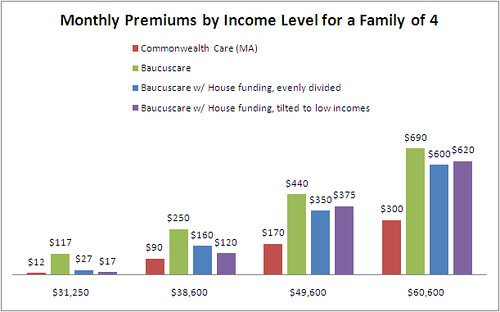


People in Massaschusetts are by and large satisfied with the Connector. It's toughest on the fairly small number of families earning just over 300% of FPL (of which there aren't that many), and on the larger number of young individuals who make just over 300% of FPL (which is $32,320 for an individual, so there are a decent number of those folks). Working class families earning up to 200% of FPL have fairly low premiums. $90 per month is going to pinch, but for uninsured households, they'll get some real value out of that: Commonwealth Care plans include dental insurance, wellness checkups have low co-payments; chronic disease care is especially well covered, and so forth. Likewise, three hundred pre-tax dollars a month for a family with a gross income of $60,000 per year is Real Money, but it's not going to break the bank. It's less than what they should be saving for college, for instance.

But as you can see from the graph, the Baucus bill doesn't fare as well. It's not even close to faring as well. The eight million individuals without insurance who earn between 200% and 300% of FPL will pay more than twice what similar households in Massachusetts currently pay. And working class families will feel a real pinch; $250 per month ($3,000 per year) for a family of four with an income of $38,000 is going to hurt.


• The community rating provision, mandating that insurers offer the same price to everyone regardless of medical history, comes with a tremendous loophole that will allow them to change five times as much for a policy based on age, which is just another way to discriminate against the sick.

• The employer "free rider" problem, called "one of the worst policy ideas I've ever seen" by Ezra Klein, would penalize employers for hiring anyone who qualifies for subsidies, encouraging them to find people who get coverage through a spouse or illegal immigrants. It also gives large employers like Wal-Mart a competitive advantage for paying crappy wages. And you can't opt out of the garbage insurance that giant employer - let's call them Ball Bart - might offer you.

• The excise tax for violating the individual mandate could cost up to $3,800 but wouldn't kick in if the individual could not find coverage that costs more than 10% of his income. In which case, you've built a robust architecture for a useless plan, because if millions opt out the coverage gets less universal and insurers want to stop come-as-you-are guaranteed issue.

• The co-ops are even weaker than imaginable:

The co-ops can only compete in the small group and individual markets. That is to say, if the co-ops prove effective, and The Washington Post would like to offer co-op coverage as an option to its workers, it can't. The co-ops are not allowed to contract with large employers, which is to say, they can't compete with private insurers in the largest market, and they can't get the purchasing power that would come from a serious foothold among corporate customers.

Not only is their size restricted, so too is what they can do with their size. The co-ops can band together to increase their purchasing power, but they can't set national payment rates for their members, a la Medicare. As I understand it, they have to bargain with each provider and drug manufacturer and hospital and so forth separately, meaning they're denied one of the main advantages of size. The insurance industry is, in other words, being protected from not just public competition, but co-op competition.


Jay Rockefeller today sent a letter proving, based on tons of research, that co-ops were a complete sham that have failed in the marketplace on a number of occasions, saying that "I believe it is irresponsible to invest over $6 billion in a concept that has not proven to provide quality, affordable health care, when we know that a public health insurance option will rein in costs and save taxpayers billions of dollars."

Marcy Wheeler has a lot more. There's one promising sign that the exchanges look expandable and available to all businesses, a neat way to gradually wean the system off of exclusive employer-based insurance, but that's about the only silver lining. Kent Conrad's gambit of increasing the budget window to make the Senate Finance bill look better did work, as the deficit reduction aspects look improved for the bill over the House bill. But crucially, that's a function of the funding, not the outlay in subsidies. Those will be too stingy to make the bill work for people, only for the bean-counters. In fact, the bill will start taking more and more from the middle class, much like the alternative minimum tax, and political reality will force scalebacks, so the budget picture doesn't look as rosy as advertised.

But it also suggests some real dangers in the bill's second decade. The unpopular elements of the bill become a lot bigger and more onerous. The excise tax on high-cost insurance plans begins affecting insurance plans that aren't particularly high-cost. The Medicare and Medicaid savings begin to tighten. That said, there are a lot of potential savings that the CBO isn't taking into account here, so that might ease the pain. Plus, at some point, we are going to have to start cutting costs in the system, and you can't escape some eventual hurt in that. But you can be sure the GOP is going to run these numbers aggressively and spin them viciously.


The good news is that this is in no way "the bill" that will get signed by the President. It has to go through a significant amount of changes, and key Democrats are already balking at it. In fact, lil' ol' Roland Burris said he wouldn't vote for anything without a public option, and with the numbers so tight, every Senator is in a bargaining position. Baucuscare is an abomination. But it doesn't have to be the endpoint, only the beginning.

I should say that one group really, really likes the Baucus bill - insurance companies.

Labels: , , , , , , , , , , ,

|

Thursday, August 20, 2009

Jon Kyl - Objectively Pro-Discrimination

Under current law, health insurance companies can deny you coverage if they decide you actually might use a doctor. They can discriminate against broad classes of Amercians based on what they call in insurance-speak a "pre-existing condition." They can even go back after you turn in a claim and find some typo in your medical history form that allows them to dump you from the coverage rolls.

Jon Kyl, the #2 Republican in the Senate, thinks this is all fine and dandy.

The distance between the parties' leaders on health care was made clear on Tuesday when the No. 2 Republican in the Senate held a conference call with reporters.

Asked by ABC News about a package of insurance market reforms that have been endorsed not only by President Obama but also by the insurance industry, Sen. Jon Kyl came out against all three proposals.

In particular, the Arizona Republican signaled that he opposes requiring insurance companies nationwide to provide coverage without regard to pre-existing conditions; requiring them to charge everyone the same rate regardless of health status; and requiring all Americans to carry health insurance.

"One of the concerns I have about the approach of the Democrats ... is an assumption that there has to be a national mandate on all insurers to do various things," Kyl told ABC News when asked for his position the three issues.

"Those are techniques that states can, and some have, used in the past with fairly disastrous consequences," he said.


Part of what community rating would ban is allowing companies to charge women more money for health insurance, because they may use more care. And actuarial statistics show that the poor have a higher propensity for sickness due to environment and food choices, which means that they are discriminated against at a higher proportion in the insurance market. That's the system Jon Kyl wants to keep in place - a segregated system where large segments of society cannot even have the option of health insurance.

Even the insurance industry supports guaranteed issue and community rating. They want that along with a forced-market monopoly, with no competition from a public insurance option, so that the government can subsidize their businesses and turn people who cannot afford health insurance into criminals. But that would be LESS RADICAL than what Jon Kyl is proposing.

These are the people with whom we must engage in bipartisanship, or so it is told.

Labels: , , , , , , , ,

|

Wednesday, July 29, 2009

Same Old Song And Dance

Here comes the part of the health care debate where people start to talk themselves into half a loaf instead of fighting for a full one.

There are many themes in the sad and frustrating history of health-care reform. But one of the central ones is that there were many points when Democrats could have accepted a compromise and did not. Richard Nixon, for instance, proposed a plan that could have passed Congress but that liberals thought comically inadequate. It was more comprehensive than anything we will get this year. George H.W. Bush also offered a pretty good proposal but got no support among Democrats.

Opportunities at health-care reform do not happen frequently. The average between major attempts is 19.5 years. That's 19.5 years in which the uninsured stay uninsured and their ranks grow. Where a situation that is already bad gets a lot worse. This year, Barack Obama is popular, and there are 60 Democrats in the Senate and huge majorities in the House. There is no reason to believe that Democrats will be in a stronger position anytime soon. It is not like when a weakened Nixon, or a fading Bush, offered a compromise.

If reformers cannot pass a strong health-care reform bill now, there is no reason to believe they will be able to do it later. The question is whether the knowledge that the system will not let you solve this problem should prevent you from doing what you can to improve it. Put more sharply, the question should be whether this bill is better or worse than another 19.5 years of the deteriorating status quo.


Ezra Klein is not an activist. He's a health care policy wonk. And he knows that we have a very broken political system and a media that gives wide berth to out and out lies from conservatives. So he reasons that health insurance reform that gives access to coverage to 40 million Americans who don't have it will be a major improvement for many Americans, and even if that's seen as a loss in the political world, it's worth achieving. Heck, if we get community rating, forcing insurers to cover everyone with the same coverage at the same basic rate, even a jury-rigged system can be universal.

This hardly solves every problem. In particular, it doesn't do much to rein in costs. But if you combine (a) Medicare, (b) our current employer-based insurance regime, and (c) community rating along with subsidies for low-income families, you've essentially institutionalized universal healthcare insurance. Not everyone will take advantage of it — there will always be a few people who go without coverage even if it's affordable — and you still a need a few other things like out-of-pocket caps. Still, it's basically a statement that everyone in the country can and should be covered. And once that becomes a cultural norm, it will never go away.


If we end up with health insurance reform, where you have to be covered, cannot be dropped, and must pay the same rate regardless of prior conditions, and you have an exchange to buy insurance instead of being forced into a regional monopoly, people in the individual market will see the difference. Of course, problems will remain. Employers, without a mandate, will still drop coverage. The costs will continue to soar, especially without a public option that can gain a big enough following to force competition in that individual marketplace, particularly on price. The smaller tweaks of health IT and prevention and comparative effectiveness are important but may end up compromised. And without getting the real savings from stakeholders necessary to drive down costs, people will still see their premiums rise. Not to mention the fact that we're going to need millions more doctors.

The reason that liberals want to enshrine a public option, not the weak co-op alternative, is that the history of the few victories in health care and social safety net reform in this country have started with an incomplete toehold that gets expanded over time. Medicare wasn't perfect at the start. Or SCHIP. Or even Social Security. They needed to be tweaked and improved and made useful for all. I don't think it's possible for co-ops to scale up in this way. We've seen the history of them taking decades to have any measurable effect.

But Democratic leaders appear to want to give in on this one.

"We think the public option is very important," said House Majority Leader Steny Hoyer, D-Md., but "we have to see what the Senate does on co-ops, and see how it's formulated, to see whether or not it would have a similar effect."

"It's really premature for me to lay out what should be in this bill," said Senate Majority Leader Harry Reid, D-Nev., when he was asked about the public option [...]

Liberals shudder at the idea of removing a public option.

"There are rumors that the leadership is getting squishy" on the public option, said Rep. Eliot Engel, D-N.Y., a member of the House Energy and Commerce Committee, which also is trying to write a version of health care legislation.

"Some of us have pushed back hard and said we will not support a bill if it doesn't have a public option," he warned. "There comes a point where some of us will say getting a bill out at any cost is not a panacea if it's a bad bill."


When Harry Reid comes out and says what can get 60 votes beats what I want, you understand that he's laying the groundwork. This is why health insurance stocks shot up yesterday. They're on the verge of getting a forced market, lowering their administrative costs (no rescission department) and adding tens of millions to the rolls.

14 House members are so far on the record saying they'll vote against any health care reform bill that doesn't include a legitimate public option, not something that Harry Reid and the gang will try to pass off as one. And yes, at some point, the President needs to weigh in and pick a side. He sounded wobbly on this yesterday.

And the other thing that we do want to do -- now, this is controversial, and I understand some people are worried about this -- we do think that it makes sense to have a public option alongside the private option. So you could still choose a private insurer, but we'd also have a public plan that you could choose from that would be non-for-profit, wouldn't have, hopefully, some of the same high administrative costs, and would be potentially more responsive to your needs at a lower cost. I think that helps keep the insurance companies honest because now they have somebody to compete with.

And I have to say, the reason this has been controversial is a lot of people have heard this phrase "socialized medicine" and they say, we don't want government-run health care; we don't want a Canadian-style plan. Nobody is talking about that. We're saying, let's give you a choice. You can choose the private marketplace, or this other approach.

And I got a letter the other day from a woman; she said, I don't want government-run health care, I don't want socialized medicine, and don't touch my Medicare. (Laughter.) And I wanted to say, well, I mean, that's what Medicare is, is it's a government-run health care plan that people are very happy with. But I think that we've been so accustomed to hearing those phrases that sometimes we can't sort out the myth from the reality.


Nothing abut co-ops yesterday, but the move, one assumes, would be to sell co-ops as the public plan. Obama's strategy has been to get to conference and make the necessary adjustments at that time.

We'll see.

Labels: , , , , , , , ,

|

Thursday, May 07, 2009

Public Enemy

The health care debate thus far has really focused on creating a public option to compete with private insurance companies. The various players are choosing up sides. The Obama Administration, expressed by their Health and Human Services Secretary, supports it, as a means to encourage competition and innovation. The White House is joined by 70-odd members of the House who have said no public plan, no deal, and 21 members of the Senate (so far), including moderates like Claire McCaskill and Jim Webb. On the opposite side are, well, Republicans, and their paymasters in the health insurance industry, simply because they want to preserve their monopoly over the market and their advantages that don't impact the bottom line for consumers, but instead get shoveled into profit margins and executive pay. The health insurance lobby's view is that they will adopt modestly more fair practices (guaranteed issue, modified community rating) as long as the government forces individuals to buy health care and subsidizes them, an indirect payment from the Treasury to the insurers themselves. Not surprisingly, these views mirror those of "moderates" like Ben Nelson, who coincidentally has taken millions from the insurance industry in campaign contributions, and previously owned a major insurance company.

(By the way, memo to the media: what the insurance industry is offering does not add up to a concession. These are the same "concessions" made by the industry in 1993, and yet they bashed the final plan and stopped its passage. These measures would reform insurance but not reform health care, which can only come through increased competition and a resetting of the perverse incentives that insurers have to limit treatment. Only real reform would lower costs and provide better care, and forcing a monopoly doesn't exactly get all the way there.)

Chuck Schumer has tried to design such a plan, and does a good job of defending it and naming it ("Plan USA"), but under the guise of a "level playing field," it's hard for me to understand how his plan would be anything more than a non-profit insurance option doing little to truly lower costs unless it were scaled up massively. Sure, this kind of public plan would limit overhead and advertising costs, and wouldn't pay executives. But if it can't bargain for lower rates in the way Medicare can, in fact over time you'd probably see what happened in Medicare Advantage (the private insurance supplement to Medicare), where the playing field got tilted to the private market until the government stepped in this year to put a stop to it.

We all know that the only way to truly bargain down costs is through a single payer option. I'm willing to support a public option grafted onto the current system, for now, as long as it retains any ability to bargain for lower costs in the way that single payer would. However, we're getting a bit afield of the nut of the issue if we continue to discuss the mechanism of the public plan. Because a far bigger obstacle to meaningful health care reform is how the hell to pay for it. Literally every funding stream that has been discussed gets quickly shut within a matter of days. Today, Charlie Rangel ended the option of capping or taxing employer-provided health benefits. Earlier they cut out Obama's plan to cap charitable deductions. We're talking about well over a trillion dollars, with big outlays in the short term to get the system to bend costs downward, and if nobody wants to determine a way to pay for it, health care reform dies.

Labels: , , , , , , , , ,

|

Tuesday, March 10, 2009

Health Care Sausage Making

If you thought the sausage-making on the stimulus was bad, wait until you see health care reform. The players are more invested in getting their way and more rigid in their opinions. Chuck Grassley seems to be mad about the Obama Administration cutting 60 worthless private tax collection jobs in Iowa (that were costing the IRS more money than the tax collectors were taking in), and folks are worried that he'll take it out on the bill. That's the silliness that we're dealing with.

Everyone's making goo-goo eyes at each other at this point, but when you get to the actual facts, there are yawning divides between the parties. Karen Ignani of AHIP, the health insurance lobby, thinks she's sketching a "deal" by offering guaranteed issue in exchange for an individual mandate. In other words, force everyone to buy health insurance and we'll sell it to everyone! But there's one missing ingredient:

The missing ingredient is affordability. And the expectation is that affordability will be guaranteed by "community rating," a policy that ends the ability of insurers to charge different customers different prices based on age, health status, location, etc. At Brownstein's forum, Ignani addressed this, too, and her comments are worth quoting:

She suggested an arrangement in which insurers and the government in effect would divide the cost of insuring the biggest risks through a combination of rating reform and public subsidies. "You have to think about the ratings and the subsidy in tandem," she argued. For instance, she noted, a pure form of community rating--in which everyone is charged the same premium regardless of their age or health status--would substantially increase rates on young healthy families (while reducing them on older or sicker people). In that instance, "you might decide well then we could subsidize those [young] individuals to cushion that," she said. Alternately, she said, you might allow insurers to vary rates somewhat based on age, but use subsidies to ensure that say, "nobody over 55 would have to pay more than 10 per cent of income" for premiums--as California did in its reform. More details on the issue are coming: "You will hear a great deal from us soon about rating," she said.


That just doesn't seem like it would work, but Ezra Klein argues that insurers are not even the main factor in affordability concerns (they take one out of every three dollars for themselves, so I'm not sure I agree), compared to pharmaceutical companies and device manufacturers and doctors and hospital associations.

So this is, simply put, a mess. And Max Baucus addressing costs by wanting to tax health care benefits, precisely what John McCain got hammered for during the campaign, is not helpful at all. I could possibly see capping the health care deduction at a certain level of care, but employers are really not the people to bargain with for revenue. It's far more important to bring down costs.

Meanwhile, Republicans are laying down markers.

Does that matter? It's hard to say. Rhetorically, the GOP has staked out a very narrow corner of opposition. Last week, Mitch McConnell, Chuck Grassley, Mike Enzi, Orrin Hatch, and Judd Gregg -- essentially, all the Senate Republicans with jurisdiction over health reform, and McConnell -- co-signed a letter to President Obama. I've obtained a copy, and it's up for download here. They draw two lines in the sand. First, they warn against using the budget reconciliation process to pass heath care. Doing so would "make it difficult to gain broad bipartisan support" and "do a disservice to this important issue." Substantively, they fear a public insurance option. "Forcing free market plans to compete with these government-run programs would create an unlevel playing field and inevitably doom true competition," they say. "Ultimately, we would be left with a single government-run plan controlling the market."

That leaves, of course, plenty of room for eventual argument and obstruction. But there's a caution worth recognizing here, too. Republicans do not want to begin in opposition. They have begun this debate by claiming that their objections lie at the margins of health reform, not at its core.


Ah, but it's on the margins where you can kill policy, and the Republicans know it. I think the health care debate is going to give me heartburn. Although one of these demands is silly. "Don't use budget reconciliation or the bill won't be bipartisan"? The POINT of using budget reconciliation is that you'd only need 50 votes. They're getting it backwards. And the Obama Administration should threaten to use reconciliation at every step to force Republicans to come along. They can either be involved in the process, or on the outside.

Labels: , , , , , , , , , ,

|

Wednesday, February 25, 2009

Mandates Are Go

There were three major issue silos that Barack Obama called for major progress on in last night's speech. On only one issue did he provide a guarantee that we'll work on it in this calendar year, and that's health care. Now Harry Reid is putting calendar dates to that request, calling for a start to the process in the summer before the August recess.

As for what form any bill will take, as I mentioned briefly, the Obama team is softening their resistance to an individual mandate.

Here's how it will work, according to the officials I've spoken to. The budget's health care section is not a detailed plan. Rather, it offers financing -- though not all -- and principles meant to guide the plan that Congress will author. The details will be decided by Congress in consultation with the administration.

One of those details is "universal" health care coverage [...]

The budget -- and I was cautioned that the wording "is changing hourly" -- will direct Congress to "aim for universality." That is a bolder goal than simple affordability, which can be achieved, at least in theory, through subsidies. Universality means everyone has coverage, not just the ability to access it. And that requires a mechanism to ensure that they seek it.

Administration officials have been very clear on what the inclusion of "universality" is meant to communicate to Congress. As one senior member of the health team said to me, "[The plan] will cover everybody. And I don't see how you cover everybody without an individual mandate." That language almost precisely echoes what Senate Finance Chairman Max Baucus said in an interview last summer. "I don’t see how you can get meaningful universal coverage without a mandate," he told me. Last fall, he included an individual mandate in the first draft of his health care plan.


The mandates argument during the Clinton/Obama primary took on a kind of mythic importance because it was among the few major differences between the candidates. Only it was not a giant difference at all, really. There was always room for mandates down the road in Obama's plan, if other approaches to get to universality didn't work. If this is the way for Congress to put their stamp on the policy, I don't think it's the worst idea.

However, I think an individual mandate would have to be carefully described. It would have to include guaranteed issue, ending the ability for insurers to deny a customer for a pre-existing condition. And it should have community rating, which would allow a flat rate of care for everyone in a community regardless of medical condition. There also must be a public option so that insurers would have to compete for this forced market on quality and price, and not have an incentive not to provide care. Finally, there has to be a focus on both prevention and overall population health, which includes nutrition and exercise and a recognition that income inequality contributes massively to poor health outcomes.

My preference would be single payer, but with all those crucial elements, an individual mandate can work.

There is a way forward with this plan, and if it includes these elements, Americans will support it. 7 in 10 “would favor a proposal that would increase the government’s influence over the health-care system in an attempt to reduce costs and expand coverage,” and most find it the number one pressing need after the economy. Of course, the two are linked. A rational health care system will increase global competitiveness and provide for worker security. This is a legacy builder. Health care is on the fast track to a solution.

SEIU and Health Care for America Now have a good action that will keep the pressure on.

Labels: , , , , , , ,

|

Thursday, November 20, 2008

And Say, Do You Want To, Make A Deal?

Ultimately, I do believe that universality is a key to driving down costs in the health care market. But you can definitely take it as a sign that an individual mandate may not be the way to go when the insurance industry is asking for it.

WASHINGTON — The health insurance industry said Wednesday that it would support a health care overhaul requiring insurers to accept all customers, regardless of illness or disability. But in return, the industry said, Congress should require all Americans to have coverage.

The proposals, put forward by the insurers’ two main trade associations, have the potential to reshape and advance the debate over universal health insurance just as President-elect Barack Obama prepares to take office.

In separate actions, the two trade groups, America’s Health Insurance Plans and the Blue Cross and Blue Shield Association, announced their support for guaranteed coverage for people with pre-existing medical conditions, in conjunction with an enforceable mandate for individual coverage.


What's important here is what's missing, as Ezra Klein notes. If you are forced to buy health insurance and the insurers won't make it affordable, that's not really a positive for the individual. Guaranteed issue must be combined with community rating (baseline insurance at the same cost for everyone in a community) for the mandate to work. And that's not what the industry is proposing.

I e-mailed Robert Zirkelbach, AHIP's spokesman, to ask if this proposal had a community rating provision:

"the proposal we issued yesterday was for guarantee issue combined with an individual mandate.

We also need to take steps to ensure coverage is affordable for all. There needs to be an adequate safety net and we should provide tax credits to low and moderate income workers. We also have to address the key medical cost-drivers that drive up the cost of coverage."

In other words, no. At least not yet.


Not to mention the intimation that they'll keep raising their rates and let government pick up the bill through tax credits.

Considering that the insurance industry is a useless, inefficient middle man that does practically nothing to make people more healthy, I don't think they should be in the business of making ultimatums. But the fact that they're at the table means that they know change is coming and they had better try to get something out of the deal than scuttle it. Hopefully, their attempts at negotiation will be met with hardline opposition unless they capitulate on price.

We have a long way to go on health care reform, and there are a lot of elements we need to make sure are included (public option and a mandate that insurers pay a hefty amount of their premiums on treatment being at the top of the list). But more than anything, this is an acknowledgement by the insurance industry that they're going to have to make a deal.

Labels: , , , , ,

|

Wednesday, February 13, 2008

Blue Cross Backs Down - And What The Legislature Can Do Now

This is why we have a fourth estate:

Facing a torrent of criticism Tuesday, Blue Cross of California abruptly halted its practice of asking physicians in a letter to look for medical conditions that could be used to cancel patients' insurance coverage.

In a statement issued about 6 p.m., the state's largest for-profit insurer said, "Today we reached out to our provider partners and California regulators and determined this letter is no longer necessary and, in fact, was creating a misimpression and causing some members and providers undue concern.

"As a result, we are discontinuing the dissemination of this letter going forward."


The Los Angeles Times occasionally earns its moniker of the Los Angeles Dog Trainer, but they have covered the many Blue Cross issues with a great deal of honor and professionalism. And they can be proud of the results.

Meanwhile, as comprehensive health care reform goes out the window in California for the coming year, Ezra Klein has a couple ideas about how to make the current private insurance system work a little better. He's right that making insurers compete to offer better care is actually counter-productive, because the costs incurred would outweigh the new memberships. But government can play a role to force insurers to compete in ways positive to both their bottom line and the welfare of their consumers, through some mandated steps:

Universality: Insurers cannot compete effectively unless everyone is in the pool. If the healthy can leave, insurers cannot compete to offer better care. They'll have to compete to attract the healthiest, which means offering the lowest costs, which means insuring the fewest sick people. The system has to be universal.

Community Rating: Insurers cannot be allowed, before offering insurance, to use demographic subslicing to cherrypick the market. That means no more preexisting histories, no complex formulas around age and income and race and region. They offer insurance to anyone who wants it for the exact same price. No exceptions.

Risk Adjustment: Merely having everyone in the system won't be enough, and nor will forcing insurers to do away with their most delicate cherrypicking tools. Insurers will just become sophisticated at advertising on G4 Tech TV, and in snowboarding magazines, and in urban centers -- in places, in other words, where the young and the healthy gather. So atop the universal system, atop the community rating, you need risk adjustment, which means either that insurers are reimbursed more for taking on sicker patients, or, my preferred method (and the one used in Germany), insurers with particularly healthy pools pay into a central fund that redistributes to insurers with less healthy pools. At the end of the day, it has to be as profitable for an insurer to insure a sick person as a healthy one.

Information Transparency: It needs to be easy for individuals to compare insurers on plan comprehensiveness, price, outcomes, etc. That means we need a marketplace where folks can go to shop for insurers, and they need to have standardized comparisons, or non-partisan rating authorities, providing information they can use.

One Market: This is contained in the last point, but there needs to be a singular place, or set of them, where individuals can shop around for insurance. This is hard stuff to find, and harder yet to understand, and real effort needs to go into constructing an easily accessible marketplace that customers can effectively navigate.


And the legislature can absolutely go through the incremental steps to implement these policies and make the current broken system a little more fair and more beneficial. The last two could arguably pass right now.

A little imagination from our leaders in the Legislature can at least improve what we have now.

Labels: , , , , ,

|

Wednesday, October 17, 2007

A Sick System

I think at this point I'm deeply frustrated by all sides of the health care debate in California. You have the purity trolls who believe that anything to the right of single-payer healthcare is the work of the devil and are feeding into right-wing attacks on the Speaker (some of them completely well-deserved, we'll get to him in a moment) to advance their goals. You have dissemblers like Arnold and his Hoover Institute backers who will claim that their plan is universal health care "just like Hillary Clinton's" when it offers no cost controls on insurers and essentially just creates an expensive forced market. And then you have the "go-along-to-get-along" folks who talk about "expanding access" while driving us into the ditch of strengthening employer-based health care, applying a 1940s solution to a 21st-century problem.

Nobody's working together because nobody has the incentive to work together, and there's the safety valve of the ballot box which all sides see as a panacea. So nothing will advance in this special session, and remarkably, that's probably a good thing.

The Republican position on health care is that people have too much health insurance. They want to make lousy insurance cheaper so people will buy it and "be covered," but not be able to use it as much. As the insurance industry LOVES this approach, it's the only thing they'll ever champion, in the name of "universal health care." This is why I disagree with some in the lefty blogosphere who think that just getting people like John Boehner to address universal health care is a win. No, it devalues the word. They've already turned it into something deceptive like the forced market Schwarznegger has put forth in his failed bill. The end result is confusion, leading to blurring like "Arnold's strategy is the same as Hillary's." Actually, that's almost completely untrue.

I'm not immune to an incremental approach while we continue to build the coalition for the end to for-profit health care in California. Here are two small things you could put on a ballot tomorrow that would pass: guaranteed issue, which would eliminate the practice of denying health care to anyone based on a pre-existing condition; and community rating, mandating that all insurers provide their coverage to a community at the same price regardless of age or relative health. Those two steps alone would be vastly preferable than trying to jerry-rig an approach that will inevitably take steps backward rather than forward. The insurance industry is hated in this state and in this country, and nothing beyond the status quo or forcing a market to them will placate their concerns. So if you're going to have a vigorous opposition, at least have it be in service to something that makes sense.

UPDATE: Ezra preaches it:

On the micro level, a health crisis can leave you bankrupt if you lack insurance, have too little insurance, have too high a deductible, or your insurance decides not to cover the costs of your treatment. On the macro level, the spiraling cost of health care is a massive threat to our economy. Looking into the future, if we don't restrain the growth in health spending, effective GDP-per-person (i.e, what's left after health costs) will actually begin to go down (here's a graph!), and we'll all become poorer. And my hunch is that the only way to restrain health costs in a humane and politically palatable way will be through integrating the system, bargaining down prices, and rearranging consumer incentives so soft rationing -- i.e, ineffective drugs receive less reimbursement, and so aren't as often used -- becomes possible.


These should be the minimum requirements of a sound policy. The conservative position, again, is "people use too much health care." Why this can't be honed into a fine point is beyond me.

Labels: , , , , , ,

|

Wednesday, October 10, 2007

Ideology Vs. Progress, Take 4

Returning to health care for a moment, there's a big debate over whether to engage in an incremental approach to health care that would be universal, or to go for broke with a single-payer system. Again, single-payer is probably the best opportunity to keep down costs and cover everyone successfully. But I tend to agree with Paul Krugman on this issue:

The generic Demoplan, which basically follows the template laid down by John Edwards, involves four moving pieces: community rating, requiring that insurance companies offer insurance to everyone at the same rate regardless of medical history; a mandate, requiring that everyone have insurance; subsidies to help lower-income people pay for insurance; and public-private competition, in which people have the option of buying into a plan run by the government.

The alternative would be single-payer, aka Medicare for all: a payroll tax on everyone, and a government insurance program for everyone. Wouldn’t that be simpler, easier to administer, and more efficient?

Yes, it would. I myself described the Schwarzenegger plan in California, which contains all these elements except the public-private competition, as a “Rube Goldberg device — a complicated, indirect way of achieving what a single-payer system would accomplish simply and directly. “

But there are very good political reasons for going with the Demoplan: basically, it looks like something that could actually happen early in the next administration, while enacting a single-payer plan like the Conyers plan or the PNHP plan, excellent though those plans are, might take a very long time.

The public-private competition in the Demoplan is crucial, by the way, because it means that the Demoplan isn’t locked into the inefficiency of the private insurance system – it could evolve into single-payer over time.


I agree that the public option is what sways me in the direction of getting this achievable system in place. (By the way, Arnold's plan does not have community rating in the sense that it does not spell out the baseline floor for care, or the ceiling for costs). And it's also why it's ridiculous to suggest that Hillary Clinton's plan is the same as Mitt Romney's. First of all, Romney doesn't have a plan. The MassCare option was the result of the state Legislature, and Romney's official plan contains none of the MassCare parts, and essentially offers grants to states that do what they want, as well as giving tax breaks that ultimately favor the rich. The Massaschusetts plan also did not have the cost controls of the Clinton plan (which is why costs have exploded in the first year), nor did it have a public option in competition with private insurers. That's a key difference.

I do worry about how you enforce an individual mandate - do people that don't buy health insurance go to jail? Get fined? But the positives of a mandate-and-subsidize, private-vs.-public plan are significant, and people shouldn't be quite so ideologically rigid when discussing this issue.

Labels: , , , ,

|

Tuesday, February 06, 2007

Some Quick Thoughts On Health Care

• In California, Arnold Schwarzenegger hasn't gotten around to mentioning that his plan for expanding access to health care calls for the federal government just giving him $3.7 billion dollars. Arnold has been extremely unsuccessful in getting so much as a penny out of the feds, so I'd say his plan is a plan in the same way that the Underpants Gnomes have a business plan.

Collect Underpants
???
Profit!


Maybe this is why the Governor isn't writing a bill and can't even seem to get a legislator to introduce his plan as a bill, either.

• Republicans in the California State Senate, meanwhile, have come up with their own plan, called CalCare. Their plan, essentially, gives tax shelters to the rich while trying to eliminate wellness plans for children under 5. Oh, and giving insurance companies tax credits to be efficient. It's a REAL GOOD HEALTH CARE PLAN, it is.

• Meanwhile, other states are pushing forward with their own universal health care plans, like New Jersey and Maryland. Both states are controlled by Democrats, so it should be interesting to see what they'll come up with. And Massachusetts, even former Governor Romney, needs to be credited with getting this ball rolling (even if their plan looks to be incredibly steep for many inviduals to pay).

• Harry Reid looks to understand the crucial issue, that a for-profit insurance industry is the enemy of access and universal health care.

The problem is that the insurance industry is the enemy of most everything we do today. They have an anti-trust exemption from the Depression era that was supposed to last only a few years (the McCarran-Ferguson Act) but is still with us today. This exemption allows the industry to do harmful things to the country. They are fixing prices, which would ordinarily be a violation of the Sherman Anti-Trust Act, but there is nothing we can do.


This is why Edwards' plan represents something very new, allowing public plans to compete with private insurers, to break this stranglehold they have, where for-profit companies can get in the way of quality health care and saving lives.

• Gov. Tom Vilsack, running for President, answered my questions to him about health care in this Kos thread:

We clearly need universal access to health care for all citizens. Our system is wasteful and immoral. The uninsured either don’t get coverage or get care in expensive emergency rooms.

But there is more to the debate than coverage, and it has to do with lowering costs and increasing quality.

We need focus on prevention and wellness, we need to cure currently incurable diseases with a coordinated national effort, and we need long term (he trailed off -ed.)

As Governor, Iowa was only one of two states to decrease the uninsured last year and we have covered over 92% of the children in Iowa with Health Insurance.


Cost containment is certainly very important, as is prevention and wellness. I think those things end up improving, however, when you stop forcing the uninsured to only use the emergency room as a last resort and sign them up for full treatment and care.

• There have been several posts about the strategy for changing the health care system. Matthew Yglesias counsels a go-slow approach, with incremental ideas like lowering the age for Medicare, or expanding the CHIP program to cover more and more kids, rather than building some compromised but comprehensive system that keeps the for-profit insurance system or the employer-based system locked in place.

To put it another way, compromising on the quantitative aspects of single-payer health care means taking small steps to the social democratic utopia of tomorrow. Compromising on the qualitative aspects, by contrast, risks locking a bad system in place forever.


• Meanwhile, Mark Schmitt thinks Presidential candidates should stop giving detailed health care plans altogether, as someone will focus in on the inevitable negative detail and blow it out of the water. (Well, yeah, but won't that happen anyway? Isn't it better to try and get elected on something specific?)

• And Ezra Klein is righteously pissed that the Edwards plan is significant to the Beltway media only because it raises taxes (I mentioned this, too).

But if the problem with the New York Times and Washington Post story was that it failed to clearly or seriously explain the plan's features, much of the media hasn't even bothered to fail at the substantive task. They, instead, have been mainly interested in Edwards' willingness to raise revenues to fund the plan. This, of course, is a no-go, a non-starter, political suicide, evidence of unelectable extremism. On the other hand, all of these reporters would happily tell you, in private, that taxes need to be raised. Most all of them support health reform. They universally loathe the politician's tendency to avoid tough questions like revenue increases. But when a politician steps up, they rush in with the very narratives and reporting style that encourages such irresponsible rhetoric. If the framing were that Edwards was willing to speak the hard truths about how to pay for his, and the country's, expressed priorities, maybe other politicians wouldn't fear honest utterances.


But if there wasn't conventional wisdom, the Beltway wouldn't have any wisdom at all!

Shum from the CNA is a single-payer evangelist, and important to the debate. I don't agree with him about Edwards' plan, however. Having competition between public and private plans will test the "single-payer is the only solution" hypothesis and force for-profit industry to either provide good service or be left behind. You're not going to overturn the entire insurance industry in a day. You can try, you can yell about it a lot, but it's not going to happen. But breaking their monopoly, chipping away at Medicare rates (lowering the age at which you can join), these things will legislate the insurance industry right out of business. Edwards is so far the only major legislator to add that component (community rating has the potential of doing the same thing, but these competitive health markets will get there faster).

Labels: , , , , , , , , ,

|