Amazon.com Widgets

As featured on p. 218 of "Bloggers on the Bus," under the name "a MyDD blogger."

Friday, September 25, 2009

Public Option Nears Finance Committee Vote

The public option debate in the Senate Finance Committee was originally scheduled for a vote today, but it was pushed back to Tuesday. While the chief cheerleaders on the committee are not entirely hopeful about its prospects in the committee, they certainly sounded confident about it overall.

"The health care bill that is signed into law by the President will have a good, strong, robust public option," (Chuck) Schumer said.

How that will happen remains an open question. But the Senators assured reporters on the call that we're all going to get a taste of their passion and persuasiveness on this issue at the ongoing Senate Finance Committee hearings on Friday.

"I think it's a great idea," (Jay) Rockefeller said of the public option. "Chuck Schumer thinks it's a great idea. And we're going to be all over it tomorrow." [...]

Schumer said that "a large majority of Democrats are for a public option" -- but that the ratio is higher in the House than the Senate, and higher in the Senate than in the Senate Finance Committee.

"I think we have a real good chance on the Senate floor," he said.


Schumer and Rockefeller have a lot of weapons at their disposal. First off, there's the pure popularity of the measure, which has ticked up in recent weeks, at 65/26 in the latest New York Times poll. This is also true in the case of swing district Democratic seats, who not only express a fundamental desire for health care reform this year, but support a public option and reject a trigger. This is also a crucially important piece from that polling:

It's wrong to think about the public option in isolation from other elements of reform. Forcing an individual mandate without a public option is a clear political loser (34% Favor / 60% Oppose), and only becomes more palatable when a public option is offered in competition with the private sector (50% Favor / 46% Oppose)

And swing district voters have already decided the private sector has failed to keep healthcare affordable, and want a public option now (48%) instead of waiting for a trigger (36%).


A mandate without a public option will be extremely unpopular because people can sense that the idea of a forced market for private insurers is designed in the interests of those insurers, not them. This is really elementary stuff.

I don't know if whether this report about Blue Dogs fading in their opposition to the public option relative to other health care goals is a sign that they're learning from these reports or not. They seem to be more interested in the regional disparities in Medicare reimbursement rates, which is really a payoff, but if those rates were adjusted, opposition to a public option tied to Medicare rates in some fashion would probably fade away. Especially considering that it's the fiscally responsible thing to do, per the CBO.

The original House bill required the public plan to pay providers 5 percent more than Medicare reimbursement rates. But as part of a package of concessions to Blue Dogs, the House Energy and Commerce Committee accepted an amendment that requires the HHS Secretary to negotiate rates with providers. That version of the plan will save only $25 billion.

In total, a public plan based on Medicare rates would save $110 billion over 10 years. That is $20 billion more than earlier estimates, a spokesman for House Speaker Pelosi said.


We'll see if this arsenal of evidence can convince Senators who really just want to protect the status quo, and more important, protect industry profits. We're finally going to see where they stand when the Finance Committee votes. We'll be watching.

Labels: , , , , , , , , ,

|

Wednesday, September 23, 2009

Who Could Have Anticipated?

Republicans decided to attack the individual mandate today, specifically hitting the notion of penalties for not buying insurance.

WASHINGTON -- Senior Republicans challenged Democratic plans to require nearly all people to carry health insurance, sharpening attacks on the first day of Senate Finance Committee debate over legislation to overhaul the nation's health-care system.

The criticism underscored Republican concerns that the legislation represents unwarranted government intrusion into private matters, and highlighted the partisan divide over the White House's top domestic priority. Put on the defensive, the committee's chairman, Sen. Max Baucus (D., Mont.), cut in half the maximum penalty for families that don't have health coverage to $1,900 from $3,800 per year.

Advocates of a coverage mandate say it is needed to ensure that young, healthy people get insurance and contribute to the system. They say this will ease costs associated with an influx of less-healthy people who are expected to get coverage under the Baucus legislation.

Republicans, who are trying to slow Democratic efforts to pass a health overhaul by the end of the year, rushed to criticize the proposal.

Iowa Sen. Charles Grassley, the Finance Committee's senior Republican, said the mandate is among the reasons that he couldn't support the bill despite months of negotiations with Mr. Baucus. "Individuals should maintain their freedom to chose health-care coverage, or not," he said.

"This bill is a stunning assault on liberty," said Sen. Jon Kyl of Arizona, the Senate's second-ranking Republican.


Now of course, Chuck Grassley is full of it. And the Republicans did agree to mandates months ago. But any Democratic official surprised by the intensity of this complaint needs to leave Washington permanently. These are the people who call the repeal of tax breaks a tax increase. They call a reduction in growth of defense spending a spending cut. Their logic has never had to subject itself to the rigors of consistency.

What's more, Obama argued against mandates in the primary campaign. And without a public option, there's a compelling argument to be made that mandates for private insurance is a forced monopoly. Furthermore, it was always going to be the case that criminalizing someone for not having insurance would be unpopular. As Richard Kirsch says, the public option makes mandates popular.

Baucus (D-Mont.) has tried to remedy the situation by halving the penalty on families who decline to buy coverage and increasing the subsidies to those middle-class families purchasing insurance. But Kirsch insists that, without the ability to choose a government run option, consumers - and by extension the politicians who represent them - will turn sour on the mandate.

"We did a poll in Maine and in 91 swing House districts," said Kirsch. "We found that if we asked people if they supported a requirement to buy health insurance they said no. But if we said, 'Do you support a requirement coverage between private and public?' they said yes."

"Conservative democrats are going to be attacked from the right on the mandates but what makes the mandates popular is the public option."


This is especially true if the coverage subsidies are too low.

So really, this is a problem of the Democrats' own making.

...to be clear, I believe in mandates because the system won't really work without them. But from a political standpoint, mandates on just private coverage are a loser.

Labels: , , , , , , ,

|

Wednesday, September 16, 2009

The Baucus Circus

The votes are in! Everybody's talking about Max Baucus' plan for health care!

Mostly, people don't like it!

Republicans don't like it because... it's a health care bill. Democrats don't like it because... it's a bad health care bill designed to kowtow to Republicans who won't even vote for it. Health care advocacy groups don't like it because it "would give a government-subsidized monopoly to the private insurance industry to sell their most profitable plans - high-deductible insurance - without having to face competition from a public health insurer." A good reason not to like it! And unions don't like it because there's no employer mandate and it would "tax health plans."

A bill of particulars:

• The bill spends too little on coverage subsidies. While putting a price tag on something that is paid for inside the budget window is misleading, the fact is that Baucus artificially lowered that price tag to meet some conception of centrism, and the lowered subsidies have a direct impact on affordability.


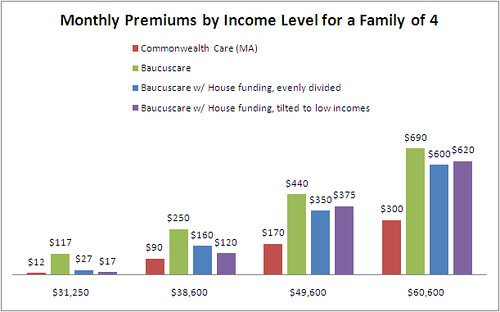
People in Massaschusetts are by and large satisfied with the Connector. It's toughest on the fairly small number of families earning just over 300% of FPL (of which there aren't that many), and on the larger number of young individuals who make just over 300% of FPL (which is $32,320 for an individual, so there are a decent number of those folks). Working class families earning up to 200% of FPL have fairly low premiums. $90 per month is going to pinch, but for uninsured households, they'll get some real value out of that: Commonwealth Care plans include dental insurance, wellness checkups have low co-payments; chronic disease care is especially well covered, and so forth. Likewise, three hundred pre-tax dollars a month for a family with a gross income of $60,000 per year is Real Money, but it's not going to break the bank. It's less than what they should be saving for college, for instance.

But as you can see from the graph, the Baucus bill doesn't fare as well. It's not even close to faring as well. The eight million individuals without insurance who earn between 200% and 300% of FPL will pay more than twice what similar households in Massachusetts currently pay. And working class families will feel a real pinch; $250 per month ($3,000 per year) for a family of four with an income of $38,000 is going to hurt.


• The community rating provision, mandating that insurers offer the same price to everyone regardless of medical history, comes with a tremendous loophole that will allow them to change five times as much for a policy based on age, which is just another way to discriminate against the sick.

• The employer "free rider" problem, called "one of the worst policy ideas I've ever seen" by Ezra Klein, would penalize employers for hiring anyone who qualifies for subsidies, encouraging them to find people who get coverage through a spouse or illegal immigrants. It also gives large employers like Wal-Mart a competitive advantage for paying crappy wages. And you can't opt out of the garbage insurance that giant employer - let's call them Ball Bart - might offer you.

• The excise tax for violating the individual mandate could cost up to $3,800 but wouldn't kick in if the individual could not find coverage that costs more than 10% of his income. In which case, you've built a robust architecture for a useless plan, because if millions opt out the coverage gets less universal and insurers want to stop come-as-you-are guaranteed issue.

• The co-ops are even weaker than imaginable:

The co-ops can only compete in the small group and individual markets. That is to say, if the co-ops prove effective, and The Washington Post would like to offer co-op coverage as an option to its workers, it can't. The co-ops are not allowed to contract with large employers, which is to say, they can't compete with private insurers in the largest market, and they can't get the purchasing power that would come from a serious foothold among corporate customers.

Not only is their size restricted, so too is what they can do with their size. The co-ops can band together to increase their purchasing power, but they can't set national payment rates for their members, a la Medicare. As I understand it, they have to bargain with each provider and drug manufacturer and hospital and so forth separately, meaning they're denied one of the main advantages of size. The insurance industry is, in other words, being protected from not just public competition, but co-op competition.


Jay Rockefeller today sent a letter proving, based on tons of research, that co-ops were a complete sham that have failed in the marketplace on a number of occasions, saying that "I believe it is irresponsible to invest over $6 billion in a concept that has not proven to provide quality, affordable health care, when we know that a public health insurance option will rein in costs and save taxpayers billions of dollars."

Marcy Wheeler has a lot more. There's one promising sign that the exchanges look expandable and available to all businesses, a neat way to gradually wean the system off of exclusive employer-based insurance, but that's about the only silver lining. Kent Conrad's gambit of increasing the budget window to make the Senate Finance bill look better did work, as the deficit reduction aspects look improved for the bill over the House bill. But crucially, that's a function of the funding, not the outlay in subsidies. Those will be too stingy to make the bill work for people, only for the bean-counters. In fact, the bill will start taking more and more from the middle class, much like the alternative minimum tax, and political reality will force scalebacks, so the budget picture doesn't look as rosy as advertised.

But it also suggests some real dangers in the bill's second decade. The unpopular elements of the bill become a lot bigger and more onerous. The excise tax on high-cost insurance plans begins affecting insurance plans that aren't particularly high-cost. The Medicare and Medicaid savings begin to tighten. That said, there are a lot of potential savings that the CBO isn't taking into account here, so that might ease the pain. Plus, at some point, we are going to have to start cutting costs in the system, and you can't escape some eventual hurt in that. But you can be sure the GOP is going to run these numbers aggressively and spin them viciously.


The good news is that this is in no way "the bill" that will get signed by the President. It has to go through a significant amount of changes, and key Democrats are already balking at it. In fact, lil' ol' Roland Burris said he wouldn't vote for anything without a public option, and with the numbers so tight, every Senator is in a bargaining position. Baucuscare is an abomination. But it doesn't have to be the endpoint, only the beginning.

I should say that one group really, really likes the Baucus bill - insurance companies.

Labels: , , , , , , , , , , ,

|

The Unceasing Disaster That Is Max Baucus

This is it. A year of planning. Three months of intensive bipartisan discussions. Weeks of preparation for the public. And Max Baucus is going to deliver his health care bill... without a single Republican vote. Which anyone with a brain could have told you would be the outcome right from the start.

Senate Finance Committee Chairman Max Baucus (D-Mont.) will release his long-awaited health care reform bill Wednesday – but without the Republican support he has sought for months.

Baucus tailored his proposal to win the backing of some Republicans, hoping to keep alive the possibility that Congress would pass a bipartisan bill.

But after months of closed-door talks, none of the three Republicans involved the bipartisan Gang of Six is expected to declare support for the bill Wednesday.

Baucus said he was still hopeful the bill will emerge from the committee vote with bipartisan backing.


Get that? Baucus wrote a Republican bill, essentially, one that is a gift to the insurance industry, and he got nowhere. And for his efforts, he got blasted by Charles Grassley, who disapproves of the "process." See, he wanted another year or two at the bargaining table delaying a final product, anything else is just a power grab. By the way, Baucus is still "hopeful" for a bipartisan vote. Which means what, he'll add in riders criminalizing abortion and commemorating Rush Limbaugh Day?

The GOP freeze-out on the Baucus bill includes Olympia Snowe, who's actually concerned, like many Democrats, about the weak affordability standards.

But let's not lose sight of why Snowe balked at the Baucus framework. For one thing, she's concerned about the financing mechanism, which she believes would hit Maine hard. But just as importantly, Snowe also believes (as I do) that Baucus' plan offers weak and inadequate subsidies. "The affordability question is crucial," Snowe said. "It's a central component, because at the end of the day people have high expectations they will have access to affordable health insurance."

In other words, one of the leading Republican negotiators on health care reform believes Baucus' plan is too conservative.


More Democrats have spoken up about the affordability concerns, which fall on the poor and middle class. At best, the weak subsidies would force loads of Americans to opt out of the mandate, making the bill useless. At worst, people would be forking over large portions of their income to private industry for substandard coverage. It's just another version of the middle-class squeeze.

Mr. Norton, 49 years old, is an adjunct professor at a local community college who earns about $40,000 a year. He's also one of roughly 200,000 Massachusetts residents who remain uninsured despite a state law requiring residents to have health insurance.

"I can't use up all of my savings just to buy mandatory insurance," Mr. Norton says. It's like penalizing "the homeless for refusing to buy a mansion." [...]

An independent contractor, Mr. Norton doesn't get benefits through the state-run Quinsigamond Community College where he works. His wife's employer, a dental practice, covers her, but not dependents. With a combined income of between $60,000 and $70,000, the family goes without cellphones for Mr. Norton and his teenage daughter, and a needed roof repair, but still makes too much to qualify for subsidies.

The cheapest plan available to him and his 16-year-old daughter costs $464 a month, or $5,568 a year, and comes with a $2,000 deductible per person.

"It's insurance you can't possibly use," he says, referring to the thousands of dollars he'd pay in premiums and deductibles before the coverage would kick in.


Baucus has an anodyne op-ed putting the best face on his plan. Those who've taken a look at it know better. And it has to be improved before getting out of the Senate.

...here's the Baucus chairman's mark. It's mostly in plain English.

Labels: , , , , , ,

|

Wednesday, September 09, 2009

Fines For Failing To Pay Insurance Companies

This was a spectacular headline to weather for a full day atop Drudge:

Americans would be fined up to $3,800 for failing to buy health insurance under a plan that circulated in Congress on Tuesday as President Barack Obama met Democratic leaders to search for ways to salvage his health care overhaul [...]

The latest proposal: a bipartisan compromise that Sen. Max Baucus, D-Mont., a moderate who heads the influential Finance Committee, was trying to broker.

Baucus, meeting with a small group of fellow senators, promoted a plan that would guarantee coverage for nearly all Americans at a cost to taxpayers of under $900 billion over 10 years.

Some experts consider that a relative bargain because the country now spends about $2.5 trillion a year on health care. But it would require hefty fees on insurers, drug companies and others in the health care industry to help pay for it.

Just as auto coverage is now mandatory in most states, Baucus would a require that all Americans get health insurance once the system is overhauled. Penalties for failing to get insurance would start at $750 a year for individuals and $1,500 for families. Households making more than three times the federal poverty level - about $66,000 for a family of four - would face the maximum fines. For families, it would be $3,800, and for individuals, $950.


As I've pointed out, the bill is a bargain because Baucus achieves it through allowing insurers to provide less comprehensive health coverage to practically everyone in the country.

This will, and should, be the next line of attack for conservatives - that everybody will have to pay $3,800 to the government if they don't buy health insurance. That's just the maximum fine, but that will become the individual fine for everyone in the country after a trip through the conservative puke funnel. And there's an exemption if you can't find insurance premiums less than 10% of your income. But I prefer to look at the other side of this. This bill forces you to give up to 10% of your income to insurance companies who have, as part of their business, lied their way out of paying for health care for decades. Health insurers can also charge individuals five times as much based on their age, under this plan, a stark difference from the 2:1 community rating in the other Congressional plans. And the coverage doesn't have to be very good, particularly for young adults, who can get "only-if-you're-hit-by-a-bus" coverage. I believe in an individual mandate to increase the risk pool to the maximum level, but the above headline is its threat - that it just looks like a stick-up.

If Baucus wants Olympia Snowe to sign on to this, and the bill appears to be designed that way, he's probably going to have to increase the subsidies to 400% of federal poverty level, or at least 350%. Of course, that would cost more money, and Snowe wants to pay for the bill entirely through internal system costs, which I don't think can fill that gap. Baucus' numbers on revenue don't even seem to add up. Maybe something like David Cutler and Judy Feder's plan could make it in:

Health policy experts David Cutler and Judy Feder, however, have an innovative proposal for making them count. In a paper for the Center for American Progress, they argue for the implementation of "failsafe" policies — crude, surefire interventions — that will kick in if the expected savings don't manifest. Limiting the growth of Medicare payments, for instance. Increasing the excise tax on insurers. Moving the public plan towards Medicare rates.

You can think of a dozen with little trouble. But if you kept them looming behind the curtain — the Oddjob to your Goldfinger — in the event that the expected modernization savings didn't manifest, it would make the anticipated savings visible to CBO, and free up money for affordability. Moreover, it would make those savings more likely to manifest, as insurers wouldn't want more of tax on their heads and hospitals wouldn't want lower rates, and so there would be more of an incentive to implement some of the softer, gentler reforms.


All in all, I understand why policy experts think the pendulum is swinging back toward reform happening. But without a public option, forcing people under penalty of fines (and what if they don't pay the fines? Prison?) to fork out a bunch of money to private insurance companies is just going to be flat-out unpopular. Especially if the help from the government to pay for that insurance is not affordable, which I don't believe it is in the Baucus plan. I guess Snowe's trigger would be tied directly to affordability, but it just seems like a trigger would be written so as to assure its never coming into existence.

Labels: , , , , , , , ,

|

Tuesday, September 08, 2009

The Dope On The Baucus Plan

I alluded to it before, but here's the draft framework for Max Baucus' plan from the Senate Finance Committee. If you don't have the time to read all 16 pages, Ezra Klein has posted a summary.

I'm trying to figure out who, if anyone, gets better health care coverage from this plan. So far I can only come up with one class: people making 100-133% of federal poverty level who can now qualify for Medicaid. For everybody else, the quality of coverage looks to my eye to be worse, though I could be missing something.

Folks in Medicare get 50% off of any prescription drugs that fall in the donut hole, but the grants of patents well beyond current law will cost them more for drugs they could be getting generically in the long run. We don't know the effects of making Medicare more efficient, but they're designed to be invisible, i.e. offering the same care at a lower cost to the government. So I'd call that a wash.

Those in the exchanges will get subsidies, of dubious affordability, up to 300%, and between 300-400% the cost of premiums will be capped. However, the coverage itself can be crappier than current law, and almost certainly will be. The out-of-pocket limits are good, but that only exists for "covered services" - for anything else you're on your own. Those covered services have to include the following:

...preventive and primary care, physician services, outpatient services, emergency services, hospitalization, day surgery and related anesthesia, diagnostic imaging/screenings (including X-rays), maternity and newborn care, pediatric services (including dental and vision), medical/surgical care, prescription drugs, radiation and chemotherapy, and mental health and substance abuse services that meet minimum standards set by federal and state laws.


They also would restrict caps on lifetime benefits. Which is fine. But there will now be a whole insurance industry sector in how to properly define what falls inside and outside primary care, surgical care, hospitalization, etc. And remember, the entire regulatory apparatus for these major insurance reforms, which will be fought in court by multi-billion dollar companies, is a state-level ombudsman's office. And even with those credits, the coverage doesn't appear to be affordable.

If you get insurance through an employer, your health care coverage is about to get a whole lot worse.

Employer Responsibility. Employers would not be required to offer health insurance coverage. However, employers with more than 50 full-time employees (30 hours and above) that do not offer health coverage must pay a fee for each employee who receives the tax credit for health insurance through an exchange. The assessment is based on the amount of the tax credit received by the employee(s), but would be capped at an amount equal to $400 multiplied by the total number of employees at the firm (regardless of how many receive a credit in the exchange). Employees participating in a welfare-to-work program, children in foster care and workers with a disability are exempted from this calculation.

As a general matter, if an employee is offered employer-provided health insurance coverage, the individual is ineligible for the tax credit for health insurance purchased through an exchange. An employee who is offered unaffordable coverage by their employer, however, can be eligible for the tax credit. Unaffordable is defined as 13% of the employee’s income. The employee would seek an affordability waiver from the exchange and would have to demonstrate family income and the premium of the lowest cost employer option offered to them. Employees would then present the waiver to the employer. The employer assessment would apply for any employee(s) receiving an affordability waiver. Within five years of implementation, the Secretary must conduct a study to determine if the definition of affordable could be lowered without significantly increasing costs or decreasing employer coverage.

A Medicaid-eligible individual can always choose to leave the employer’s coverage and enroll in Medicaid. In this circumstance, the employer is not required to pay a fee.

Coverage offered by an employer of any size, including fully insured and self insured plans, is not required to comply with the list of benefits required of plans in the non-group and small group markets. Employers must provide first dollar coverage for prevention services (except where value-based insurance design is used), however, and cannot have a maximum out-of-pocket limit greater than that provided by the standards established for Health Savings Accounts (HSAs).


So small businesses can opt out of giving their employees health insurance and pay a fraction of the cost, about $20,000 for 50 employees. That will become the chic thing to do. If the employees aren't paid more than the requirement for Medicaid, employers can scrap coverage and let their employees take Medicaid and pay no fee. They are incented not to give their employees a living wage, in other words. And if they make coverage available for those above 133% FPL, they are bound by no standards like that coverage on the exchange, and their employees couldn't reject that coverage for something half-decent. Assuming regression to the mean, virtually every employer will immediately move to offering the shittiest coverage imaginable. They could only get to the exchange if the employer coverage is unaffordable, or 13% of their total income. So an employer, "AlmartWay" in Marcy Wheeler's construction, could conceivably take 12.9% of an employer's income for offering a plan that probably wouldn't cost that much.

Hell, if I were a rapacious manager like AlmartWay's completely hypothetical managers were, I'd turn employee health care into a profit center because (if I read this right) you could require employees to pay back 12.9% of their income for health care, and the only thing you'd really have to promise in return is preventative care. So I predict, if this bill passes in anywhere near this form, that AlmartWay will start making its own employee health care a big profit center because they will be stuck.

By golly. This is even a health care plan Blanche Lincoln and Mark Pryor and their biggest constituent could love!! Though frankly, Bad Max's plan is even worse than Wal-Mart itself--with a call for part time mandates and no disability discrimination--called for (though maybe Wal-Mart was thinking of the free subsidy for its Medicaid eligible employees all along).


And... there is no employer mandate, but the "free rider" aspect of the coverage will, in all likelihood, incentivize employers not to hire anyone who doesn't have family money.

Under the proposal, employers who do not offer health coverage would have to pay the full cost of the subsidies provided to employees who purchase coverage through the new health insurance exchange and qualify for a subsidy because their family income is below 300 percent of the poverty line. [1] But employers would not have to contribute to the health insurance costs of employees with higher family incomes. The new requirement would apply to firms with 50 or fewer employees.

The proposal would make it considerably more expensive for employers to hire workers from lower-income families than workers from higher-income backgrounds to do the same job. As a result, it would distort hiring decisions. Employers would have strong incentives to tilt hiring toward people who have a spouse with a good income (or have health coverage through a family member), teenagers whose parents make a decent living, and people without children (since the eligibility limit for the subsidies in the new health insurance exchanges will increase with family size). Low-income women with children in one-earner families would be particularly disadvantaged [...]

While language could be included to try to ban such discriminatory effects, it would be virtually impossible to enforce effectively. It would be extremely difficult to prove in court that an employer has passed over one applicant and hired another because of the health surcharge that employers would face if they hired people receiving health insurance subsidies.

Moreover, most low-income job applicants who do not get hired could not afford to hire attorneys to initiate legal proceedings. For the tiny number that might be able to institute proceedings, the legal complaint likely would take months and, more likely, years to adjudicate. In short, the fact that low-income workers would cost an employer up to several thousand dollars more to perform the same job could not easily be overcome.

This differential treatment of workers based on their family income also would likely influence employer decisions about which of their employees to let go when they trim their workforces to cut costs, such as during a recession. Workers from low-income families would cost the firm significantly more to retain than other workers who are paid the same wage to do the same job.

Although this clearly is not intended, the proposal likely would have discriminatory racial effects on hiring and firing. As noted, it would discourage the hiring of lower-income people. And since minorities are more likely to have low family incomes than non-minorities, a larger share of prospective minority workers would likely be harmed.


This is essentially legalized class-based discrimination.

So, worse coverage for employers, arguably worse coverage for individuals and small businesses, same for Medicare patients, probably better for a sliver of Medicaid patients. And it criminalizes people for not giving 13% or so of their paycheck to private health insurers. The affordability credits are nice, but don't look sufficient. Here's a contrary view.

The legislation really would protect millions of Americans from medical bankruptcy. It really would insure tens of millions of people. It really will curb the worst practices of the private insurance industry. It really will expand Medicaid and transform it from a mish-mash of state regulation into a dependable benefit. It really will lay down out-of-pocket caps which are a lot better than anything people have today. It really will help primary care providers, and it really will make hospitals more transparent, and it really will be a step towards paying for quality rather than volume.

To put it more starkly, it really will be the most important progressive policy passed since Lyndon Johnson. The subsidies should probably sit at 400 percent of poverty, and the employer mandate should be reworked, but such failures are relatively easy to fix, and may well be patched over by the time the legislation arrives on the Senate floor. The fact that a bill of this size and scope can still be considered disappointing is evidence that the doors of the possible have been thrown wide open.


This ignores the reality that most insurers, like now, won't abide by the rules because there's no policeman to enforce them (an ombudsman? Really?). As well as the reality that the subsidies don't make health care affordable. And it will be hard to expand on this reform, considering that there's no public option, a weak insurance exchange and useless co-ops. In fact, considering that it cements in the broken system we already have and just fills in the cracks, it looks basically like it was written by the industry itself. That's because it was.

Labels: , , , , , , , , , ,

|

Thursday, September 03, 2009

The "Insurance Companies Support Health Care Reform" Gambit


Angela Braly, the CEO of Wellpoint, called for health care reform at a meeting in Indianapolis.

One of them most powerful women in the nation is calling for health care reform. Wellpoint CEO Angela Braly says she supports guaranteed coverage for everyone - as long as everyone gets and stays covered [...]

"The high and rising cost of health care in America is just not sustainable," Braly said. She said the current system, including Medicare, which is administered by the federal government, was inefficient and promotes quantity over quality. She also said it posed "a real threat to the social and fiscal obligations of the government and to the health and prosperity of the American people."

"We believe insurance companies have a role to play. We can and are making a difference," Braly said. She said Wellpoint's strategy was moving beyond processing claims and managing risk, noting employee incentives when customers get healthy.

Braly says the what worries her most about the plan currently under consideration is the "public option."


This is, essentially, the insurance company-approved argument for health care reform. They see it as forcing everyone to buy their coverage, making refusal to buy their insurance a crime, and offering no competition to their monopoly over it. I'm sure they don't want to see that anti-trust exemption of theirs lifted either, the one that has led to 94% of the individual insurance market becoming "highly concentrated" in the hands of one or two companies.

Braly kept talking about how the current system is inefficient and leads to skyrocketing costs, as if she has no agency over that whatsoever. There are issues with how the fee-for-service system promotes quantity of medical care and not quantity, but that's due to the profit incentive, which is exactly the same in the insurance market. Braly's argument seems to be that it's doctors and hospitals at fault for chasing profit in health care, but insurance industry CEOs like her are good samaritans and innocent bystanders who just so happen to do the same thing. If a profit-driven health care system is wrong, then it's pretty much wrong across the board. And she actually advocated for an outcome where insurers would be "free to offer a range of choices," while worrying about a public option... which would just be another choice, one that could deliver quality coverage at a lower cost.

Braly tried to argue that health insurance profits aren't all that big:

According to Braly, the difference between the Medicaid or Medicare payouts and actual costs are shifted to the private plans, costing you $1,500 a year. Add that to the $1,000 a year shifted to the private plans to cover the uninsured and it costs you a total $2,500 a year.

"Sounds a lot like the Fannie Mae for health care and I think we all know how that experiment is going," Braly said [...]

"If you completely eliminated insurance company industry profits which is clearly the aim of some, you would pay for two days of health care in America and in the process you would eliminate the market mechanism to control costs and improve quality of health care being delivered," Braly argued.


I don't know what any of this means. The market mechanism in health care has not controlled costs in America whatsoever, yet throughout the industrialized world we see public programs that control costs and provide better health outcomes. Private industry has begged off completely from limiting health care costs through any means other than denying coverage to their customers and rationing. Health care spending in Medicare and Medicaid is lower than spending through the insurance market. And insurers have used the employer market effectively to confuse employers and employees alike about the true cost of their service. Braly throws out "Fannie Mae" for health care, but the current system is clearly "Goldman Sachs" for health care - where the relentless drive for profit at the expense of people creates a spending bubble that nobody ever bothers to burst until it's too late.

In the end, Braly calls Wellpoint a "supporter" of health care reform. That's funny, I would think that a company committed to health care reform wouldn't illegally force their employees to lobby against it.

Consumer Watchdog in Santa Monica has asked California Atty. Gen. Jerry Brown to investigate its claim that UnitedHealth Group and WellPoint Inc. pushed workers to write their elected officials, attend town hall meetings and enlist family and friends to ensure an overhaul that matches their interests [...]

WellPoint, whose Anthem Blue Cross unit is the largest for-profit insurer in California and employs 8,000, took a more overtly negative tack.

"Regrettably, the congressional legislation, as currently passed by four of the five key committees in Congress, does not meet our definition of responsible and sustainable reform," Anthem said in a company e-mail last week. The proposals would hurt the company by "causing tens of millions of Americans to lose their private coverage and end up in a government-run plan."

The appeals amount to illegal coercion under California law, Consumer Watchdog research director Judy Dugan said. "While coercive communications with employees may be legal, if abhorrent, in most states, California's labor code appears to directly prohibit them," said Dugan, citing sections forbidding employers from "tending to control or direct" or "coercing or influencing" employees' political activities or affiliations.


Insurance companies like WellPoint support health care reform, all right - completely on their terms, and guaranteed to provide them a financial windfall. Anything else would be unacceptable, and they will take any tactic - no matter legal or illegal - to stop it.

Labels: , , , ,

|

Thursday, August 20, 2009

Lower Your Sights

Paul Starr tells us all to give up on the public option. Paul may be very smart and right on the merits, but he fails to understand the political contours of the debate.

Because the public option has stood no realistic chance of being enacted in the form it was conceived, its main value all along this year has been as a bargaining chip. The proposal will now have served a valuable political purpose if, by sacrificing it, the White House is able to provide enough cover to Democratic senators from red states to get a bill out of the Senate Finance Committee, through the upper chamber, and into conference with the House.

The Republicans have focused their opposition on the bugaboo of "government-run health care." By jettisoning the public plan, swing Democratic senators can tell their constituents that they prevented a government takeover. This argument will not sway die-hard right-wing voters, but it may suffice for many others and thereby help give those senators confidence they can vote for the bill.

Some liberal members of Congress are still insisting the public option must be part of health reform. They should continue to say so -- their protests may make the ultimate concession all the more valuable. But if any of them actually do vote against the final bill and prevent it from passing because it fails to offer a public option, they will help to ruin the best chance in years to put health care on a path toward reform. And they will do severe damage to the presidency of Barack Obama.


Um, it hasn't swung one Republican, who keep talking about "Trojan horses." This is why the leadership has now resorted to talking about splitting the bill.

Furthermore, this idea that liberals are pawns in Paul Starr's Great Game just will not sit will with the only people out there fighting for this bill. As we saw in polling yesterday, support for reform collapses without a public option. That's the reality of the situation, folks, and to try and decouple the public option now will just remove all the energy from the fight, all the support, leaving the White House in the unenviable position of trying to pass something without any public engagement on their side. The legislation is shaky enough as it is, before cutting all the public support off at the knees. That would be suicide for the bill.

Max Baucus has been saying that the public option is a bargaining chip to get insurers to embrace other reforms since March. There's no question that he and the White House saw it that way. But we're now in August, and support is collapsing, and the only thing holding this bill together are progressives, who don't really want to be humiliated anymore. Especially when we know that offering an individual mandate without a viable public insurance option would be political suicide.

Keeping in mind that this anonymously sourced report could be total bunk, it's worth pointing out that axeing the public option and requiring individuals to purchase coverage under a private health insurance plan would be a horrible political miscalculation. If you think we're having problems selling health care reform now, just wait until we try to explain why all adults under 65 will be required to purchase health insurance from the private sector with no public option.

Oh, you're not interested in making that argument? I didn't think so.

When coupled with a public option (or the sort of rigorous regulatory regime which isn't under consideration), a mandate achieves universal coverage and cures the free-rider problem. But without the public option, the private sector will have a monopoly on a product the public is required to buy, and over the long-run you'll almost certainly see premiums skyrocket and quality of care plummet.


Progressives don't support a public option because they're four year-olds and they reflexively support anything conservatives oppose. They support it because they want to see an end to the private insurance monopoly that's put the squeeze on them for decades. And no, the bill as designed currently wouldn't do that to the degree it must to reverse incentives, because it firewalls out those who get coverage from their employers; but these kinds of things have the tendency to evolve over time, and it's crucial that it's put into place now. Without doing so, Democrats are once again putting themselves at risk with losing a generation.

But on a political level, the left has been betrayed over and over again on the things that matter to us the most. The village is pleased, I'm sure. But the Democratic party only needs to look back eight short years to see just how destructive it is to constantly tell their left flank to go fuck themselves.

In 2000, I recall standing in line to see Al Gore speak here in LA and I was inundated by a bunch of young, impressionable lefties, inspired by the globalisation movement and Ralph Nader's message. We sparred for some time, me telling them how third parties don't work, and them having none of it. They had no political experience except what they saw as a betrayal of liberalism and they found Nader's analysis of the two parties as being in bed with corporate interests extremely convincing. And it was very hard to argue that point, although I did try valiently, knowing as I did that while both parties were corporate whores, the Republican Party, being insane, wanted to actually kill large numbers of people in foreign countries, put the church in everyone's bedroom and give everybody's money directly to the wealthiest people in the nation. But I didn't convince any of them. And we know the result.

At the time nobody believed that an incumbent Vice President in a roaring economy would have a race so close that the Republicans could steal it. But we know differently now don't we? And you would think that the Democratic establishment would also know that because of that, it may not be a good idea to alienate the left to the point where they become apathetic or even well... you know. It can happen. It did happen. Why the Democrats persist in believing that it can't happen again is beyond me. Perhaps they internalized all the villager CW about Al Gore being a bad candidate, but the fact remains that if a slice of the left hadn't been so disgusted by the New Democratic, mushy centrism of the Clinton years, he would have won.

Obama mobilized a whole lot of young people who have great expectations and disappointing them could lead to all sorts of unpleasant results. Success is about more than simply buying off some congressional liberals or pleasing the village. It's worth remembering that a third party run from the left is what created the conditions for eight long years of Republican governance that pretty much wrecked this country.


And that's where we're at right now. Obama can pretend Chuck Grassley is acting in good faith and renounce the public option in the name of bipartisanship (that's a really brilliant move by Grassley, by the way, he's playing in the big leagues), or he can support the people who elected him and believed in his message of change. I think those 60-odd million are more important than Sen. Grassley's feelings, but what do I know, I don't live in Washington.

I do know this: alienating your key supporters right when they're needed the most is a recipe for disaster.

Labels: , , , , , , , , ,

|

Tuesday, July 14, 2009

Tri-Committee Bill Released

I should mention that the Tri-Committee health care reform bill from the House has been released, and rather than bend to the dictates of marginalized Blue Dogs who value their relationships with the health care industry over their constituents, they created a pretty darn good bill. It's not perfect, of course, but it represents a far better bill on the left flank than, say, the Waxman-Markey bill did.

I'll post the brief on what the reform bill does for consumers:

LOWER COSTS
• No more co-pays or deductibles for preventive care
• No more rate increases for pre-existing conditions, gender, or occupation
• An annual cap on your out-of-pocket expenses
• Group rates of a national pool if you buy your own plan
• Guaranteed, affordable oral, hearing, and vision care for your kids

GREATER CHOICE
• Keep your doctor, and your current plan, if you like them
• More choice, with a high quality public health insurance option competing with private insurers

HIGHER QUALITY
• You and your doctors make health care decisions — not insurance companies
• More family doctors and nurses will enter the workforce, helping guarantee access
• Mental health care must be covered

STABILITY & PEACE OF MIND
• No more coverage denials for pre-existing conditions
• No more lifetime limits on how much insurance companies will pay
• No reason to ever make a job or life decision again based on health care coverage


The "national pool" refers to the insurance exchange, which is a hard concept to put into bullet points, but this is a pretty good list of how the average Americans would benefit from this plan.

As to the specifics, here's Ezra Klein, Scarecrow, Mcjoan and Jon Cohn. You'll notice a consensus. 97% of the population would get covered in 10 years. The subsidies are 400% of poverty and Medicaid gets expanded to 133% of poverty - both more generous subsidies than the Senate bills. Insurers are regulated against denying coverage for pre-existing condition or rescission, and the benefits floor is pretty decent. There are caps on out-of-pocket expenses, and efforts at controlling costs. It includes an individual mandate and an employer mandate that gets exempted for certain-sized small businesses. About the worst thing you can say about the bill is that some of the good stuff doesn't happen fast enough (to keep the size of the cost down):

I do have one, not minor concern: It will be a while before people see the best stuff. Most of the major elements--the insurance exchange, the subsidies, the insurance regulations, the public plan--won't come online until 2013 or later. This is, I believe, also true of counterpart bills in the Senate.

There's a sound policy rationale for going slow; it takes a lot of work to set up exchanges, regulations, and the like. But four years is a long time. And I suspect money has a lot to do with the pace. Slower implementation makes it possible to keep the price tag to around $1 trillion.

On the bright side, some provisions--filling in the Medicare drug donut hole, bolsteirng the primary care workforce, among others--would start in the next two years.


The cost of the bill, scored by the CBO at around $1 trillion dollars over 10 years, gets paid with $500 billion in internal cost savings and around $500 billion in new revenues, mostly with a surtax on the wealthy. I prefer other methods, but let's get real about this:


The details haven't been released yet, but most (if not all) of the families that fall under Rangel's tax plan will also be in this 1% range.

These are families that paid a lower rate in 2006 (the last date of available data) than they did 15 years ago. That's not an argument for upping the taxes, of course. But it puts it in perspective. (Confession: If you go back to the Reagan years, the top effective rate is lower. But the current rate is still below the historical average.)

News reports have anticipated Rangel proposing a 1-3% surtax. Even a 3% increase across the board will leave an effective rate lower than it was in 1995.


The President approves of the general approach of the House bill, and the Education and Labor Committee will start markup this week. The bill text is here and a summary is here.

We're off and running.

...more on the surtax from Tim Foley.

Labels: , , , , , , , ,

|

Wednesday, June 03, 2009

The Way Health Care Can Die

The news that the White House will push for a public insurance option for health care is welcome, and I believe a direct result of the line in the sand from the Progressive Caucus, conditioning their vote on a robust public plan. That completely changed the debate and allowed activists to engage. All well and good.

But there was quite a bit more in that Obama letter to Senate Democratic leaders on his vision for health care. Here's the key bit, for me.

At this historic juncture, we share the goal of quality, affordable health care for all Americans. But I want to stress that reform cannot mean focusing on expanded coverage alone. Indeed, without a serious, sustained effort to reduce the growth rate of health care costs, affordable health care coverage will remain out of reach. So we must attack the root causes of the inflation in health care. That means promoting the best practices, not simply the most expensive. We should ask why places like the Mayo Clinic in Minnesota, the Cleveland Clinic in Ohio, and other institutions can offer the highest quality care at costs well below the national norm. We need to learn from their successes and replicate those best practices across our country. That's how we can achieve reform that preserves and strengthens what's best about our health care system, while fixing what is broken [...]

I understand the Committees are moving towards a principle of shared responsibility -- making every American responsible for having health insurance coverage, and asking that employers share in the cost. I share the goal of ending lapses and gaps in coverage that make us less healthy and drive up everyone's costs, and I am open to your ideas on shared responsibility. But I believe if we are going to make people responsible for owning health insurance, we must make health care affordable. If we do end up with a system where people are responsible for their own insurance, we need to provide a hardship waiver to exempt Americans who cannot afford it. In addition, while I believe that employers have a responsibility to support health insurance for their employees, small businesses face a number of special challenges in affording health benefits and should be exempted.

Health care reform must not add to our deficits over the next 10 years -- it must be at least deficit neutral and put America on a path to reducing its deficit over time. To fulfill this promise, I have set aside $635 billion in a health reserve fund as a down payment on reform. This reserve fund includes a number of proposals to cut spending by $309 billion over 10 years --reducing overpayments to Medicare Advantage private insurers; strengthening Medicare and Medicaid payment accuracy by cutting waste, fraud and abuse; improving care for Medicare patients after hospitalizations; and encouraging physicians to form "accountable care organizations" to improve the quality of care for Medicare patients. The reserve fund also includes a proposal to limit the tax rate at which high-income taxpayers can take itemized deductions to 28 percent, which, together with other steps to close loopholes, would raise $326 billion over 10 years.

I am committed to working with the Congress to fully offset the cost of health care reform by reducing Medicare and Medicaid spending by another $200 to $300 billion over the next 10 years, and by enacting appropriate proposals to generate additional revenues. These savings will come not only by adopting new technologies and addressing the vastly different costs of care, but from going after the key drivers of skyrocketing health care costs, including unmanaged chronic diseases, duplicated tests, and unnecessary hospital readmissions.

To identify and achieve additional savings, I am also open to your ideas about giving special consideration to the recommendations of the Medicare Payment Advisory Commission (MedPAC), a commission created by a Republican Congress. Under this approach, MedPAC's recommendations on cost reductions would be adopted unless opposed by a joint resolution of the Congress. This is similar to a process that has been used effectively by a commission charged with closing military bases, and could be a valuable tool to help achieve health care reform in a fiscally responsible way.


Let's take a look at all of this. First of all, on the individual mandate, I'm glad he said that makes no sense if individuals cannot afford the coverage, and that he'd provide a hardship exemption. Hopefully this will spur Congress to devise the most affordable plans possible.

Obama and his team have foregrounded the importance of cost control, arguing that the long-term health care budget projections are unsustainable without reform, and that we must bend the cost curve while providing greater access (the whole "entitlement reform is health reform" thing). I'm all for efficiency and putting our dollars to the best use and comparing medical effectiveness so that we don't pay more money for a less effective treatment and all of that. But Obama also seeks fiscal austerity in this package in the short-term in addition to reining in costs over the long-term. He wants the package to be deficit neutral, in other words paid for, over the next ten years. That means the money has to come from somewhere. It didn't for two wars, TARP, and a whole host of other things, but for health care, you have to pay up front.

The $635 billion he's talking about includes the capping of charitable deductions that was DOA as soon as it reached Congress. And $635 billion is not all of what's needed. Senate leaders have talked about limiting the employer deduction on health benefits, and while Peter Orszag took it off the table, Obama seemed to be open to it, even though he campaigned hard against John McCain when he proposed eliminating the employer deduction. Obviously, there's a difference between McCain's plan, eliminating the deduction while offering a meager tax credit to individuals to fend for themselves, and this plan, limiting the deduction to raise money for providing subsidies and building a public option, etc. So there is a difference. But it may not be enough to convince Congress, and you can see the "he's taxing your health benefits" commercials now.

Let's replay that other piece of the letter:

I am committed to working with the Congress to fully offset the cost of health care reform by reducing Medicare and Medicaid spending by another $200 to $300 billion over the next 10 years, and by enacting appropriate proposals to generate additional revenues. These savings will come not only by adopting new technologies and addressing the vastly different costs of care, but from going after the key drivers of skyrocketing health care costs, including unmanaged chronic diseases, duplicated tests, and unnecessary hospital readmissions.

To identify and achieve additional savings, I am also open to your ideas about giving special consideration to the recommendations of the Medicare Payment Advisory Commission (MedPAC), a commission created by a Republican Congress. Under this approach, MedPAC's recommendations on cost reductions would be adopted unless opposed by a joint resolution of the Congress. This is similar to a process that has been used effectively by a commission charged with closing military bases, and could be a valuable tool to help achieve health care reform in a fiscally responsible way.


You can pretty reasonably read that and come up with the idea that Obama wants to pay for health care by cutting back on the enormously popular Medicare program. The truth is a little murkier, but only a little.

For example, Medicare Advantage truly sucks - the government overpays private insurers for the same treatment received inside Medicare. But what's all this about "reducing Medicare spending"? And what's MedPAC? Ezra Klein explains.

You probably haven't heard of MedPAC. Most people haven't. It stands for The Medicare Payment Advisory Commission and it's an independent congressional agency formed in 1997 to advise the Congress on matters relating to Medicare. The commission is staffed by experts who are appointed for three-year terms, and its existence is due to a simple insight: Medicare payment policy is too technical for the Congress. There aren't five senators with an informed opinion on the "equipment use standard" for imaging machines, much less 50, and much less 100.

Every year, MedPAC releases a "report to the Congress on Medicare payment policy." The report contains acres of analysis (this year's "assessing payment adequacy and updating payments in fee-for-service Medicare" was particularly thrilling) and a final chapter on recommendations. The recommendations tend to be smart, aggressive, reforms. The sort of reforms experts agree are needed, but interest groups effortlessly stymie. The recommendations don't, in other words, matter. None of it does, really. The report sits on a shelf.

But what if it didn't? What if MedPAC had power? [...]

The theory is that it would act as a Federal Reserve for Medicare. "Congress has proven itself to be inefficient and inconsistent in making decisions about provider reimbursement under Medicare," said Rockefeller. "Congress should leave the reimbursement rules to the independent health care experts.”

That's the plan Obama spoke of favorably in yesterday's meeting. But what hasn't been reported is that senior administration officials are also considering another variant: This plan would package MedPAC's yearly recommendation and fast track them through Congress for a simple, up-or-down vote. No filibuster. No changes to the package of recommendations. Health reform, under this scenario, would become a yearly legislative project.


The idea is that reforms to Medicare would spread across the industry and cut costs. The idea is that the people who understand health care can provide some order on the current chaos, and with added power can force changes in the system that will reverberate and cannot be subject to interest-group vetoes. Health care policy experts like it, lobbyists and conservatives don't. They will call it the dreaded rationing. They will say that Congress is coming to take your Medicare away.

But what has MedPAC hisotrically proposed? I've got past recommendations here and here. They're written in bureaucrat-ese, but they include raises in reimbursement rates along with reductions, and the vague "updates" in payment rates for certain services. Seeing that these are experts, and that trusted sources are calling their recommendations smart and sound, I'm willing to believe that for now.

Still, the politics of this stink on ice. Given the reality that health care must be paid for in the short term, I see lots of reasons for lawmakers of both parties to have problems with just about every kind of revenue-raiser imaginable. They'd knock down sin taxes. They'd knock down caps on charitable deductions. They'd knock down limiting the employer deduction. In the end, the pool of money needed becomes unattainable. And then we have this proposal to allow unspecified reductions to Medicare and Medicaid spending, with a board of experts empowered to do so, and I'm wondering if anyone passed that by anyone with political insight. Because it will get trounced in the court of public opinion.

In many respects, I'm more hopeful about the prospects for health care reform than ever. In other respects, I'm completely in despair. As we get further in this debate, we will find that nobody in Congress wants to pull the trigger on paying for this, and the Medicare cuts are so ripe for demagoguery that Harry and Louise will look like a Care Bears commercial by comparison. And I feel that progressives aren't even paying attention to the most important contours of this debate.

Labels: , , , , , , , , ,

|

Wednesday, May 20, 2009

This Year, We Have Activists

The biggest difference between 1993 and 2009 when it comes to health care is the coordinated message machine - on the left this time - pushing for reform. Under Clinton, the White House horded the policy and nobody could go out and sell it, or at least rebut the attacks from industry. This time, the Health Care for America Now structure allows activists a place both to attack back at industry and keep them occupied, while arguing for a consistent set of principles that must be part of any reform. Today, HCAN did something great, calling on the Justice Department to look at monopolies in the insurance market.

Activists backing President Barack Obama's health care overhaul are asking the Justice Department to open a wide-ranging investigation of what they say is monopoly-like power in the hands of major insurers [...]

"A lack of antitrust enforcement has enabled insurers to acquire dominant positions in almost every metropolitan market," said the letter to the Justice Department, signed by Richard Kirsch, the group's director. "The failure to attack anticompetitive practices has enhanced the dominant positions of these insurers. This must be reversed." [...]

In a report earlier this year, the American Medical Association found that insurance markets in most major metropolitan areas were dominated by two companies, and in many cases only one. In all, 94 percent of the metropolitan areas met the government's definition of "highly concentrated" markets for health insurance.

Separately, a recent report by the congressional Government Accountability Office found that in most states, a single insurer dominates the market for small business health insurance, even though many companies offer coverage. The GAO found that the median, or midpoint, statewide market share of the largest insurer was about 47 percent, although the median number of licensed carriers was 27.


This is all the more important, considering that the health insurance industry's "compromise" solution for reform is to EXPAND THEIR MONOPOLY by mandating that everyone in America buy health insurance from them, without the opportunity for a public plan alternative. With nobody to compete with and essentially a forced market, insurers would have every incentive to consolidate further, the very action which has driven up health care premium costs over the years, as an HCAN report later today will show. While insurers aren't the only cause of rising health care costs - pharmaceuticals, medical device operators, hospitals, there's plenty of blame to go around - this model of activism can be scaled to pressure both the industry and the political class.

Health care reform will rise or fall this year based on the success of these activist efforts, toward both the special interests and the politicians. Frank Luntz (who won't say who paid him for the health care memo) isn't the only game in town anymore.

Labels: , , , , , ,

|

Tuesday, May 12, 2009

Health Care State Of Play

One problem with yesterday's "game changer" of an announcement on industry-wide health care cost reduction is that it will not improve prospects to pay for health care from the government's perspective. As long as the Congressional Budget Office cannot "score" the savings into their assessment of paying for the health care plan, you still need to find the same dollars. Igor Volsky thinks that the prospect of savings makes the prospect of health care more plausible, because it provides a counter-weight to the CBO gospel, but if you still have to find the dollars, I don't see how that matters. Ezra Klein offers the idea of "directed scoring," where the CBO is essentially forced to account for industry-wide cost savings, but it's not entirely likely.

Regardless, the Senate Finance Committee is moving forward with a game plan for how to get a bill to the floor.

In a document laying out health-care options, Senate Finance Committee Chairman Max Baucus, a Democrat, and Senator Charles Grassley, the panel’s top Republican, yesterday endorsed the idea of requiring everyone to have coverage. Insurers have sought such a requirement in exchange for agreeing to accept President Barack Obama’s demand that they enroll all applicants, regardless of medical condition.

The committee will discuss the options on May 14 with the goal of getting the measure to the Senate floor in July. Obama has said he wants Congress to create a plan that would reduce medical costs and extend coverage to the 46 million uninsured people in the U.S. They were 15 percent of the U.S. population in 2007, according to U.S. Census data released in August.


So we're seeing the AHIP-friendly individual mandate in exchange for guaranteed issue and modified community rating. People will be able to keep the health care they have if they choose. The government would provide subsidies to allow lower-income Americans to afford health insurance, and employers of large companies may have a mandate to cover their employees. And then there's the real sticking point, the public option:

Obama’s administration says competition from a government- backed health plan will improve quality and lower costs.

Last week, Health and Human Services Secretary Kathleen Sebelius told the House Ways and Means Committee that Obama has no wish to “undermine” private health-insurance companies by supporting a government-backed alternative. She also said Obama would be willing to consider a requirement that everyone have health coverage, a proposal he criticized during his presidential campaign.

The so-called public option to purchase government-provided health care is a central issue. House Speaker Nancy Pelosi has said the chamber will include such an approach in legislation it considers later this year. Republicans and some insurers, including Aetna Inc., have opposed the creation of a new program modeled on Medicare.

‘Medicare-Like’

Baucus and Grassley said one way to fashion a government plan would be to make it “Medicare-like” and have it administered by the Department of Health and Human Services. Alternatively, it could be run by the states or by private- sector, third-party administrators, they said.


Groups like Health Care For America Now are pushing hard from the outside to force inclusion of a public option, and they appear to be having an impact. Kirsten Gillibrand offered her support yesterday, and none other than Arlen Specter has signaled openness to a public plan. As Jon Cohn notes, "the nice thing about nakedly opportunistic politicians is that their ever-shifting positions are a leading indicator of changing political currents."

The President failed to mention the public plan in his statement yesterday, focusing on the matter at hand, the industry wide cost reduction. My personal view is that you need a public option, guaranteed issue, real community rating (where consumers pay the same baseline rate regardless of their medical condition), medical device reform, comparative effectiveness research, and stiffer penalties for non-compliance at a MINIMUM if you're going to go to this individual mandate/shared responsibility model. And all of these must be legitimate, particularly the public plan, which cannot just be a non-profit insurance option without monopsony bargaining power.

But we're moving toward a solution, and even if it passes, it will only be a step to an eventual single-payer system. That's my view on it.

Labels: , , , , , , , , ,

|

Thursday, May 07, 2009

Public Enemy

The health care debate thus far has really focused on creating a public option to compete with private insurance companies. The various players are choosing up sides. The Obama Administration, expressed by their Health and Human Services Secretary, supports it, as a means to encourage competition and innovation. The White House is joined by 70-odd members of the House who have said no public plan, no deal, and 21 members of the Senate (so far), including moderates like Claire McCaskill and Jim Webb. On the opposite side are, well, Republicans, and their paymasters in the health insurance industry, simply because they want to preserve their monopoly over the market and their advantages that don't impact the bottom line for consumers, but instead get shoveled into profit margins and executive pay. The health insurance lobby's view is that they will adopt modestly more fair practices (guaranteed issue, modified community rating) as long as the government forces individuals to buy health care and subsidizes them, an indirect payment from the Treasury to the insurers themselves. Not surprisingly, these views mirror those of "moderates" like Ben Nelson, who coincidentally has taken millions from the insurance industry in campaign contributions, and previously owned a major insurance company.

(By the way, memo to the media: what the insurance industry is offering does not add up to a concession. These are the same "concessions" made by the industry in 1993, and yet they bashed the final plan and stopped its passage. These measures would reform insurance but not reform health care, which can only come through increased competition and a resetting of the perverse incentives that insurers have to limit treatment. Only real reform would lower costs and provide better care, and forcing a monopoly doesn't exactly get all the way there.)

Chuck Schumer has tried to design such a plan, and does a good job of defending it and naming it ("Plan USA"), but under the guise of a "level playing field," it's hard for me to understand how his plan would be anything more than a non-profit insurance option doing little to truly lower costs unless it were scaled up massively. Sure, this kind of public plan would limit overhead and advertising costs, and wouldn't pay executives. But if it can't bargain for lower rates in the way Medicare can, in fact over time you'd probably see what happened in Medicare Advantage (the private insurance supplement to Medicare), where the playing field got tilted to the private market until the government stepped in this year to put a stop to it.

We all know that the only way to truly bargain down costs is through a single payer option. I'm willing to support a public option grafted onto the current system, for now, as long as it retains any ability to bargain for lower costs in the way that single payer would. However, we're getting a bit afield of the nut of the issue if we continue to discuss the mechanism of the public plan. Because a far bigger obstacle to meaningful health care reform is how the hell to pay for it. Literally every funding stream that has been discussed gets quickly shut within a matter of days. Today, Charlie Rangel ended the option of capping or taxing employer-provided health benefits. Earlier they cut out Obama's plan to cap charitable deductions. We're talking about well over a trillion dollars, with big outlays in the short term to get the system to bend costs downward, and if nobody wants to determine a way to pay for it, health care reform dies.

Labels: , , , , , , , , ,

|

Friday, March 27, 2009

The Week In Health Care

This has been a very interesting week in the fight for health care reform. Let's take a look at some of the major developments.

Single-payer: Sen. Bernie Sanders introduced S.703, a single-payer health care bill (called the American Health Security Act of 2009), in the Senate. While this would be a companion bill to HR676 on the House side, it's the first time I can remember, and apparently the first time since the death of Paul Wellstone, that anyone in the Senate has carried a single-payer bill. Sanders in the release calls the bill "the most fiscally conservative option for reform" because private insurance overhead would be eliminated, saving over $400 billion dollars annually. Now that such a bill has been introduced in both Houses, there should be a demand from single-payer advocates to get the CBO to score the bill. Without numbers that Washington trusts, and sadly the CBO is the only number-crunching body with that authority, single payer will not be taken seriously. But a true accounting of the cost savings could spur reform. You can find the bill here.

The Public Option: Howard Dean has jumped squarely into the health care debate from his perch at DFA, advocating strongly for a public insurance option to compete with the private market. Dean has gone so far as to say that without a public option, health care reform essentially doesn't exist.


Obviously, the insurance industry wants no part of a public option, that would force them to compete on price and quality of coverage, instead of the current system of competing to deny care to their customers to maximize profits. They say such a system would put them out of business. To which I say, YAY! What's important to understand is that there are public options and there are public options. Ezra Klein explains the structure of the three most common proposals:

• Single-Payer Lite. This was the rationale you heard during the primary campaign. A public insurance plan able to use Medicare's bargaining power to secure deep discounts for its customers and ensure the maximum possible network would be cheaper and more efficient than private insurers. Over time, this increased efficiency would make the plan more attractive because it could offer more coverage for less money. As consumers recognized this fact, they would increasingly migrate towards the plan, and the public insurer would become, if not a de facto single payer system, something close to it. The public insurer, in this scenario, is a game changer. But it's a game-changer because it's a form of single payer using a mild version of monopsony buying power.

• The Level Playing Field Plan. Insurers, predictably, howled that a public insurer with access to Medicare's market power would put them out of business. (Generally speaking, liberals agreed with that.) The messaging they settled on was conceptually odd but has proven pretty effective. A public insurer, they argued, would not be competing on a "level playing field." This might have caused someone to wonder when, exactly, the market had ever cared about "fair." But instead, this frame has been widely adopted, with Obama telling Chuck Grassley, "I recognize that there's that concern. I think it's a serious one and a real one. And we'll make sure that it gets addressed." In answer to this, Len Nichols proposed a public insurance plan that doesn't have access to Medicare's bargaining power, and this is the policy that CAP's paper advocates. This is not single-payer lite. It's just an insurer without shareholders or highly-paid executives. (I should note that some, like Harold Pollack, believe you could begin with this plan and end with the single-payer lite plan. I'm not convinced, but its possible.)

• The Catch-All. I've heard that the insurance industry and some advocates are interested in a compromise that looks a lot like Medicaid choice. Here, you'd have a public insurance option, but only for people making under a certain income level. It's a way of folding Medicaid into the new system.


If the single-payer lite plan is jettisoned, with the "level playing field" plan offered, such a public option would not achieve the kind of bargaining power to make it cost-effective. You reduce a bit of overhead and eliminate the profit motive to a certain extent, but you will not have done much to force private industry to heel. So if Dr. Dean wants to advocate for a public option, it had better be the right kind. For his part, Max Baucus, who has as much power over health care reform as anyone in Congress, characterized the public option as more of a bargaining chip than an actual policy point:

"Essentially, it's to keep it on the table to encourage the private health insurance industry to move in the direction it knows it should move toward—namely, health insurance reform, which means eliminating pre-existing conditions, guaranteed issue, modified community ratings. [TRANSLATION: Measures that would force the insurers to cover the sick as well as the healthy, at a cost that everyone could afford.] It's all those actions that insurance companies must take in order to provide affordable coverage. And the public option helps encourage the private companies to move in that direction, because they're worried. We might have to modify the public option to get enough votes. I hear some concerns among Republicans about the public option. The main purpose is to keep the health insurance feet to the fire."


Which leads us to...

Industry Concessions: The insurance industry has offered what I imagine they consider their grand bargain: they will agree to both guaranteed issue (no more denial for pre-existing conditions) AND community rating (charging a flat rate for a community regardless of medical history) in exchange for an individual mandate that forces everyone to buy health care. This would be significant, but the devil is in the details:

The companies left themselves several outs, however. The letter said they would still charge different premiums based on such factors as age, place of residence, family size and benefits package.

"If the goal is to make health care affordable, this concession does not go far enough," said Richard Kirsch, campaign manager for Health Care for America Now. "It still allows insurers to charge much more if you are old." His group, backed by unions and liberals, is trying to build support for sweeping health care changes.

Importantly, insurers did not extend to small businesses their offer to stop charging the sick higher premiums. Small employers who offer coverage can see their premiums zoom up from one year to the next, even if just one worker or family member gets seriously ill.

Ignagni said the industry is working on separate proposals for that problem.

"We are in the process of talking with small-business folks across the country," she said. "We are well on the way to proposing a series of strategies that could be implemented for them."


Lots of outs for themselves, particularly age, which is intimately tied to increased need for care. It's good in the abstract because the industry clearly feels the need to move in the direction of reform. But they sang a lot of this tune in 1993 as well. Kevin Drum has more.

Massachusetts Debate. One of the more interesting arguments among health care reformers concerns Massachusetts' "universal health care" policy adopted in 2006. It included an individual mandate and shared responsibility for stakeholders to provide subsidies to ensure everyone signed up for insurance. Monica Sanchez took a look at the MassCare plan relative to Barack Obama's principles for health care reform and found it lacking. A sample:

1. Does it protect families' financial health?

NO - Of those surveyed in a fall 2008 survey of Massachusetts residents on healthcare conducted by the Boston Globe and the Blue Cross Blue Shield of Massachusetts Foundation: in a recent survey 13% of insured said they were unable to pay for a health service; 13% said they were unable to afford to fill a prescription; and 33% ranked the cost of care their biggest health concern.

2. Does it make health coverage affordable?

NO - not for the middle class and not even for some people with low incomes. According to the report released last month, "Massachusetts' Plan: A Failed Model for Health Care Reform," by Drs. Nardin, Himmelstein, and Woolhandler, in fiscal year 2009, to bring cost increases down from more than 15.4% to 9.4% for CommCare, the state cut benefits and increased copays.


Read the whole thing. Jon Gruber argues that cost control was not entirely a part of the Massachusetts reform, as it focused more on universality. Thus it created what amounts to an entitlement in the hopes that the political dynamic could be changed to focus on bringing down costs once the plan was in place. In other words, there is, as Ezra Klein put it, an embedded political logic to doing coverage first.

States don't really have the bargaining power to bring down costs, nor can they deficit spend, so I don't know how building the political advantage for cost control really helps them, actually. And while this would possibly make sense on the national level, the Obama plan seeks to do everything at once, so it's not really germane.

Budget Reconciliation. Harry Reid says he is completely open to using the budget process for health care reform, meaning that such legislation would only need 50 votes. Others violently disagree, not just Republicans but people like Budget Committee Chair Kent Conrad and Ben Nelson. In steps Steny Hoyer, of all people, as a mediator.

As House Speaker Nancy Pelosi (D-Calif.) did earlier Thursday, Hoyer defended the House’s decision to include budget reconciliation in its budget.

“Reconciliation on healthcare is a fallback position. It is not the preferred option. The preferred option is creating a bipartisan consensus,” Hoyer said [...]

Republicans argue that Democrats, by having reconciliation in their hip pocket, can pull out of any negotiations, whenever they want, making those talks potentially pointless for the GOP.

Hoyer said that if Democrats acted in that way, the Republicans would have a right to complain.

“If they are negotiating in good faith and then we pull the rug out from under them, I think that would be harmful to our objective of passage with a degree of bipartisan support and therefore credibility in the public,” he said.


Without reconciliation as a fallback, Republicans wouldn't even come to the table. So I do think it's a vital tool and shouldn't be set aside just yet. Hoyer had some interesting things to say about single payer and the public option, as well.

Labels: , , , , , , , , , , ,

|