Amazon.com Widgets

As featured on p. 218 of "Bloggers on the Bus," under the name "a MyDD blogger."

Wednesday, November 04, 2009

Rockefeller, Harkin Sparring With Insurance Industry

(Sick for Profit)

Senate Democrats are trying to extract some embarrassing information from the insurance industry about their deceptive practices.

First, Tom Harkin, who is seeking to subpoena insurers for failing to provide information requested by his committee.

Harkin, the chairman of the Senate Health, Education, Labor and Pensions (HELP) Committee, said his committee may demand information from health insurance companies about the reasoning for steep increases in premiums faced by small businesses.

"I've been inundated with letters and information about the exorbitant increases in premiums for small businesses in this country," Harkin said during an appearance on MSNBC. "I asked them to come and testify at a hearing I had yesterday. They refused."

"So now I'm asking them to give us information on which we can make some decisions on why these premiums are going up so much for small businesses," he added.


Here's the video:


Jay Rockefeller also wants some information about the industry's "medical loss ratio," and how they cook the books to pretend that they spend a substantial amount of premium money on treatment and care.

The New York Times reports: "The health insurance industry likes to cite figures showing that 87 cents of every dollar in premiums is spent on medical claims. But a new Senate analysis suggests that for-profit insurance companies are spending much less than that, especially for policies sold to individuals and small businesses. Instead, as little as 66 cents of each dollar paid in premiums goes toward doctor and hospital bills, while the rest covers administrative expenses, marketing and company profits, according to the analysis. .... The [health reform] legislation that may reach the House floor later this week would initially require insurers to spend at least 85 cents of every dollar in premiums on medical claims."

A long-standing complaint from individuals and small businesses is that they get less for their money. "But insurance companies generally do not disclose how much they spend in different segments of the market. The Senate analysis of the figures does not include information from California, because that state's filings are not available through the National Association of Insurance Commissioners. ... The insurance industry's trade group, America's Health Insurance Plans, said Monday that the 87-cent figure it cited as the industry average was based on information collected by the federal government and was an accurate reflection of how much of each dollar in premiums was spent on medical claims." (Abelson, 11/2).


This comes at a time when the Senate is about to unveil their health care bill. This information could be crucial to massing public opinion against the industry and keeping the entire Democratic caucus on board with reform.

Labels: , , , , ,

|

Wednesday, October 07, 2009

The Secret Letter

I'm hearing from sources about a letter to Harry Reid from a collection of liberal Senators, led by Sens. Jay Rockefeller and Sherrod Brown, insisting that Reid publicly commit to putting a public option in any health care bill that reaches the Senate floor. There's a big difference between having a public option in the bill before the fact or trying to get it in by amendment. It's likely that amendments to the bill will require a 60-vote threshold, therefore it would take 60 votes to get a public option into the bill if it's absent, or 60 to get one out of the bill if it's present. Nobody has said that there are those numbers of votes to do either of those actions. So whether the bill comes to the Senate floor with a public option or not is a crucial decision. The four people in that room making that decision are Max Baucus of the Finance Committee, Tom Harkin of the HELP Committee, Harry Reid and someone from the White House. A lot of this will depend on the White House's inclination, and they certainly floated their support over the weekend. But Reid's public statements have been noncommital.

The liberal faction in the Senate, led by Rockefeller and Brown but also for the first time including Sen. Barbara Boxer, want a real commitment. According to sources, Sen. Reid will meet with this faction at 5pm ET. Senator Reid's office confirms that this meeting will be held today. So presumably, some kind of accommodation will be offered, although the liberal Senators in the meeting will seek a definitive commitment, I'm told.

There have been various talks from public option supporters in the Senate about wanting to see it in the final bill, but this is the furthest it has gone, to my knowledge. Some Senators, like Sen. Boxer, are going on the record insisting a public option for the first time. Of course we don't know what form this "public option" will take - the Wall Street Journal reports today that Tom Carper's state-based approach is gaining support among Senate moderates, and Debbie Stabenow in a press conference today confirmed that this is a possibility:

In a press conference this morning with other Democratic senators, Sen. Debbie Stabenow (D-MI) -- member of the Senate Finance Committee and a supporter of a robust public option -- says it's a "broad definition."

"The states are one way to go," she said

Sen. Robert Menendez (D-NJ), who also sits on Finance and supports a public option as enthusiastically as Stabenow does, added, "There are state options that are devised in such a way that only a region of the state is included, in which case that's not really a significant public option."

"If the whole state is included in a public option -- they have that option -- well that's a much more significant standard than some that have been proposed," Menendez told reporters.


I would assume that Reid may offer this as a compromise inclusion in the bill. We'll see if the Brown-Rockefeller faction will take the deal. Certainly they are pushing very hard for a higher standard than that. And with the House of Representatives close in getting majority support for a public option using Medicare +5% rates, perhaps that gives them some leverage too.

...Greg Sargent reports that Nancy Pelosi just floated a lesser public option with negotiated rates, not Medicare +5%, to the Dem caucus, prompting outrage. I'm seeing a convergence here, with the Senate pushing up from the rank and file to get any public option into the bill, and the House pushing down from the leadership to get a public option that can pass the Senate.

Labels: , , , , ,

|

Monday, October 05, 2009

Senate Finance Committee Final Vote Delayed

Any guesses as to why this is happening?

Early in the amendment process, the panel agreed not to hold a vote until a preliminary analysis on the legislation's cost-saving potential was available, and it appears as if the CBO will not complete its work until later in the week. That would touch off yet another delay--one that's likely to frustrate Democrats and liberal activists, who've grown impatient over the glacial pace of reform efforts.


Maybe everyone's waiting for the final CBO score. But I have a couple other theories. One is that the Committee needs some time for the White House to twist the arms of Democrats wary of approving the bill for various reasons. Jay Rockefeller and Ron Wyden are particularly upset about the fate of some of their amendments in the markup, and could take it out on the bill. If both of them refuse to support the bill, it won't pass, in all likelihood, unless Olympia Snowe votes for it.

Although Chairman Max Baucus (D-Mont.) said he has the votes to pass the 10-year, $900 billion bill out of the committee, Sens. Ron Wyden (D-Ore.) and John D. Rockefeller IV (D-W.Va.) remained undecided Sunday. If all 10 Republicans on the panel vote no, two Democratic defections would be enough to send Baucus and the Obama White House scrambling to regroup.

"More needs to be done to hold insurance companies accountable, to hold premiums down for the American people," Wyden said in an interview Sunday. "I want to continue these discussions."

Committee defeat of the bill is an unlikely scenario, but one that highlights the power every Senate Democrat -- and perhaps a few Republicans -- holds going forward in a process that could stretch beyond Thanksgiving.


I think Wyden and Rockefeller think they can improve the bill down the road. But the maximum leverage is right now, before the committee vote. So they're withholding their support until they can wring some concessions. Ultimately, Baucus will probably get his votes, but he'll need a little more time. Jon Cohn looks at the five key swing votes on the Committee - Rockefeller and Wyden, plus Bill Nelson, Blanche Lincoln and Olympia Snowe.

I have a guess that there may be another factor, however. Kent Conrad has made no secret of his disdain for the reconciliation possibility. If it did go that route, requiring only 50 votes, we may end up with a bill that, in some key parts, wouldn't even get Conrad's vote. So he's been trying to sabotage it for some time. The more the delays continue, the more that the deadline of October 15 for reconciliation comes into play. Before long, the Senate committees would have to begin that process. Conrad doesn't want that to happen. Neither does Baucus, in all likelihood, since it would lessen the power of his more centrist bill. And they've been delaying ever since. Given that there are so many issues that will need to be decided by the leadership when they merge the bills, the Finance Committee has probably already delayed the vote long enough to make reconciliation an impossibility. Mission accomplished.

Labels: , , , , , ,

|

Thursday, October 01, 2009

Finance Committee Follies

So how's that Finance Committee doing on health care?

Well, they did manage to beat back a requirement that people show a photo ID to use the exchanges or access subsidies, though the enforcement requirements in the bill still deny undocumented immigrants the ability to but insurance on the exchanges, which is pitiful, and restrict LEGAL immigrants from doing the same for five years. So it's a win without a victory.

In better news, Max Baucus continues to be pushed to the left on affordability.

In a push to lock down votes, Senator Max Baucus, the Montana Democrat and chairman of the Senate Finance Committee, is pulling together a last-minute package of changes to his health care legislation aimed at addressing the chief concern among his fellow Democrats: that health insurance be made as affordable as possible for moderate-income Americans.

“There’s an effort to solve people’s problems,” said Senator John D. Rockefeller IV, Democrat of West Virginia, who has been a critic of the bill. “How far that’ll go, we’ll see.”

Among the proposals under consideration is an amendment by Senator Maria Cantwell, Democrat of Washington, that would create a “basic health plan” for Americans earning less than 200 percent of the federal poverty level, or $44,100 for a family of four. The proposal would let states develop or expand various existing insurance programs that now typically cover people who qualify for Medicaid. Small states could develop plans jointly.

The Baucus bill would already expand Medicaid to Americans earning up to 133 percent of poverty, and Ms. Cantwell’s proposal would effectively expand it further. But because her plan is expected to be cheaper than providing subsidies to those low-income people to buy their own insurance, it could save money that could be used to make other provisions of the bill more generous.


The Cantwell Amendment sounds pretty good at first blush. While not a public option, it's a proven idea (Washington state has this) that would reduce costs up to 200% FPL that can be used to increase subsidies above that level. UPDATE: Ezra Klein has a good interview with Cantwell about her proposal. She claims it would hit 75% of the total uninsured.

But I really like what Jay Rockefeller's cooking up - a legitimate floor for what insurance companies must spend on treatment and care.

This is delectable politics. Fresh off a meeting with Ob-Rahma, Jay Rock has come back to the Senate and demanded 90% loss ratio for any coverage the subsidies pay for. "Loss ratio" is insurance-speak for what they actually have to spend providing actual health care. That means the insurance companies can't steal 20% of our tax dollars to pay for executive salaries. They get 10%.

They're peeing their pants right now.

But I suspect Jay Rock has offered this as an outcome of his meeting with Ob-Rahma. I'm sure at that meeting they said, "Jello Jay, We'd like you to pitch other ways to save money. We'd like to come up with a way to keep costs down."

And voila!!! 90%!!! Insurance companies have to actually provide health care without gobs of executive subsidies. We're actually going to demand a certain amount of health care in exchange for the half trillion MaxTax!!!


There's no way to vote against this and still claim that you are on the side of the people instead of the insurance companies. With the cost savings in the bill, not to mention the ease of using the exchange to advertise services, insurers should easily be able to spend 90% of all premiums and still make a health profit. The only problem with this is enforcement, and how you get compliance from insurers who lie about loss ratios currently.

The Finance Committee will consider all these amendments and have a final vote on the bill next week, with Harry Reid bringing a merged bill to the floor the following week. We now know the schedule - time to make sure the best bill gets out.

Labels: , , , , , , , , ,

|

Tuesday, September 29, 2009

The Other Health Care Fires

The public option vote was expected, and we'll see a lot more wrangling and floor amendments and other votes before that's done. Supporters picked up Tom Carper and Bill Nelson, so progress was made, actually. I'd like to look at some of the other aspects of the bills moving through Congress, which also have important implications, and what the progress looks like on those fronts:

• Byron Dorgan, Kent Conrad's colleague from North Dakota, will fight to stop the White House/Big Pharma deal from getting implemented. He's going to offer amendments to the final bill to allow reimportation of prescription drugs from Canada, at a savings of $50 billion dollars over 10 years. Surely the free-traders won't have a problem with that, and if they do, they can put a pool together and find the $50 billion that we're otherwise wasting by restricting such a common-sense measure.

• Jay Rockefeller is looking to extend the bill protections to "self-insured" health plans. I just found out about this a couple weeks ago. Apparently, 70 million people in America work for large corporations which self-insure. They have health insurance companies to administer the billing, but the corporation is taking on all the risk themselves. And, they reap the profits, too. These corporations have essentially turned their employee health care into a small profit center. And none of the regulations in the bill would impact these 70 million, simply based on who their employer is. Those employees should have the same protections, regardless of how "well" the self-insured market is working currently.

• In terms of pernicious amendments, anti-abortion activists want to block the exchanges from providing reproductive choice as part of their health care coverage. That would include private companies, and would represent the government telling private insurers what they cannot cover. That's fine to free marketeers because it would restrict legal medical services like reproductive choice. It's complicated, but the anti-abortion types want to use the Hyde Amendment to say that anyone getting subsidies to use the exchange couldn't buy a plan which covers abortion. Thing is, Jon Cohn writes that taxpayers already subsidize plans that offer reproductive choice:

Remember, the single largest tax subsidy in health care today is the tax break for employer-sponsored insurance. If you have insurance through your job, then you're getting government assistance just as surely as if Washington wrote you a check. And if your policy happens to cover abortion services--which about half of you do, according to the Kaiser Family Foundation's annual benefits survey--then the taxpayers are helping to subsidize it.

I'm not trying to accuse abortion rights opponents of hypocrisy or inconsistency. I'm sure they'd eliminate everybody's subsidy if they could. By trying to keep funding out of the exchanges, they're trying to hold the line--to keep more abortions from happening. I don't agree with their position, but there's nothing illogical about it.

But I suspect a lot of voters think the distinction makes sense for a different reason. They have mixed feelings about abortion, so they like the idea of supporting choice in principle while opposing taxpayer funding. The trouble is, it's not a meaningful distinction because of the employer tax subsidy, which (much to my regret, for unrelated policy reasons) is here to stay.


This is a larger attempt to overturn Roe v. Wade without going to court, basically.

• House Democrats will probably add the tax on high-dollar insurance plans into their funding mechanism for health care. Unions hate it, because they've given up wage increases for high-quality health care. But the employer deduction, as Cohn says above, is very pernicious and inefficient, and taxing insurance plans is a way to get at it. I would think that companies would welcome cash payouts over maintaining such high-price health care benefits. Hijacking health care reform to save parochial interests, when we should be moving away from employer-based health care entirely, doesn't make sense.

Labels: , , , , , , , , ,

|

Public Option Finance Committee Live Debate

(Bumped)

I'm listening to the public option debate in the Senate Finance Committee at this link. I guess I can embed it right here:


Chuck Grassley is going on and on with his series of lies about the public option. All you need to know is that it saves hundreds of billions of dollars, and everyone who presumes to be worried about the total cost of the bill and at the same time rejects the public option is full of it.

Jon Walker has a good liveblog going. Earlier, Jay Rockefeller went to town on the Baucus bill:

10:24 - Rockefeller quoted in his defense of the public option former Cigna excutive Wendell Potter who called Baucus's bill the, "the Insurance Industry Profit Protection and Enhancement Act."

10:33 - Rockefeller pointed out that while the private insurance companies will receive a half trillion dollars in federal money, there is no requirement in the Mark for the private insurance companies to spend that money on care. The House bills has an minimum 85% medical loss ratio. Baucus's bill has no minimum medical loss ratio

10:37 - Rockefeller is putting the private health insurance industry on trial. He is going through all the different ways private insurance companies screw over their costumers and deny claims.


Chuck Schumer just now asked Grassley what he thinks of Medicare. He called it "part of the social fabric of America." It wasn't in 1964! Maybe in 40 years, the public option will be part of the social fabric of America. Grassley is dancing.

Bill Nelson interjects saying "how in the world do you make that leap" that a public option will lead to single payer? Grassley uses the Lewin Group statistics, not based on the public option plan on offer - also Lewin Group is owned by United Health Group and not an unbiased source.

...just to be clear, it's likely for us to lose this one. But this debate, according to Schumer, will revitalize the debate for the Senate floor. Hopefully Schumer will ensure that the floor amendment on the public option will only require a majority vote. Robert Reich has a good story on this as well.

...Orrin Hatch is trading off of the decades-old demonization of government from the Reagan era onward, saying that DC bureaucrats cannot manage health care. Well, I eagerly await Hatch, essentially a DC bureaucrat, recusing himself from all health care votes this session, including participating in any filibusters, because he clearly considers himself such a bad manager. Incidentally, the reason we're doing health care reform right now is because private management of health care has failed.

...Bob Menendez comes out for the public option. I think he may have been on the fence until now. That's another member of the leadership, the head of the Democratic Senatorial Campaign Committee, for the public option. He's the guy who delivers resources to Senate candidates, including incumbents, so that's notable.

...Note the states Menendez singled out for having no competition in the insurance market - Maine, Wyoming, Iowa, Montana, North Dakota. Every one in the Gang of Six!

...Conrad is up. Calls his co-op crap "the public interest option"! His main complaint is the Medicare reimbursement rate, which is more of an issue than I made of it last week. We'll see if he votes yes on the Schumer amendment, which does not tie a public option to Medicare rates. I think there's a way to meet halfway on this. Tying the public option to Medicare rates saves lots of money, but it could save half that by equalizing the reimbursement rates in some states.

...Nelson asks Conrad to change the name of his co-ops to something even more indecipherable.

...Bingaman is up. He's getting some clarifications. Rockefeller is getting a little fed up with the distortions of his amendment.

...Bingaman supports a public option, but it looks like he'll only vote for the Schumer "level playing field" public option instead of Rockefeller's. That's a cost, according to the CBO, of $85 billion dollars, if you look at the House bills. So I'm sure Bingaman will come up with $85 billion in new funding to make up for that, right?

...Schumer is making a very strong case for the public option. Of course, his plan would score lower and save less money, which he admits.

...TPM has that exchange between Schumer and Grassley, where Grassley calls Medicare part of the social fabric of America.


John Ensign is dredging up that Belinda Stronach (Canadian MP) came to the US for health care canard. He won't mention that she raised money for adding the cosmetic surgery she needed - COSMETIC, not the care itself - in the Canadian health care system.

Then Ensign claimed that US health care is great because if you take away every car accident and gun death, it turns out our preventable death rate is excellent. Which is just about the stupidest thing I've heard yet in this debate. Is John Ensign calling for a total gun ban in the United States?

...Debbie Stabenow's going to wrap up the debate before a lunch break. Stabenow frames the public option as "the grand compromise," which it is.

Labels: , , , , , , ,

|

Friday, September 25, 2009

Public Option Nears Finance Committee Vote

The public option debate in the Senate Finance Committee was originally scheduled for a vote today, but it was pushed back to Tuesday. While the chief cheerleaders on the committee are not entirely hopeful about its prospects in the committee, they certainly sounded confident about it overall.

"The health care bill that is signed into law by the President will have a good, strong, robust public option," (Chuck) Schumer said.

How that will happen remains an open question. But the Senators assured reporters on the call that we're all going to get a taste of their passion and persuasiveness on this issue at the ongoing Senate Finance Committee hearings on Friday.

"I think it's a great idea," (Jay) Rockefeller said of the public option. "Chuck Schumer thinks it's a great idea. And we're going to be all over it tomorrow." [...]

Schumer said that "a large majority of Democrats are for a public option" -- but that the ratio is higher in the House than the Senate, and higher in the Senate than in the Senate Finance Committee.

"I think we have a real good chance on the Senate floor," he said.


Schumer and Rockefeller have a lot of weapons at their disposal. First off, there's the pure popularity of the measure, which has ticked up in recent weeks, at 65/26 in the latest New York Times poll. This is also true in the case of swing district Democratic seats, who not only express a fundamental desire for health care reform this year, but support a public option and reject a trigger. This is also a crucially important piece from that polling:

It's wrong to think about the public option in isolation from other elements of reform. Forcing an individual mandate without a public option is a clear political loser (34% Favor / 60% Oppose), and only becomes more palatable when a public option is offered in competition with the private sector (50% Favor / 46% Oppose)

And swing district voters have already decided the private sector has failed to keep healthcare affordable, and want a public option now (48%) instead of waiting for a trigger (36%).


A mandate without a public option will be extremely unpopular because people can sense that the idea of a forced market for private insurers is designed in the interests of those insurers, not them. This is really elementary stuff.

I don't know if whether this report about Blue Dogs fading in their opposition to the public option relative to other health care goals is a sign that they're learning from these reports or not. They seem to be more interested in the regional disparities in Medicare reimbursement rates, which is really a payoff, but if those rates were adjusted, opposition to a public option tied to Medicare rates in some fashion would probably fade away. Especially considering that it's the fiscally responsible thing to do, per the CBO.

The original House bill required the public plan to pay providers 5 percent more than Medicare reimbursement rates. But as part of a package of concessions to Blue Dogs, the House Energy and Commerce Committee accepted an amendment that requires the HHS Secretary to negotiate rates with providers. That version of the plan will save only $25 billion.

In total, a public plan based on Medicare rates would save $110 billion over 10 years. That is $20 billion more than earlier estimates, a spokesman for House Speaker Pelosi said.


We'll see if this arsenal of evidence can convince Senators who really just want to protect the status quo, and more important, protect industry profits. We're finally going to see where they stand when the Finance Committee votes. We'll be watching.

Labels: , , , , , , , , ,

|

Monday, September 21, 2009

Health Care Update

Looks like lawmakers are gradually expanding the puny subsidies in the Baucus health care bill:

The chairman of the Senate Finance Committee, Max Baucus, said Monday that he would modify his health care bill to provide more generous assistance to moderate-income Americans, to help them buy insurance.

In addition, Mr. Baucus said he would make changes to reduce the impact of a proposed tax on high-end health insurance policies.

Mr. Baucus, Democrat of Montana, disclosed his plans in an interview a day before the committee is to begin meeting to debate and vote on the sweeping legislation, which is intended to remake the nation’s health care system and guarantee insurance for millions of Americans.

Mr. Baucus said the changes showed that he had heard the criticism of his bill from colleagues, who asserted that many people would be required to buy insurance who could not afford it — even with federal subsidies to help defray the cost of premiums.

“Affordability — that, I think, is the primary concern,” Mr. Baucus said. “We want to make sure that if Americans have to buy insurance, it’s affordable.”


Affordability to Baucus means reducing the limit of policies from 13% of total income to 12% of total income, through subsidies up to 400% of the poverty level. That's at least a start, though still short of what's in the House bills.

As it says above, responding to changes Baucus will reduce the impact of taxing insurance companies, basically by raising the threshold when plans start to hit the tax. But this is paradoxical. Raising the subsidy levels costs money. Raising the tax threshold takes away money. Lawmakers want the bill to protect more people on affordability while taking away some of the money that would pay for those protections. There is a late and familiar entry here, however, and that's Jay Rockefeller's idea to add back in a variation of what the Obama Administration sought all along:

In fairness to Rockefeller, he's got some ideas along those lines.

He's said many times he would be perfectly happy with the sort of financing they have in the House--i.e., a straight-up tax on the rich. And while such a scheme might have trouble in the Senate, Rockefeller is trying gamely to intorduce a more scaled-down version.

Among the amendments he's introduced for this week's Finance Committee hearings is a proposal to cap the deductability of charitable contributions at 35 percent--which would, in effect, reduce the deductability of contributions that very, very wealthy people make to charities. It seems to be a version of what President Obama proposed at the beginning of this process, an idea that still has a lot of merit even though many Senators rejected it out of hand.

Would they reject it again? Maybe not in scaled-back form, which might be enough. In the end, the most likely solution to the funding problem is some sort of combination strategy--a tax that hits expensive health benefits, a tax that hits the wealthy, and, maybe, some sort of tax sugary drinks or tobacco. The new Rockefeller proposal, according to Capitol Hill sources familiar with it, will probably raise about $90 to $100 billion--which is a decent chunk of change and could pay for a lot of new subsidies.


The President wanted to roll the charitable deduction credit back to 28% - exactly where it was during the Reagan Administration, at a savings to the government that could easily top $300 billion over ten years, enough to make the subsidies big enough to make health care truly affordable for everyone. And it would only hit those who make enough money to take advantage of the charitable deduction to begin with. It's really a no-brainer.

Of course, there are more areas of conflict in the bill beyond affordability and financing. There are various amendments in the Senate Finance Committee to add a public option, as well as Olympia Snowe's amendment to add a trigger, and a weak trigger to boot. Obama went on the record saying “I absolutely do not believe that (the public option is) dead," although his close colleague Dick Durbin said today that only a "variation" of it could make it through the Senate. Nancy Pelosi continued her public statements that the public option must be included to pass the House, though House liberals, wary of a bait and switch, asked the Speaker to stand with them when the bill reaches a conference committee. Jerry Nadler reiterated the seriousness of the threat from the progressive side:

Rep. Jerrold Nadler (D-N.Y.) said Monday he is optimistic that any healthcare bill from the House will include a public (or "government-run") option, and are undertaking a whip count to test lawmakers' commitment to that measure.

"The public option is still very much alive only because the progressives have stood together and held our ground and said that, regardless of what the President or Leadership says, we won't vote for any bill [without] a public option," Nadler said in a chat online hosted by the liberal AMERICAblog.

Nadler told the blog that 60 lawmakers had pledged to vote against any healthcare bill lacking the public plan, and that liberal Democrats are "undertaking a whip count now to see how firm these pledges are."


While affordability and financing may come to some compromise position that is at least passable, the statements above show that there's no such middle ground for the public option. This may vex the White House, but they will eventually have to show their cards.

Labels: , , , , , , , , , , , , ,

|

Friday, September 18, 2009

Rockefeller And Wyden: Senate Finance Holdouts

Ezra Klein had two very good interviews today, with Sen. Jay Rockefeller and Sen. Ron Wyden, detailing their concerns with the Senate Finance bill and how they hope to change it. I know that people are getting bent out of shape about the emphasis on the Finance Committee bill when four other committees have jurisdiction, but right now, it's the only committee left to report something out, Wyden and Rockefeller sit on the committee so they represent the best hope for improving that version, and let's be honest, the White House is certainly using Baucus' bill as a framework, with the hope to at least just get it out of there. So it's important to take a look at their concerns.

Wyden, who like Rockefeller spent time at the White House this week, emphasized affordability concerns, like most other Democrats have. But Wyden also wants his proposal for Free Choice in the bill, allowing anyone to buy insurance off the exchange, not just those who don't get coverage through an employer. I thought he answered the concerns about the "end of the employer-based system" (you say that like it's a bad thing) pretty well:

Let me ask you about some of the concerns people have on this bill. One is that it will hasten the decline of the employer-based system. Young workers will leave quickly for cheap, catastrophic plans on the exchange. Workplaces will be left with older, sicker workers, and they won’t be able to continue offering health-care insurance.

That just doesn’t make sense, either from an economic standpoint or the nature of American life. First, companies will continue to see good benefits as a recruitment tool. It remains a primary way to attract young, talented workers. Second, as we look at this in terms of who would leave, I don’t get the sense that young, healthy workers will be the first to traipse off. Are they really going to be the ones to fill out the forms and contact the exchanges and all that? I think the most likely to go shopping are middle-class people who are pinched right now. We’ve also put into the bill safety valves for any worst-case scenario: after-the-fact risk adjustment that will review who stayed and who left and make adjustments based on that fact.

If what we’re saying is that we can’t find a sweet spot between blowing everything up in 15 minutes and telling people that you can’t improve your situation and have more choices, we’re not doing our job. And I think this is that sweet spot.


Wyden also spoke strongly against the "free rider" position, and said he is working with the Center for Budget and Policy Priorities to improve it.

Rockefeller, who has become the stand-in for liberals on health care in the Senate, has a whole different set of concerns, while still keying on affordability.

There are a number of big things. The Children's Health Insurance Program is put into the exchange. That's like putting it into a farmer's market. It loses its defined benefits. And children need defined benefits.

Obviously the public option. I feel very strongly about that as a discipline on the private health insurance market. The public health insurance option doesn't have to make a dime. It doesn't have to make Wall Street happy or shareholders happy. It just has to sell a product at cost. That will put pressure on private insurance companies to bring down their premiums. What's the alternative? My staff has done extensive research on co-ops and everyone says they can't do health insurance. The best health care co-op exists in the state of Washington, and both of Washington's senators are adamantly for a public option. That ought to tell you something.

Another issue is that 46 percent of the American people have health insurance from fairly large companies that self-insure. And they're not included in the regulations. They have to have protection from preexisting conditions and lifetime caps and rescissions too. People hear that the regulations in the bill don't apply to these companies and they think it's not possible. But it's true. And it's almost half of the insurance market!

Another piece is the MedPAC proposal. if you really want to be honest about it, eight to 10 percent of the members of Congress understand health care. At maximum. I chaired the intelligence committee, and health care makes it look like riding on a tricycle it's so complicated. So what you have is lobbyists picking on congressmen who don't know health-care reform, and they say, you know what, you could get a lot more jobs in your state if you only put more money into oxygen or a certain medical device. If you're going to do Medicare right, understanding that the trust fund is going to go downhill in 2016, you can't have Congress making these decisions. You need professionals.


My understanding is that MedPAC is in the Baucus bill, but I could be wrong. The self-insurance thing is something I discovered only recently. Large conglomerates like Disney and GE run their own insurance companies, essentially, contracting out to a health insurer to do the billing, at a fixed rate. So the profit that an insurance company could make off of insuring the employees of a large company is actually going to that large company themselves. They are running a small profit center off of their own employees. And that seems insane to me. So Rockefeller is right to bring this up.

Rockefeller did offer this bit of optimism, though.

What's the mood in the Democratic Caucus like right now?

There's very hot discussion. At the second-to-last meeting with Baucus, Democrats really let loose at Baucus. When you're getting close to the time you need to vote, public policy takes on a new type of intensity. Baucus, to his credit, had another meeting last night, and it was the best meeting we've ever had with the chairman. He told me they'd make sure CHIP is preserved. He knows he needs our votes. That's why I said I wouldn't vote for the bill. Democrats need leverage.


Rockefeller added that Olympia Snowe is getting hammered by Republican leadership for her dalliances with supporting the bill. Maybe that's why she laid down a subtle hint that "the party left me" and maybe she'd be better off elsewhere.

The fact that some Democrats are getting louder about what they would and would not accept is extremely healthy for this process. Maria Cantwell said yesterday that she wouldn't vote for a bill without a public option, and like Rockefeller and Wyden she's on the Finance Committee. Ultimately, progressives should encourage those who want to bring the bill back to the center of the Democratic caucus and away from being a Republican-lite bill.

Labels: , , , , , , , , , , ,

|

Wednesday, September 16, 2009

The Baucus Circus

The votes are in! Everybody's talking about Max Baucus' plan for health care!

Mostly, people don't like it!

Republicans don't like it because... it's a health care bill. Democrats don't like it because... it's a bad health care bill designed to kowtow to Republicans who won't even vote for it. Health care advocacy groups don't like it because it "would give a government-subsidized monopoly to the private insurance industry to sell their most profitable plans - high-deductible insurance - without having to face competition from a public health insurer." A good reason not to like it! And unions don't like it because there's no employer mandate and it would "tax health plans."

A bill of particulars:

• The bill spends too little on coverage subsidies. While putting a price tag on something that is paid for inside the budget window is misleading, the fact is that Baucus artificially lowered that price tag to meet some conception of centrism, and the lowered subsidies have a direct impact on affordability.


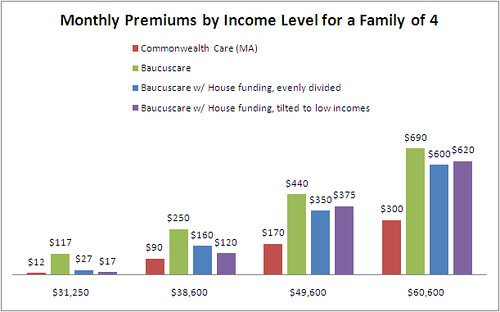
People in Massaschusetts are by and large satisfied with the Connector. It's toughest on the fairly small number of families earning just over 300% of FPL (of which there aren't that many), and on the larger number of young individuals who make just over 300% of FPL (which is $32,320 for an individual, so there are a decent number of those folks). Working class families earning up to 200% of FPL have fairly low premiums. $90 per month is going to pinch, but for uninsured households, they'll get some real value out of that: Commonwealth Care plans include dental insurance, wellness checkups have low co-payments; chronic disease care is especially well covered, and so forth. Likewise, three hundred pre-tax dollars a month for a family with a gross income of $60,000 per year is Real Money, but it's not going to break the bank. It's less than what they should be saving for college, for instance.

But as you can see from the graph, the Baucus bill doesn't fare as well. It's not even close to faring as well. The eight million individuals without insurance who earn between 200% and 300% of FPL will pay more than twice what similar households in Massachusetts currently pay. And working class families will feel a real pinch; $250 per month ($3,000 per year) for a family of four with an income of $38,000 is going to hurt.


• The community rating provision, mandating that insurers offer the same price to everyone regardless of medical history, comes with a tremendous loophole that will allow them to change five times as much for a policy based on age, which is just another way to discriminate against the sick.

• The employer "free rider" problem, called "one of the worst policy ideas I've ever seen" by Ezra Klein, would penalize employers for hiring anyone who qualifies for subsidies, encouraging them to find people who get coverage through a spouse or illegal immigrants. It also gives large employers like Wal-Mart a competitive advantage for paying crappy wages. And you can't opt out of the garbage insurance that giant employer - let's call them Ball Bart - might offer you.

• The excise tax for violating the individual mandate could cost up to $3,800 but wouldn't kick in if the individual could not find coverage that costs more than 10% of his income. In which case, you've built a robust architecture for a useless plan, because if millions opt out the coverage gets less universal and insurers want to stop come-as-you-are guaranteed issue.

• The co-ops are even weaker than imaginable:

The co-ops can only compete in the small group and individual markets. That is to say, if the co-ops prove effective, and The Washington Post would like to offer co-op coverage as an option to its workers, it can't. The co-ops are not allowed to contract with large employers, which is to say, they can't compete with private insurers in the largest market, and they can't get the purchasing power that would come from a serious foothold among corporate customers.

Not only is their size restricted, so too is what they can do with their size. The co-ops can band together to increase their purchasing power, but they can't set national payment rates for their members, a la Medicare. As I understand it, they have to bargain with each provider and drug manufacturer and hospital and so forth separately, meaning they're denied one of the main advantages of size. The insurance industry is, in other words, being protected from not just public competition, but co-op competition.


Jay Rockefeller today sent a letter proving, based on tons of research, that co-ops were a complete sham that have failed in the marketplace on a number of occasions, saying that "I believe it is irresponsible to invest over $6 billion in a concept that has not proven to provide quality, affordable health care, when we know that a public health insurance option will rein in costs and save taxpayers billions of dollars."

Marcy Wheeler has a lot more. There's one promising sign that the exchanges look expandable and available to all businesses, a neat way to gradually wean the system off of exclusive employer-based insurance, but that's about the only silver lining. Kent Conrad's gambit of increasing the budget window to make the Senate Finance bill look better did work, as the deficit reduction aspects look improved for the bill over the House bill. But crucially, that's a function of the funding, not the outlay in subsidies. Those will be too stingy to make the bill work for people, only for the bean-counters. In fact, the bill will start taking more and more from the middle class, much like the alternative minimum tax, and political reality will force scalebacks, so the budget picture doesn't look as rosy as advertised.

But it also suggests some real dangers in the bill's second decade. The unpopular elements of the bill become a lot bigger and more onerous. The excise tax on high-cost insurance plans begins affecting insurance plans that aren't particularly high-cost. The Medicare and Medicaid savings begin to tighten. That said, there are a lot of potential savings that the CBO isn't taking into account here, so that might ease the pain. Plus, at some point, we are going to have to start cutting costs in the system, and you can't escape some eventual hurt in that. But you can be sure the GOP is going to run these numbers aggressively and spin them viciously.


The good news is that this is in no way "the bill" that will get signed by the President. It has to go through a significant amount of changes, and key Democrats are already balking at it. In fact, lil' ol' Roland Burris said he wouldn't vote for anything without a public option, and with the numbers so tight, every Senator is in a bargaining position. Baucuscare is an abomination. But it doesn't have to be the endpoint, only the beginning.

I should say that one group really, really likes the Baucus bill - insurance companies.

Labels: , , , , , , , , , , ,

|

Tuesday, September 15, 2009

Not So Fast, Mad Max

Jay Rockefeller is actually the chair of the health subcommittee in the Senate Finance Committee. Any "Gang of Six," or really any legislation on the Committee, should at least have his input, if not his controlling hand. Yet Max Baucus froze him out of the legislation in favor of Republicans who will never sign on to the final version and worthless schemes like the Conrad co-op proposal (which is just a thin ploy to get Blue Cross of North Dakota, which controls 90% of the market in Conrad's state, the "co-op" label so it can access federal start-up funds). Rockefeller may have the last laugh when the bill moves into the full committee.

U.S. Senator John Rockefeller, a Finance Committee member and a strong backer of a government-run insurance option, said on Tuesday he will not support the panel's healthcare bill in its present form.

Rockefeller told reporters he was unhappy with the lack of a government-run "public" insurance option in the bill, which is scheduled to be made public on Wednesday, and had problems with some of its changes in children's health insurance and Medicaid, or healthcare for the poor.


In particular, Rockefeller wants a public insurance option instead of the weak co-ops, better affordability provisions so working people can actually use the bill, and changes to the way that Baucuscare deals with the Children's Health Insurance Program and Medicaid.

Rockefeller specifically said "There is no way in its present form that I will vote for it... unless it changes during the amendment process by vast amounts." Now, getting amendments through may not be an easy task. Each Rockefeller amendment in that committee would have to get the votes of all the Democrats plus at least a couple Republicans, if Baucus and Conrad hold firm on them. Considering that 10 of the 13 Democrats on the panel were completely shut out of the process during the Gang of Six talks, I'd expect a lot of support for what Rockefeller wants to do, but Baucus and Conrad can basically nullify anything meaningful on their own, should they want to.

Still, Rockefeller's advocacy is important because it sets the tone for Democrats with the full Senate, where votes like his will be needed. Jon Cohn explains.

A little over a month ago, right before the August recess, I spoke with Rockefeller at some length. And he was clearly wrestling with how to position himself.

No living senator has done as much to promote health reform as he has. It's the cause of his life and, for the first time, the goal is within reach. He admitted that voting against a package, even a flawed one, was difficult to imagine.

But Rockefeller also made clear his frustration with the compromises Baucus was making, whether it was replacing the public plan with a co-op or gradually reducing the subsidies to help people pay for insurance. He was particularly incensed about the changes to Medicaid and CHIP, programs to which he's devoted much of his time--and on which many West Virginians rely.

At the time, it seemed like Rockefeller was still on board, if only to help get a bill out of the Finance Committee and onto the Senate floor. But you got the feeling--well, I got the feeling--that he was near the breaking point.

Sometime since that interview, clearly, he's hit it.


Every vote is precious in the Senate, given that votes on the Republican side other than Olympia Snowe and maybe Susan Collins will not be forthcoming. Harry Reid has laid down the marker that anything less than 60 votes will lead him to go through the reconciliation process (and I don't think Reid's low poll numbers in Nevada will be much of a factor - the consequences of doing nothing on health care would be far graver for him). Therefore everyone in the Democratic caucus, essentially, represents an interest group to be satisfied. Rockefeller is standing up and saying that he's perfectly willing to vote against something that doesn't fulfill the promise of health care reform as he sees it. Bernie Sanders probably feels the same way. Maybe Barbara Boxer does. Or others. Max Baucus and his cronies will have to wrestle with that.

...Incidentally, the fact that we could have a new interim Senator from Massachusetts as soon as this week makes things even more interesting.

Labels: , , , , , , ,

|

Monday, August 24, 2009

Waxman's Gambit

Henry Waxman's move to ask insurance companies for their records on compensation and perks is as consequential a move as any member of Congress has made in the fight over health care reform, because it has the potential to change the entire narrative around the issue. It's seen as so successful on Capitol Hill, in fact, that Jay Rockefeller is supplementing it.

A U.S. Senate Democrat asked the top 15 health insurers to explain what portion of premiums go to profits versus patient care, putting further pressure on the companies to explain their business practices as Congress considers sweeping health reform legislation.

In letters to the companies on Friday, Sen. John Rockefeller also asked for information about how insurers disclose financial practices to customers [...]

"Too often consumers are not getting a fair deal for what they pay, they are not getting the protections they deserve, and the insurance companies are awash in profit," Rockefeller, chairman of the Senate Commerce, Science and Transportation Committee, said in a statement.

The letters were sent to companies including UnitedHealth Group, Wellpoint and Aetna, the committee said.


Robert Zirkelbach, a spokesman for the health insurance lobby AHIP (America's Health Insurance Plans), dismissed the Rockefeller probe as a way to "shift the focus" to the insurance industry. I think Rockefeller and Waxman would argue that the insurance industry deserves such a focus.

Waxman actually initiated his investigation back in July, right around the time he was negotiating with House Blue Dogs over concessions in his bill in the Energy and Commerce Committee. At the time, he was responding to examples of astroturf (fake grassroots) efforts performed by the insurance companies. Seeing the ferocity of their efforts, Waxman surely assumed that the industry was concerned primarily with protecting profits over being any kind of partner for reform.

Earlier this week, Waxman sent letters requesting detailed financial information including compensation, revenue and profit numbers to 52 insurance companies with annual premiums greater than $2 billion.

But nearly a month earlier, on July 21, Waxman and Investigations Subcommittee Chairman Bart Stupak sent letters to AHIP and Dewey Square Group asking for emails and internal documents about a news report in April that several senior citizens had not written letters to the editor submitted under their names.

Waxman’s committee’s spokeswoman said Waxman was merely trying to gather information critical to the health care debate.

“If we're going to get health costs under control, we need to make sure that our private health insurance dollars are spent as efficiently as possible. That means our premium dollars should be paying hospitals and physicians for providing health care, not wasting resources on administrative bloat,” she said.


The connection between the astroturfing campaigns, which industry is paying millions to lobbyists to conduct, and industry profits is obvious. Those campaigns to weaken the health care reform bill are being carried off using customer premiums.

The results of the Rockefeller and Waxman probes are due right when the House and Senate return from recess. If used skillfully, these reports can weave a narrative - whether industry participates in them or not - of insurance company excess at a time when the system is broken and millions have been denied coverage. And despite the AHIP mouthpiece's claims, this "shifts the debate" to where it ought to be - not on mythical stories and smears about reform, but about the fundamental choice between filling the pockets of an already bloated insurance industry or providing for the general welfare of all Americans. While I'm well aware that insurers are not the only problem with the health care system, they are the one actor that adds nothing of value to the process, and changing their incentives, toward lower cost and better quality instead of how to deny care, will have an impact on the system at large.

Labels: , , , ,

|

Wednesday, August 05, 2009

The Actual Business Of Health Care

The teabag rallies are theater, but some actual substance has made its way into the health care debate this week.

First of all, the President has openly considered a partisan process to pass health care reform.

President Obama urged Democratic senators on Tuesday to persevere in trying to get a bipartisan deal on health care, but left open the possibility that they might have to pass a bill with only Democratic votes if Republicans stood in the way.

At lunch with Democrats at the White House, Mr. Obama vowed to respond to Republican attacks on his plan, which aims to guarantee insurance for all Americans while slowing the explosive growth of health costs.

The Senate majority leader, Harry Reid of Nevada, said there was “absolute unity” among members of the normally fractious Democratic conference.

“Everyone recognizes that we are going to do, if there’s any way humanly possible, a bipartisan bill,” Mr. Reid said. “We don’t want to do a partisan bill, and we hope our Republican colleagues acknowledge that. We’ll continue to work with them as long as we have to.”


I take the nods toward bipartisanship is simply what you say. The news here is Obama suggesting they must not be an obstacle. And frankly, it's about time. Chuck Grassley today actually referenced Ted Kennedy's brain tumor to try and whip up a fear of rationing. And he's one of the Republicans in the midst of bipartisan talks! They are simply not bargaining in good faith.

In an interview today with Chuck Todd, Obama reinforced the deadline for those talks in the Senate Finance Committee.


"I am glad that in the Senate Finance Committee, there have been a couple of Republicans--Chuck Grassley, Mike Enzi, Olympia Snowe--who have been willing to negotiate with Democrats to try to produce a bill. But they haven't yet. And I think at some point, sometime in September, we're just going to have to make an assessment."


He says he'd "prefer" a bipartisan process. And I'd prefer dinner every night at Nobu. But I can't get that. So I eat what I can get. Obama's saying the same thing. I think everyone's ready to go to war on this. And you will see arm-twisting to end cloture like you wouldn't imagine.

Meanwhile, Jay Rockefeller is doing a good job savaging the Finance Committee talks, talks which he has been shut out of even though he chairs the Health Subcommittee on the panel. Rockefeller's tough talk will push the debate in that committee to the left, just as liberals in the House are pushing Nancy Pelosi and the leadership to the left and drawing a line on the public option. And the September deadline enforces the whole process, telling Republicans like Grassley they can either have input or watch a bill get passed without them.

That's the theory, anyway, we'll see how it works in practice.

Couple other things. Health Care for America Now has a good report personalizing the health care debate and explaining what reform will bring for every type of family. And the White House has apparently secured a win in the all-important budget nerd battle:

The White House scored a point today in its ongoing battle to convince establishment Washington that health-care reform will succeed at cutting costs even as it expands coverage. The White House and budget director Peter Orszag, as well as the House Blue Dogs, are very bullish about allowing an independent board to pursue cost-cutting measures in Medicare. But when CBO scored the measure to determine if it would be succesful, they produced a very lukewarm estimate. Today, though, a group of health-care experts sent a letter [PDF] to Obama arguing that IMAC, the independent cost-cutting board, would be very effective if done right -- and nine of the signatories are members of the CBO's Panel of Health Advisers, nearly half the membership. It's a good sign for the White House, and will help push the message that, while CBO's scores are important, the assumptions made in that office are not carved in concrete.


The CBO simply should not be the final arbiter on questions that are really outside their purview.

Labels: , , , , , , , , ,

|

Friday, July 31, 2009

Democrats Behaving Badly - For Good, Not Evil!

It's so rare when Democrats push back and show some sturdiness, that it's worth noting when it happens. First, here's Jello Jay Rockefeller eviscerating the "co-op" idea floated by Kent Conrad:

Ed: It's not going to work. There's really no successful model out there to support the basis of signing on to a co-op. Would you sign on to a co-op or is that unacceptable?

Rockefeller: That's unacceptable and I can almost prove it. We've been in touch with all the folks that oversee, represent all the co-ops in the country on all subjects and they point out that there are probably less than twenty health co-ops in the country. There are only two that really work that well. One in Puget Sound, one in Minnesota, except for those two, they are all unlicensed. All present health co-ops are all unlicensed, they're unregulated. Nobody knows anything about them, nobody has any control over them and nobody has ever said, which is stunning to me, no government organization or private organization has ever done a study to what effect they might have in terms of bringing down the insurance prices.

They are untested, they are unlicensed, they are unregulated, they are unstudied. Why would we even think about putting them in as a control on this massive insurance industry instead of the public option?


Rockefeller actually knows what he's talking about because he's been studying the issue for decades, unlike Conrad, who threw a dart at a board and hit the magical Broderist middle with the co-op brainstorm. Rockefeller does not seem like he'll play along on this bait and switch.

Then there's Anthony Weiner forcing the "no government takeover of health care" Republicans to be as good as their word.

Yesterday, Rep. Anthony Weiner (D-NY) decided that it was “put-up or shut-up time for the phonies who deride the so-called ‘public option.’” He offered an amendment that would eliminate government-run Medicare:

Not a single member of Congress voted for the amendment, and Republicans were blasting it as a “political farce.” Last night, Weiner went on MSNBC and explained the GOP’s hypocrisy:

WEINER: Well, for some reason, I guess Republicans don’t like publicly funded, publicly administered health plans except for Medicare, and, I guess, except for the Veterans Administration and except for the health care that our military gets from the Department of Defense. The fact of the matter is, what we’ve learned is that government administered health care works pretty darn well. It’s got lower overhead and people like it.

So, when my Republican colleagues pound the drum and pound the podium about how they hate government-run health care, I guess they haven’t looked at what they get.


Sometimes this spine-stiffening happens for about a week, but I like this week's Democrats.

Labels: , , , , , ,

|

Friday, June 26, 2009

The Health Care Endgame

Clearly, Democrats and the White House are advocating strongly for a public health insurance option, as the only way to truly lower costs, both to the federal budget and for consumers. The polls show that the American people generally agree - they may have concerns about cost and quality, but they support competition and choices. And the ABC poll cited above arguably skewed the public option question the most of any; opinion appears to skew in favor of a public option. Republicans have called it a deal breaker.

There are a million rumors flying around about this Senator and that. And there are plenty of process stories about whether Democrats should have pre-compromised reform by taking single payer off the table (which normally I would agree with, but this is the most plausible rebuttal to that scenario that I've ever seen - basically that such a strategy could have arrived DOA at the Capitol, and doomed reform because there's no assurance of a deal at the end of the road). And there's going to be more outright lying from those on the right who basically want nothing to be done.

At the end of the day, this sounds right to me as an endgame:

The stimulus was a huge and important accomplishment. If you had told liberals in 2007 that they were going to pass an $800 billion dollar spending bill that made good on decades of promises about infrastructure rebuilding and comparative effectiveness research and train construction and broadband internet and green energy, they would have laughed at you.

But by the time the bill actually wound its way through Congress, most liberals were frustrated by the outcome: A few Senate moderates had lopped $100 billion in spending off of the total and done so for no apparent reason. Top economists said that the legislation, though helpful, would not be enough to close the output gap and should thus be larger. The stimulus was a historic legislative accomplishment that nevertheless left liberals frustrated because they made concessions they didn't see any reason to make and ended up with a bill that they knew would not fully solve the problem.

That, I'd bet, is how health reform will close out as well. We will spend a trillion or a bit more covering the un- and underinsured. We will regulate a fairer and more decent insurance market into existence. We will expand Medicaid and build out subsidies to at least 300 percent of poverty and create health insurance exchanges. We will fund all this through sharply progressive taxes. We may even have a public plan. In 2006, it would have been a great deal. But as the legislation winds its way through the Senate, there will be unpleasant compromises, and unconscionable omissions, and the constant knowledge that though this is progress, it is not sufficient, and the people who stand in the way of a better bill are frequently incoherent or disingenuous. And that will be terribly frustrating for supports of the effort. The result will probably be a historic win when compared to the status quo, but I doubt it's going to feel like that for supporters of the initiative.


That's playing out as we speak. The Senate Finance Committee is trimming the subsidies to make health care affordable, reducing their availability to families at 300% of poverty instead of 400%. But they are NOT the only game in town. We have a solid House bill with a decent public option, which will reduce costs when factored in to the CBO score. We have the ability to keep insurers honest. We can implement a number of provisions to change the incentives for doctors to ring up more treatment instead of effective treatment. And we have allies like, amazingly enough, Jay Rockefeller:

Rockefeller estimates at least 100 million Americans face major problems paying for health care today.

"We can't count on insurance companies. They are just maximizing their profits. They are sticking it to consumers.

"I am all for letting insurance companies compete. But I want them to compete in a system that offers real health-care insurance. I call it a public plan," Rockefeller said [...]

On Thursday, Rockefeller admitted he expects little bipartisan support.

"There is a very small chance any Republicans will vote for this health-care plan. They were against Medicare and Medicaid [created in the 1960s]. They voted against children's health insurance.

"We have a moral choice. This is a classic case of the good guys versus the bad guys. I know it is not political for me to say that," Rockefeller added.

"But do you want to be non-partisan and get nothing? Or do you want to be partisan and end up with a good health- care plan? That is the choice."


In other words, we have a chance to reverse the dynamic, where bipartisanship is favored above everything and the policies are calibrated to the one holdout conservative, and instead have a dynamic where a public plan becomes the key for garnering support from enough Democrats to pass. We can keep pushing from the outside to ensure that dynamic holds.

Labels: , , , , , ,

|

Thursday, May 14, 2009

They Lie For A Living

Nancy Pelosi came out and said it today. It was a bit much when these right wingers kept lauding torture as this awsom program keeping Americans safe, and at the same time pointing the finger and yelling "Nancy knew!" as if there was something wrong with it. Ultimately, it doesn't matter even a little bit who knew what and when. The action is illegal and ought to be prosecuted. But today Pelosi confirmed that the CIA and the Bush Administration lied repeatedly to Congress.

PELOSI: The CIA briefed me only once on enhanced interrogation techniques in September 2002, in my capacity as ranking member of the intelligence committee. I was informed then that the Department of Justice opinions had concluded that the use of Enhanced Interrogation Techniques were legal. The only mention of waterboarding at that briefing was that it was not being employed. [...]

We also now know that techniques including waterboarding had already been employed and that those briefing me had given me inaccurate and incomplete information. At the same time the Bush administration…was misleading the American people about the threat of weapons of mass destruction in Iraq [...]

PELOSI: So on the subject of what’s happening in Iraq, when it’s talking about the techniques used by the intelligence community on those they’re interrogating, at every step of the way, the administration was misleading the Congress. And that is the issue. And that is why we need a truth commission to look into the issue.

REPORTER: So Madame Speaker, just to be clear, you’re accusing the CIA of lying to you in September of 2002?

PELOSI: Yes. Misleading the Congress of the United States.


It goes without saying that, at the time of this briefing, the CIA was ALREADY waterboarding prisoners.

And we know they've been lying about the rest of it. Bob Graham, then the chair of the Senate Intelligence Committee, received no information about waterboarding, and in fact received less info than the House Intelligence Committee leaders, probably because ranking member Richard Shelby was leaking like a sieve at that time. Jay Rockefeller, later the ranking member on Senate Intel, stated outright that the CIA document listing briefings and attendees is wrong, that he didn't attend a briefing which the document has him attending. We know that Rockefeller is probably telling the truth since the CIA won't vouch for anything in the document.

As I've said, the CIA's job description requires their agents to lie. Why anyone would trust anything put out by them is beyond me. The CIA basically is blame-shifting here and Nancy Pelosi threw it right back in their face today.

This is precisely why those of us seeking accountability and justice have called for a full investigation so we can learn from what happened as well as ensure it never happens again by actually prosecuting those responsible. Anything less practically ensures we have this conversation again and again down the road.

(And that secret DiFi Intelligence Committee panel does not fill the bill here. We need transparency.)

Labels: , , , , , , , , ,

|

Saturday, April 18, 2009

Wiretapping Suits To Go Forward - Obama's DoJ Should Give Up

Perhaps more important than the revelation that the NSA "overcollected" information on innocent Americans was the news late yesterday that Vaughn Walker, the judge in many of the wiretapping cases currently before the court, elected to keep the Al Haramain suit going.

Accordingly, the parties are hereby ordered to meet and confer regarding the entry of an appropriate protective order which shall be entered herein before the court rules on the merits. The United States District Court for the District of Columbia has successfully employed protective orders in the In Re Guantánamo Bay Detainee Litigation, D DC No Misc 08-0442 TFH, even providing for the use of top secret/sensitive compartmented information (TS/SCI). See, for example, the documents at docket numbers 409 and 1481 in that matter. The United States has advanced no argument that would suggest a reason why the court’s use of a protective order in instant matter modeled on those in use in the Guantánamo Bay would not adequately protect the classified information at issue here.


As Marcy Wheeler later describes, having read the evidence in the case, including the document Bush's Justice Department inadvertently gave Al Haramain's lawyers showing a transcript of their wiretapped conversations, Walker wants the case to proceed.

Unless I'm misreading these tea-leaves (which I doubt, because the tea-leaves have been reading the same way since well before January), Walker is prepared to rule that al-Haramain is an aggrieved party. Meaning, Walker is convinced the government wiretapped al-Haramain illegally.

Not a surprise, in the least, but it's nice we're finally getting around to this [...]

But he's also called the government's bluff. Last we heard in this case, after all, the government was squawking like Cheney, threatening to come take its documents away if Walker tried to give them to al-Haramain. But what's it going to do now, if Walker has his ruling on the merits all but written now? Take Walker's rulings away? Take his notes? In other words, Walker has read the documents--documents that likely impact not just this suit, but also the other suits against the government. And the government can't take his review of those documents away at this point.


Walker has multiple wiretapping suits before him, and this ruling will have implications for them as well. Which is why Obama's DoJ should just give up with the state secrets reasoning at this point. Clearly it won't work, and it only gets them more deeply involved in a cover-up. Just allow the cases to reach court and let the chips fall.

Meanwhile, Jay Rockefeller may have speculated that NSA was wiretapping him earlier this year, in which case I'll be happy to not help him, since he led the effort to indemnify the telecoms. You're on your own, Jay.

Labels: , , , ,

|

Tuesday, January 06, 2009

The Panetta Saga

So now Joe Biden is acknowledging a mistake in the transition not informing the Senate Intelligence Committee chair about the choice of Leon Panetta for CIA Director, which was probably leaked, because there's no reason to intentionally antagonize the Committee Chair who will direct the confirmation hearings. I guess Obama talked it over with Feinstein, and apologized. Other committee members, including Ron Wyden, were consulted beforehand, suggesting that Obama really did want a break with the capitulationist elements of the Senate Democrats. Scott Horton considers this a plus.

So why would the Obama team, which has been so careful and thoughtful in approaching the nominations process, have failed even to consult the two Democratic senators who have the most to say about intelligence? I don’t think this was accidental. I read something else into it. The bottom line is that Jay Rockefeller was an abject failure when it came to intelligence oversight. His term as ranking member and then chair of the Senate intelligence committee was one in which Congress generally, and the Senate in particular, failed to live up to their Constitutional mandate. The intelligence community was steered by the Bush Administration into a series of criminal escapades. Effective congressional oversight would have exposed these failings and brought them to heel. But the Rockefeller-Feinstein record was little short of disastrous. I’m delighted that the Obama team didn’t consult them.


Feinstein, for her part, has commented further, saying that she understands the desire for a break with the past, but that she also wants the same guy working in Bush's CIA to stay on.

"I understand their thinking" in choosing Panetta, Feinstein explained, describing herself as "very respectful of the president's authority ... this is the man [Obama has chosen]."

I asked Feinstein whether her reticence about Panetta's lack of ties to the CIA would be mitigated by having Steven Kappes, her preferred choice for CIA director, stay on as the agency's No 2. "I believe very strongly" that Kappes should stay, Feinstein said, adding that Panetta's standing would be "very much enhanced" were Kappes to stay his deputy.


The entire point of the Panetta pick would be undermined by a #2 like Kappes. That would be a huge mistake IMO. And the idea that a CIA Director needs "experience" in intelligence matters flies in the face of history. Several good leaders at CIA had no intel experience whatsoever.

Meanwhile, Russ Feingold loves the Panetta pick.

I am pleased by reports of the nomination of Leon Panetta to be the next CIA Director. These reports indicate that President-elect Obama recognizes the need for fresh leadership for the intelligence community. Leon Panetta has a long and distinguished career in public service and there are few people of whom I have a higher opinion. He has been a strong voice opposing the interrogation practices authorized by the Bush Administration and he is well-equipped to restore our national security, which has been undermined by the current administration's policies. I look forward to closely examining his record, hearing his plans for protecting our nation against al Qaeda and other threats, and learning how he will help restore the rule of law after years of lawlessness that have undermined our national security.


This whole thing could be as simple as courtliness and some random fights in California (maybe going back to when Panetta and Jane Harman, who was up for the job, ran against one another for Governor in 1998). But the insistence on Kappes suggests this is a body-burying effort.

...Ezra Klein scores an interview with Sen. Wyden, who says that DiFi is about to introduce legislation to "end torture and close Guantanamo." Well, we shall see, but everyone trying to get to the left of one another on this issue is a good thing.

Labels: , , , , , , , , ,

|

Wherein I Defend Leon Panetta

It's more than a little surprising to me that the choice for CIA Director of Leon Panetta, who I considered a card-carrying Villager if there ever was one, is ruffling such feathers inside official Washington, particularly official Democratic Washington. At first blush this looked like whining about not being informed, but it seems like there's more there. Here's the relevant section from the LA Times:

Sen. Dianne Feinstein (D-Calif.), who this week begins her tenure as the first female chair of the Senate Intelligence Committee, said today that she was not consulted on the choice and indicated she might oppose it.

"I was not informed about the selection of Leon Panetta to be the CIA director," Feinstein said. "My position has consistently been that I believe the agency is best served by having an intelligence professional in charge at this time." [...]

A senior aide to Sen. John D. Rockefeller IV (D-W.Va.), outgoing chairman of the Senate Intelligence Committee, said that the senator "would have concerns" about a Panetta nomination.

Rockefeller "thinks very highly of Panetta," the aide said. "But he's puzzled by the selection. He has concerns because he has always believed that the director of CIA needs to be someone with significant operational intelligence experience, and someone outside the political realm."


Most of the intelligence professionals at the top over the past eight years had plenty of "experience" and that didn't work out too well. The one who came from the political arena, Porter Goss (who was a former spy), wasn't so objectionable to Dianne Feinstein - I mean she voted to confirm him, after all. Of course, he was a Republican, which makes everything OK.

But I don't think this is about Panetta's lack of experience; it's his wealth of it, which presages a change in culture inside the agency.

Panetta's selection suggests that Obama intends to shake up the agency, which has had little public accounting of its role in detaining top terror suspects and transferring others to regimes known to use torture, a procedure known as extraordinary rendition.

The CIA, which denies subjecting detainees to torture, is part of a 16-agency intelligence community whose annual budget now exceeds $47.5 billion. The agency keeps its own budget and number of employees secret. Its successes, too, are mostly kept secret while some of its failures reach front pages.

Panetta has suggested that Obama could do much to signal a break with Bush administration policies by signing executive orders during his first 100 days that ban the use of torture in interrogations and close the Guantanamo Bay prison.

"Issuing executive orders on issues such as prohibiting torture or closing Guantanamo Bay would make clear that his administration will do things differently," Panetta wrote Nov. 9 in a regular column he published in his local newspaper, the Monterey (Calif.) County Herald [...]

"He will be an outsider and I think the president wants an outsider's perspective on the CIA," said Lee Hamilton, a former Indiana congressman and a former chairman of the House Permanent Select Committee on Intelligence who heads the Woodrow Wilson Center in Washington. "The intelligence community has lost a lot of confidence with the American people and the Congress. I'm talking about 9/11, the Iraq war."


It's that he's an outsider with enough institutional power to actually make changes, and the moral compass to make those decisions based not on burying the past but rooting it out. THAT'S what has DiFi and Jello Jay spooked. In fact, they wanted Michael Hayden's right-hand man to take over.

NBC News has learned that Senate Democrats -- including Dianne Feinstein and Jay Rockefeller, who are the incoming and outgoing Intelligence chairmen -- have privately recommended a career CIA officer to head the agency.

Democratic sources indicate that both have recommended deputy CIA Director Steve Kappes, a veteran CIA intelligence officer who is widely credited with getting the Libyans to give up their nuclear program. Kappes also was former Moscow station chief [...]

One potential downside for Kappes: Like former counter-terror chief John Brennan, some critics says he had line authority over controversial decisions involving interrogation and detention. Brennan was taken out of contention for the CIA job after criticism on the Web on that issue, even though he says he privately objected to the policies and was not in the chain of command at the time.


Panetta isn't going to be sneaking through the Middle East collecting human intelligence; he's going to be managing a large bureaucracy. But moral lepers like DiFi value "experience" that will lock in the status quo over experience that will reveal the agency's sins, and by extension her own. They don't want to risk any culpability on their part from becoming public, so they'd rather "keep it in the family." By the way, the resultant fight suggests that "liberal bloggers" were only the excuse for the Obama transition to disqualify John Brennan; in fact, they wanted a strong manager with a spine who would follow the rules. That is distasteful to those Senate Dems who don't want the family secrets spilling out.

And lest this become abstract, read today's New York Times:

When Muhammad Saad Iqbal arrived home here in August after more than six years in American custody, including five at the military prison at Guantánamo Bay, Cuba, he had difficulty walking, his left ear was severely infected, and he was dependent on a cocktail of antibiotics and antidepressants.

In November, a Pakistani surgeon operated on his ear, physical therapists were working on lower back problems and a psychiatrist was trying to wean him off the drugs he carried around in a white, plastic shopping bag.

The maladies, said Mr. Iqbal, 31, a professional reader of the Koran, are the result of a gantlet of torture, imprisonment and interrogation for which his Washington lawyer plans to sue the United States government [...]

Mr. Iqbal was never convicted of any crime, or even charged with one. He was quietly released from Guantánamo with a routine explanation that he was no longer considered an enemy combatant, part of an effort by the Bush administration to reduce the prison’s population.

“I feel ashamed what the Americans did to me in this period,” Mr. Iqbal said, speaking for the first time at length about his ordeal during several hours of interviews with The New York Times, including one from his hospital bed in Lahore.

Mr. Iqbal was arrested early in 2002 in Jakarta, Indonesia, after boasting to members of an Islamic group that he knew how to make a shoe bomb, according to two senior American officials who were in Jakarta at the time.

Mr. Iqbal now denies ever having made the statement, but two days after his arrest, he said, the Central Intelligence Agency transferred him to Egypt. He was later shifted to the American prison at Bagram Air Base in Afghanistan, and ultimately to Guantánamo Bay.

Much of Mr. Iqbal’s account could not be independently corroborated. Two senior American officials confirmed that Mr. Iqbal had been “rendered” from Indonesia, but could not comment on, or confirm details of, how he was treated in custody. The Pentagon and C.I.A. deny using torture, and American diplomatic, military and intelligence officials agreed to talk about the case only on the condition of anonymity because the files are classified.


There are hundreds of human beings like this - at least the ones who are alive - who really don't care if Dianne Feinstein or Jay Rockefeller will be "embarrassed". They were flown around the world, interrogated and tortured, and in the process, America not only created thousands of new terrorists while received no actionable intelligence, but lost its soul. The road to restoration has nothing to do with the delicate sensibilities of Senate Democrats.

Labels: , , , ,

|