Amazon.com Widgets

As featured on p. 218 of "Bloggers on the Bus," under the name "a MyDD blogger."

Thursday, February 05, 2009

Iraqi Election Update

The newspapers are reporting a big win for Prime Minister Maliki in the provincial elections, and predictably are leaving out the nuance that such a victory entails. First of all they are claiming that this win for Maliki is a "loss for Iran," as if Iran doesn't have major ties to the Dawa Party and Maliki himself.

Second, while everyone is focusing on the Shiite Maliki/Sadr split - and really, Maliki had all the guns, so his victory was sealed when the US military helped him raid Basra - it's the marginalization of the Sunnis in Baghdad that could spark outrage and unrest, much like the apparent electoral fraud in Anbar:

The conventional wisdom has been that the provincial elections would redress the sectarian imbalance in the Baghdad Council -- which had only one Sunni, a Communist, out of 57 seats because of their boycott of the 2005 elections. Sunnis (many of whom continue to believe themselves a majority) expected to capture a significant share of the Baghdad council this time. Most U.S. analyses shared that expectation, which was the basis for hopes that the provincial elections would lock in the incorporation of Sunnis into the political process.

But a dramatic increase in Sunni representation (commensurate with their aspirations) was always unlikely for one big reason: the clearly visible refusal to take serious measures to allow refugees or internally displaced persons to vote. IDPs were technically enfranchised, but the rule that they vote in their place of origin and the inefficiency of the bureaucracy ensured that few actually would. In September, Brian Katulis and I warned that failure to deal effectively with the IDP problem would "essentially ratify the country's new sectarian map" created by the bloody sectarian cleansing of 2006-07. According to IOM's authoritative surveys, about 64% of Iraqi displaced come from Baghdad -- and it is in Baghdad where the effects of their disenfranchisement are most being felt. With less than 10% (or even 20%) of the seats in the Baghdad council, Sunnis may well feel that this warning has come true. How will they react?

The unexpectedly strong showing of Maliki may reflect a popular yearning for a strong central government. But add on the unexpectedly strong showing of the Islamic Party in Anbar, and it is difficult to not wonder whether there is more to the strong showing of the incumbent parties than their popularity. Months of "shaping operations" and state-funded patronage may have had something to do with it as well. But either way, the provincial elections seem likely to shift attention to exactly the question we worried about last fall: how will frustrated challengers react to their failure to obtain the share of state power that they had expected? Ahmed Abu Risha, head of the Iraqi Awakening Conference and a key American ally in Sunni Iraq, has already proposed one answer: "We will form the government of Anbar anyway...An honest dictatorship is better than a democracy won through fraud." That beats the "Darfur" and "graveyards" and "streets running with blood" of which others speak, I suppose... but none are quite what the cheerleaders for this process seem to have had in mind.


The Sunni Awakening was predicated on hopes that they would get a share of power somewhere down the line. If they are shut out of the political process, who's to say they won't turn to other means?

...It looks like some thumbs were placed on the scales in Anbar, giving the election to a third party and not the Awakening coalition or the Iraqi Islamic Party. Lynch:

I never expected the provincial elections to solve all of Iraq's problems, and they didn't. The elections have created new problems that need to be recognized and dealt with -- especially Sunni frustration in Baghdad, intra-Sunni strife in Anbar, perceptions of electoral fraud in support of incumbents, IDP and refugee disenfranchisement, and the impact of the election of a strongly anti-Kurdish front up north. But that doesn't mean that disaster is lurking around every corner -- with luck, these new problems can be dealt with constructively.

Lest my coverage appear too negative, let me say that I'm very pleased to see the collapse of ISCI across much of the country and hopefully the end of its designs on creating a Shia super-region. And I'm happy with the strengthening of forces calling for a stronger central state -- since I've been arguing for years that the consolidation of a Weberian Iraqi state is the key to establishing the conditions for successfully extracting the U.S. military. With luck, the coalition-building phase can allow points of entry for some of the potentially frustrated challengers.

I'm sincerely hoping that all the parties involved can work out their conflicts peacefully and that the results are accepted as broadly legitimate -- both of which require frank, honest looks at what really happened and why. And then with the elections out of the way, the U.S. should move on to the business of starting its troop withdrawals and setting a new course.


UPDATE: This Anthony Zinni story is completely weird. He was offered the Ambassador job in Iraq and then never heard anything until he found out he was replaced by Christopher Hill (who ran the North Korea diplomacy)? How could they do that? Zinni is a valuable asset for Democrats on national security. Is the Obama team going to disrespect every Democratic general one by one?

Labels: , , , , , , , ,

|

Wednesday, February 04, 2009

Post-Election Uncertainty

Marc Lynch had a good piece yesterday excoriating the conventional wisdom about the "successful" Iraqi provincial elections and warning of potential trouble ahead:

I'm a bit confused by the rapturous reception across the board of the Iraqi provincial elections. I'm as delighted as everyone that the Iraqi provincial elections went off without major violence. But as I've been warning for many long months now, the dangerous part of the provincial elections comes when those groups who expected to win find out they didn't. Early signs are extremely concerning -- Anbar is under curfew after threats of violence, Diyala's outcome may signal a rapid escalation of Arab-Kurdish tensions, and that's not even looking at Baghdad [...]

The only result that the IHEC has certified is the surprisingly low turnout -- only 51%, significantly less than in the much-maligned 2005 election even with much increased Sunni participation. That should be a sobering number to those who have put such great emphasis on these provincial elections as a transformative moment.

That said, I want to focus on Anbar.

One of the main reasons that the U.S. pushed so hard for the provincial elections in the first place was as a reward for the Awakenings groups which had cooperated with the U.S. against al-Qaeda. For over a year the Anbar Salvation Council and various tribal groupings have been engaged in a nasty political battle with the Iraqi Islamic Party. The IIP controlled the provincial council after most Sunnis boycotted the election, and the Anbar Salvation Council wanted power for itself as a reward for its service against AQI. It almost came to violence at several points -- but it was always tamped down (in part) by the U.S. pointing to the elections as the moment for power to be transferred peacefully and legitimately.

I kept warning, publicly and privately, that they might not actually win those elections: that tribal influence may be exaggerated, that the Awakenings were internally divided, that the Islamic Party could draw on state resources. But I was told again and again by military sources and others that this was impossible, that the tribal groups controlled the streets, and that the IIP had no chance.

Well, early returns suggest that the Islamic Party has won at least a plurality in Anbar. Turnout was only 40%. Ahmed Abu Risha, formerly of the Anbar Salvation Council and now of the Iraqi Awakenings Conference [corrected], has been telling everyone who will listen that there was massive electoral fraud in Anbar, and that if the IIP is declared the winner the province will look "like Darfur." Another leader, Hamed al-Hayes of the Anbar Salvation Council, is warning that if the IIP is declared the winner his men will turn the province into a graveyard for the IIP and its collaborators. The Iraqi military has declared a curfew to prevent outbreaks of violence.


An uprising by Awakening groups in Anbar would be terribly violent, and the big question would be: who would step in to stop it? The Maliki government, a Shiite group putting down a Sunni rebellion? The US military, which has left Anbar to the Iraqis?

Today, there is news that Iraq is investigating voter fraud in Anbar:

BAGHDAD, Feb. 3 -- The head of Iraq's electoral commission said Tuesday that it is investigating "serious" allegations of electoral fraud in Anbar province that, if corroborated, could alter the outcome of Saturday's election, providing the clearest indication yet that voting irregularities occurred during provincial balloting.

A coalition of parties that competed against the Iraqi Islamic Party in Anbar submitted complaints that the commission considers grave, commission chief Faraj al-Haidari said. "We will deal with it seriously because it might change the result of the election in this province," he said.

As tensions sparked by the allegations of electoral fraud spread through Ramadi, the provincial capital, Iraqi law enforcement officials and U.S. Marines braced Tuesday for a possible outbreak of violence.


If the Awakening groups are awarded the election over the Iraqi Islamic Party, wouldn't that just cause violence as well? This seems like a damned if you do, damned if you don't scenario at this point. It's out of the public eye beyond this WaPo story, but this could be a very difficult several days for Iraq. Stay tuned.

Labels: , , , , ,

|

Friday, September 05, 2008

The Latest In Iraq

I've been remiss in not writing more about Iraq lately, but Gen. Petraeus' recommendation to pause any drawdown in troops until Bush can hightail it out of office provides an opening. At first blush, you have to look at this and shake your head. Republicans spent a whole convention telling us that we're unquestionably winning in Iraq, and now the commander (with the President sure to follow) says that the situation is fragile and we have to wait another Friedman Unit before we start sending anyone home.

Now, Petraeus is right in a certain respect. Baghdad remains a dangerous place, and this campaign to evict squatters carries quite a bit of risk, as those displaced begin to return. The situation in Kirkuk is approaching a reckoning, with the Kurds seeing how Maliki routed them in Diyala and sensing that he will do the same there, depriving the autonomous region of their only oil-producing town. The Sunnis are raging over a friendly-fire incident where the US killed 6 members of their security forces, and while the US has handed over security for Anbar province to the Iraqis, that could intensify tensions, not dampen them, because Maliki is unlikely to integrate the Awakening forces he now essentially controls into the security apparatus. In fact, Maliki's swelled head is a serious threat to long-term stability in Iraq:

He is making himself the symbol of Iraqi nationalism by insisting on a date certain for withdrawal of US forces. Of course, this is more symbolic than real. Any deal will have plenty of loopholes in it. If Maliki wants to keep US forces around after 2011, and McCain is in the White House, he can do so. (Maybe not if Obama wins.) But the appearances are important here. He can go to the provincial elections (if they happen) and the national elections (if they happen) in 2009 saying that he is the man who got a timetable for American withdrawal. Moreover, he just replaced the Foreign Ministry team negotiating with the US side with his own team, headed by his national security adviser Muwaffaq al-Ruba'i and made up of experts not from the FM but from the prime minister's office. This is his negotiation now in a very personal way. Just today the first major oil deal of the post-Saddam era was announced, and it was with a Chinese company. Another bit of symbolism.

He has conducted a fairly successful campaign against the Sadrists, or at least it seems so far. He has skillfully used the new Iraqi forces and the US to cut at the power of the Mahdi Army and go after Sadrist leaders and officials. In doing so, he has also portrayed himself (with some accuracy) as the man who cleaned up militia misbehavior in Basra [...] He is now openly taking on the Sahwa (Awakening Councils) forces, demonstrating that he will not compromise on Shia Arab control of the Arab parts of Iraq. He is reneging on his earlier promises to integrate tens of thousands of Sahwa guys into the regular security forces [...] He is pushing a bit against his own allies in his coalition itself. There was a very interesting incident in Diyala province two weeks ago, covered by al-Hayat. The Iraqi forces in Diyala entered Kurdish areas in the province (Khanaqin) and ordered the peshmerga out. There was a stand-off, eventually settled when Massoud Barazani made a rare trip to Baghdad to work out the problem. But the taste left in the mouth of the Kurds was not a pleasant one, and Maliki has made it clear that the Iraqi Army can go wherever in Iraq he orders it (well, he hasn't tried to send it into the KRG) [...]

So we have what looks like a coherent strategy to go after opponents, weaken allies and portray oneself as the symbol of Iraqi nationalism in dealing with the U.S. Is Maliki overreaching? Despite the Mahdi Army setbacks, Sadrists could still do better at the polls (if they happen) than Maliki's candidates. The Sahwa people could return to insurgency, destroying the security advances of the last year. The Kurds could undercut Maliki's government in parliament. An ambitious army general could push him aside, if his control of the army is less than total. But so far, Maliki seems to be on a winning streak.


This is some solid analysis. The Bush Administration probably feels it is in their best interest to allow Maliki to rule as a strongman. They have always been attracted to dictatorial rule as a means of maintaining order. However, Maliki's tough moves against the Sunnis and Kurds could easily backfire. Maliki clearly thinks he can go it alone, and thus he's extracting all sorts of concessions on a status of forces agreement. I agree that the implementation of that agreement will depend on the US President, and Maliki is largely playing a political game to be the nationalist champion of Iraq.

The truth is, however, that such tension would end if the US simply left Iraq. Maliki is pushing to become the strongman right now because he has US backup. If we actually left instead of constantly pretending to leave he would be forced to negotiate with all sides of the conflict. Plus it would take the large target off the backs of the occupying force. Maliki's worrisome slide into dictatorship would be stifled, threats toward our troops would end, and the situation would force a negotiated solution far more than the current stalemate.

McCain and his team wants to focus on the decision of the surge, when that is irrelevant to what we need to do to go forward. I think the circumstances clearly argue for withdrawal, whereas McCain's position is that leaving is losing. Eventually this will catch up with him in November. He really has become marginalized as virtually the only political figure who wants to stay there indefinitely. It's not only stubborn, it's the wrong strategy for long-term stability.

Labels: , , , , , , , ,

|

Wednesday, July 23, 2008

Reality Used To Be A Friend Of Mine

The McCain camp is trying to defend his laughably bad gaffe about the Sunni Awakening and the surge by saying it doesn't matter, anyway.

Democrats can debate whether the awakening would have survived without the surge ... but that is nothing more than a transparent effort to minimize the role of our commanders and our troops in defeating the enemy, because to credit them would be to disparage the judgment of Barack Obama and praise the leadership of John McCain.


Well, that's completely besides the point. McCain said the surge enabled the sheikhs in Anbar to fight Al Qaeda. And that's just not true. In fact, the sheikh McCain was talking about who was "protected" by surge forces, Sheikh Sattar Abu Risha, was actually murdered last year.

They're going ahead with this, though. "Senator McCain is correct,'' said spokesman Tucker Bounds today. Reality is just besides the point.

McCain's team is really flailing about these days.

Labels: , , , , ,

|

CBS Needs An Awakening

I think I have to reiterate how important this John McCain Iraq timeline incident is. As Steve Benen noted, this is the kind of thing that killed Gerald Ford in 1976. During a debate with Jimmy Carter, he claimed that "there is no Soviet domination of Eastern Europe," which was an obvious fiction, and the resultant outcry cemented his inevitable defeat. Now McCain says something just as obviously wrong, and this time it actually got some half-decent coverage in the media.

Except on the station where it originated, and that's why it's journalistic malpractice for CBS to have covered up for McCain in the way they did.


Apparently, CBS violated their own standards and practices by substituting a different answer for the question they asked, taking it completely out of context. That's completely shameful, and it wasn't done to save time. They actually ADDED some separate answer from elsewhere in the interview.

You need to contact them.

The story on their website is still solid, but the presentation on air was not and is outrageous. There must be some repercussions against this gaffe no matter who is involved and what happened. They need to come out and apologize for their ethical lapse.

Here’s CBS’s contact info:

TV Show CBS Evening News with Katie Couric

Abbott Heather, Producer (212) 975-3019 (212) 975-1893

evening@cbsnews.com

http://www.cbsnews.com/sections/eveningnews/main3420.shtml

Arensberg Chloe Producer, (212) 975-3691, (212) 975-1893

Contct CBS and demand they a) explain themselves on this egregious action. b) to hold those accountable.

evening@cbsnews.com http://www.cbsnews.com/sections/eveningnews/main3420.shtml


It is unacceptable for a news organization to so blatantly distort the truth. Sen. McCain screwed up - big time - and deserves to take the hit. CBS should not be able to run interference.

UPDATE: Meanwhile McCain is in hiding today. Guess he hasn't figured out a satisfactory answer to his own stupidity on Iraq.

Labels: , , , ,

|

Tuesday, July 22, 2008

Sweet Neocon

It's a long list, but this could very well be the stupidest day of John McCain's campaign, and he has brought the stupid in ways so reminiscent of the national catastrophe of the past eight years. First there was the suggestion that McCain gets his information about offshore drilling from the oil executives, much like Dick Cheney had CEOs set our energy policy for the past eight years. Then there's the schoolyard taunt that Obama would rather lose the war to win the campaign, which caused him to even lose Joe Klein (wonder if Jon Chait wants to rethink that statement that McCain would put an end to the politics of Karl Rove). And finally, there's this.

Kate Couric: Senator McCain, Senator Obama says, while the increased number of US troops contributed to increased security in Iraq, he also credits the Sunni awakening and the Shiite government going after militias. And says that there might have been improved security even without the surge. What's your response to that?

McCain: I don't know how you respond to something that is as-- such a false depiction of what actually happened. Colonel McFarlane [phonetic] was contacted by one of the major Sunni sheiks. Because of the surge we were able to go out and protect that sheik and others. And it began the Anbar awakening. I mean, that's just a matter of history. Thanks to General Petraeus, our leadership, and the sacrifice of brave young Americans. I mean, to deny that their sacrifice didn't make possible the success of the surge in Iraq, I think, does a great disservice to young men and women who are serving and have sacrificed.


Sean McFarland, in fact, was contacted by Sunni sheikhs in September 2006, months before the surge troops arrived, months before the President even DECIDED on the surge. And everybody knows this - heck, even Kimberly Frickin' Kagan knows this. As Ilan Goldenberg puts it, this is a fundamental misunderstanding of Iraq from the candidate who presumes to be a national security expert.

This is not controversial history. It is history that anyone trying out for Commander and Chief must understand when there are 150,000 American troops stationed in Iraq. It is an absolutely essential element to the story of the past two years. YOU CANNOT GET THIS WRONG. Moreover, what is most disturbing is that according to McCain's inaccurate version of history, military force came first and solved all of our problems. If that is the lesson he takes from the Anbar Awakening, I am afraid it is the lesson he will apply to every other crisis he faces including, for example, Iran.


There were even additional factors beyond Anbar that led to the slight drop in violence, relative to 2005, that you're seeing today, including the ethnic cleansing of Baghdad and the Sadrist cease-fire. And the surge, of course, didn't work on its own terms, as the political situation is still stalemated, the region is still chaotic, hundreds still die every month, and the endgame is still as far away as it was before the escalation of troops.

(There's a media angle here, too, as CBS apparently deleted this part of the interview from their broadcast. Looks like all that whining about how the media loves Obama is working.)

Here's the point. John McCain has been consistently wrong for six years about Iraq (watch the video). And in the one instance where he wants you to know he got it right, on the surge, he fails to recognize countervailing factors and lies about the timeline of those factors. This is the same obfuscation we've been subjected to for eight years. McCain simply won't talk straight with the public about Iraq, and substitutes his judgment for literally everyone else's. This is rampant neoconservatism.

Labels: , , , , , ,

|

Thursday, May 08, 2008

The Totally Awesome Iraq War

How do I count the ways:

• Iraqi soldiers are arresting Iraqi policemen and accusing them of being in league with the Mahdi Army and Shiite militias. This of course calms fears that the Iraqi security forces are dysfunctional and operating as arms of the central government's power-aggrandizement scheme.

• Our strategy in defending the Iraqis continues to be bombing the crap out of them and putting up giant walls to trap civilians in the areas we bomb, but it's OK because we're destroying Sadr City in order to save it, and anyway we have gated communities here in America so what's the diff between that and walling up Iraqis unwillingly?

• Combat fatalities in Anbar Province, supposed to be the model of security and stability, are edging up, suggesting that the fragile peace among former Sunni insurgents and the military is not holding, or Al Qaeda militants are not as "on the run" as we keep boasting.

How many times do we have to keep noting the constant ebb and flow of events in Iraq before we realize we're providing nothing of value to the long-term stability of the country?

Labels: , , , , , ,

|

Sunday, February 17, 2008

Iraq'd

Over the last several days there's been quite a bit of troubling news coming out of Iraq, aside from the continued suicide bombings and general chaos. Actually, signs are pointing to a very challenging spring.

Today the second group of Awakening members, this time in Babil, have refused to work with American forces because for some odd reason they react badly to being bombed from the sky.

Citizen brigades in the province of Babil quit work after three members were killed by U.S. forces Friday, a local police spokesman said Saturday.

Another high-profile fatal incident occurred in the same province a little over two weeks ago. Nationwide in that time span, 19 citizen militia members have been killed and 12 wounded by U.S. forces, said the police spokesman, Capt. Muthanna Ahmed.

The action in Babil province follows a strike by citizen brigades members in Diyala province, northeast of Baghdad, that has gone on for more than a week. The citizen militias allege the local police chief leads a death squad and seek his removal, among other demands.

Also this past week, a leader in another powerful citizens militia warned that U.S. and Shiite-dominated Iraq forces should no longer interfere in its work, suggesting coordinated efforts against insurgents might be coming to an end.


This is beyond serious. The slight gains in security were already slipping away, but if the Sunni forces turn on the Americans, and if the Shiites in the south start turning on each other, and especially if Sadr stops the cease-fire, we're back to 2006 again, and we'll be at pre-surge levels as well. All of the other elements are there. Unemployment is still high, services are meager, Baghdad has sewage so thick so can see it from Google Earth, and the political situation, while buoyed slightly by the passage of three bills earlier in the week, is still fractured. The country's democratic structures are completely broken, as the Iraqis attempt to learn about the rule of law from the likes of George Bush and Michael Mukasey. An example of how this works is here.

In Mosul last March, the Provincial Reconstruction Team took me to a meeting of one of Iraq's new terrorism tribunals. Three judges were trucked up from Baghdad to preside over Baghdad-related terrorism cases -- all in Mosul, so the insurgents wouldn't, you know, kill the judges. Interesting idea, heavily billed as a rule-of-law achievement, but boring as hell to watch.

Then at the end, as people are milling about and chatting on their way out the door, one of the PRT officials tells a judge how important it is to stand up against terrorism and promote equality and fairness before an impartial system of law. The judge nods at the platitude. "Tell me," he says through a translator, "is it true that in America, Bush can fire prosecutors he doesn't like?"


Paying the Sunnis not to kill us was all that was working. And our persistent bombing campaigns, necessitated by the fact that we don't want casualty rates to go up again for naked political reasons, are squandering that.

The good news, of course, is that they baked a cake in honor of the surge in Baghdad.

Happy eatin'!

Labels: , , , , , , ,

|

Monday, February 11, 2008

Checking In On Iraq

I don't know if you've been following events in Iraq... oh wait, actually if you're 99.9% of America you haven't. Because there's an election and Britney Spears is all crazy and your favorite shows might come back soon and Amy Winehouse got a Grammy. So you're getting most of your news about Iraq from John McCain speeches and dog-eared National Review copies on your loony uncle's coffee table. It's beyond time for someone other than them to get in the game and weigh in, because events are starting to overtake the United States' ability to control them.

We know that dozens are still dying every day in an increasing series of car bombs and suicide attacks. Even the Secretary of Defense, who has wanted more flexibility with his forces, is acknowledging that there will be 130,000-plus troops in Iraq on the next President's first day in office. The pitfalls of Turkish warplanes bombing northern Iraq, Sunni militants evading American forces and terrorizing towns in the Diyala River Valley, and Shiite extremists murdering women who violate Islamic teachings still exist. Meanwhile, today we saw a new development returning ominously to the region:

Two CBS News journalists have been kidnapped in the southern city of Basra and remain missing, Iraqi officials said Monday.

The journalists, a British citizen and an Iraqi, were taken from their hotel late Sunday night by about 20 armed men wearing the uniforms of Iraq's security services, according to Brig. Gen. Jalil Khahlaf, the provincial police chief. He said authorities did not know the condition of the journalists and had not been contacted by the kidnappers, whose identities were unknown.

"All efforts are underway to find them," CBS News said in a three-sentence statement. A network spokeswoman said she would not comment on the account given by Iraqi police and asked news outlets not to report the missing journalists' names or jobs.


This is starting to look like 2005 again. And the security "gains" made by the concerned local citizens groups in Anbar province (now called the Sons of Iraq) are starting to break down in surprising and frightening ways.

Hundreds of members of an anti-Al-Qaeda front in Iraq's central city of Baquba on Friday donned keffiyeh headdresses and took to the streets demanding the police chief be sacked, witnesses said.

Fighters ran militia-style through two neighbourhoods in the capital of Diyala province, ordering shops to shut and people to stay indoors, prompting police to declare a curfew, an AFP correspondent said.

The action came after demands by the group earlier in the week that police chief Major General Ghanim al-Quraishi be sacked were ignored.

"Despite our efforts and the blood we shed in order to expel Al-Qaeda members from Diyala, we received no help from the government or the police," said Haji Basim al-Karkhi, who is in charge of the "popular committees."

"The police chief committed violations such as abducting Sunnis in front of the Diyala police headquarters," said Karkhi. "He also does not accept Sunni recruits."

What with this and the Anbar Salvation Council threatening to take up arms against the elected council and refusing to fly the new Iraqi flag and dismissing the entire Parliament as illegitimate and Awakenings leaders declaring that no Iraqi police are allowed in their territory and clashing with them when they do and blaming Shi'ite militias (and not al-Qaeda) for the wave of attacks against them and fighting over territory and threatening to quit if they aren't paid, it really is hard to see why anybody would think that there might be anything troublesome about the relationship between the Awakenings and the Iraqi "state". Nothing to see here but great big gobs of victory folks, please move along.


This, by the way, is the biggest victory of the "surge" (even though it had nothing to do with the surge).

Then you have Muqtada al-Sadr's cease-fire nearing its end, and a resumption of violence by his forces, whether he calls for it or not, would lead to a near-total breakdown in civil order. And paradoxically, continuing to arrest Sadrist forces could lead to more violence and not less:

Among Sadrist rank and file, impatience with the ceasefire is high and growing. They equate it with a loss of power and resources, believe the U.S. and ISCI are conspiring to weaken the movement and eagerly await Muqtada’s permission to resume the fight. The Sadrist leadership has resisted the pressure, but this may not last. Critics accuse Muqtada of passivity or worse, and he soon may conclude that the costs of his current strategy outweigh its benefits. In early February 2008, senior Sadrist officials called upon their leader not to prolong the ceasefire, due to expire later in the month.

The U.S. response – to continue attacking and arresting Sadrist militants, including some who are not militia members; arm a Shiite tribal counterforce in the south to roll back Sadrist territorial gains; and throw its lot in with Muqtada’s nemesis, ISCI – is understandable but short-sighted. The Sadrist movement, its present difficulties aside, remains a deeply entrenched, popular mass movement of young, poor and disenfranchised Shiites. It still controls key areas of the capital, as well as several southern cities; even now, its principal strongholds are virtually unassailable. Despite intensified U.S. military operations and stepped up Iraqi involvement, it is fanciful to expect the Mahdi Army’s defeat. Instead, heightened pressure is likely to trigger both fierce Sadrist resistance in Baghdad and an escalating intra-Shiite civil war in the south.


I don't really know if there's a whole lot we can do about this at this point, but clearly stating that the surge has failed, as the Democratic leadership has pretty well done but not nearly loudly enough, is a start. The consequences of us sinking further in the quicksand are too great to simply sit on the sidelines until there's a new President. I don't agree with everything in this Matt Taibbi story, particularly the parts about antiwar movement organizing and dovetailing with a partisan strategy to elect more Democrats (that's the words of a national reporter who never checked in with the local organizing on the ground), but it's completely clear that the Democrats can't wait for 2009 to come so they can stop keeping their heads in the sand on the occupation.

Quietly, while Hillary Clinton and Barack Obama have been inspiring Democrats everywhere with their rolling bitchfest, congressional superduo Harry Reid and Nancy Pelosi have completed one of the most awesome political collapses since Neville Chamberlain. At long last, the Democratic leaders of Congress have publicly surrendered on the Iraq War, just one year after being swept into power with a firm mandate to end it.

Solidifying his reputation as one of the biggest pussies in U.S. political history, Reid explained his decision to refocus his party's energies on topics other than ending the war by saying he just couldn't fit Iraq into his busy schedule. "We have the presidential election," Reid said recently. "Our time is really squeezed."

There was much public shedding of tears among the Democratic leadership, as Reid, Pelosi and other congressional heavyweights expressed deep sadness that their valiant charge up the hill of change had been thwarted by circumstances beyond their control — that, as much as they would love to continue trying to end the catastrophic Iraq deal, they would now have to wait until, oh, 2009 to try again. "We'll have a new president," said Pelosi. "And I do think at that time we'll take a fresh look at it." [...]

An honest attempt to end the war, say Democrats like Woolsey and Lee, would have involved forcing Bush to execute his veto and allowing the Republicans to filibuster all they wanted. Force a showdown, in other words, and use any means necessary to get the bloodshed ended.

"Can you imagine Tom DeLay and Denny Hastert taking no for an answer the way Reid and Pelosi did on Iraq?" asks the House aide in the expletive-filled office. "They'd find a way to get the votes. They'd get it done somehow."


It's especially craven when you consider that just token pressure from Democrats, particularly the Presidentials, got the White House to back down on at least part of this "long-term security guarantee" with the Iraqi government. While Clinton and Obama failing on Iraq in the eyes of Michael O'Hanlon is a step forward, the real failure would be spending the next 11 months digging an even bigger hole over there, with no political or social progress, with the factions at each other's throats, while both chambers of Congress go silent on the issue. Now is the time for honest men to pick a fight, not cower from one.

Labels: , , , , , , , , , , , ,

|

Monday, January 28, 2008

SOTU Preview

So here's Bush's last State Of The Union if you want it smirk-free. It's pretty much the same garbage, but a couple thoughts:

1) "Tax relief" is a pernicious term and the Democrats haven't found anything acceptable to counter it. I prefer "tax fairness," but that has yet to catch on (except with the FairTax people). It's something to think about.

2) The President actually admits that the Anbar Awakening had nothing to do with the surge:

The Iraqis launched a surge of their own. In the fall of 2006, Sunni tribal leaders grew tired of al Qaida’s brutality and started a popular uprising called “The Anbar Awakening.” Over the past year, similar movements have spread across the country. And today, this grassroots surge includes more than 80,000 Iraqi citizens who are fighting the terrorists. The government in Baghdad has stepped forward as well — adding more than 100,000 new Iraqi soldiers and police during the past year.


The surge didn't begin until 2007. Points for honesty. Of course, what's dishonest is what's omitted - that we're paying these Sunnis not to kill us, and that the Iraqi government doesn't want any part of them in the security forces. Wonder if anyone will pick up on that.

3) Of course, he touted the de-Baathification law that was pushed by Sadrists and boyocotted by the Sunni parties. Points for honesty taken away!

4) Here's the part where he yells at Congress for not allowing him to destroy the Fourth Amendment. It's actually quite modest:

One of the most important tools we can give them is the ability to monitor terrorist communications. To protect America, we need to know who the terrorists are talking to, what they are saying, and what they are planning. Last year, the Congress passed legislation to help us do that. Unfortunately, the Congress set the legislation to expire on February 1. This means that if you do not act by Friday, our ability to track terrorist threats would be weakened and our citizens will be in greater danger. The Congress must ensure the flow of vital intelligence is not disrupted. The Congress must pass liability protection for companies believed to have assisted in the efforts to defend America. We have had ample time for debate. The time to act is now.


That whole "believed to have assisted" formulation is so Orwellian. But this is actually less threatening than I expected. Bush knows that Congress is actually pretty emboldened. Whether they'll follow through is anyone's guess.

Labels: , , , , , , , , ,

|

Sunday, December 16, 2007

Over In The Forgotten War

Speaking of Iraq, it turns out that the military understands that their only chance to keep the lid off the cauldron is to keep every available troop in Baghdad.

In a change of plans, American commanders in Iraq have decided to keep their forces concentrated in Baghdad when the buildup strategy ends next year, removing troops instead from outlying areas of the country.

The change represents the military's first attempt to confront its big challenge in 2008: how to cut the number of troops without sacrificing security.

The shift in deployment strategy, described by senior U.S. military officials in Iraq and Washington, is based on concerns that despite recent improvements, the capital could again erupt into widespread violence without an imposing American military presence.


Smells like progress!

The worst part of this is what it presages. By taking troops out of the outlying areas, particularly in the Sunni triangle around Anbar province, you're essentially ceding that territory over to well-armed militias.

The new planning is not without risk and controversy. The change in U.S. deployment strategy is likely to shift the balance of political power in Iraq by putting much greater authority over provincial affairs in the hands of local and regional officials. That will increase their influence and offset the authority of the Shiite-dominated central government in Baghdad.


That basically creates the soft partition that Joe Biden is always screaming about. But it's not that simple. The Sunnis in Anbar actually want a return to national rule. With the aid of American money and know-how, the Sunnis are organizing themselves into a force that threatens the Maliki government.

Officers who've served in Iraq warn that the Great Awakening could be transitory. "The Sunni insurgents are following a 'fight, bargain, subvert, fight' approach to get what they want," said one colonel. So Americans need to explore whether U.S. forces are courting long-term strategic success, or if the expedient cash surge is leading U.S. forces into a new phase of conflict that could engulf the region and create a perfect storm.


We're playing with a lot of fire. We have the Shiite forces biding their time, led by a ruthless group of young militiamen. We have Turkey routinely incurring into Iraqi air space, with the help of the US military, to pound PKK rebels, and at any point that conflict has the potential to turn into another front of the war. Meanwhile the actual military strategy is to push the Shiites and Sunnis into further conflict:

The new U.S. military view worries officials in the Iraqi government who fear their power will be diminished. The ruling Shiite Muslim bloc already has expressed concern over U.S. plans to hand over security responsibilities to recently recruited police forces, particularly in Sunni Muslim strongholds such as Anbar where the new officers are mostly Sunnis.

But the day-to-day commander in Iraq, Army Lt. Gen. Raymond T. Odierno, and his staff believe that the increasing competence of provincial security and political leaders will put pressure on the government in Baghdad that "will breed a better central government," said his chief of staff, Brig. Gen. Joseph Anderson.

"There are different schools of thought here," Anderson said in an interview in his office at the U.S. military headquarters at Camp Victory, outside the capital. "Our school of thought is provincial capacity will ultimately lead to enhanced central government capacity. That's our view."


That's madness. This isn't a situation where you can run ads or try to pick off certain legislators in elections. This is a thousand year-old struggle at the root, and there's a fine line between pressuring the central government and antagonizing them. I know that media figures and politicians fly into Baghdad, hence the reason to keep that area relatively under control. But this is being done at the expense of long-term stability, and if that falls through, you have heavily armed camps ready for civil war. This is bad.

Labels: , , , , , , , , ,

|

Friday, September 21, 2007

Going Down With The Ship

The Levin-Reed amendment failed this morning, and with it so did the entire menu of Democratic options regarding Iraq. The Senate Republicans simply won't budge.

It's curious, this intransigence. The Petraeus hearing clearly bought some time, and they'll tout that the 20,000 or so troops coming home by next summer (which is, you know, a long way off) represents some kind of progress. But the warning signs in Iraq are actually horrific. Due to the Blackwater shooting, the country is on lockdown, with US diplomatic personnel unable to leave their homes. Even the CIA can't walk the streets without Blackwater's cover; that's right, the licensed-to-kill years-of-training CIA can't even walk around. The mercenary company exists in a legal black hole that Congress is only now beginning to understand, making their exit from Iraq unlikely. If the Maliki government can't even expel contractors from their own country, the people of Iraq are quickly going to decide "what good are they as a government," and in addition American forces will increasingly become targets, even more so than they are now. This isn't the only contractor problem, as we learn today that deals totaling $6 billion dollars are under CRIMINAL review by investigators. The procurement system is a treasure trove for profiteers, and as that money doesn't go toward reconstruction or security, the people of Iraq are again angered.

And this is the least of their worries. There are Iraqis whose entire family are being systematically killed, and there are two million Iraqis living as refugees abroad, in addition to the other two million who are internally displaced. They are running out of money and goodwill in places like Syria and Egypt, and this humanitarian crisis could spark more regional tension; meanwhile the United States has a quota to take in a MEASLY SEVEN THOUSAND refugees, and hasn't even managed that; 68 Iraqis have been admitted as of March. We talk about the responsibility we owe to these people, yet the ones who would likely be killed as a result of a pullout, the ones who have been working with the US military, are meaningless to us.

Meanwhile this "Anbar miracle" is just window dressing, and actually has the potential to make things more dangerous. The Sunni sheikhs have no interest in compromise with the Shiites in the government, and indeed are cooperating with the Americans because they think they have beaten them. Meanwhile the constant talk about success in Sunni-controlled Anbar endangeres the lives of our troops.

I worry that’ll be the case on the political scene, as well. Sunni political and tribal leaders are increasingly throwing in their lot with U.S. forces here against Al-Qaeda in Iraq and other insurgent types. But, to get them to come over to our side, the American military has fed them a steady diet of anti-Shi'ite propaganda.

Arrests and killings of Shi’ite militants are announced from loudspeaker blasts; President Bush’s bellicose rhetoric towards Shi’a Iran is reported on friendly radio programs. But the majority of this country is Shi’ite. Are we setting ourselves up as the enemies of the majority here? Are we priming the pump for an all-in sectarian battle royale? It seems like a possibility.


In a country flush with weapons on the black market, most of them put there by US contracts, the idea of allowing both sides of the civil war to be heavily armed is just shocking.

So why have Republicans bought it, when the public certainly hasn't? Why are they content to go down with the sinking ship? Who knows, maybe they think we need the oil that badly, or maybe they've simply been duped by one too many dog-and-pony shows. They believe what they want to believe. But it's clear to me that the best of a lot of horrible options in Iraq is for the military to disengage and for diplomacy to take root, whatever that results in.

Labels: , , , , , , ,

|

Thursday, September 13, 2007

Anbar Is Not Missouri

When the President poked his head into Anbar Province, he spent an hour with Sattar Abu Risha, a Sunni tribal sheik notorious for highway banditry and petty theft, a con man pretty much any way you look at it. He was also held up as the de facto leader of the Administration's brand-new "bottom-up" security strategy.

Sheikh Sattar, whose tribe is notorious for highway banditry, is also building a personal militia, loyal not to the Iraqi government but only to him. Other tribes — even those who want no truck with terrorists — complain they are being forced to kowtow to him. Those who refuse risk being branded as friends of al-Qaeda and tossed in jail, or worse. In Baghdad, government delight at the Anbar Front's impact on al-Qaeda is tempered by concern that the Marines have unwittingly turned Sheikh Sattar into a warlord who will turn the province into his personal fiefdom.


Risha was murdered today.

The most prominent figure in a U.S.-backed revolt of Sunni sheiks against al-Qaida in Iraq was killed Thursday by a bomb planted near his home in Anbar province, 10 days after he met with President George W. Bush, Iraqi and U.S. officials said.

Abdul-Sattar Abu Risha and two of his bodyguards were killed by a roadside bomb planted near the tribal leader's home in Ramadi, Anbar's provincial capital, said Col. Tareq Youssef, supervisor of Anbar police.

Abu Risha was leader of the Anbar Salvation Council, also known as the Anbar Awakening — an alliance of clans backing the Iraqi government and U.S. forces. His death deals a sharp blow to American efforts to recruit tribal leaders to fight terror.


Obviously, al Qaeda will be seen as responsible; in fact, Gen. Petraeus has already said as much. But it appears Risha had a lot of enemies. He was forcing other Sunni tribes into acting under his command, under threat of being branded as al Qaeda. The central government in Baghdad didn't want to see him set up a personal Sunni kingdom out in the desert and resist efforts to unify. Risha granted an interview recently to Al Jazeera which added to those worries.

Enders interviews the famous Sattar Abu Risha in Amman (he claims to be the leader of all Iraq's Sunni tribes, and makes some rather grand promises), and also presents harsh criticism of Abu Risha from his rival Ali Hatem (who denounces Abu Risha as a con man and fraud, as he has repeatedly to various American journalists) [...]

Hatem and the Shia head of Maliki's reconciliation office both warn that the Americans are pouring weapons into the hands of people who will still have those weapons once the immediate AQI problem is gone. Maliki's guy describes it as bringing a "baby crocodile" into the house which will grow into a monster, warning that putting more guns into the hands of "war criminals" responsible for sectarian cleansing guarantees more bloodshed down the road. Hatem warns that once AQI is gone the weapons will be used for intra-tribal fighting. When Abu Risha told Enders (on camera) that "we are on our way to Mosul and Kirkuk, God willing", one wonders whether that should be seen as a promise or a threat (it also lends plausibility to the story making the rounds in the Iraqi press yesterday that during the meeting with Bush Abu Risha offered to extend the services of his tribesmen into the center and south of the country if the US would provide more money and guns.. exactly what many Shia fear).


There is absolutely no reason to automatically state that Risha was a martyr killed by al Qaeda. The Shia and other Sunni tribes in the area feared his taking power and resented his public relations campaign to curry favor with US interests. Add on that he wanted to move into Mosul and Kirkuk, and any interest group in the whole country had a motive.

This demonstrates a few things.

• Anbar Province is still incredibly dangerous, and not the rosy picture we've been given over the last week.

• Competing interests in Iraq will not hold the country together, but drive the country further apart. This isn't a case where you arm both sides and expect a detente to hold; you just ensure more blood.

• Furthermore, dealing with tribal interests leads to tribal warfare, as warlords compete for power. This is completely unsurprising, and why signs point far more to Risha being killed by fellow national insurgent groups and not foreign jihadis.

• General Petraeus made the point, unwittingly, during Congressional hearings that we do not have the power to control events in Iraq. This proves it; the architect of the "Anbar miracle" strategy has now been gotten to a mere few days after meeting with the President of the United States. We are not going to be able to mold the future course of events in Iraq, whether we're in the region with 160,000 troops or 130,000 troops or 50,000 troops or three advisers and a flashlight. The Iraqis will determine the future of Iraq. And we've unleashed a whirlwind that ensures that future will be deadly and tragic.

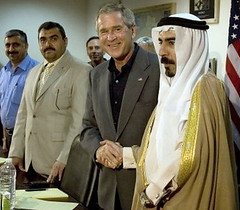
• If you want to make yourself a marked man in Iraq, take a picture of yourself shaking hands with President Bush and put it in every newspaper in the country.


...wonder if this will get a mention in tonight's speech in between all the happy talk about how Anbar is like Paris in the springtime...

Labels: , , , , ,

|

Tuesday, September 11, 2007

Day 2 in the Senate

Today's Senate hearings with Ambassador Crocker and General Petraeus have been more interesting political theater. I particularly enjoyed when Russ Feingold boxed in Crocker, who was the US Ambassador to Pakistan before leaving for Iraq, by asking him whether or not the safe haven for Al Qaeda in Waziristan is a bigger problem than Al Qaeda in Iraq. This is an important point in the overall strategy of containing and disrupting terror, which after all was given as a proximate reason to attack Iraq. Given that the former Prime Minister of Pakistan was exiled again by a President who acts like a despot, that democracy is on the brink, and that the safe havens are likely where Osama bin Laden is broadcasting new messages on the anniversary of 9/11, I think that the Pakistan question is FAR more important.

Feingold also noted that American casualties have gone up every single month this year compared to last year. Senator Boxer explained that our role has become that of an occupying force, which General Petraeus himself has explained is not optimal.

"There's a half-life on our role here, you wear out your welcome at some point. It doesn't matter how helpful you are. We aren't here to stay."


Joe Biden gave a stirring speech this morning, reframing the debate.

“General Petraeus, you say the numbers show that violence is decreasing. Others, including the independent Government Accountability Office, have different figures and contrary conclusions.

“This debate misses the point.

“The one thing virtually everyone now agrees, is that there is no purely military solution in Iraq. Lasting stability requires a political settlement among the Sunnis, Shiites and Kurds.

“In announcing the surge, President Bush said its primary purpose was just that: to buy time for a political settlement to emerge.

“And so, the most important questions we must ask are these:

Are we any closer to a lasting political settlement in Iraq at the national level today, than we were when the surge began eight months ago?

And, if we continue the surge for another six months, is there any evidence that Sunnis, Shiites and Kurds will stop killing each other and start governing together?

“In my judgment, the answer to both questions is no.


John Kerry rightly knocked down the argument that the "Anbar miracle" has anything to do with reconciliation and not sheikhs taking over control of their own territory and not giving it up to foreign jihadis, which we ALWAYS KNEW they would not allow. They're not interested in reconciliation, whatsoever.

COOPER: And are these -- these tribal groups willing to work with the central government in Baghdad, the Sunni -- the Shia- dominated government, and vice versa? Is -- is the government of al- Maliki willing to work with -- with these Sunni tribes?

WARE: The answer is no on both counts, Anderson.

These guys made it very clear to us on this day and on other days when I have contact with other groups, they are opposed to the Maliki government and any government that they believe is beholden to Iranian influence, a belief shared by many within the U.S. mission. So, these are anti-government forces that America is supporting against the government it created. And, certainly, within the Iraqi government, they believe that this is America building Sunni militias to act as a counterbalance to their influence -- Anderson.


Michael Ware also gets on the record in that report that we're arming the Sunnis in Al Anbar.

This is about buying time. But the Senate Foreign Relations Committee isn't buying it.

UPDATE: Here's Senator Feingold grilling Crocker and Petraeus.

Labels: , , , , , , , ,

|

Proof That I Watched Several Hours of Iraq Testimony

Let's be clear that the MoveOn ad is getting all of this attention because of one word: Betray. The rest of the ad makes the mainstream argument, made by almost every Democratic politician, that the facts General Petraeus are asserting to prove military progress are random numbers without sourcing. And it's been reported plenty that the White House and Petraeus are coordinating with one another. The apoplexy over MoveOn would not be nearly as great without that word, Betray.

(by the way, the LA Times runs a point-counterpoint between professional conservative operative Hugh Hewitt and former special assistant to President Reagan Doug Bandow? The hell?)

And it's instructive to note that the original construction, General BetrayUs, comes from Rush Limbaugh.

Anyway, it also appears to have been borrowed, indirectly, from Rush Limbaugh. According to a Free Republican diary, Rush took a call in January from a listener who suggested he contrast General Petraeus with Senator Chuck Betrayus -- i.e., Hagel.


Hagel is ALSO a military veteran, who left Vietnam with two Purple Hearts. So this faux shock at a group "questioning the patriotism" of an officer who wears the uniform is just precious. I guess that recently retired general cited in this story is incredibly unpatriotic, too.

It's a WORD. It was an unwise choice of words, but a word all the same. Sticks and stones. The facts are pretty simple. David Petraeus has been cooking the books, spinning whatever has been under his leadership, for some time. He's emphasizing small events and not the big picture. He's doing that intentionally, because the big picture offers no encouraging signs. A reversal of violence in Iraq in 2007 to mid-2006 levels doesn't really do much for anyone, even if it's true; 1,000 attacks a week remains an unstable security environment. You have a US Ambassador claiming that provincial government began in Anbar after security improved, yet they're also claiming that Baghdad's security has improved as well and none such provincial governments are seen. It's incoherent. The commanders on the ground are trying to thread a needle between touting grand progress and warning that the country would collapse when we leave so we must stay for years and years. As I've heard many times before, if it remains true that, the day American troops leave Iraq, the country will collapse, then we might as well leave now, because all you're doing is wasting lives and treasure. And since four years have passed with that exact same dynamic in place, I believe withdrawal is the least worst option.

Juan Cole has a provocative piece today that delves into this a bit, but is a bit more charitable than I am about David Petraeus and the purported leaders of Iraq. In fact, he hopes that they can do the impossible and build up the country so that it doesn't collapse when we inevitably leave.

But in all likelihood, when the Democratic president pulls US troops out in summer of 2009, all hell is going to break loose. The consequences may include even higher petroleum prices than we have seen recently, which at some point could bring back stagflation or very high rates of inflation.

In other words, the Democratic president risks being Fordized when s/he withdraws from Iraq, by the aftermath. A one-term president associated with humiliation abroad and high inflation at home? Maybe I should say, Carterized. The Republican Party could come back strong in 2012 and then dominate politics for decades, if that happened.

It is all so unfair, of course, since Bush started and prosecuted this disaster in Iraq, and Bush is refusing to accept responsibility for the failure, pushing it off onto his successor.

But life is unfair.

So what can the Dems do to avoid being made the fall guy this way?

They could try to legislate stronger US diplomacy aiming at ensuring peace between Sunni Saudi Arabia and Shiite Iran even if there is sectarian violence on a greater scale in Iraq. They could resist the temptation to demonize Iran or to push it onto a war footing with threats or even bombings.

As for Iraq itself, the best hope for the Dems may be that Gen. Petraeus actually succeeds, over the next year, in significantly reducing ethnic tensions. It is a slim reed to hold onto, as they recognize.

But from the moment Bush went into Iraq, Americans were screwed. And that includes the Democratic Party, which is being set up to take the fall.

I'm a severe skeptic on the likelihood of anything that looks like success in Iraq. But I don't think career public servants such as Ryan Crocker and David Petraeus are acting as partisan Republicans in their Iraq efforts. I think they both are sincere, experienced men attempting to retrieve what they can for America from Bush's catastrophe. They may as well try, since the Democrats can't over-rule Bush and get the troops out, anyway. If the troops are there, they may as well at least be deployed intelligently, which is what Gen. Petraeus is doing. I wish them well in their Herculean labors. Because if they fail, I have a sinking feeling that we are all going down with them, including the next Democratic president. And their success is a long shot.


This is a "cork in the bottle" strategy, and I think a few Democrats know it, even the Presidentials, which is why they're being more aggressive about the "great advantage to our enemies" to keeping all of these troops over there. Another year of the status quo makes Cole's scenario much more likely. We've seen a little movement today with Rep. Walsh, and Senator Lugar called out the Iraq strategy this morning.

WASHINGTON - A prominent Republican on Tuesday said he remains deeply skeptical of the U.S. war strategy in Iraq, comparing the long and bloody military campaign to a farmer risking his savings to plant on a flood plain.

"In my judgment, some type of success in Iraq is possible, but as policymakers, we should acknowledge that we are facing extraordinarily narrow margins for achieving our goals," Sen. Richard Lugar, the top Republican on the Senate Foreign Relations Committee, told the top U.S. military commander there.


Hopefully everyone gets that through their heads.

Labels: , , , , , , , , ,

|

Monday, September 10, 2007

Arming The Sunnis

I wondered about this too. General Petraeus has said that we're not arming the Sunni tribes in Iraq to go against Al Qaeda. He says we're just "applauding" them when they do a good job. What he does NOT say is whether or not we're giving these tribes money. Which me most certainly are, and money buys guns. I'm not so sure we're not eliminating the middle man and giving the weapons too. Plus there's this:

Moreover, Petraeus and Crocker are both bragging about Anbar Sunnis joining the local police force and presumably we are arming the local police force and given that Shiite militias in Shiite areas find it easy to infiltrate the local police there, it seems like the new, Sunnified Iraqi local police in Sunni areas are just going to be Sunni insurgent groups, but this time with uniforms.


Just like the Iraqi police force is a Shiite militia, only with uniforms.

Labels: , , , ,

|

Crock(er)

Ryan Crocker is trying really really hard to find the pony, without much success. He's talking about "provisional de-Baathification" (what the hell does that mean, some Shiite shared an ice cream cone with some former Baathist one time?) and trying to make a parallel between Iraq and the tumultuous gap between our Articles of Confederation and the Constitution.

It's clear what's actually happening. The assessment has been made that the political leaders won't be able to come to agreement, and that it's not even desirable if they do. So we're arming absolutely everyone to try and crate some kind of detente between the various ethnic groups. Only mutually assured destruction doesn't quite work as well as a policy between individuals. It's just going to make an inevitable civil war more deadly.

Crocker's talking about the fake agreement between Iraqi political leaders designed to save their own bacon, and this curious idea of bottom-up reconciliation, which again is arming people AGAINST a federal government, not for it.

2. What is the "bottom-up" reconciliation plan for southern and northern Iraq? Because Iraq's national political process is deadlocked, the Bush administration has tried to shift attention towards pockets of increased stability in the western al-Anbar province. This shift not only overlooks the fact that the central goal of the surge was to achieve progress in Iraq's national political process, it also ignores a deteriorating situation in the southern and northern parts of the country.

During the past six months, Iraq's south has seen escalating conflict between rival Shiite militias. In August alone, two governors of southern provinces were assassinated, militia clashes in the holy city of Karbala killed 50 people, and four top aides to the leading Shiite cleric Ayatollah Ali Sistani were murdered. These events are signs that various political groups in Iraq's Shiite ruling coalition are engaged in a deadly struggle for power. Northern Iraq is experiencing conflict between Arabs and Kurds -- much of it centered on the disputed city of Kirkuk. Will the new "bottom-up" reconciliation model address these problems?


Never mind though, because we built a couple sewers! And there's 6% economic growth! 6% of 0=0, by the way.

Labels: , , ,

|

Here Are The Recommendations

Essentially, he's buying the John Warner strategy of letting a brigade go by Christmas, and then a reduction of the surge (which has to happen anyway) by next summer. We shouldn't make any other changes for another Friedman Unit (next March).

By the way, Warner's recommendation was met with howls from the Right; now that St. Petraeus is agreeing with it, do you expect a change in tone there?

Petraeus lets his slip show here. Defending the need to wait another six months, he claims that we couldn't have known what would have happened in Anbar Province, or in other tribal areas, or with repsect to Iran (another push for the drumbeat), just six months ago. That's pretty much because WE'RE NOT DRIVING IT. The "Anbar miracle" started without us, and we've had no impact on the political situation. We're similarly going to have no impact on the future of Iraq, whether we stay for 6 months or 60 years.

UPDATE: Also, Petraeus himself predicted the "Anbar Miracle" at his confirmation hearing, before the surge even began, suggesting that we had nothing to do with said "miracle," not will we be able to meaningfully impact it in the future.

UPDATE 2: The actual plan.


It's a graphical representation of Friedman Units.

Labels: , , , ,

|

Tom Motherflippin' Lantos.

His wind-up was pretty long, but he is doing an excellent job. "Anbar Province has only 5% of the Iraqi population." "Removing a brigade is nothing more than a political whisper..." "We need to leave and we need to leave now."

Now Duncan Hunter is decrying the politicization of the Petraeus testimony by comparing any insult of him to insulting the troops ("they are going to watch how we treat him"). Right, that's not politicization. Apparently, David Petraeus is going to bring down the Berlin Wall and bring peace to El Salvador, too.

UPDATE: Lantos' statement:

Labels: , , , ,

|

Sunday, September 09, 2007

Petraeus Against The World

Beware the opinions of one man lionized for years who now sees his mission as a crusade.

For two hours, President Bush listened to contrasting visions of the U.S. future in Iraq. Gen. David H. Petraeus dominated the conversation by video link from Baghdad, making the case to keep as many troops as long as possible to cement any security progress. Adm. William J. Fallon, his superior, argued instead for accepting more risks in Iraq, officials said, in order to have enough forces available to confront other potential threats in the region.

The polite discussion in the White House Situation Room a week ago masked a sharper clash over the U.S. venture in Iraq, one that has been building since Fallon, chief of the U.S. Central Command, which oversees Middle East operations, sent a rear admiral to Baghdad this summer to gather information. Soon afterward, officials said, Fallon began developing plans to redefine the U.S. mission and radically draw down troops.

One of those plans, according to a Centcom officer, involved slashing U.S. combat forces in Iraq by three-quarters by 2010. In an interview, Fallon disputed that description but declined to offer details. Nonetheless, his efforts offended Petraeus's team, which saw them as unwelcome intrusion on their own long-term planning. The profoundly different views of the U.S. role in Iraq only exacerbated the schism between the two men.

"Bad relations?" said a senior civilian official with a laugh. "That's the understatement of the century. . . . If you think Armageddon was a riot, that's one way of looking at it."


There has been a sustained PR offensive designed to promote the message that the escalation has been universally good and that this fact is unanimously accepted by the serious people. But that's not the case, as this "bloom-off-the-rose" story proves. I believe Gen. Petraeus thinks he's being sincere but he also has a tremendous ego despite a record of failure (which makes him a perfect Bushie). His first order of business after delivering testimony on Capitol Hill is to give an exclusive interview to Fox News, fercryinoutloud. And he is leading a strategy that his superiors are so desperate to have work that they'll enter into the dumbest alliances imaginable:

Why the sheiks turned remains a point of debate, but it seems clear that the tribes resented al-Qaeda's efforts to ban smoking and marry local women to build ties to the region. "Marrying women to strangers, let alone foreigners, is just not done," Australian Lt. Col. David Kilcullen, a Petraeus adviser, wrote in an essay.

The sheik who forged the alliance with the Americans, Abdul Sattar Buzaigh al-Rishawi, traced the decision to fight al-Qaeda to Sept. 14, 2006, long before the new Bush strategy, but the president's plan dispatched another 4,000 U.S. troops to Anbar to exploit the situation. As security improved, the White House eagerly took credit.

The "Anbar Awakening" represented perhaps the most important shift in years, but it generated little debate at the White House. Long before the tribes switched sides, the administration conducted a policy exercise on how to team up with former insurgents. But when such an alliance occurred, it bubbled up from the ground with no Washington involvement. "We're not smart enough to know the course that these matters might take," Rice conceded to an Australian newspaper last week.


We're still not smart enough. Bush is betting on Sattar Abu Risha, a petty thug who is building his own militia loyal only to his tribe. And we're arming it. We're setting things up for an even more raging conflagration in the near future.

It'd be nice to see a real debate at the Petraeus hearing tomorrow and not the clown show I expect.

Labels: , , , , , ,

|