As featured on p. 218 of "Bloggers on the Bus," under the name "a MyDD blogger."
Monday, October 20, 2008
We Need To Get Debra Bowen's Back - Again
Over the weekend, we learned about YPM, the voter registration company hired by the state Republican Party which was illegally switching voters' party affiliations under false pretenses, and (this is the buried lede) changing their ballot status in a clear act of voter suppression:
Those who were formerly Democrats may stop receiving phone calls and literature from that party, perhaps affecting its get-out-the-vote efforts. They also will be given only a Republican ballot in the next primary election if they do not switch their registration back before then.
Some also report having their registration status changed to absentee without their permission; if they show up at the polls without a ballot they may be unable to vote.
Robert Cruickshank mentioned that the head of YPM has been arrested in this case and charged with voter registration fraud. In response, the Yacht Party has decided to attack Debra Bowen:
On the eve of California's voter registration deadline, California Secretary of State Debra Bowen has decided to once again show her partisan colors and charge an individual for questions surrounding his own, personal voter registration stemming from 2006 and 2007.
The fact that these charges are being leveled against an individual operating in a highly-contested area of California, and the significant gap between recent allegations and the charges we've seen today suggests that this is politically motivated.
It's clear that Bowen, herself the recipient of an ACORN endorsement (still displayed on her campaign website), has elevated these issues to achieve maximum political benefit and deflect attention from the Democratic Presidential nominee's high-profiled problems and associations with the radical community activist group ACORN.
While we condemn voter fraud in all forms, it is evident that Debra Bowen is using her office to play politics with the public's perception of political parties. This is inappropriate at least, and an abuse of her office and a willing suspension of her duties at worst.
Now, let's make clear that in the original article, YPM founder Marc Jacoby cited Bowen's work - falsely - to prove his own innocence:
He also said that plainclothes investigators for Secretary of State Debra Bowen, a Democrat, have conducted multiple spot checks and told his firm it is doing nothing improper.
"Every time, they gave us a thumbs-up," Jacoby said. "People are not being tricked."
But Nicole Winger, a spokeswoman for the secretary of state's office, said the agency "does not give an OK or seal of approval to voter registration groups."
That's an out-and-out lie, and it's completely within the purview of the Secretary of State to enforce the laws regarding voter registration. The Yacht Party is being completely disingenuous about Jacoby's illegality here ("personal voter registration" my ass), and they dredge up ACORN, which is not only unrelated to the YPM case, but a situation where paid registration gatherers were defrauding ACORN more than anything else. But it's not surprising to see the Yacht Party fan the fires of hate and use the ACORN scapegoat to answer for their own illegal activities.
And this is Yacht Party illegality. Steve Poizner paid for the YPM voter drive and put a bounty on new registrations.
This story is starting to hit traditional media. Debra Bowen did nothing but her job, and she needs to be supported. Whether you write a letter to the editor, call the Yacht Party offices (hey, here's contact information, imagine that) or just spread the word to your friends and neighbors, do something to call out Republican voter suppression today.
2) Charlie Brown (CA-04) - Charlie has been to all three Netroots Nation events, including the first two when it was known as Yearly Kos. He is a hero among this community, and he has a lot of support here. In fact, he proved it with a very well-received appearance at the Lurker's Caucus.
One of the people attending the caucus was Charlie Brown. He was there to do what a great many political candidates came to the convention to do -- speak to people, press the flesh, make them aware of his campaign and expand awareness. I was taking a seemingly arbitrary route around the room in calling on people to talk about themselves, and Charlie was one of the first people I called on.
Obviously there was a great interest in him, and there was a lively give and take between the attendants and The Colonel for about 15 minutes. He cheerfully answered questions and gave us all a good measure of him.
Now, there are a couple of things here that make this moment extraordinary to me. First of all, the odds were very slight that there were any people in this caucus who were from his home district. And this was the Lurkers Caucus, a group whose only unifying distinction is that they don't blog!! But here was Charlie, in a convention filled with bloggers, talking to the very people least likely to blog his appearance. (Yes, I'm blogging it now, but he didn't know I was going to be there...)
Secondly, after he spoke, we still had about 50 minutes of the caucus and we had resumed moving around the room, giving people opportunities to express themselves. Now, I know that Charlie was not there to share his lurking experiences. He was there to campaign. I fully expected him, and would not have blamed him in the least, to quietly slip out of the room in search of more campaigning opportunities at the convention. In fact, that's part of the reason I kind of steered the circuit of speakers to allow him to speak early. But Charlie stayed for the entire session, listening to people explain why they don't blog!
It was indicative of the respect Brown has shown for this entire community, from top to bottom, and it's what's going to make him a great Congressman from the 4th District. This is one of the top races in the country from the perspective of the netroots.
3) Debbie Cook (CA-46) - I think Debbie Cook, Annette Taddeo and Alan Grayson were among the most well-received newcomers at the event. Cook's passion for environmental and energy issues matched up perfectly with the overriding concerns of the entire conference, which helped a lot. At the Energy Panel she sat on, along with Alaska Senate candidate Mark Begich and Oregon Senate candidate Jeff Merkley, people in the room told me she was the most impressive. And Talking Points Memo was similarly taken with Mayor Cook, as can be seen in this interview for the popular site.
Cook switched her flight so she could make the Netroots candidate event on Friday night. I think she served her candidacy a great deal through this appearance, and considering that in-district donations to her campaign passed 70% in Q2, she has a lot of potential to raise her national profile online.
4) Rocky Delgadillo, LA City Attorney - Delgadillo, who lost to Jerry Brown in a primary for the Attorney General in 2006, appeared on a health care panel that I thought was the most interesting of the entire conference. I'm going to do a larger story on it, but Delgadillo's work in this area, rooting out corruption and illegal acitivity among health insurers, was justly recognized. I didn't see him walking around the conference. Here's a great diary from nyceve at Daily Kos about his efforts.
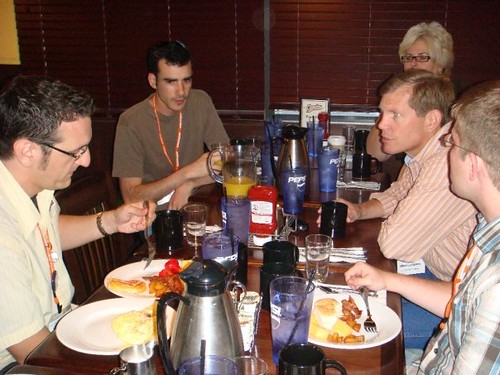
5) Mike Lumpkin (CA-52) - Calitics actually held an extended breakfast conversation with Lumpkin, running in the open seat created by Duncan Hunter's retirement. Here's a pic:
That's me, my subpar breakfast, Brian, Mike Lumpkin, and Lucas.
I thought Lumpkin was pretty good. He's a former Navy SEAL with 20 years of experience in counterinsurgency and command techniques, serving in both Afghanistan and Iraq. Notably, his plan for Iraq includes a total withdrawal of all forces, leaving no residual troops. He tends to frame most of the issues in terms of national security, which I guess is to be expected, and he talked about securing the border as well as energy security as two of his major issues on the campaign trail. Duncan Hunter's son, also named Duncan Hunter, is his opponent, and in the primary polls revealed that a substantial portion of voters thought they were casting a ballot for the incumbent, so this is not really an open seat in the traditional sense. Still, this is a race to watch, and I appreciated Lumpkin taking the time to talk with us.
6) Gavin Newsom, San Francisco Mayor - Mayor Newsom walked around the hall on Saturday, showed up at our Calitics/Alternet Books party, and introduced Van Jones on Sunday morning. Joe Garifoli has a little interview on why he attended:
Newsom is no stranger to online communication. He's been regularly courting Bay Area bloggers for stories that the uh, ahem, other news poohbahs in town aren't into. Just this week, he chatted up the city's wind power project with a handful of local and statewide bloggers. He's a Daily Kos and Huffington Post regular reader and occasional poster, and he copped to following threads around Facebook. "I really don't have time to be on there," he said of the social networking time suck.
"I'm not a convert, I'm one who recognizes the power and extraordinary influence the netroots have. Not just with politics, but it's about a different interactions with people." He went to Austin because "I wanted to understand more fully the intensity behind those names. We actually met 'Bill in Portland Maine.'"
Clearly Newsom was there to build a profile for a statewide run for governor, and I thought that was generally successful. There seemed to be a buzz around his visit as he walked the halls, and the crowd was receptive to his Sunday morning message, which focused on the environment. Some were skeptical of the message, and I hope he clarifies his position, but when I spoke with him, I found him very willing to engage on the issues. I asked about prison policy, one of my hobby horses, and while he wasn't fully informed on the topic, he expressed a need to drill down and asked me personally to provide him with whatever information I could muster. You bet I'll do so, and I respect anyone in politics willing to have a two-way conversation.
7) Nancy Pelosi, Speaker of the House - You may recall she had a little discussion with some dude on Saturday morning. That's been well-covered elsewhere. Speaking to Pelosi's staffers, I can tell you that she enjoyed the back and forth and expected MORE of a grilling, which may have been a fault of the organization or the perhaps too-respectful commenters themselves.
8) Russ Warner (CA-26) - This was Russ' second Netroots Nation, and he did his best to focus on meeting as many people as possible. I did tend to see him and his campaign staff just about everywhere. He delivered his passionate message about his son, who was in attendance, at the Netroots candidate event as well.
9) Steve Young (CA-48) - Steve is running for Congress but he's also a member of the community, and during the California caucus he was as active as anyone in participating in the discussion. The numbers he's been showing around on his race suggest there is a real chance here, and I hope he got a lot out of the event.
She's a rock star. She's going to receive the "Profile in Courage" award from Ted Kennedy this year. We really couldn't have a better evangelist for the right to vote and election integrity than Debra Bowen.
What I like about Debra is that she's focused like a laser on her core issue, and can explain it in a very lucid way. She has the ability to change the conversation about election reform. And I'm glad she's admitted the mistakes about LA County and the double bubble system and how she can learn from those and other mistakes.
Bowen makes a great point about how she has not taken a position on the election and how she should never have a role in the campaign of any election where she has to certify the results.
"I would like to see in my lifetime an automatic registration system and everyone able to cast a ballot in the manner than is most convenient for them." A very warm reception for Debra.
The best thing in the world about CA Secretary of State Debra Bowen is that the best way to reach her is through her Facebook page. So she got back to me pretty quickly when I asked about this delegate situation. I was wrong about a couple things. The vote has not been certified, although I was led to believe that the counting had to stop within 30 days of the voting, which would have been March 4. In fact, that may be true; but the county registrars have a few days left to report their results. Also, it's up to the state Democratic Party to award the delegates, but that's based on the certified vote count in the respective districts. The upshot is that the counties have to report by March 11, and Secretary of State Bowen will certify the vote by March 15. Then the CDP will award delegates based on that.
None of this should obscure the fact that, based on the current numbers, the vote count is 203-167. And the zombie lie that it's different has spread to the pages of the Washington Post:
To be sure, Team Obama's small-state strategy may have been the candidate's only option against a far-better-known opponent, and it has worked. In the Feb. 5 Super Tuesday contests that Obama's campaign staff had hoped to merely survive, Obama and Clinton just about broke even. He won more delegates in Kansas and Idaho than she won in New Jersey. Her big win in California -- with its net gain of 41 delegates -- was negated by his wins in Georgia and Nebraska.
Except the net gain is currently 36 delegates, but what the hell do I know, I'm not some big-city editor.
Republican voter registration in California is on the decline, but nowhere is the effect more pronounced than in the Sacramento region's 3rd Congressional District.
Incumbent Rep. Dan Lungren, R-Gold River, now has the slimmest registration edge of any Republican-held congressional district in the state.
According to district registration figures updated before the Feb. 5 primary election by the secretary of state's office, the Republican advantage over Democratic registration has slipped below five percentage points, 41.6 percent to 36.9 percent. Before the 2006 general election, the GOP margin was almost 6.6 points.
This was made pretty clear when the percentage of Democratic turnout in the February 5 primary was 53.1%, also the largest of any Republican-held district in the state. There's something definitely happening in this district, most of which is located in Sacramento County. The demographics are shifting and Democrats have been very aggressive in registering new voters. Debra Bowen's focus on increasing registration led to thousands of new voters placed onto the rolls before the primary, and the residual effect of that is more Democrats. They of course need to be turned out. But it's clear that Lungren is paying attention to this development. After Bill Durston launched an effort to highlight Lungren's terrible environmental record (he has a 5% rating from the League of Conservation Voters), Lungren took a walk on the most recent environmental vote in the House - a vote to eliminate subsidies for oil companies and re-route those tax breaks to renewable energy companies. Lungren obviously feels some vulnerabilities on this, and he need look no further than at Richard Pombo. The LCV listed him as one of their "Dirty Dozen" in 2006, and that year, not only did Pombo end up losing, but 9 of the 13 "Dirty Dozen" (I guess it was a baker's dozen) lost as well.
If Bill Durston could secure some outside resources like that, this could be the sleeper Congressional race of 2008 in California. Keep an eye on this one.
You might as well call it "The Lying Lounge," but I just spent a little bit of time there. It's quite surreal, all this attention paid to people who are saying the most obvious statements imaginable ("My candidate did well!"). But I sought out some of our California legislators, and tried to ask them about some of the issues outside of the debate that we talk about a lot.
• Rep. Hilda Solis: It was great to see Rep. Solis here! I wasn't aware that she was a Clinton supporter (previously she had supported Bill Richardson), and I had to look up at her sign (every "spinner" has a sign) to recognize that after she started talking to me. She said that Hillary had a good chance to explain her proposals in a lot of detail tonight, including on health care and "green jobs." I mention that she was barely given a chance to mention green jobs, and asked her what she thought about the fact that every CNN debate has been sponsored by the coal industry. "I think that's not right," she said. She went on to mention some environmental justice legislation she's co-sponsored with Sen. Clinton, and I asked her to come to Calitics and tell us about it.
• Speaker Fabian Nuñez: I didn't want to hijack the interview, but I really wanted to hear his views in the aftermath of the health care reform failure in the State Senate. Fortunately, someone beat me to it, and wound the conversation around to that. After saying that Sen. Clinton "understands the complexities of the health care crisis," he was asked about the lessons of what took place in Sacramento this week. "That was a question of our fiscal crisis. The State Senate felt we couldn't afford it, and I respect their perspective. But at the federal level, there's a way to do it in a much more flexible way and get it paid for. For all the reasons we couldn't accomplish it at the state level, you can at the federal level." I wasn't able to add the question of what concrete proposals we could get through this year. But I respect that answer, maybe because it's what I've been saying for a long, long time.
• Rep. Xavier Becerra: The Hollywood Democrat is an Obama supporter, and he talked about how to get his message out to Latino voters. He talked about how his life is an embodiment of the immigrant experience and how he has worked with those communities. I asked him about the DTS voter issue, and how to get them educated that they have to opt in to get a Democratic primary ballot, and he basically said "Yeah, we have to do that." Wasn't much of an answer there. I think this is an under-the-radar issue in this primary.
• Secretary of State Debra Bowen: On E minus-5, she seemed calm. Bowen, in her role as elections cop, is maintaining a position of neutrality in the primary. "It'll be harder in the general election," she said. I asked her, in the aftermath of John Edwards dropping out of the race, should California look into Instant Runoff Voting so that people who voted early aren't disenfranchised by having their candidate drop out. She said that's something that the parties should look into ("The Green Party would probably do it immediately"), and that it would take a good deal of voter education, too. There are studies about voters in San Francisco who didn't understand IRV and ended up having their vote eventually not count because they only filled out one choice.
Well, I made the best of it and tried to get the least lies possible.
Last night I was fortunate enough to be present at a small-group discussion with Secretary of State Debra Bowen hosted by the California League of Conservation Voters. Despite this being a hectic time for the Secretary of State (E-12, in her parlance), she took a couple hours to fill us in on efforts leading up to this year of three separate elections.
In the final two weeks for voters to be eligible for the February 5 primary, there was a surge of registration. At a "midnight registration drive" in Sacramento, over 1,500 citizens registered to vote in one day (sadly, registrars in places like Los Angeles County resisted efforts to do the same because it would be "inconvenient" for them to update their voter rolls). While she had no prediction on turnout in the primary, Bowen was confident that there will be a lot of excitement and potentially a good turnout. One drawback is the fact that decline-to-state voters have to opt-in to receive a ballot for the Democratic primary (they are shut out from the Republican primary). When I asked Bowen about this, she replied that counties are required to actually notify DTS voters of their rights, and that some precinct locations will have signage notifying them to that end, but that this is insufficient and her hands are tied by state law to some extent. The parties who want to welcome DTS voters into their primary have a big role to play in this. The Democratic Party, if they want to expand their base, should make a legitimate effort to let DTS voters know they can vote in the primary. It will have the effect of getting them in the habit of voting Democratic and give them a stake in the party. There are also legislative reforms, regarding mandatory signage inside the polling place, changes to the vote-by-mail process (nonpartisan voters must request a partisan ballot), that can be taken.
Bowen's great achievements since taking over the Secretary of State's office include an insistence on voter security, and outreach to young voters. On the security front, despite the howls of protest from county registrars, Bowen will be limiting precincts to one touch-screen voting machine (for disabled voters) and will be undergoing increased security and auditing procedures. A lot of these measures will be behind the scenes, like delivering voting equipment in tamper-proof bags so that evidence of changes to the equipment will be obvious. And the auditing procedures, with an open testing process, may delay voting results, but are crucial to maintain confidence in the vote. A court recently ruled in favor of Bowen and against San Diego County in implementing these changes, but she expects an appeal. As Bowen said, "Since cavemen put black stones on one side and white stones on the other, people have tried to affect election results." But she is doing whatever possible to make sure those efforts will be supremely difficult in California. None of her provisions so far are slam-dunks; it's hard to create something foolproof, considering that memory cards for many machines can fit in your pocket, and so many machines are hackable. But Bowen is making an excellent start.
Bowen was cool to this idea of voter fraud, which has been pushed by conservatives for years. She described that there has only been one documented case of voter fraud in recent history, and that it's a high-work, low-reward strategy for cheating. Efforts to stop this non-existent problem include voter ID laws, expected to get a boost with the Supreme Court likely to allow the one in Indiana to go forward, despite Constitutional concerns. While Bowen deflected many attempts to get voter ID laws enacted in California while on the Elections Committee in the Senate, she believed that such attempts would never pass this Legislature.
As far as reaching out to young voters, we all know about Bowen's use of MySpace and Facebook to keep young voters informed (and yes, she also reads Calitics). But one measure she talked about last night struck me. On February 5, over 140,000 California high school students will engage in a mock election, featuring a Presidential primary and three mock ballot initiatives: 1) should the vehicle license fee be ties to auto emissions, 2) should voting be mandatory, and 3) should government do more to stop bullying on social networking sites. This is an ingenious way to get people interested and excited in politics at an early age, and sounds like a model program.
We have a long way to go on national election reform; Bowen noted that only three Secretaries of State (her, and the two in Ohio and Minnesota) agree that there needs to be a federal standard for national elections. What we need to do is elect more competent professionals like Debra Bowen and keep pushing the debate in the direction of reform and voter confidence.
Our analysis of all recent primaries in New Hampshire showed that there was always a big primacy effect big-name, big-vote-getting candidates got 3 percent or more votes more when listed first on the ballot than when listed last.
Until this year, New Hampshire rotated candidate name order from precinct to precinct, which allowed us to do that analysis.
This year, the secretary of state changed the procedure so the names were alphabetical starting with a randomly selected letter, in all precincts.
The randomly selected letter this year was Z.
As a result, Joe Biden was first on every ballot, Hillary Clinton was near the top of the list (and the first serious contender listed) and Barack Obama was close to last of the 21 candidates listed.
Thus, I'll bet that Clinton got at least 3 percent more votes than Obama simply because she was listed close to the top.
At some point you just have to give up, and say that if people are that conditioned to pick the choice that appears at the top of the ballot, they get the democracy they deserve. But this speaks to the larger point of our broken elections, with its frozen servers, paper jams, hackable machines, and little in the way of backups or verifiable recount-ready systems. We need to radically rethink how we organize our elections.
One by one, states are renouncing the use of touch-screen voting machines. California and Florida decided to get rid of their electronic voting machines last spring, and last month, Colorado decertified about half of its touch-screen devices. Also last month, Jennifer Brunner, the Ohio secretary of state, released a report in the wake of the Cuyahoga crashes arguing that touch-screens “may jeopardize the integrity of the voting process.” She was so worried she is now forcing Cuyahoga to scrap its touch-screen machines and go back to paper-based voting — before the Ohio primary, scheduled for March 4. Senator Bill Nelson, a Democrat of Florida, and Senator Sheldon Whitehouse, Democrat of Rhode Island, have even sponsored a bill that would ban the use of touch-screen machines across the country by 2012.
It’s difficult to say how often votes have genuinely gone astray. Michael Shamos, a computer scientist at Carnegie Mellon University who has examined voting-machine systems for more than 25 years, estimates that about 10 percent of the touch-screen machines “fail” in each election. “In general, those failures result in the loss of zero or one vote,” he told me. “But they’re very disturbing to the public.”
This is a long and extremely stomach-turning article, which suggests that there is a tenuous nature to this democracy that we must consider. Mail it to all of your friends.
The forces trying to put the Dirty Tricks Initiative on the June ballot in California had a deadline of November 29 to gather signatures. That has passed and they still need signatures and money, but somehow the movement rages on:
Organizers had set this week as a deadline for wrapping up their petition drive, but said they had not raised the roughly $2 million needed to pay petition circulators. Secretary of State Debra Bowen had recommended a deadline of Nov. 29.
Campaign manager Dave Gilliard said that agents would work through the weekend to obtain the 434,000 valid signatures required to put the Electoral College initiative on next June's ballot and that he expected to submit the names by midweek.
Gilliard was less than certain that he would reach his goal of 700,000 names, a number allowing leeway for signatures that might be disqualified.
"We won't know until they're collected," he said.
Man, the whole initiative structure in California is weird. Bowen RECOMMENDED a deadline? Does that have any force of law? Guess not.
Initiative backers are already floating that they'll push off efforts to November, which would be fantastic, because it wouldn't come close to passing compared to catching everyone napping in a low-turnout June election. So obviously there's a lot of weakness here.
My favorite part was at the very end:
The idea of altering California's system has been discussed within Republican circles for years.
It became so serious in the 2004 campaign that California Republicans approached the Republican National Committee about it.
But the GOP and President Bush's political team concluded that Bush could win the election without the added boost that such a move would bring.
Even the BUSH campaign thought this idea was too hot to handle. Soon, these chumps will find out the same thing.
Let's turn D-Day into Court TV for a little while, shall we? There seems to be a spate of lawsuits going on in California. First, Debra Bowen has sued ES&S, a voting machine company, for selling systems that were not certified by the state to 5 counties. Bowen is simply fulfilling campaign promises here, though the company is screaming and crying about it.
Jerry Brown has made the strongest move to date against companies who profited from toxic toys made in China, suing Mattel, Toys "R" Us and about 20 other companies for "knowingly" selling the products with illegal amounts of lead.
The suit, filed in Alameda County Superior Court, alleges the companies knowingly exposed children to lead and failed to provide warning of the risk, which is required under the Safe Drinking Water and Toxic Enforcement Act of 1986, known as Proposition 65.
If the suit is successful, the companies could pay a $2,500 fine for each violation, according to the complaint [...]
The suit, which was joined by the Los Angeles city attorney’s office, also named as defendants Wal-Mart, Target, Sears, KB Toys, Costco Wholesale and others.
That could add up in a hurry, when you consider the millions of lead-filled toys in California that have been sold.
Lawyers for car manufacturers, dealers and trade associations said California's 2002 law, the model for statutes in 11 other states, amounted to a requirement for higher gas mileage, a subject that only the federal government can regulate.
Although federal law allows California to take a lead role in reducing air pollution, Congress never "intended a single state to have such sweeping authority to unilaterally set national fuel economy policy ... and profoundly affect a vital national industry," said Raymond Ludwiszewski, lawyer for a trade group of international automakers.
But U.S. District Judge Anthony Ishii suggested that the industry's argument had been undercut by a U.S. Supreme Court ruling in April upholding the federal government's authority to limit emissions of greenhouse gases.
The district judge will follow precedent here; this lawsuit is frivolous. But the point is to buy time. Meanwhile, the EPA is still foot-dragging on granting a waiver that would put the 2002 tailpipe emissions law into effect, and the state has sued the federal government over that.
How cool is it that the Secretary of State of California invited me to a worldwide protest about a country halfway around the world, and she did it on Facebook?
RED SHIRT FOR BURMA
IN SUPPORT OF OUR BRAVE FRIENDS IN BURMA: MAY ALL PEOPLE AROUND THE WORLD WEAR A RED SHIRT ON FRIDAY SEPTEMBER 28.
It's also telling that one of the first things the ruling junta did to combat the protestors was cut Internet access. In years past invading armies would bomb the radio tower.
Security forces clamped down on protests in Myanmar's two biggest cities Friday, firing warning shots and using baton charges in the third day of a crackdown that has left at least 13 people dead.
The military regime also appeared to have cut the main Internet link to block images and reports of the violence from the isolated nation, which have galvanised world opinion against the ruling generals.
About 10,000 people surged onto the streets of the main city of Yangon, playing a deadly game of cat-and-mouse as they repeatedly confronted police and soldiers before scattering and regrouping once more.
They are brave as hell. I'm wearing my red, are you?
I have an op-ed in Capitol Weekly about California Secretary of State Debra Bowen's rare achievement: actually doing what she said she would do. You can find it here.
Debra Bowen is doing what we elected her to do. After her top-to-bottom review of the voting systems in California revealed serious flaws, she acted:
In a dramatic late-night press conference, California Secretary of State Debra Bowen decertified, and then recertified with conditions, all but one voting system used in the state. Her decisions, following her unprecedented, independent "Top-to-Bottom Review" of all certified electronic voting systems, came just under the wire to meet state requirements for changes in voting system certification.
Bowen announced that she will be disallowing the use of Direct Recording Electronic (DRE, usually touch-screen) voting systems made by the Diebold and Sequoia companies on Election Day, but for one DRE machine per polling place which may be used for disabled voters. The paper trails from votes cast on DREs manufactured by those two companies must be 100% manually counted after Election Day. DREs made by Hart-Intercivic are used in only one California county and will be allowed for use pending security upgrades.
The InkaVote Plus system, distributed by ES&S and used only in Los Angeles County has been decertified and not recertified for use after the company failed to submit the system source code in a timely manner to Bowen's office. LA County is larger than many states, and questions remain at this time as to what voting system they will use in the next election.
Read the whole thing. Bowen is going up against some really powerful forces and needs out support. The registrars are going to scream holy hell about this, and we'll hear that we don't have the money to up and change everything now. That dog shouldn't hunt. I think everyone in this state, or at least a vast majority, is willing to pay for the security of our democracy.
I am a film and video editor, stand-up comedian, and blogger. My editor resume is here. A sample of my stand-up is here. The blog is what you're reading right now. Wasn't that easy?