Amazon.com Widgets

As featured on p. 218 of "Bloggers on the Bus," under the name "a MyDD blogger."

Wednesday, April 29, 2009

Will Our Attorney General Candidates Get The Prison Crisis?

Today, Chief Privacy Officer at Facebook Chris Kelly announced an exploratory committee for the race for California Attorney General. He joins a field that includes Assemblymembers Ted Lieu, Pedro Nava and Alberto Torrico; San Francisco DA Kamala Harris, and Los Angeles City Attorney Rocky Delgadillo. In his statement, which you can find at his website, Kelly talked about efficienct and effective government, Internet safety, proper training and equipment for law enforcement, and stopping trafficking. The words "prisons," "jails," "corrections" or "parole" was not mentioned.

Our prison system is a mess. We have the highest recidivism rate in the country, mostly because 2/3 of our prisoners returning to jail go there because of technical violations of their parole. This turns jails into giant holding pens instead of areas for rehabilitation and treatment, as well as colleges for nonviolent offenders on how to get involved in violent crime. The overstuffed prisons cost more money to staff and service as they become more dangerous, leading to the state spending more on incarceration than higher education. Despite all this spending, conditions in the prisons are medieval, with the ACLU proposing the closure of the LA County Men's Central Jail. Prison officials are discussing release of 8,000 nonviolent and terminally ill offenders, but that's a drop in the bucket. We also have denied prisoners their Constitutional right to health care, and have a federal receiver now remedying that situation, taking it out of the hands of the legislature. The "tough on crime" mantra that has ruled the thinking of both parties on this issue has utterly and completely failed.

And yet, our Attorney General candidates and our gubernatorial candidates view this absolute crisis as just another check on their list, instead of the serious problem it is. Gavin Newsom didn't bring it up in his speech, though I did ask him about it in the blogger meeting afterwards. He talked about how we need a re-entry strategy better than the failed parole system, and cited some re-entry reforms in San Francisco that have helped matters. And he stated that having the courts step in to fix the problem presents an opportunity for real reform. With respect to the drug war, which lies at the heart of this, he expressed his support for drug courts and mental health courts and the kind of options that wouldn't consign nonviolent offenders to the rigors of overcrowded prison life when they need medical treatment. And he vowed to have more detailed programs available soon. But when it counted, on stage, he said nothing. Jerry Brown did tackle the issue, but his non-stop fight against the prison health care receiver and sensible steps like Prop. 5 destroy any credibility he may have had on the issue.

I have appreciated Greg Lucas' interviews with some of the candidates in the Attorney General's race, and I have paid particular attention to their views on the prison crisis.

Here are Alberto Torrico's ideas to deal with recidivism:

CC: What’s the best way to reduce recidivism?

AT: First, we need to evaluate. See what programs work and don’t work. We’ve got to figure out what we’re going to do about these parolees. Put all these people out and then there’s too many parolees and too few parole officers. We can’t continue to pretend our prisons are drug rehab centers because they’re not. We need to get resources to people who can be helped and make sure when they’re tried at the local level they get put into programs that work.

I’ve been a criminal defense lawyer. I’ve been a labor lawyer. I represented a public agency. The judge tells people under Prop 36 (drug rehab law) that you’re not going to jail, you’re going to get counseling once a week for 12 weeks. You’re not going to beat an addition one hour a week over 12 weeks.


He seems earnest about lowering the recidivism rate as a financial and moral imperative, and these ideas are somewhat noble, but they read like bullet points, without the innovation necessary to really deal with this crisis. It's not just about hoping the locals solve the problem, but a strategy that focuses on rehabilitation, re-entry and alternatives to prison right at the top.

Here's Ted Lieu on the same subject:

CC: Not sure how much it costs but it has to be expensive when we parole 120,000 people a year and within two years over 70 percent are back in prison.

TL: It is a sort of downward spiraling problem. Because we have a prison-overcrowding situation we now aren’t doing any of the skills training in prison programs that teach people how to function in society when they leave prison. And then people come back to prison because they have nowhere to go and that increases the over-crowding.

I’m a big supporter of drug courts. If someone is addicted, they should get treated. When revenues are falling off a cliff its extremely difficult to fund the programs we need to help people when they get out of prison. Long-term view is that yes it costs some money now but in the long-term it would help the state save money.

If an inmate works toward a degree then they should get early release credits as an incentive to do such things. Part of the problem – and this is a much larger fix – is I think I we also need to improve our education system. If we did, we’d have less people in prison as well.


I just see a lot of people talking around the problem. I support drug courts as well, but I think there's a mindset change that's needed. The Attorney General at this point is in a position to transform the entire way we think about prisons and rehabilitation. Rocky Delgadillo gets closer to that.

CC: Speaking of costs, recidivism is very expensive. Something like 120,000 people are paroled each year and 70 percent are back behind bars within two years.

RD: We’ve got to get on the front end. One thing we know about gang members and people who have been in prison is they tend to have a shelf life it tends to end. But if they’re young and active and they go out they do it again. Why? Because in prison they get to hang out with the best in their business. And we pay for it. Great health care plan. So when they get out, they go back to it again. So the answer is to send less in.

We have a program called “First Chance.” I grew up in Northeast Los Angeles. People would say they’ll give you a second chance. You can’t have a second chance until you have a first chance. This is a program for young, but adults who get into our system. Not where they’ve done a serious crime but we know they’re involved with gangs or negative activity. We allow them to go to job training and school and if they complete it, we drop the charges. It’s a much better investment up front then to try and deal with them after they’ve been in prisons. In there, it’s an abyss.


Finally, here's Kamala Harris, who actually pre-empts the discussion by raising recidivism without being asked:

CC: What role can the Attorney General play in the state’s seemingly endless budget mess?

KH: First, critically examine how the criminal justice system is working and whether we are being most efficient with limited dollars. Here’s an obvious example: Recidivism. California has the highest recidivism rate in the country. On an annual basis we release more than 120,000 prisoners and within two years of their release 71 percent recidivate. That’s costing us a lot of money.

In San Francisco, we created a re-entry initiative in my office. Its called “Back on Track.” It’s for low-level, first-time, non-violent offenders. I brought on my friends from labor — the building trades guys — friends from the business community, non-profits, and we give the parolees job skills development, education and help them meet things like parenting needs. A lot of these young offenders are parents. We reduced recidivism for this specific population from 54 percent to less than 10 percent. The national DA’s association has designated “Back on Track” as a national model.


My vote in this crowded Attorney General's field will be almost entirely predicated on each candidate's approach to the prison crisis. Will they reverse the "tough on crime" myth and start talking about sentencing reform? Will they discuss serious options to reform parole? Will they bring up innovative strategies around re-entry and recidivism that would put the focus on rehabilitation and spend on the front end to save on the back end (Hint: check with Kansas)? Will they touch the third rail of the failed drug war by moving toward decriminalization and keeping tabs on those who commit crimes with victims instead of nonviolent drug abuse?

I eagerly await the answers.

Labels: , , , , , , , , , , ,

|

Tuesday, July 22, 2008

California Pols at Netroots Nation - A Roundup

2) Charlie Brown (CA-04) - Charlie has been to all three Netroots Nation events, including the first two when it was known as Yearly Kos. He is a hero among this community, and he has a lot of support here. In fact, he proved it with a very well-received appearance at the Lurker's Caucus.

One of the people attending the caucus was Charlie Brown. He was there to do what a great many political candidates came to the convention to do -- speak to people, press the flesh, make them aware of his campaign and expand awareness. I was taking a seemingly arbitrary route around the room in calling on people to talk about themselves, and Charlie was one of the first people I called on.

Obviously there was a great interest in him, and there was a lively give and take between the attendants and The Colonel for about 15 minutes. He cheerfully answered questions and gave us all a good measure of him.

Now, there are a couple of things here that make this moment extraordinary to me. First of all, the odds were very slight that there were any people in this caucus who were from his home district. And this was the Lurkers Caucus, a group whose only unifying distinction is that they don't blog!! But here was Charlie, in a convention filled with bloggers, talking to the very people least likely to blog his appearance. (Yes, I'm blogging it now, but he didn't know I was going to be there...)

Secondly, after he spoke, we still had about 50 minutes of the caucus and we had resumed moving around the room, giving people opportunities to express themselves. Now, I know that Charlie was not there to share his lurking experiences. He was there to campaign. I fully expected him, and would not have blamed him in the least, to quietly slip out of the room in search of more campaigning opportunities at the convention. In fact, that's part of the reason I kind of steered the circuit of speakers to allow him to speak early. But Charlie stayed for the entire session, listening to people explain why they don't blog!


It was indicative of the respect Brown has shown for this entire community, from top to bottom, and it's what's going to make him a great Congressman from the 4th District. This is one of the top races in the country from the perspective of the netroots.

3) Debbie Cook (CA-46) - I think Debbie Cook, Annette Taddeo and Alan Grayson were among the most well-received newcomers at the event. Cook's passion for environmental and energy issues matched up perfectly with the overriding concerns of the entire conference, which helped a lot. At the Energy Panel she sat on, along with Alaska Senate candidate Mark Begich and Oregon Senate candidate Jeff Merkley, people in the room told me she was the most impressive. And Talking Points Memo was similarly taken with Mayor Cook, as can be seen in this interview for the popular site.


Cook switched her flight so she could make the Netroots candidate event on Friday night. I think she served her candidacy a great deal through this appearance, and considering that in-district donations to her campaign passed 70% in Q2, she has a lot of potential to raise her national profile online.

4) Rocky Delgadillo, LA City Attorney - Delgadillo, who lost to Jerry Brown in a primary for the Attorney General in 2006, appeared on a health care panel that I thought was the most interesting of the entire conference. I'm going to do a larger story on it, but Delgadillo's work in this area, rooting out corruption and illegal acitivity among health insurers, was justly recognized. I didn't see him walking around the conference. Here's a great diary from nyceve at Daily Kos about his efforts.

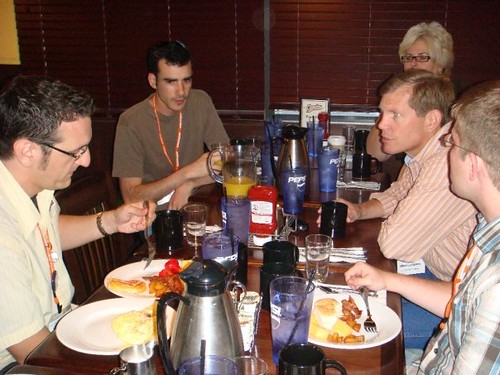
5) Mike Lumpkin (CA-52) - Calitics actually held an extended breakfast conversation with Lumpkin, running in the open seat created by Duncan Hunter's retirement. Here's a pic:


That's me, my subpar breakfast, Brian, Mike Lumpkin, and Lucas.

I thought Lumpkin was pretty good. He's a former Navy SEAL with 20 years of experience in counterinsurgency and command techniques, serving in both Afghanistan and Iraq. Notably, his plan for Iraq includes a total withdrawal of all forces, leaving no residual troops. He tends to frame most of the issues in terms of national security, which I guess is to be expected, and he talked about securing the border as well as energy security as two of his major issues on the campaign trail. Duncan Hunter's son, also named Duncan Hunter, is his opponent, and in the primary polls revealed that a substantial portion of voters thought they were casting a ballot for the incumbent, so this is not really an open seat in the traditional sense. Still, this is a race to watch, and I appreciated Lumpkin taking the time to talk with us.

6) Gavin Newsom, San Francisco Mayor - Mayor Newsom walked around the hall on Saturday, showed up at our Calitics/Alternet Books party, and introduced Van Jones on Sunday morning. Joe Garifoli has a little interview on why he attended:

Newsom is no stranger to online communication. He's been regularly courting Bay Area bloggers for stories that the uh, ahem, other news poohbahs in town aren't into. Just this week, he chatted up the city's wind power project with a handful of local and statewide bloggers. He's a Daily Kos and Huffington Post regular reader and occasional poster, and he copped to following threads around Facebook. "I really don't have time to be on there," he said of the social networking time suck.

"I'm not a convert, I'm one who recognizes the power and extraordinary influence the netroots have. Not just with politics, but it's about a different interactions with people." He went to Austin because "I wanted to understand more fully the intensity behind those names. We actually met 'Bill in Portland Maine.'"


Clearly Newsom was there to build a profile for a statewide run for governor, and I thought that was generally successful. There seemed to be a buzz around his visit as he walked the halls, and the crowd was receptive to his Sunday morning message, which focused on the environment. Some were skeptical of the message, and I hope he clarifies his position, but when I spoke with him, I found him very willing to engage on the issues. I asked about prison policy, one of my hobby horses, and while he wasn't fully informed on the topic, he expressed a need to drill down and asked me personally to provide him with whatever information I could muster. You bet I'll do so, and I respect anyone in politics willing to have a two-way conversation.

7) Nancy Pelosi, Speaker of the House - You may recall she had a little discussion with some dude on Saturday morning. That's been well-covered elsewhere. Speaking to Pelosi's staffers, I can tell you that she enjoyed the back and forth and expected MORE of a grilling, which may have been a fault of the organization or the perhaps too-respectful commenters themselves.

8) Russ Warner (CA-26) - This was Russ' second Netroots Nation, and he did his best to focus on meeting as many people as possible. I did tend to see him and his campaign staff just about everywhere. He delivered his passionate message about his son, who was in attendance, at the Netroots candidate event as well.

9) Steve Young (CA-48) - Steve is running for Congress but he's also a member of the community, and during the California caucus he was as active as anyone in participating in the discussion. The numbers he's been showing around on his race suggest there is a real chance here, and I hope he got a lot out of the event.

Labels: , , , , , , , , ,

|

Tuesday, February 05, 2008

Double Bubble Update

I just got off the phone with our pal thereisnospoon, an Obama precinct captain. He informs me that all Obama precinct captains in LA County are aware of this, and they are fanning out to poll sites to educate pollworkers about this problem.

If anyone knows about anything the Clinton campaign is doing, please email me or leave a comment and I'll update. I think this was referring to a different issue (there were other glitches reported in LA County today), but it's not encouraging:

From the inbox: This is really weird. From the Clinton campaign:

4:25 PM EST HILLARY WIRE UPDATE…

* False reports about voting problems in LA are being drudged up
– Everything is going smoothly in LA.


I hope they wake up to what's happening.

UPDATE ETC: I get emails, from the CA field director for Obama, Buffy Wicks:

Californians have reported problems voting as "Decline to State" voters, commonly referred to as "unaffiliated," "independent" or "non-partisan" voters.

Please read this email for clarification of how "Decline to State" (DTS) voters can vote in today's election for Barack Obama. Even if you've already voted, please make sure this information gets to as many voters as possible.

DTS voters have the right to vote for Barack Obama in the Democratic Presidential Primary.

DTS voters must identify themselves as DTS or non-partisan voters and ask to vote in the Democratic Presidential Primary when they arrive at their polling location. They will get instructions from a poll worker on how to vote in the Democratic Primary. If a voter gets into the voting booth and finds that he or she does not have an option to vote for Barack Obama, the voter should not cast his or her ballot. Instead, he or she should return the partially filled-out or unmarked ballot to the poll worker, and ask the poll worker to seek clarification from the supervisor at the polling location or from the County Registrar of Voters.

In Los Angeles County, DTS voters will be given a non-partisan ballot which they must take into a "Democratic" booth. They must mark both the "Democratic" bubble and the bubble for Barack Obama.

If you or anyone you know has any problems voting today, please contact the local County Registrar of Voters or one of our election protection hotlines at:

Los Angeles:
310-801-9546
310-779-0816

San Francisco/Bay Area:
415-606-6043

Oakland/East Bay Area:
510-520-5025

San Diego:
619-770-7105

Or email electionprotection@obamaca.com

Thank you for your support.


UPDATE II: The city attorney of Los Angeles, Rocky Delgadillo (who, in the interest of disclosure, is an Obama supporter), issued this statement.

Los Angeles City Attorney Rocky Delgadillo Tuesday issued the following statement in the wake of numerous reports of wide-spread nonpartisan voter confusion over Los Angeles County's "double bubble" voter ballot:

"I have heard numerous reports from voters throughout the City of Los Angeles which point to wide-spread voter confusion over Los Angeles County's so-called 'double-bubble' Decline-to-State non-partisan voter ballot. We understand this ballot is unique to the County of Los Angeles.

"In light of these reports, I am calling upon Secretary of State Debra Bowen and L.A. County Registrar Dean Logan to review the county's unique and potentially confusing ballot design.

"It would be unfortunate if non-partisan voters, confused by the county's unique "double bubble" ballot design, did not have their vote counted.

"I urge the Secretary of State and County Registrar to do everything within their power to ensure that every vote is counted, and to carefully weigh voter intent against this confusing Los Angeles County ballot design.

"Los Angeles' non-partisan voters must not be disenfranchised because of a confusing ballot design."


One important thing to remember is that the more attention that gets paid to this, the more likelihood that the registrar and the Secretary of State will act in the proper fashion to ensure these votes are counted. But these votes will not be counted tonight... keep that in mind. California is unlikely to be called in any meaningful way tonight.

Labels: , , , , ,

|