Amazon.com Widgets

As featured on p. 218 of "Bloggers on the Bus," under the name "a MyDD blogger."

Wednesday, April 28, 2010

Workers Memorial Day In Los Angeles

I'm a blogger fellow with Brave New Films on their 16 Deaths Per Day campaign for worker safety. Join us on Facebook.


Today is Workers Memorial Day, the day we remember those who have died on the job. They come from all walks of life, merely trying to get ahead and create a better world for themselves and their families. And yet, each year, thousands of people die from unsafe working conditions or hazardous duty; 16 deaths per day, in fact.


Over the weekend I attended a Workers Memorial Day event in Los Angeles, at the UCLA Labor Center near MacArthur Park. I saw the makeshift memorial to some of the 404 workers who died at their place of employment in California in 2008, adorned with pictures, flowers, and also the tools of work - cleaning supplies, a computer mouse, fruits and vegetables, a surgical mask, and paint rollers. I read about Damien Whipple, 24, who fell off a train into the tracks while working to switch out rail cars. I read about Abdon Felix, 42, who collapsed in 108 degree heat while loading grapes at Sunview Farms in Delano. I read about Carlos Rivera, a 73 year-old dockworker at the Port of Long Beach who was struck by a forklift carrying rolls of sheet metal.

Every year, worker rights and safety advocates, unionists, clergy, and the families of the victims gather in Los Angeles, to honor these workers and bring awareness of the real problem of worker fatalities. They hold a mock funeral procession around the area, to make everyone in the community aware of the issue, and to demonstrate solidarity with the cause. Leaders read names of 40 of the 404 who died, and after every name, the crowd assembled replied "Presente!" in a show of unity.

Representative Laura Richardson (D-CA) of nearby Long Beach spoke at the event. She's a former member of the Machinist's Union, and she talked about her employment history. "I worked at 'The Bomb Shelter,' a restaurant area, when I went to UCLA. I cleaned the toilets and the tables, and I never recall anyone offering me any gloves," Richardson said. "I worked at UPS, and no one offered me steel-toed shoes." She painted a picture of workers often taken advantage of on the job, of a lack of protective gear and supplies, a lack of training, a lack of empathy by forcing workers to show up even when sick or injured, upon threat of termination.

"That's why I support HR 2067, the Protecting America's Workers Act," Richardson announced to the crowd. "Even though our laws in California are better than most, they're not good enough, and the federal laws haven't been improved in 40 years."

In fact, Workers Memorial Day Coincides with the anniversary of the passage of the Occupational Safety and Health Act, and Richardson is correct - many of those statutes have not been updated for a changing workplace since their passage. "It's not good enough to put a poster on the wall," Richardson said, "we need supervisors following the law, and if they aren't they should be penalized."

We're seeing with the recent high-profile cases of worker deaths, like with the Gulf of Mexico oil rig explosion, that employers have grown savvy at beating the system and circumventing regulations. That's why they need to be strengthened and given the teeth needed to truly provide for a safe workplace.


And if anything, the recession has deepened that need. We've seen corporate productivity rise as their workforce gets reduced. Basically, most companies are producing more with less. The staffs have increased stress and that can lead to more accidents. Some advocates for hotel workers told me that hotel staff has been slashed across the board even as amenities increase and the workload rises. This can easily lead to preventable accidents.

In a proclamation today on the 40th anniversary of OSHA, President Obama recognized the need for constant vigilance in protecting America's workers:

Although these large-scale tragedies are appalling, most workplace deaths result from tragedies that claim one life at a time through preventable incidents or disabling disease. Every day, 14 workers are killed in on-the-job incidents, while thousands die each year of work-related disease, and millions are injured or contract an illness. Most die far from the spotlight, unrecognized and unnoticed by all but their families, friends, and co-workers -- but they are not forgotten.

The legal right to a safe workplace was won only after countless lives had been lost over decades in workplaces across America, and after a long and bitter fight waged by workers, unions, and public health advocates. Much remains to be done, and my Administration is dedicated to renewing our Nation's commitment to achieve safe working conditions for all American workers.

Providing safer work environments will take the concerted action of government, businesses, employer associations, unions, community organizations, the scientific and public health communities, and individuals. Today, as we mourn those lost mere weeks ago in the Upper Big Branch Mine and other recent disasters, so do we honor all the men and women who have died on the job. In their memory, we rededicate ourselves to preventing such tragedies, and to securing a safer workplace for every American.


Now OSHA merely needs the proper tools to succeed in their mission. And the Protecting America's Workers Act can provide it.

Labels: , , , ,

|

Tuesday, September 08, 2009

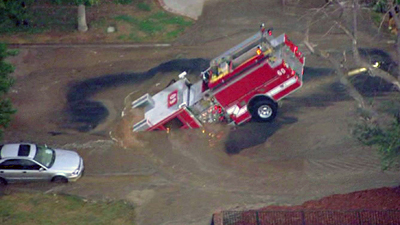
If This Picture Doesn't Sum Up California...


Over the weekend, while fire raged in the Angeles National Forest, over in the San Fernando Valley they were inundated with water. A water main built in 1914 broke and flooded Ventura Boulevard in Studio City throughout the weekend. While it reopened on Monday, today a second break on the same water main hit another section of Coldwater Canyon Avenue and produced maybe the ultimate piece of imagery - a fire truck consumed by flood. I don't think the truck was headed to La Cañada, but the inference is made anyway.

You cannot write 1,000 words on our crumbling infrastructure that capture the subject better than this. A state without the revenue to heal itself becomes a state where fire trucks sink in a flood caused by unattended 100 year-old pipes. The layers of meaning just fall into one another. This is the picture of a state that cannot fix itself.

Labels: , , ,

|

Friday, August 21, 2009

A California Economy In Free Fall

Whether it's the continued foreclosure crisis, the impact of state budget cuts or the cumulative effect of depressed consumer spending, it's now extremely clear that the state's employment picture shows no sign of bottoming out, reaching an all-time high in the post-war period.

California's unemployment rate took an unexpected leap in July, reaching a post-Word War II high of 11.9%. The increase contrasts with the national rate, which declined slightly over the same period, and reflects ongoing weakness in the state's battered construction and financial services industries.

The state lost a net 35,800 jobs last month, more than any other state, the U.S. Labor Department said today. It has lost 760,200 jobs over the last year.

Every category of nonfarm jobs in the state except education and health services experienced year-over-year losses. The construction sector was the hardest hit, shedding 18.6% of its jobs. Manufacturing jobs fell 8.7% from the same time last year.


Job loss did slow relative to the previous two months. But I don't think anybody believes that 11.9% is a floor. Los Angeles, where the jobless rate jumped 0.7% in just a month, is one of the worst big cities to find a job in America. The city has 15,000 homeless veterans. And areas of the Central Valley and the Inland Empire are in far worse shape. It's basically a depression in those parts.

And we are just starting to add a round of painful state budget cuts to increase the economic shortfall. Whether it's closing parks that provide economic benefits, or dropping or cutting aid to 100,000 IHSS recipients, or wiping out the entire domestic violence budget, the cuts will not only force the poor and infirm to slip through the cracks and cause mass suffering and even death, but the economic impact will be profound. Caregivers will lose their jobs. Relatives will shift their schedules to care for their families. Productivity will reduce. It's just a plain fact that lowering public spending during a deep recession will negatively impact the economy. Consumers aren't spending, companies aren't trading and businesses aren't investing. Government is the spender of last resort. And that spending has been slashed.

I honestly don't know where the bottom is.

Labels: , , , , ,

|

Friday, August 14, 2009

Oddly, Nobody Protests This Health Care Forum

This week, Remote Area Medical, an organization that got its start providing health care services to the impoverished in the Third World, descended on Inglewood to provide those same services to the most disenfranchised group, from a medical care standpoint, in the industrialized world - the uninsured and underinsured in America.

They came for new teeth mostly, but also for blood pressure checks, mammograms, immunizations and acupuncture for pain. Neighboring South Los Angeles is a place where health care is scarce, and so when it was offered nearby, word got around.

For the second day in a row, thousands of people lined up on Wednesday — starting after midnight and snaking into the early hours — for free dental, medical and vision services, courtesy of a nonprofit group that more typically provides mobile health care for the rural poor.

Like a giant MASH unit, the floor of the Forum, the arena where Madonna once played four sold-out shows, housed aisle upon aisle of dental chairs, where drilling, cleaning and extracting took place in the open. A few cushions were duct-taped to a folding table in a coat closet, an examining room where Dr. Eugene Taw, a volunteer, saw patients.


These were not only uninsured patients, over 1,500 in the first day alone, but underinsured patients who cannot get the services they need with their coverage.

No cable news outlet discussing health care reform and the town halls around it ever get around to mentioning this reality. In the poorest areas of this country, health care access is so nonexistent that people will wait around for days in their cars, driving for sometimes hundreds of miles, to find a volunteer clinic that they now use as their primary care physician. South Los Angeles lost one of its only health care providers when King-Drew Medical Center shut down a couple years back, and really nobody, outside of Remote Area Medical, has filled the breach. This is an absolute tragedy, and at the end of the day, it costs our medical system far more than it would to cover everyone, because nagging problems only served by free clinics every couple years eventually find their way into the emergency room. And the disconnect between this circumstance and those right-wingers yelling and shrieking across the country is striking.

The enormous response to the free care was a stark corollary to the hundreds of Americans who have filled town-hall-style meetings throughout the country, angrily expressing their fear of the Obama administration’s proposed changes to the nation’s health care system. The bleachers of patients also reflected the state’s high unemployment, recent reduction in its Medicaid services for the poor and high deductibles and co-payments that have come to define many employer-sponsored insurance programs.


Somebody should leak to one of the astroturf groups activating the right about these town halls that there will be a major Congressional event over at the Forum in Inglewood, and then sit back and watch their face sink when they show up to protest and instead encounter the horrors of this broken system.

...from a reader:

"Obama should be at this event, talking to people and forcing the media to cover it. He should even invite/dare the three health care CEOs who told Congress they would still use recission to cut costs."

This is something Digby and I just said to each other about a minute ago. He's already out west this weekend. There's no sharper way to bring forward the case for changing the system. And sure, the Malkinites will start looking up the addresses of those being helped, and if they have cell phones or TVs or granite countertops, but I think the witness of this giant line of thousands of people with no outlet but to practically beg for health care would swamp the nonsense.

Labels: , , ,

|

Sunday, July 12, 2009

Another Special Election Merry Go-Round

If you look at state economic statistics and the consistently worsening projections as each month of revenue collection goes by, you would recognize that, even if the positive talks on closing the current budget gap result in a deal, the possibility - even probability - of another deficit requiring a revision could take hold as early as this winter. That's what happened last year, and if anything the economy in the state has softened since then. At this time, the value of having a fully seated Senate and Assembly, due to the need for 54 Assembly votes and 27 Senate votes to move anything, becomes even more pronounced. Right now, we are down one Assembly seat owing to Curren Price's move to the Senate (owing to Mark Ridley-Thomas' election as LA County Supervisor last November). The CA-10 race could leave another opening if Sen. Mark DeSaulnier or Asm. Joan Buchanan emerge victorious. And in Los Angeles, an opening on the City Council may cost the Assembly another seat for a period of time.

Los Angeles voters showed a profound disinterest in the civic election in March when just 18% turned out, but there was a virtual stampede of candidates this week to run for the San Fernando Valley seat of former City Councilwoman Wendy Greuel, who won the race for city controller.

The slate of 14 candidates for the Sept. 22 special election reflects the varied geography of the 2nd District, which stretches from Studio City and Sherman Oaks at its southern border, through Van Nuys, Valley Glen, North Hollywood and Sun Valley to the rugged reaches of Sunland-Tujunga at its northern edge [...]

With just two months to raise money, a number of City Hall watchers are eyeing several strong contenders: former Paramount Pictures executive Chris Essel; state Assemblyman Paul Krekorian, a Democrat who lived in Burbank until moving this spring to Valley Glen; and Los Angeles Unified School District board member Tamar Galatzan.


Krekorian, who is an assistant majority leader, moved into the Council District but not out of his own Assembly District (Valley Glen is on the edge) to pursue this seat. If he wins, it probably wouldn't take effect until December 8, assuming that he doesn't reach 50% +1 on September 22. AD-51 (Curren Price's old seat) will have a new Assemblymember by November 3 at the latest, but Joan Buchanan or Mark DeSaulnier could reach the US Congress on the same day, and Krekorian might move to the LA city council and vacate AD-43 soon after. By the time all these special elections shake out, we'll be well into 2010.

All of this shows the need to modernize our system of filling special elections, which always seem to be more widespread in California. Wendy Greuel was elected City Controller back in March. There's little reason to drag out the search for her replacement this long. And if we had Instant Runoff Voting for the first round, we would not need to wait two months for an additional round, paralyzing state and local government and costing the state money in setting up additional elections. In the case of federal and state legislative elections, this is particularly perverse, since the way in which runoffs occur (with the top vote-getter in each party) almost always become useless races where the ultimate victor is well-known from the beginning.

Labels: , , , ,

|

Monday, July 06, 2009

Jackson Tour No Victory For LA City Budget?

Here's yet another major event - like the Lakers victory parade and various Fourth of July fireworks displays - that a city in California fears having the funds to accommodate - the Michael Jackson memorial event at Staples Center in Los Angeles.

Meanwhile, Los Angeles City Councilwoman Jan Perry said she'd "love it" if the Jacksons helped defray some of the city's expected costs associated with Tuesday's memorial, but that officials hadn't heard from the family.

Perry said the city didn't immediately have an estimate of those costs. More than 1.6 million fans registered online for a chance to attend the Staples Center ceremony, and only 8,750 names were chosen. Los Angeles officials are concerned about other fans clogging city streets.

"We're encouraging people to stay away," Perry said on CBS' "The Early Show" on Monday.


I don't think that the city leaders have entirely thought this one through. The shops and restaurants in the LA Live complex around Staples tomorrow will probably set a one-day record. Obviously the city will have to pay out some overtime for cops and the like, and traffic will put a crimp in productivity (don't expect to get anywhere near downtown tomorrow), but overall, the city stands to make money off of this, given the economic activity generated.

Still, the fact that it's almost become a cliché to discuss major California events in the context of distressed state and local budgets shows the scope of the problem.

Labels: , , ,

|

Wednesday, April 22, 2009

Waterboarding Said To Have The Ability To Send Interrogators Back In Time

Why exactly is LAist taking the bait on the latest right-wing claim that Khalid Sheikh Mohammed had to be waterboarded 183 times in one month in order to get the intelligence to foil the plot to blow up Los Angeles' Library Tower in 2002? One fairly glaring flaw with this logic is, um...

The first reason to be skeptical that this planned attack could have been carried out successfully is that, as I've noted before, attacking buildings by flying planes into them didn't remain a viable al-Qaida strategy even through Sept. 11, 2001. Thanks to cell phones, passengers on United Flight 93 were able to learn that al-Qaida was using planes as missiles and crashed the plane before it could hit its target. There was no way future passengers on any flight would let a terrorist who killed the pilot and took the controls fly wherever he pleased.

What clinches the falsity of Thiessen's claim, however (and that of the memo he cites, and that of an unnamed Central Intelligence Agency spokesman who today seconded Thessen's argument), is chronology. In a White House press briefing, Bush's counterterrorism chief, Frances Fragos Townsend, told reporters that the cell leader was arrested in February 2002, and "at that point, the other members of the cell" (later arrested) "believed that the West Coast plot has been canceled, was not going forward" [italics mine]. A subsequent fact sheet released by the Bush White House states, "In 2002, we broke up [italics mine] a plot by KSM to hijack an airplane and fly it into the tallest building on the West Coast." These two statements make clear that however far the plot to attack the Library Tower ever got—an unnamed senior FBI official would later tell the Los Angeles Times that Bush's characterization of it as a "disrupted plot" was "ludicrous"—that plot was foiled in 2002. But Sheikh Mohammed wasn't captured until March 2003.


I don't even think this "means justifying the ends" argument is germane when you're talking about breaking domestic and international laws. But as has always been the case with the torture apologists, their evidence for "success" on this score breaks down upon the slightest scrutiny. As Emptywheel, who's been all over this story, notes, even on the "ends justify the means" scale, there is no point to torture.

We already have a way to assess how much intelligence we got directly from torturing Abu Zubaydah and Khalid Sheikh Mohammed: the 9/11 Report. After all, the 9/11 Report integrates a huge amount of information from interrogation reports, and cites them all meticulously. As early as June 6, 2003, the 9/11 Commission asked for, "“all TDs and other reports of intelligence information obtained from interrogations” of forty named individuals, including Abu Zubaydah and (apparently) Khalid Sheikh Mohammed, and they used what they got in return to write their report. So if there was useful information in those reports, they presumably got it [...]

And in the case of Abu Zubaydah, such an assessment is horrifying.

In the entire 9/11 Report, just ten pieces of information are sourced to Abu Zubaydah's interrogation reports.

Ten.

And there are several other damning details that come from this analysis. One of the ten pieces of intelligence that appears in the 9/11 Report--regarding Abu Zubaydah's role running terrorist training camps--came from July 10, 2002, before the CIA first received oral authorization to use torture. Thus, it either came from persuasive, rather than coercive, techniques. Or it came from treatment that had not been legally approved.


It's horrifying enough to have apologists justify torture because of the benefits, while discounting the costs. The fact that they lie about it is just the icing on the cake.

Labels: , , , , ,

|

Monday, April 20, 2009

CA-Gov: A Look At Mayor Villaraigosa

We've had less than glowing reviews of the public comments of potential gubernatorial candidates Jerry Brown and Gavin Newsom, but there has been somewhat less talk about the other leading potential candidate, Los Angeles Mayor Antonio Villaraigosa. His re-election performance was uninspired and listless, but that's not a description of his policies.

I have said in the past that the enduring image of Villaraigosa's leadership is a crane in front of a half-finished building. Now we are seeing him tested in a time of crisis. Los Angeles has a close to $1 billion dollar deficit, and he is trying to balance cuts with continued support for labor, and the results have not been pretty. While Villaraigosa led the effort to add a penny to the sales tax for public transit, he has vowed not to raise local taxes to cover the deficit, and as a result, the mayor will cut salaries for city workers almost across the board by 10%, and LA Unified will lay off 5,000 teachers this year.

Los Angeles school district officials moved forward Tuesday with plans to lay off more than 5,000 teachers, counselors, custodians, clerks and other employees, but the battle over funding will rage on for weeks -- affecting who goes, who stays and what schools and classrooms will look like for students next year.

The Board of Education's 4-3 vote, after more than four hours of pleading and debate, closed most of a $596.1-million deficit for next year in the nation's second-largest school system.

"Anger is appropriate and outrage is appropriate," said school board President Monica Garcia, who voted with the majority. "Nobody wants to do these layoffs."


While the board, which Villaraigosa effectively bought after a series of election cycles, did spare 1,900 elementary school teachers, the layoffs will be deeply felt, particularly in those ten schools the Mayor personally controls.

In his State of the City speech last week, Villaraigosa denounced Sacramento lawmakers, yet he supports the same failed propositions that will not address the structural problems with state government, and he did nothing, of course, to move forward on any of those while Speaker of the Assembly. However, he did spend a lot of time in his speech talking about his innovative environmental policies in Los Angeles, which have had an impact.

Villaraigosa denounced the "politics of no" as he called for a green technology hub along the west side of the Los Angeles River to attract new jobs and start-up companies.

"We need to build a future in which clean technology is as synonymous with Los Angeles as motion pictures or aerospace," said the mayor, appearing at the Harbor City factory of Balqon Corp., which manufactures electric big-rigs for use at the city's ports [...]

As a centerpiece of his speech, Villaraigosa reintroduced his plan for a "green" industry corridor just east of downtown that would serve as a spawning ground for environmentally conscious businesses. The speech echoed Villaraigosa's message during his recent reelection campaign, when he promised to make Los Angeles "the greenest big city in America."

Over the last four years, Villaraigosa has pushed the Port of Los Angeles to replace up to 17,000 diesel trucks with cleaner-burning models. And at the Department of Water and Power, he has pressed officials to expand the utility's reliance on renewable sources of energy -- primarily wind, solar and geothermal power.


And that agenda could be scaled up to offer a new economic future for California. Villaraigosa selected longtime green activist David Freeman as his environmental deputy, and as a result you'll probably see some form of solar initiative along the lines of Measure B, which was defeated in March, come into law.

So there are glimmers here. But I will personally never forget Villaraigosa leaving town in 2006 for an 18-day Asian trip in the middle of the Schwarzenegger-Angelides race, and neglecting to even endorse Angelides until late in the campaign (and even then, not in Los Angeles). The Mayor has a few good ideas, has been less successful with the follow-through, and on the big structural issues has offered no vision of reform.

We still have no movement candidate in this race.

Labels: , , , , , ,

|

Saturday, March 21, 2009

California's Most Important Traffic Jam

Perhaps the most important part of Barack Obama's Southern California trip, in my view, was not hearing the perspectives of a nervous public, or checking out battery technology in Pomona, or using the bully pulpit to speak to the nation on the Tonight Show. It's that he got stuck in traffic.

He got caught in traffic on the 110. He bantered with Jay Leno. And he sought to reassure people worried about the sagging economy and the spiraling national debt.

President Obama ended a two-day swing through Southern California on Thursday, a trip that exposed him to both celebrity and everyday struggles. Like many people navigating the freeways at midday, he was briefly tied up in traffic, his motorcade wheezing along at 10 mph as he made his way from west of downtown Los Angeles to Burbank. But he also got to trade quips on "The Tonight Show" with Leno, mixing a sober assessment of the AIG bonus scandal with details about his life inside the White House.


Traffic has actually improved in the LA area over the last six months, at least in peak hours with less workers traveling. But it remains incredibly difficult to move for large chunks of the daytime, which decreases productivity and causes harmful and unnecessary carbon emissions. Los Angeles' transit infrastructure has been abysmal for so long that few remember how it was built, along streetcar lines. Increased revenue from Measure R can spark a transit revival, with a subway to the sea, a Green Line to LAX, and increased light rail and bus service throughout the region, but that will take years if not decades, especially without federal aid. And this goes back to the need for smart growth solutions to reduce the need for highway travel for work.

Clearly, the status quo is unsustainable. Just ask the guy in the motorcade stuck on the 110 last Thursday.

Labels: , , , , ,

|

Tuesday, March 10, 2009

Property Values - The Next Huge Wave Of Revenue Losses

The enactment of Prop. 13 in 1978 prohibited commercial and residential property taxes from rising as property values rose. Curiously (actually not so curiously), it did not prohibit them from falling should values fall. And as property values crater year-over-year in the housing implosion, homeowners and businesses have the ability to reassess. They have every right to do so under the law. But this is going to bankrupt California cities.

Assessors in Los Angeles, Riverside and San Bernardino counties are forecasting the first drops in property tax collections in more than a decade, presaging reduced revenues for many cash-strapped local governments.

Until now, property tax revenues had been a relatively stable source of money for cities amid a recession that has dramatically reduced sales tax intake, particularly from car dealers.

Even with the decline in home values, the property tax base in five Southland counties grew last year thanks to continuing sales and the completion of construction begun during the 2003-2006 building boom. But assessors in those counties said they have reduced the value of more than half a million properties and expect to make deeper cuts to their rolls by the summer.

This is bad news for local governments that have been relying on property tax proceeds to help make up the shortfall from reduced incomes and spending in their areas. Already, cities and counties across California have been freezing jobs, imposing work furloughs and pay cuts, postponing repairs and reducing some public services.


The reason Prop. 13 is such a disaster is that property taxes are a stable revenue source no matter what the economic climate. Unless a massive housing bubble bursts and prices collapse. Just to show you how big this is, the county assessor in Los Angeles is predicting a 1% decline in the property tax base. That comes out to ELEVEN BILLION DOLLARS. The drop in San Bernardino County, one of the ground zero sites of the housing crisis, is predicted to be much greater, nearly 6%. I can only imagine what the number is in the Central Valley, which lawmakers want declared an economic disaster area.

When you keep in mind that property taxes fund a great deal of municipal education, you can see what a major problem this is. And without structural change, not one that's fixable.

Labels: , , , , ,

|

Wednesday, March 04, 2009

LA City Election Wrap-Up

First of all, the turnout was indeed 15%, down from 28% for the primary just four years ago. That's mainly due to the top of the ticket, which was competitive last time around and featured just Antonio Villaraigosa and a bunch of tomato cans this time. But I don't think Villaraigosa should be celebrating about his performance. Despite 4 years of work as the Mayor, despite a field of underfunded nobodies, he actually got LESS votes in 2009 than he did in 2005. His support has diminished and not increased. And the seas are about to get a lot choppier.

Flanked onstage by Weiss, sometime-rival City Atty. Rocky Delgadillo and labor leader Maria Elena Durazo, Villaraigosa turned to the mounting challenges ahead from the city's looming $1 billion deficit to the possibility of widespread layoffs.

"I know these are troubled times for many of our families -- you see I've traveled around the city for the past few months and I witnessed the anxiety rising," Villaraigosa said. "I have a simple message for Los Angeles tonight, we're going to rebound out of this economic crisis and we will emerge stronger than ever."


The guy who is less likely to emerge stronger than ever is Villaraigosa. He ended up with just 56% of the vote after running a dismissive non-campaign where he refused to debate and spent almost no time in the city. One of his top lieutenants, Jack Weiss, is now in a runoff for city attorney despite spending millions on his campaign. And Measure B, the solar power initiative which the mayor backed, is too close to call at this hour, as provisionals and late absentees are tabulated.

That's an objectively terrible performance. And it should stop the Mayor from thinking about his next campaign so quickly. The enduring image of the Villaraigosa tenure is a crane alongside a half-built skyscraper. He is full of good ideas that never get the follow-through they deserve. That's what this election was like - he was already thinking about the Governor's race before finishing his re-election campaign. This may now be a fatal blow, but it doesn't look good for him. The Mayor of Los Angeles is a challenging, maddeningly complex position. It would be nice if the current occupant paid more attention to it.

Labels: , , , , ,

|

Tuesday, March 03, 2009

LA City Elections: Promise, Pitfalls, Potential For Change

Today is Election Day in LA City, and given the turnouts we've seen in other off-year elections, as well as the fact that the mayoral race, the biggest ticket on the ballot, is basically a coronation, turnout is likely to be very small, save for the wide-open 5th District City Council race, which is really anybody's to win (very unusual in LA politics). The expectation is about 15%. Despite the fact that Los Angeles actually has a fairly rich culture of political activism, from the Latino student sit-ins to recent Prop. 8 actions and hundreds more, the recent history is that city elections do not draw much of a crowd. That's a shame in a city that's larger than the total populations of many states, and it reduces accountability on the elected officials.

I don't live in Los Angeles, but I work here, and I have a conflicted view about the way the city runs. I think if every resident were forced to watch The Garden, the Oscar-nominated documentary about South Los Angeles residents being forcibly evicted from a community garden, nobody would vote for anyone currently on the City Council, least of all Mayor Villaraigosa. The film, almost a real-life version of The Wire, revealed a city government of backroom deals and power-brokers able to make their voices heard well beyond the needs of the community. You can add to that the rare bit of journalism from the LA Weekly about the City Council, and you could be convinced that the lack of accountability from the electoral process has bred a toxic atmosphere at City Hall. The likely consolidation of power that would result from Villaraigosa allies in the city attorney and city controller offices would lead you even closer to that conclusion.

Yet among the morass, there are some very earnest public servants trying to manage a very unwieldy city, with a host of unique problems and challenges that would vex any lawmaking body on Earth. Set aside this year's $1 billion dollar budget; the problems of immigration, gang violence, income inequality, traffic, health care, air pollution, education, and much, much more all converge in this city. From 10,000 feet these problems look intractable, and yet there are gradual, slow steps toward mitigation, and even areas where Los Angeles is a national model. The sales tax receipts from Measure R may finally bring sustainable transit infrastructure to fruition for more than a handful of the city's residents. The Green Trucks Program is an innovative, first-in-the-nation effort to bring labor and environmental groups together to reduce pollution, create living wage jobs and help save the planet. And the city's Green Jobs Training program is seen as so potentially game-changing that it was used as a model in a White House staff report from their Middle Class Task Force:

The City of Los Angeles has undertaken or is in the midst of undertaking several initiatives that, together, begin to constitute a model for how cities can maximize the benefits of “going green” for working families. As is often the case, necessity was the mother of policy innovation. A few years ago, the city faced a number of stark challenges including: a state renewable energy mandate (a statewide “portfolio standard” requiring 20% renewable energy by 2017) and a state cap on greenhouse gas emissions; an impending shortage of skilled construction workers; entrenched poverty and joblessness in many low-income neighborhoods; and toxic levels of diesel pollution that were imposing huge health costs and blocking the growth of the nation’s largest port complex.

In the past year, Los Angeles has adopted a comprehensive approach to redevelopment which will ensure that city-subsidized development projects are built green and serve as vehicles for moving low-income residents into middle-class construction careers. The Port of Los Angeles has also begun to implement a comprehensive solution to freight-related air pollution that will increase efficiency, enhance security, and improve work conditions and living standards for port truck drivers. Most important is the fact that these initiatives are being undertaken on a large scale: the city’s construction policy is expected to impact 15,000 jobs over five years while the Clean Trucks Program (discussed below) could affect as many as 16,000 port truck drivers.

In 2008, the City of Los Angeles Community Redevelopment Agency (CRA) adopted a landmark policy designed to protect the environment, safeguard the interests of taxpayers, and ensure that city-supported projects create good construction jobs and career pathways for city residents. The Construction Careers and Project Stabilization Policy establishes minimum labor standards and a process for avoiding labor disruptions by means of a master agreement between the CRA and local building trades unions. The policy requires participating contractors and unions to make construction job opportunities available to local residents, including individuals who face barriers to employment such as a criminal record or a limited education.

The policy is being implemented alongside a requirement that large subsidized projects meet the U.S. Green Building Council’s Leadership in Energy and Environmental Design (LEED) standards. In this way, city leaders have begun to lay the foundations for building a green-collar construction workforce in Los Angeles. The UCLA Center for Labor Research and Education
projects that the policy will make at least 5,000 apprentice-level construction jobs available to residents of neighborhoods with high levels of unemployment over the next five years. At least 1,500 jobs are expected to go to individuals who might otherwise remain homeless, unemployed, dependent on welfare programs, or caught up in the criminal justice system. But the most important result of the Construction Careers policy will be to leverage public investments in economic development to turn short-term jobs into long-term careers in the construction industry.


I wish there was more structural accountability in Los Angeles, from the Mayor on down. I wish the city wasn't so dominated by big-city machine politics and red-letter projects that often fail to follow through on their promise. And where criticism is warranted, I'm sure to be first in line. But Los Angeles is a very complex and hard-to-pigeonhole place, and that is true of its politics as well.

Labels: , , , , , ,

|

Monday, February 09, 2009

Crips And Bloods: The Manifestation of a Failed Prison Policy

The Stacy Peralta-directed documentary Crips And Bloods: Made In America looks at the history of gangs in South Los Angeles over the last 50 years, and the violent civil war on the streets that has raged for the past 30, killing as many as 15,000 residents, three times as many as in the Unionist/Catholic war in Northern Ireland in the 1970s and 80s. Anywhere else in the world, UN peace negotiators would be brought in and Security Council resolutions passed to stop the violence. In South Central, the battles continue, and children growing up among the chaos, according to a recent RAND Corporation study, have higher rates of PTSD (post-traumatic stress disorder) than children growing up in Baghdad.

One of the more amazing things about the documentary is that, despite unparalleled access to the gang-bangers surviving on the streets over the past 30 years, there is precious little about the actual feud between the Crips and Bloods. Most of the history of why they fight and why they kill has been lost in the minds of the young leaders on both sides who suffered an early death. Crips and Bloods shoot and get shot largely because they are supposed to oppose one another. Wearing the wrong colors in the wrong neighborhood is a death sentence, but it's unclear why. At one point, one of the original gang leaders, Masuka, says that "one of the ways the oppressor state functions is by turning the subjects against one another."

The story traces gang culture from the earliest days, through the Watts riots of 1965, the Black Power movements of the late 1960s and early 1970s, and the rise of the Crips and Bloods, as South Los Angeles fell into a self-perpetuating cycle of decay and despair. After the major factory jobs left in the early 1960s, residents were without opportunity and without hope. Crack cocaine and other drugs eventually became the only economic salvation. And it led to violence and warfare in the streets.

The most revealing sequence in the film comes when every current gang member is asked about their childhood, and they all - to a man - respond that they were products of a broken home, without fathers, with the family members who raised them selling drugs out of the house, caught at an early age without positive role models or figures to enable their own empowerment. Those living in South LA with strong family units had mothers and fathers who kept them off the streets and away from the gangs. Those without had little hope. And this is a very direct consequence of an insane prison policy that locks up nonviolent offenders, particularly in the black community, at absurdly high rates. One out of every four black men will be imprisoned at some point in his life, and particularly in California, the inability of the system to handle all the warehousing of inmates leads to a lack of rehabilitation and an expanded recidivism rate. In fact, the explosion of gang activity inside the prisons ensures an increase outside the jail. This revolving door in and out of prison rips apart families and leads to a sustained cycle of gang activity and violence. The "war on drugs" is unquestionably a war on people of color and the lower classes.

That is the faillure we are talking about when we look at California prison policy, a failure that will now lead to mass release in the absence of leadership in Sacramento. Policymakers would rather lock away the problem instead of facing the terrible blight in the black community. Indeed, they have locked up these people inside AND outside of prison, confining them to the few miles in South Central that is their turf; there are stories in the film of young gang members who have spent their entire lives in a 10-block radius. The border between South Central and suburbs like Lynwood and South Gate has been a virtual pen for black youth for 50 years, with anyone crossing the border risking a beating or even their lives. We built communities that are prisons, through restrictive housing covenants and police directives to "maintain order". This is what created gang life, out of mutual protection from whites. And what now sustains it is not only the locking up of parents from sons and daughters, not only the locking up of blacks inside ghettos and away from opportunity, but the locking up of minds, the locking in of self-loathing and the snuffing out of the flame of hope.

While South LA is now as Latino as it is black, the difficulties for residents and the ravages of gang life remain. While violent crime has decreased since 1992 it remains unspeakably high. As we look at prison policy in California, and in particular the efforts by elites in Sacramento to block any meaningful reform, despite bending over backwards from federal receivers to work out agreements that allow for inmates to retain their Constitutional rights to be free from cruel and unusual punishment, we need to think about the Crips and the Bloods, about why they persist, about why they fight, and about why we made them.

Labels: , , , , , ,

|

Wednesday, December 03, 2008

Looking Beyond Funding In Education Reform

The fairly spectacular flameout of LAUSD superintendent Adm. David Brewer, hailed as a savior for the district just two years ago and now on the verge of being fired by the school board, could perhaps provide a valuable lesson to progressives about education policy. Too often the focus is solely on finances - protecting education funding, fighting fee hikes at colleges and universities, spending X amount per classroom. These are noble and important goals, with far-reaching effects; a report today shows that college may become unaffordable for the vast majority of incoming students, which is totally unacceptable and would cause a virtual caste system in this country. But Brewer's tenure shows the pitfalls of this focus at the expense of proper management and development, which is simply a disaster in Los Angeles, the state's largest school district and one of the largest in the nation. A lot of it has to do with internal politics. Antonio Villaraigosa spent millions to put his acolytes on the school board, and Brewer was seen as a legacy of the past. There was a Solomonic gesture to make everyone happy, and it made things worse.

Eventually, Brewer's accumulated missteps -- and his dismaying lack of prowess -- led to an arrangement in which he ceded much of his authority while preserving the illusion of his leadership, a revision of his job description that avoided roiling the city's ever-tenuous racial politics. Senior Deputy Supt. Ramon C. Cortines was hired in April to oversee academic matters for the district, while Brewer continued to preside over administrative matters such as payroll and construction; Brewer also acts as a public figurehead and attends the protracted board meetings. This is classic Los Angeles politics: Administrative and racial comity is achieved by paying two superintendent-level salaries for one complete superintendent-level package. It also typifies all that is wrong with L.A. Unified. The district protects administrators who fail rather than students whose futures depend on a solid education.

For his part, Brewer was overconfident about his ability to navigate the political shoals that lay ahead. Shortly after starting his job, he was confronted with an enormous payroll snafu, as a new computer system put in place by his predecessor repeatedly spat out inaccurate checks -- for months, some teachers were overpaid, some paid not at all. Though Brewer tackled the problem competently, he also compounded it, first by trying to blame district employees for the mess and then by hiring expensive and ineffectual public relations consultants to spin a new image for the district.


On Which Way, LA last night, one guest reported that the Administrative newsletter had to be scaled back to a 10th-grade reading level because it was causing difficulties for the TEACHERS. And there were a lot of horror stories about the composition of the district political architecture itself. These are not all questions of finance, and many positive steps could be achieved for students without an appreciable amount of funding, or cutting back on needless public relations spending. This CAP report about teacher tenure and high-poverty schools might be a good place to start.

I think we need to have a broader conversation about education policy than "protect our school money," is all I'm saying.

Labels: , , , ,

|

Tuesday, December 02, 2008

Now You Get To Hear About My Morning Commute!

An indulgence, please, for some local radio blogging.

KCRW-FM (89.9 in LA) has undergone a facelift. Taking leave is Nic Harcourt, who broke several major acts on his flagship show Morning Becomes Eclectic, but who had a tendency to feature one treacly singer-songwriter after another and take the notion of the "exclusive track" to ridiculous heights - my common parody of him would include the line "New music there actually recorded in my basement at home and never released." In his place is Jason Bentley, who hosted the great show Metropolis at night, which mainly stuck to electronica. Yesterday was Bentley's first Morning Becomes Eclectic, and I expected him to liven things up a bit, which he did, but by such a small degree that you might not notice a change were it not for the loss of the British accent. I do have faith in Bentley to bring a little more heat to the morning and put the "eclectic" back in Morning Becomes Eclectic.

By the way, the DJs at KRCW have their Top Ten albums of the year up, and it's definitely worth a look. Good resource if, like me, you have forgotten to buy music since January.

Labels: , , ,

|

Tuesday, November 18, 2008

Wildfires And The Urgency Of Combating Climate Change

While this recent spate of wildfires have been put relatively under control today, the devastation is pretty severe. The number of houses destroyed in Yorba Linda shot up yesterday, the fire in Montecito claimed several dozen more homes, and the mobile home park in Sylmar is a near-total loss.

Even without getting back to his home, Mr. Grieb is fairly certain that all is lost.

He and his neighbors have seen aerial photos of the devastated development and, in stark black and white, a chalkboard at an evacuation center lists the homes, by lot numbers, that were spared. About 124 out of 600 homes are on the list, and Mr. Grieb’s home is not among them.

For the park’s residents, it was as if an entire village had vanished in the flames.

“I used to refer to it as our little Mayberry,” said Tracey Burns, 47. She and her partner, Wendy Dannenberg, 46, lived in Oakridge for 15 years. Ms. Burns’s parents lived nearby in a part of the complex that was spared by the fire.

“It was just a very nice community,” Ms. Burns said. “Someplace safe with a lot to offer from the pool to the tennis courts to bingo on Tuesday nights. It was a very nice way of living. People waved not because they had to but because they wanted to. We always took offense to people calling it a trailer park because you had a yard, a porch, a garage, a garden. It was a home, not a trailer.”


While some scientists are dismissing the idea that climate change has something to do with the increasing frequency of fires in the region, clearly the reduction of the snowpack in the Sierras, combined with the extended drought conditions, have extended the fire season to the point where it is year-round and unsustainable. And that is expecteed to only worsen in the future.

The current drought in the Southwest may simply be part of the normal cycle of wet and dry spells. But looking over the next century, Cayan said, regions with a Mediterranean climate such as Southern California are expected to get drier.

"I have to believe that is going to make us more vulnerable to some of these more intense fire episodes."


While the relief efforts of the local communities are admirable, it's simply not sustainable to have major parts of the region go up in smoke at regular intervals. We have barely enough money in the kitty to provide basic services, let alone a year-round fire season.

Through global warming, we have now fire season all year round. We used to have fire seasons only in the fall, but now the fire seasons start in February already, so this means that we have to really upgrade, have more resources, more fire engines, more manpower and all of this, which does cost extra money.


The scientists may want to be circumspect, but this is global boiling, a consequence of rising temperatures and a drier climate. And while myopic conservatives like Dan Walters don't realize it, a massive shift to green technologies is essential for financial reasons as well as environmental ones. Fighting massive fires costs lots and lots of money that can be avoided if we reduce emissions and protect the planet. Backwards-looking folks like Walters always examine the up-front costs while paying no attention to the externalities. Burning the earth has severe monetary consequences, and on the flip side, creating greener ways to power our lives and transport our people is exportable technology that can make California a global economic leader.

Of course, it's going to take more than one state, and fortunately we have a new President-elect who understands the need for immediate action. Not only is he raising money for relief organizations helping with the current wildfires, but today he made a surprise appearance at the Bi-Partisan Governors Global Climate Summit in Los Angeles, calling for "a new chapter of American leadership on climate change." I've put the video and transcript below. We finally have leadership to heal the planet, which is as beneficial for California as it is for anywhere in the country.


Let me begin by thanking the bipartisan group of U.S. governors who convened this meeting.

Few challenges facing America - and the world - are more urgent than combating climate change. The science is beyond dispute and the facts are clear. Sea levels are rising. Coastlines are shrinking. We've seen record drought, spreading famine, and storms that are growing stronger with each passing hurricane season.

Climate change and our dependence on foreign oil, if left unaddressed, will continue to weaken our economy and threaten our national security.

I know many of you are working to confront this challenge. In particular, I want to commend Governor Sebelius, Governor Doyle, Governor Crist, Governor Blagojevich and your host, Governor Schwarzenegger -all of you have shown true leadership in the fight to combat global warming. And we've also seen a number of businesses doing their part by investing in clean energy technologies.

But too often, Washington has failed to show the same kind of leadership. That will change when I take office. My presidency will mark a new chapter in America's leadership on climate change that will strengthen our security and create millions of new jobs in the process.

That will start with a federal cap and trade system. We will establish strong annual targets that set us on a course to reduce emissions to their 1990 levels by 2020 and reduce them an additional 80% by 2050.

Further, we will invest $15 billion each year to catalyze private sector efforts to build a clean energy future. We will invest in solar power, wind power, and next generation biofuels. We will tap nuclear power, while making sure it's safe. And we will develop clean coal technologies.

This investment will not only help us reduce our dependence on foreign oil, making the United States more secure. And it will not only help us bring about a clean energy future, saving our planet. It will also help us transform our industries and steer our country out of this economic crisis by generating five million new green jobs that pay well and can't be outsourced.

But the truth is, the United States cannot meet this challenge alone. Solving this problem will require all of us working together. I understand that your meeting is being attended by government officials from over a dozen countries, including the UK, Canada and Mexico, Brazil and Chile, Poland and Australia, India and Indonesia. And I look forward to working with all nations to meet this challenge in the coming years.

Let me also say a special word to the delegates from around the world who will gather at Poland next month: your work is vital to the planet. While I won't be President at the time of your meeting and while the United States has only one President at a time, I've asked Members of Congress who are attending the conference as observers to report back to me on what they learn there.

And once I take office, you can be sure that the United States will once again engage vigorously in these negotiations, and help lead the world toward a new era of global cooperation on climate change.

Now is the time to confront this challenge once and for all. Delay is no longer an option. Denial is no longer an acceptable response. The stakes are too high. The consequences, too serious.

Stopping climate change won't be easy. It won't happen overnight. But I promise you this: When I am President, any governor who's willing to promote clean energy will have a partner in the White House. Any company that's willing to invest in clean energy will have an ally in Washington. And any nation that's willing to join the cause of combating climate change will have an ally in the United States of America. Thank you.

Labels: , , , , , ,

|

Sunday, November 16, 2008

The Fires

Here in Southern California, if you sit outside for more than half a minute you're bound to see some pieces of ash falling on your head. The entire region is bathed in a film, the air quality is miserable, and the horizon is barely discernible. Two fires - one in the northern San Fernando Valley in Sylmar, another south in Orange and Riverside counties in the Chino Hills area - have devastated local communities, burning hundreds of homes to the ground, including an entire trailer park. Today, despite more favorable conditions, hundreds more homes have been burned and thousands evacuated.

More residents of Southern California were urged to leave their homes Sunday despite calming winds that allowed a major aerial attack on wildfires that have destroyed hundreds of homes and blanketed the region in smoke.

Fires burned in Los Angeles County, to the east in Riverside and Orange counties, and to the northwest in Santa Barbara County. More than 800 houses, mobile homes and apartments were destroyed by fires that have burned areas more than 34 square miles since breaking out Thursday.

No deaths have been reported, but police brought in trained dogs Sunday morning to search the rubble of a mobile home park where nearly 500 homes were destroyed. No bodies had been found by midday.

"This has been a very tough few days for the people of Southern California," Gov. Arnold Schwarzenegger said after touring damage.


Our best to the firefighters on the front lines.

Labels: , ,

|

Thursday, November 06, 2008

Massive Protest At Mormon Temple In Los Angeles

Lots of people are angry about the passage of Prop. 8 and they are just channeling that anger organically. One of the results has been street protests, and today's blocked Santa Monica Boulevard.

Hundreds of people protesting California's new ban on gay marriage demonstrated outside a Mormon temple in Westwood on Thursday, blocking traffic on a major boulevard.

The protesters claim the Church of Jesus Christ of Latter-day Saints spent millions to air deceptive advertisements in support of Proposition 8, which passed on Tuesday with 52 percent of voters casting their ballots to define marriage as a heterosexual union.


If you're unfamiliar with LA, that is a HUGE temple.

There is other talk of boycotting Utah and Marriott hotels, and further street actions. This is how civil rights movements typically mature. And many are correct in the previous thread in saying that rights are not usually put to a vote. This is all being done haphazardly. Will a leader emerge from this movement?

Labels: , , , , ,

|

Monday, October 27, 2008

Three Looming Battles in California

I know that we all have to be focused on the final eight days of this election, and I'm committed to bringing a great victory for Senator Obama, wins up and down our Congressional and legislative targets, and progressive values embodied in passing high speed rail and beating back the extremism of Props. 4, 6, 8, and 9. But there are some events on the near-term horizon that we all need to be aware of going forward. The challenge does not end on November 4. Eternal vigilance, price of liberty, etc.

• Rick Caruso, a right-wing Bush Republican developer who created the great eyesore that is The Grove in Los Angeles along with Americana at Brand in Glendale, is seriously considering a run for LA Mayor. Right now, there will either be a legitimate election between Caruso and Antonio Villaraigosa, or Villaraigosa will win in a walk. Caruso, a billionaire, says he will make the decision by the end of the week. Caruso would certainly self-fund and would have the ability to basically buy the seat if he were so inclined. Richard Riordan was able to win as a Republican and I have no doubt that Caruso could as well. He'd play it moderate on social issues over which the mayor has no jurisdiction, and mask his true colors as a right-wing plutocrat. As we head into an economic downturn, Caruso would be simply horrendous for the biggest city in the state.

• Not only has Arnold Schwarzenegger already tipped off his next move after redistricting reform (and he shouldn't be counting his chickens), but the ballot initiative has already been filed. A measure calling for open primaries has been handed in to the Secretary of State. Instead of a primary where the top vote-getter in each party would move to the general election, open primaries would move the top two regardless of party into the general. Candidates would also be allowed to remove their party affiliation from the ballot. The Governor's office is saying they have nothing to do with this filing, but color me skeptical. We've already beaten the open primary concept at the ballot box at least once in recent years. The political culture is already too diffuse to allow a candidate to hide their party affiliation at the ballot, and the success of this idea in providing competition to the political process is more than mixed.

• And then there's the Governor's race in 2010. That gadfly Willie Brown is telling anyone who will listen that Dianne Feinstein is a legitimate candidate and is seriously considering the race:

She didn't tell me outright that she's running. She talked a lot about how she wanted to make sure the Democrats have 60 seats in the Senate after Nov. 4 so they and Barack Obama will be filibuster-proof - assuming he's elected as well.

But she didn't talk about staying in the Senate, either.

She talked about how things are supposed to work between the Legislature and the governor, and she wondered why they aren't working these days - and did I have any formula for fixing it?

She even brought notes. I don't know who prepared them, but somebody had done what appeared to be a detailed briefing paper on the state of California, including its finances.

It was not the kind of information you'd be seeking unless you figured that dealing with that mess might soon be your job.


Good thing she's asking Willie Brown on how to fix Sacramento. I'm sure that appealing to the state's high Broderists would be the only way she would ever govern. God forbid she ask her constituents.

Let me be perfectly clear. Dianne Feinstein cannot be allowed to ever assume the Governor's mansion. She has stabbed Democrats in the back time and again in the US Senate and would only do the same as Governor. A perfect example of this is her cutting an ad for No on Prop. 5, putting her face out in front of a position DIAMETRICALLY OPPOSED to the consensus view of the state Democratic Party. It's not surprising; DiFi is the original "tough on crime" Democrat, and policies like the ones she advocates have caused a terrible crisis in our prisons where we are routinely violating the Constitutional rights of our citizens and bankrupting the state to pay for this warehousing. And yes, Jerry Brown's no good on this either; there's a political class of Democrats that think being tough on crime is the right thing to do, despite thirty years' worth of failure reflected in our current prison mess.

Compare this to our other Senator from the state and how she's been busying herself this campaign season - raising hundreds of thousands of dollars for potential Senate colleagues, sending a mass email to her entire list urging a No vote on Prop. 8 (good for Sen. Boxer) and writing the Treasury Department to demand that the government backstop the bad deals of AIG that would absolutely cripple public transit across the state. That's what a Senator that has respect for her constituents would do, not the contempt that Sen. Feinstein shows.

So, those are the looming battles.

Labels: , , , , , , , ,

|

Saturday, October 18, 2008

MTA Cutbacks At Precisely The Wrong Moment

Measure R on the Los Angeles ballot would impose a 1/2 cent sales tax on county residents to pay for increased transit lines and services. This couldn't come at a more crucial time, as the MTA is poised to become a casualty of the financial crisis:

The next potential victims of the nation's credit crunch: nearly 1.5 million people who ride buses and trains each weekday in Los Angeles County. Transit officials say riders could soon be facing serious service cuts.

That's because the Los Angeles County Metropolitan Transportation Authority might have to quickly come up with hundreds of millions of dollars to pay investors under terms of deals it made involving American International Group, the troubled financial and insurance giant.

"I've lost a lot of sleep over this," said Terry Matsumoto, the chief financial service officer and treasurer for the MTA. He said it was "absolutely" certain the agency would have to cut service if the deals sour.


The state is already cutting transit funding in the budget, and sales tax revenues, which already partially fund the MTA, are seizing up, as the economy slows and job loss increases (fortunately unemployment flattened out in September, albeit at 7.7%).

This is not the time for cutbacks in service at the MTA. Ridership is at record highs, as people both avoid still-high gas prices (historically speaking) and more attention is paid individually to greenhouse gas emissions. The Air Resources Board just released their final draft for compliance with AB32, and I can't see how they could possibly reach their goals for greenhouse gas emission cuts without an increase in transit. That includes passing high-speed rail, of course, but obviously the existing transit structures, can't be pulled back at this important time.

Speaker Bass has been calling for the Governor to prioritize a federal stimulus package and has also been making noises about a state-based stimulus as well. That has to include protections for transit concerns like the MTA, and increased funding flowing to them as well. It's a job creation engine, an economic sustainability engine, and an engine to a better environment.

We can all do our part in Los Angeles County by passing Measure R as well.

Labels: , , , , , , ,

|