Amazon.com Widgets

As featured on p. 218 of "Bloggers on the Bus," under the name "a MyDD blogger."

Saturday, July 11, 2009

The Post-IOU World

Today is the first day that most large banks stop taking IOUs from individuals and small businesses. For those left holding them, the options are limited. Citibank agreed to a one-week extension, and Bank of the West will accept them - but only for existing customers. Other big banks may offer lines of credit or other short-term bridges for customers, but on a case-by-case basis. IOU holders needing cash might be able to try credit unions, or inevitably, check-cashing stores. And this all appears to suit Arnold Antionette just fine:

State Treasurer Bill Lockyer tried to persuade the big banks to change their minds about the IOUs. "We're just trying to convince them that it would be in the best interest of their customers and the best interest of taxpayers to give it more time," said his spokesman Tom Dresslar.

Gov. Arnold Schwarzenegger made no such attempt at persuasion. "His focus is to get a solution to our budget so we don't have to deal with IOUs," said his spokesman Aaron McLear. "I don't think it was anyone's expectation that they would honor them forever."

Emerging from a meeting with legislative leaders Friday, the governor would say only that "IOUs are one more reason to get the budget done as quickly as possible."

In 1992, the last time the state issued IOUs, the major banks accepted them for about a month. Their refusal to go any further was widely seen as a move to pressure officials to pass a budget.


Yes, of course, this is why he vetoed solutions that would have stopped the issuance of IOUs in the first place.

Meanwhile, John Chiang's latest release of the state economic picture shows a $10 billion dollar shortfall in Fiscal Year 2009, and a still-contracting revenue picture that has led to a $4 billion dollar delay in payments to local school districts. They has planned on sending out the money Friday; now they will hold off until July 30.

And the Big Five have returned to the negotiating table today, where they claim "constructive" negotiations, which we've heard plenty of times before. No word on whether the Governor continues to hinge a budget deal on uncorroborated fictions about fraud in social services or fiscally unwise cuts to programs like welfare.

Labels: , , , , , ,

|

Wednesday, February 04, 2009

Yacht Party Wankers Of The Day

Two nominations here. By the way, since it recently came up in comments, the reason we here at Calitics call the California Republican Party the "Yacht Party" can be best explained here and here.

Nominee #1: Sen. Roy Ashburn of Bakersfield, who introduced a bill that would eliminate IOUs for tax refunds.

State Sen. Roy Ashburn, R-Bakersfield, has introduced legislation requiring California’s controller to issue state income tax refunds in cash.

Controller John Chiang has announced his office will have to delay refunds for 30 days starting Feb. 1 because of the state’s cash-flow problems. He has threatened he may have to issue refunds in the form of IOUs if a budget addressing the $41 billion shortfall the state’s projected to have by mid-2010 isn't passed.

Chiang has said refunds will resume when he’s sure there’s enough state cash on hand.

Ashburn has said tax refund money belongs to the taxpayers, not the government, and taxpayers should get it back in the form it was paid — “cold, hard cash.” California’s constantly taking in cash, he’s said.


Hey Roy, I know a bill you could pass that would get cold hard cash back in the hands of your constituents. It's called the budget, and without it California is out of money, and fiduciary responsibilities (sorry for the $1 word) stipulate that other priorities must be paid first. It's called "how government works," and though you're a State Senator I'm not surprised at your ignorance.


Nominee #2: Faux-moderate Abel Maldonado, angry about the Controller's office "requesting new furniture" even though the current Controller, uh, didn't do that.

"I don't like the fact that hard working people in my district are getting IOUs and he's buying millions of dollars worth of furniture," Maldonado said in an interview. (For the record, taxpayers due refunds from the state and others missing payments aren't getting IOUs just yet. They're simply not receiving anything at all.) [...]

Chiang's office struck back, calling Maldonado's accusation "pathetic."

"Had he done any homework, the senator should have realized that the expansion project, including furniture,...began before Controller Chiang took office," his office said.

Further, Chiang's office argued, the controller "demanded that staff cut down the costs, and by changing financing, materials, design, and construction, reduced the overall expense of the project by more than 50 percent" - a $4 million savings.


Next for Maldonado, he'll lambaste Arnold Schwarzenegger for Prop. 187. Wanker.

Labels: , , , , ,

|

Sunday, January 25, 2009

Broke

The accounting gimmicks and clever tricks have reached their end. Sacramento is out of money.

(John) Chiang, whose office writes the state's checks, says California is about out of stopgap tricks to pay its bills and keep all its programs running.

The controller says California is down to Plan D on its checklist of paying bills. Its cash reserves are piddling; the special funds it borrows from are tapped out, and no one in the private sector is going to lend it any cash at a reasonable interest rate.

That leaves what in state government circles are called "payment deferrals" and what in real life is called "stiffing your creditors."

In this case the creditors include income taxpayers expecting refunds, college students waiting on state aid, counties that operate public assistance programs, and companies that sell goods and services to state agencies.

Chiang has said he won't write $3.7 billion worth of checks for those and other state programs if legislators and the governor haven't reached a deal by next Sunday to close the budget gap.


The overarching problem here is a tax system that is too closely aligned to the boom and bust cycles of the national economy. That is protected by the 2/3 rule. And the result is a state that lurches from one crisis to the next, seemingly without end.

Well, the end is pretty much near. The state may not declare bankruptcy, but that will be functionally the case. And while IOUs may be a couple months down the road, the payment deferrals are going to put a lot more people out of work. The counties and various agencies aren't in the financial position to float by until some revenue floods in.

Of course the fact that IOUs still may be a few months away is of limited consolation to those who will be out of luck if Chiang pulls the no-payment trigger next week.

"For the first time in my career, there are counties facing the reality of just not being able to front the state the money to keep these programs operating," said Frank Mecca, executive director of the County Welfare Directors Association.

Mecca, who has been in the human services field for 20 years, said counties are facing a double whammy: Revenue is withering while needs are blossoming.


This is at a time when we're seeing jobless rates as high as 15% in some counties, and over 10% in 31 of the 58 counties in the state.

That stimulus spending from the federal government, perhaps $21.5 billion over two years, can't come fast enough. But if there's not a solution in the next week, it may not matter. The damage will be done and the pain will spiral out of control.

Labels: , , , , ,

|

Saturday, January 17, 2009

Will IOUs Wake People Up?

I just heard Will.I.Am on NPR talking about education cuts in California. The budget crisis has gone mainstream. And once everyone gets the news that tax refunds, welfare checks and student grants will be suspended because the state is out of cash, a whole lot of other people might get some awareness as well. The dirty little secret about "liberal bastion" California is that we are not a civically engaged people, generally speaking. The budget has been in "crisis" for decades but not enough Californians have mustered up the interest in it. We have right-wing astroturf movements that play to base emotion, but not really citizen's movements that ask for basic fairness. Californians are 45th in the country in volunteering, 44th in attending community meetings and 45th in working on community problems. Chalk it up to traffic or self-absorption or what have you, but the general take is that Californians don't see much beyond what is in front of them. IOUs would change that. Well, maybe. It depends on if the banks will accept them, which is still being negotiated.

The payments to be frozen include nearly $2 billion in tax refunds; $300 million in cash grants for needy families and the elderly, blind and disabled; and $13 million in grants for college students.

Even if a budget agreement is reached by the end of this month, tax refunds and other payments could remain temporarily frozen. Chiang said a budget deal may not generate cash quickly enough to resume them immediately [...]

State officials have already designed an IOU template, Chiang said, and have been negotiating with banks over whether taxpayers could cash or deposit them if they are issued. The state could be forced to pay as much as 5% interest on delayed tax refunds if they are not paid by the end of May, Chiang said.

The last time the state issued such IOUs -- the only time since the Great Depression -- was in 1992.


In other words, the only way this delayed tax refund is going to work is if it causes MORE debt for the state. But let's go back to 1992. This was the last big recession in the country, and California again found itself unable to pay its bills. Tell me again how the budget problems aren't structural. Anyway, the state issued about $350 million in IOUs that year, about 15% of what is being prepared today. The process was not smooth:

IOUs have caused headaches for the state in the past. California issued $350 million worth of IOUs to 100,000 recipients in 1992 during a budget impasse between then Gov. Pete Wilson and the Legislature.

A four-year legal battle ensued after some workers had trouble cashing them. The dispute was settled in 1996 with some state workers getting paid time off for the inconvenience they experienced.

Beth Mills, a spokeswoman for the California Bankers Association, said individual banks statewide haven't decided yet whether they will accept the state IOUs this time.


Banks are barely willing to lend money, I just don't think they're going to be interested in accepting $2.3 billion in IOUs when the process was so difficult last time, and there is more uncertainty in the financial markets now. And even if they do, it will not be uniform across all banks, and customers are going to have varying experiences.

The State of the State speech that nobody watched proved the need for fundamental reform, but it generated barely a blip among non-elites. Having trouble cashing your disabled mom's assistance payment, that's a whole different story. Not to mention the fact that the continued erosion of jobs and the 5,300 public works projects that have been delayed by the state will create a lot of angry and idle minds.

Pitchforks and torches may be at a premium. And while it's hard to write a new Constitution in a riot, something needs to shake up this decayed and dysfunctional system.

Labels: , , , , , , , ,

|

Friday, January 09, 2009

Real-World Consequences Of The California Meltdown

Look around you and you probably know somebody who had been affected by the economic slowdown, particularly here in California. Maybe it's someone you know in the construction industry:

State Controller John Chiang refused to make payments Thursday to contractors for work done on more than three-dozen public-works transportation projects. The action, the first of what are likely to be a series of blocked payments, was prompted by the state's unprecedented budget shortage.

The move was required by the Pooled Money Investment Board, which on Dec. 17 ordered a halt to the payments to projects financed with a mix of voter-approved bond funds pending a resolution of the state's fiscal dilemma [...]

The projects are all being handled by Caltrans, which has objected to cutting off the money to the contracts. Some $33 million and 39 public projects are affected.


(It's hilarious that the Governor objected to this after his own Finance Director voted to shutter all infrastructure projects a few weeks ago. Did he not know that this would be the result? Another Santa Claus Republican.)

Or maybe it's that friend of yours who doesn't have any health care or the ability to pay for treatment, or that other lady you know who works at the hospital:

California hospitals are threatened. With only 1.9 hospital beds per 1,000 population,3 the state’s residents are being placed at risk by the negative impact caused by inadequate Medi-Cal payments and California’s faltering economy. Currently ranked 49th nationally, hospital bed availability is likely to contract further in this environment, diminishing access to health care services even more. As a result of low Medi-Cal payments, the majority of california hospitals have already made cutbacks or anticipate reducing services, including closing subacute units and psychiatric units; eliminating skilled nursing beds and ER beds; reducing cardiology, obstetrics and other clinical services; and laying off staff or reducing pay.

The impact of the economic downturn is evident. Hospitals report a 73 percent increase in consumers having difficulty paying out-of-pocket health care costs, and 33 percent report an increase in ER visits for uninsured
patients. With the growth in unemployment, hospitals are experiencing the effects of more californians without job-based insurance. in fact, hospitals report a 30 percent decrease in volume for elective procedures — one of the few areas that provide hospitals an opportunity for revenue growth. In addition, the capital markets are providing a significant hurdle for many california hospitals. More than 25 percent report the inability to access financing for construction, remodeling, equipment purchases or working capital. This has resulted in 41 percent of hospitals halting construction projects or equipment purchases. This has a significant impact on the state’s economy and jobs.


Or maybe your neighbor has a son or daughter who wants to go to college.

The University of California system may cut the number of in-state first-year students by 2,300, or 6 percent, as the recession squeezes the budget.

The proposal to reduce enrollment for the 2009-2010 school year, as well as a plan to freeze 285 salaries of administrators, will be presented Jan. 14 to the Board of Regents by President Mark Yudof, the Office of the President said today in an e-mailed statement. The system, based in Oakland, has 220,000 students on 10 campuses.


As an aside, health care and education were the only two industries to INCREASE jobs in today's dismal employment report. Here in the Golden State, we are going in the opposite direction.

The failure of leadership over the last decade at all levels of government is now coming due. We are not prepared - nor are we taking seriously enough - the magnitude of this meltdown on the state of California. We are about 3-4 weeks away from the state sending out IOUs. That's functionally bankruptcy, and the trickle down of that will be fast and painful. Everyone in the state will either be affected or know someone close who is.

California's dysfunctional government has finally caught up to itself. The general lack of urgency about this is stunning to me.

Good thing an old-politics hack like John Burton will lead us out of the abyss!

Labels: , , , ,

|

Friday, December 26, 2008

California's Reverse Stimulus and How To Reverse The Reverse

The national media is starting to pick up on the developments with the California budget, and their potentially devastating impact on the larger economy. Bloomberg has an article on the shutdown of infrastructure projects and the impact statewide:

Just $5 million of work is needed to complete a new California Court of Appeals building in Santa Ana. The state may not have the money, and come July judges may be writing opinions in their living rooms.

“I’ve been on the bench for 23 years, and I’ve never seen anything like this,” said David G. Sills, the presiding justice for the Fourth District Court of Appeals, Division Three, in a telephone interview.

California’s worst budget crisis has held up $3.8 billion in spending on public works, possibly including the courthouse adjacent to Santa Ana City Hall. Sills and his seven fellow jurists had planned to move in before the lease on their temporary offices expires June 30.

“Everyone will have to work from home,” said Sills, 70, “and we’ll have to rent a place for when we hear arguments.”


The story ticks off all of the projects lying unfinished - highway improvements, bridge and levee repairs, a hospital at San Quentin, a middle school in South Gate. The delays are not only a threat to the soaring unemployment rate and the state's economic future, but public safety.

South of downtown Los Angeles, a delay finishing a school building could put children in danger, said German Cerda, principal of South Gate Middle School. About a third of his 2,900 students are scheduled to move into the new building a half-mile away in 2012, relieving overcrowding inside and making nearby streets safer, he said.

On Dec. 2, a 14-year-old South Gate student was killed when a car stuck him a block away, an accident Cerda attributed to congestion.

“The biggest complaint we get from parents is what happens when the bell rings at 2:42 p.m. each day,” Cerda said. That’s the time that his students are dismissed and 3,000 more are leaving a high school down the street. “They don’t want to see another tragedy.”


Then there are the expected cuts to state Medicaid programs, at precisely the time when more Californians qualify for services.

Among the states with the gravest financial problems -- and pressures on Medicaid -- is California. In July, Medi-Cal, as the program there is known, slashed by 10 percent the rates it pays hospitals, nursing homes, speech pathologists and other providers of health care. It tried to lower payments to doctors and dentists, too, but they have sued to block the decreases.

Gov. Arnold Schwarzenegger (R) has asked the state legislature to approve other cuts, including an end to dental care for adults, about 1 million of whom use it now, and a sharp reduction in care for recent immigrants.

At two hospitals run by NorthBay Healthcare, midway between San Francisco and Sacramento, about one patient in five is on Medi-Cal. The rate cuts translate into a $4 million loss this year. In September, the health system closed a rehabilitation program for children that provided physical therapy, speech therapy and other help to about 300 young patients at a time -- with 100 more usually on the waiting list.

"It was heart-wrenching to have to go out and announce," said Steve Huddleston, NorthBay's vice president of public affairs.


The Obama campaign is weighing options for both backfilling Medicaid for the states and jump-starting infrastructure spending through cash infusions. However, the biggest thing the federal government could do right now is what John Chiang describes in a letter to the Obama transition team and California's congressional delegation - guarantee the financing for infrastructure projects. The reason they cannot be funded right now is that the market for revenue anticipation notes and bonds is locked. Though California has never defaulted on these securities, investors are nervous that the careening budget crisis will cause them to do so. So putting the full faith and credit of the US government behind the notes, which if California does repay its creditors would cost the feds next to nothing, would immediately allow the infrastructure projects to begin again. That's the short version - here's Chiang with the greater plan, including incentives for banks to lend.

This proposal is simple, straight forward and cost effective:

1) Develop a federal guarantee program of limited duration for state and local debt issued to fund new infrastructure construction and renovation. Each state could designate a state commission or agency to disburse the state’s allocation of federal guarantees in accordance with the program guidelines;

2) Allocate these benefits, or guarantees, in the amount of $500 to $1,000 per capita to states. The allocations can be based on unemployment or 2000 census population, with a minimum “baseline” allocation to low-population states; and

3) Furthermore, the proposal would greatly benefit from abolishing the limit on the amount of deductible interest costs for commercial banks related to the purchase of these particular state and local infrastructure bonds during the term of the program. This restriction has been in place since enactment of the Tax Reform Act of 1986.


This would mean the restoration of up to 200,000 jobs in California alone, as well as $16 billion in economic activity. Those are numbers that an incoming Obama Administration cannot afford to lose as they begin implementing a recovery package.

Obviously, the biggest remedy to show confidence to the markets and gets the lending flowing again would be to pass a budget and prove to investors that California is getting its financial house in order. That is up to the Governor to decide, and 200,000 jobs hang in the balance.

Labels: , , , , , , , ,

|

Monday, December 22, 2008

Today In Budget Hell

With the Governor and the legislature still no closer on a special session solution on the budget, Controller John Chiang issued a strong warning about the very near future, finally bringing public the possibility of IOUs for state vendors:

"Specifically, my office will be forced to pursue the deferral of potentially billions of dollars
in payments and/or the issuance of individual registered warrants, commonly referred to as IOUs," Chiang said in a letter to the governor and other officials.

"In order to ensure that the State can meet its constitutionally required obligation to schools and debt service, the Capitol's budget paralysis may leave me no choice but to, in full or in part, withhold payments or to issue IOUs to other individuals and entities entitled to state payments. Given the current financial instability of the banking industry, it is highly unlikely that the banks, if they accept the IOUs at all, will be able to do so for any sustained period of time. Consequently, the recipients of the registered warrants may have no apparent options but to hold them until redemption."

Chiang said his office is also pursuing the issuance of "revenue-anticipation warrants," a form of short-term borrowing that carries high interest and heavy fees because it's believed that the state cannot issue "revenue anticipation notes" that would have to be repaid by June.


If it was impossible to sell revenue anticipation notes to lenders, I don't see why they'd accept revenue anticipation warrants, even if they offered the promise of higher interest rates.

It goes without saying that this stalemate, and the prospect of eliminating vital services, comes at the worst possible time, when California's most at-risk citizens need a social safety net the most. The California Budget Project detailed this today in a paper, appropriately titled Proposed Budget Cuts Come at a Time of Growing Need.

More Californians are turning to income support and related programs, such as Food Stamps, WIC, Healthy Families, Medi-Cal, and CalWORKsfor assistance.

Increased demand for public programs comes at a time when policymakers have proposed deep cuts to health and human services programs to close the state’s budget gap.

However, prominent economists argue that carefully chosen tax increases are preferable to spending cuts during a recession because “steep budget cuts will exacerbate the economic downturn and harm vulnerable low-and moderate-income”families.


With unemployment rising to the third-highest rate in the nation, with one in five Californians out of work for longer than 27 weeks, with projections of the unemployment rate rising over 9.3% by 2010, with almost a million Californians underemployed (working less than they'd like), with applications for food stamps up 33% over the past year, and with every county in the Central Valley experiencing double-digit unemployment, including an incredible, depression-era 23.4% unemployment in Imperial County in Southern California, the prospect of losing vital services to those affected would be absolutely devastating. And yet that's where we are. County governments are already expecting the worst, to have their funds raided by the state to eventually fill the budget hole, so they're cutting back. The self-sustaining cycle of cutbacks creating job loss creating less revenue creating more cutbacks has already begun. And that's why it's not just bad politics but horrible policy for Schwarzenegger to hold the state hostage for extremely marginal rewards that will almost certainly be overturned once he's out of office anyway. His intransigence, perhaps based on his inability to get anyone in state government to listen to him, is puerile nonsense. But it also really hurts people.

As I've said continuously, the budget mess in California cannot be solved under the current broken system without serious help from Washington. Fortunately federal lawmakers are fighting for state and local government relief for California, done in such a way that we can actually access it without having to put money up front (which is impossible given the current cash-flow crisis).

(As a side note, I want to on behalf of the editorial board thank our friends in the blogosphere for driving attention to our ongoing Calitics budget coverage, in particular paradox at The Left Coaster. I think I speak for everyone in saying we appreciate the links and support.)

Labels: , , , , , , , , ,

|

Thursday, September 04, 2008

Update On State Worker Salary Slash - Chiang Outflanks Arnold Again

You may remember that Arnold Schwarzenegger sued John Chiang in state court to follow his order, and his dream, of cutting all state worker salaries to the minimum wage while we wait for a budget. The court date was set for September 12, which salvaged the salaries for the month of August. Chiang's next move was to partner with some labor allies and move the lawsuit into the federal courts. This not only would delay the question of whether or not Chiang needs to follow the order, but removes a serious liability problem for the state, because if they slashed salaries per a state court order and then had it overturned by the feds, they would be on the hook for expensive penalties and payments.

Now, this has become complete, with the state canceling the September 12 court date.

This afternoon, controller spokesman Jacob Roper delivered this bit of news via e-mail to the State Worker:

Since the case has moved to the Federal court, the Sept 12th superior court hearing will not be held. A group of labor organizations has filed a motion to move the case from the Eastern Federal district to the Northern district, and a hearing on that motion is scheduled for October 31.

Roper also restated the controller's position that cutting salaries to minimum wage would be a massive, time-consuming reprogramming task, "so there is no reason to believe that minimum wage checks would be issued anytime soon."


While the lingering budget crisis is still incredibly painful for all manner of Californians, with missed payments sure to come if nothing is settled by the end of the month, at least the state workers have John Chiang in their corner, fighting for their interests. And this is mirrored by the stirring testimony of everyday workers who are losing their benefits and the control of their lives as the Yacht Party turns up its nose and turns its back on the people. John Chiang is doing his part, and Republican rank and file citizens are putting on the pressure in selected districts; the only way to ultimately win this fight is at the ballot box.

Labels: , , , , ,

|

Wednesday, August 27, 2008

Controller Chiang on the Budget

I just chatted a bit with John Chiang about the ongoing budget stalemate. He was unaware that Gov. Schwarzenegger remarked yesterday to the SacBee that he would be fine with a budget in November or December. Chiang's reaction was that it would cost the state hundreds of millions of taxpayer dollars to wait that long. Basically, there are two types of borrowing systems - one that assumes an imminent budget, with a discount rate, and one that does not, which has the normal rate. If we keep delaying the budget, we will be funneling hundreds of millions of dollars to the financial services industry, and in the words of Chiang, "put Wall Street above Main Street."

This is another aspect of the Yacht Party's holding hostage of the budget process - enriching a key constituency.

On the coming lawsuit over the slashing of state employee pay to the minimum wage, the hearing is scheduled for September 12. Chiang has asked for the case to be moved to federal court, which would delay it a couple months, but the main reason is because California would have no immunity if the state upholds the wage cut, and the federal courts overturn it.

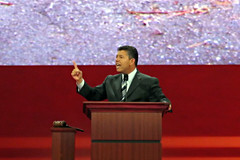
About speaking at the convention yesterday, Chiang felt pretty good about it, and he offered a little secret that may explain why a lot of people are speaking over their applause lines. Apparently the speakers get a very strict set of time at the podium. After they go over, they start beeping and flashing lights at the podium speaker to get them to wrap up.

Labels: , , ,

|

Friday, August 22, 2008

John Chiang's Leadership

One of the few bright spots of this 8-week budget roller coaster has been the leadership of State Controller John Chiang, who stood up and simply said "no" to the shock doctrine tactics of the Governor and his attempts to slash state worker salaries to the minimum wage and eliminate the jobs of thousands of others. Schwarzenegger's talk of compromise among the legislature and right-wing Republicans didn't extend to state workers, and he took Chiang to court to force him to uphold his executive order. As a result of Chiang at least offering resistance, the workers have a reprieve for August.

State workers targeted by a gubernatorial order to cut their pay to federal minimum wage have dodged that bullet - at least for August.

A Sacramento Superior Court judge Wednesday set a hearing to decide the pay dispute for Sept. 12, too late to affect this month's state payroll.

Judge Timothy Frawley's timetable ensures that 145,000 state employees and an additional 30,000 managers and supervisors will receive full pay for August.


This doesn't happen unless Chiang goes to back for those employees. And the grassroots in California is grateful. Frank Russo reports on a meeting in Oakland:

California Controller John Chiang spoke to the Alameda County Democratic Lawyer’s Club yesterday at a small restaurant in Oakland and had a lot to say about the state employee pay order. But he had a lot more to say, about his approach to government, helping average Californians, and his values and philosophy about government while speaking for over a half hour without notes and then taking questions.

From the beginning, he was treated as a rock star—introduced by club President Meredith Brown, as “the man who stood up to the man.” He covered a lot of territory—and was paid rapt attention as he challenged this body of lawyers to continue their good work for the betterment of society. He even worked in themes from the Obama campaign, as he prepares to speak at the Democratic National Convention in Denver and appear on the national stage. Josh Richman, a reporter and “blogger” for the Oakland Tribune attended this meeting and you can see his write up for a feel of what transpired as well.


Read the whole thing for Chiang's comments, which are great. Hopefully he'll repeat them at the DNC this week. Amazing what can happen to Democrats if they stand up for themselves, isn't it?

Labels: , , , ,

|

Monday, August 11, 2008

Let's Everybody Go To Court

Just a quick update on the latest on Gov. Schwarzenegger's slashing of state worker salaries. After John Chiang refused to carry out the executive order, today Arnold sued him.

Schwarzenegger's Department of Personnel Administration filed a lawsuit against Chiang late Monday in Sacramento County Superior Court. The suit says the state Constitution and several sections of law prohibit the state from paying full wages without approval of a budget.

“Except where payments are self-executing under the California Constitution, the state has no authority to pay state employees their full salaries where it does not have an appropriation such as in this case, where there is no budget for fiscal year 2008-2009,” the lawsuit says.

Chiang, a Democrat, has balked at making the pay cuts, saying the state has enough money to cover its needs into October.

“The governor has created a solution to a problem that does not exist...,” Chiang said in a statement after the lawsuit was filed.


This has become less about fiscal responsibility during a budget crisis and more about an authoritarian demanding his way. As for the original intention of the order, to force a compromise on the budget, that's, er, not happening.

Schwarzenegger met Monday with the Legislature's Democratic leaders to try to reach a budget compromise.

“We're still talking. We haven't thrown anything at each other,” Senate President Pro Tem Don Perata, D-Oakland, said after emerging from the governor's office.

Labels: , , , ,

|

Monday, August 04, 2008

California: The Ultimate In Dysfunction

It's really the ultimate way for this state employee wage cut to end up - turns out that the payroll generation is so antiquated, they can't change it to reflect the new salary structure for months.

State Controller John Chiang said Monday an antiquated state computer system makes it impossible to adjust the state payroll quickly to issue minimum-wage checks to state workers. He said it would take at least six months to make the change.

The Democratic controller has vowed to defy Gov. Arnold Schwarzenegger's executive order directing the state to pay workers the federal minimum wage of $6.55 per hour until a budget agreement is reached. He has previously asserted that the Republican governor's order is based on an untested 2003 state Supreme Court legal opinion and that he will continue issuing full paychecks to state employees.

But in a meeting with The Bee Capitol Bureau on Monday, Chiang said that even if Schwarzenegger's legal reasoning were sound, the state could not logistically retool its outdated payroll system in a matter of weeks, as the governor has asked. If the change were eventually made, Chiang also said it would take an additional nine to 10 months to issue checks to employees for their full back pay.


We've seen this in LA County with errors in paychecks to teachers, which resulted in major repayments and "treble" damages, which require the government to pay three times as much in damages to those affected.

Of course, the state could always update their payroll systems - which would require more revenue. Or they could just throw more manpower at the problem - which would require hiring those state workers that Arnold tried to fire (which agencies are promptly not firing).

It's really a tragicomedy over there in Sacramento.

Labels: , , , ,

|

Thursday, July 31, 2008

Fraying At The Edges

I was on a conference call earlier with State Controller John Chiang and Rep. Hilda Solis about the Governor's callous executive order, and both delivered predictably strong comments. Chiang, who has told the governor he will refuse to comply with the order, blasted Schwarzenegger, saying "state workers shouldn't be put in the middle of a political battle," and that this was a nakedly punitive attempt against California's state employee unions, which the whom the Governor has always held a grudge (they helped deep-six his "reform" agenda in 2005). Rep. Solis was even more outraged, saying "let's put him on the federal minimum wage, and get rid of the special interests paying for his hotel room across the street from the Capitol, and see how he likes it." She rocks.

Chiang has made his decision, and now only litigation can force him to carry out the Governor's order (and Chiang discouraged litigation as a "waste of time.") But we expect these kind of statements from Democrats. Take a look at this one from Republican Greg Aghazarian:

"While I appreciate the Governor's leadership on this budget crisis, I cannot support reducing the salaries of our state employees to minimum wage.

If our state workers had the power to pass a budget, then it might be appropriate to hold them accountable, but that's not where the responsibility lies according to our State Constitution. I cannot predict when a budget will be passed, but I do know this, when it does happen it will be because we worked to achieve bipartisan solutions.

I understand what the Governor is trying to accomplish with this action, but I must respectfully disagree and urge the Governor to reconsider his executive order."


Now, Aghazarian is talking out of both sides of his mouth. He's trying to win a Senate election against Lois Wolk in SD-05, and he wants to be seen as some kind of moderate when his record suggests the opposite. But the fact that he's gone off the reservation means that there's a lot of pressure to come out against the Governor on this one, putting him alone on an island of his own making. It's important to keep pounding away and make him completely unpopular and unable to help his party in the fall as a result of this stupid, heartless action.

The Governor has set up a Web site to answer employee questions about the wage cut. Predictably, it has no interactive function. If he allowed comments on it the server would be down.

Labels: , , , , , ,

|

Tuesday, July 29, 2008

Democratic Leadership On Arnold's Worker Scam

The CDP sent out a message from Controller John Chiang about the proposed wage cut to state workers:

When I received word that Gov. Schwarzenegger was proposing to use California's state workers as pawns in the budget battle by cutting their pay to the federal minimum wage of $6.55, I said civil servants should not bear the brunt of the budget stalemate.

Since then, thousands of Californians have joined with me to protest the Governor's proposed -- and needless -- order to slash the pay of California's public servants. I want you to know I will stand strong against the Governor's threats.

Show Gov. Schwarzenegger that you stand with me by signing the California Democratic Party's petition at www.cadem.org/supportcaliforniaworkers.

Forcing public servants to involuntarily loan the State cash by foregoing their hard-earned paychecks puts an untenable burden on our teachers, health care workers and those who provide critical public services. That is just wrong.


Excellent. Chiang is really coming out like a hero in this.

Taking another tack, Lt. Governor John Garamendi sent a letter to the Governor (via the SacBee's new state worker blog:

Dear Governor Schwarzenegger:

I write to you today regarding the proposed executive order to reduce the minimum wage of 200,000 of California's state workers to the federal minimum wage of $6.55 an hour.

As you contemplate signing this executive order, please ask yourself - how would you feed and care for your family on $262 per week ($1,048 per month)? How would your hardworking staff fare on these minimal earnings? Could you and your family do it for one week?

It is our duty, as elected officials of this great State, to find solutions to the many challenging problems that face California, such as the state budget. Those solutions should always look to improve the quality of life for all Californians, not impede it.

Please walk a week in a state worker's shoes before you sign this executive order and imagine yourself and your family surviving on $262 per week.


This is reminiscent of the SEIU's "Walk A Day in My Shoes" program, as well as the challenge taken by members of Congress earlier this year to live on a food stamp budget for a week. It gets replicated because it works. Garamendi is taking the right approach to humanize the budget crisis.

Labels: , , , , ,

|

Friday, July 25, 2008

John Chiang: Working Class Hero

It does appear that our state Controller has basically said "No Dice" to the governor's plan to punish state workers for his own leadership failures.

While the governor is poised to order the cuts on Monday, state Controller John Chiang, who is responsible for disbursing state workers' paychecks, said Thursday that he will refuse to go along with the governor, setting up a political standoff and a possible legal fight.

"The authority to issue people's paychecks is mine. I have both constitutional and statutory authority," said Chiang, a Democrat. "Frankly, (the governor) is just trying to make me do something that's improper and illegal."


The same exact thing happened in 2003, with Steve Westly refusing to cut salaries as then-Gov. Gray Davis requested. And Westly got his way until the budget was eventually signed on August 2. This basically throws the whole issue into the courts and delays the implementation of any salary cut. And that's a legal fight I relish having. For too long the chief executive of the state - and in some cases, the legislature - has absolutely overstepped their authority with regard to fiscal matters. The most egregious example is their raiding municipal government and transit funds to fill in the cracks of the budget deficit, which leads to ridiculous outcomes like cutting bus service at a time when mass transit should be expanding.

But Chiang standing with workers and holding on to his authority as a statewide elected official is just as important. We elect a governor, not a king, and this encroachment on the jurisdiction of other constitutional officers is illegal and increasingly dangerous. State workers who are rallying against the proposed cuts should understand that they have a champion in John Chiang, and that his decision deserves their support. The California Democratic Party has a petition you can sign to stand with the Controller in this effort.

Labels: , , , , ,

|

Monday, April 09, 2007

VICTORY: Cabrillo LNG Terminal Stopped

I was unexpectedly yet unavoidably unable to attend any of today's public hearing in Oxnard for the proposed BHP Billiton LNG Terminal, but enough people showed up to make a difference.

The State Lands Commission decided late Monday not to award a lease essential to a proposed liquefied natural gas terminal off the Southern California coast, citing environmental concerns.

In the 2-1 vote, commissioners complicated efforts by Australia's BHP Billiton LNG International Inc. to build an $800 million terminal in the ocean northwest of Los Angeles, about 14 miles off Malibu and about 20 miles off Oxnard. BHP officials have said the facility would provide a reliable source of low-polluting energy.

The decision was met with loud cheers by the estimated 900 people who packed the auditorium for Monday's commission hearing. Many were opponents who wore blue shirts emblazoned with the words "Terminate the Terminal."


900 people, WOW. That's some real grassroots action. I'm guessing that Garamendi and Chiang did the right thing here (although a 2-1 vote the other way elected not to certify the environmental impact report, which keeps the door open for future predations, I fear).

LNG is a lower-polluting energy, but this terminal was unecessary, would have increased foreign consumption of oil, and would have lessened air quality. It's good to see it go down (for now).

Labels: , , , ,

|