Amazon.com Widgets

As featured on p. 218 of "Bloggers on the Bus," under the name "a MyDD blogger."

Monday, October 05, 2009

Murder In Texas: Update

Glenn Smith writes that a Texas state Senator is trying to investigate the astonishing "Saturday Night Massacre"-style dismissal by Gov. Rick Perry of three members of a commission which was about to look into his negligence which led to the state-sanctioned murder of an innocent man. He wants the newly installed member of the Texas Forensic Science Commission to schedule a hearing on the execution of Cameron Todd Willingham, and fast.

Last week, Perry scuttled the Texas Forensic Science Commission hearing into the evidence that convicted Cameron Todd Willingham, scheduled for last Friday. The governor, without warning, replaced three of his four appointees to the nine-member commission. The commission had been scheduled to hear from nationally recognized arson expert Craig Beyler, who had issued a report in August questioning the evidence in the Willingham case. Beyler wrote:

The investigators [in Willingham's case] had poor understandings of fire science and failed to acknowledge or apply the contemporaneous understanding of the limitations of fire indicators. Their methodologies did not comport with the scientific method or the process of elimination.

Sen. (John) Whitmire said he would bring Williamson County prosecutor John Bradley, Perry’s newly appointed Forensic Science Commission chairman, before his Senate committee. Craig Beyler should also testify, saying publicly what Perry stopped him from saying last week. A legislative committee shouldn’t pre-empt an executive branch function — even if it’s been obstructed by the governor. But Beyler has already publicly issued his report. Legislators have a right to hear it from the horse’s mouth.

Also somewhat lost in the outrage over Perry’s Nixonian action were statements from two of those let go from the Forensic Science Commission, Fort Worth prosecutor Alan Levy and Commission Chairman, Sam Bassett, an Austin lawyer. Neither man had prior knowledge that the axe was falling on their heads, and that raises further questions about Perry’s motives. Perry said his action was just “business as usual,” noting that the terms of the agency officials had expired. Operating under business as usual, their dismissals would not have been kept secret from them.


Smith has a lot more at the link. I don't know if this case will start a national debate on the death penalty based on how the system sent an innocent man to his death, but clearly Rick Perry doesn't want to have that debate. Seeing that he's in a primary fight for his job, and the cover-up is so brazen and obvious, we could actually see this get some wider attention.

Labels: , ,

|

Friday, October 02, 2009

Perry's Cover-Up

I'm sure the Fox-bots will be talking about some other grave misconduct inside the Obama Administration today ("the candy czar took a Snickers bar away from a baby!"), but a truly sickening story of political cover-up is unfolding in Texas, should they care to turn their heads.

A top prosecutor in the Tarrant County district attorney's office said Wednesday that he has no idea why Gov. Rick Perry abruptly removed him from the Texas Forensic Science Commission.

Perry abruptly replaced three members of the commission -- including the chairman -- just two days before it was to meet to discuss a finding that a faulty investigation might have led to the execution of an innocent man.

The meeting was subsequently cancelled.

Perry also removed board member Aliece Watts, a forensic scientist in Euless.

The governor told The Associated Press that the board members' terms were expiring and that replacing them “was pretty standard business as usual.”

But several board members have had their appointments renewed, The AP reported.


The chairman was replaced by a DA named John Bradley, "one of the most conservative, hard-line prosecutors in Texas," who never heard of the position until Perry offered it to him on Wednesday.

Cameron Todd Willingham was put to death in 2004 for an arson that killed his three daughters, but the overwhelming body of evidence, detailed in this New Yorker article, is that he was an innocent man. The article notes that Dr. Gerald Hurst, an arson expert, ran an investigation of the incident and concluded there was no evidence pointing to Willingham and that the fire resulted by accident, and delivered a report saying the same to Gov. Perry's office before the execution, which the Governor then ignored (there's no evidence he even looked at it). The board meeting to review the case could have determined that Perry's negligence led to the state killing someone innocent of any crime.

Perry didn't want that information revealed, and so he shut down the board. And given that he faces a March primary for another term as Governor, he probably really wanted to make sure that the board wouldn't meet again until after then.

Simon Malloy writes:

This is all, at the very least, quite fishy. It's also potentially earth-shaking -- never before has it been conclusively determined that someone in this country was wrongfully put to death. If Cameron Todd Willingham's innocence can be proven, it would upend the entire rationale behind our system of capital punishment. And yet there hasn't been a whole lot of media coverage - a Nexis search of all news sources for the past two days for (cameron w/2 willingham and perry) turned up seven results.

What are we being treated to instead? In-depth and sensationalist reports about what President Obama's "safe schools czar" said to one of his students 21 years ago. That's the problem with letting Glenn Beck set the news agenda - the stories that actually matter sometimes slip through.


We're talking about state-sanctioned murder here, or at least negligent homicide, with one of the most obvious cover-ups to that action.

I know I'm not conservative enough to be America's assignment editor, but this seems worth a mention.

Labels: , , , ,

|

Thursday, March 19, 2009

Change Comes From Bill Richardson

Not only do I like Gov. Richardson's conclusion, I appreciate his deliberative thought process. A two-term governor has spent time with victim's families, no question. He has witnessed the grief and the anger and the frustration. But in the end, he went with his own moral precepts.

Gov. Bill Richardson signed legislation Wednesday to repeal New Mexico's death penalty, calling it the "most difficult decision in my political life."

The legislation replaces lethal injection with a sentence of life in prison without the possibility of parole.

"Faced with the reality that our system for imposing the death penalty can never be perfect, my conscience compels me to replace the death penalty with a solution that keeps society safe," the Democratic governor said at a news conference in the Capitol.

New Mexicans will be safer with the punishment of life in prison without parole because the worst criminals "will never get out of prison," he said.


The language of "safety" remains prevalent, but I admire the recognition that life in prison without the possibility of parole is a sufficient deterrent, rather than using the power of the state to roll the dice on killing a potentially innocent human being.

15 states now have no death penalty, but New Mexico is just the 2nd to ban the practice since the Supreme Court's reinstatement of capital punishment in 1976. New Jersey did the same in 2007, suggesting that the issue is somewhat less politically charged. It remains a very tough move, however, and nobody really knew what Richardson would do after the legislature voted to repeal. He sought guidance from the people who elected him, a novel idea:

In preparing for his decision, the governor solicited input over the weekend from state residents. According to his office, he got more than 9,000 responses by e-mail and in person.

"In a society which values individual life and liberty above all else, where justice and not vengeance is the singular guiding principle of our system of criminal law, the potential for wrongful conviction and, God forbid, execution of an innocent person stands as anathema to our very sensibilities as human beings," Richardson said in prepared remarks. "That is why I'm signing this bill into law."


As a practical matter, the consequences are relatively small: New Mexico has executed but one prisoner in the last 49 years. As a moral matter, inching this country closer to the international consensus that state-sponsored killing does not comply with modern civilization, speaks volumes.

Labels: , , ,

|

Thursday, June 26, 2008

God Save This Blessed Court

It's getting so I try not to read anything with "Supreme Court" in the headline on the last week of June, because that's when all the most controversial cases come down, and given the current makeup of the Court it means "pound progressives into the cement" week in America.

The Court did rule that the death penalty shouldn't apply to child rapists, which, while a horrible crime, is not proportional to state-sanctioned murder. Sen. Obama short-circuited the inevitable Kitty Dukakis question by saying he disagreed with the ruling, but the fact that he did so on state's rights grounds is alarming. I don't know if Justice Kennedy made a well-argued case here, but I don't believe in the death penalty as a deterrent (I don't think rapists and murderers are all that rational) or as a properly applied system of jurisprudence (look at all the problems with cases at the state level) so anything that blocks its expansion is generally fine with me. I wish we had a court that would throw the whole practice out as cruel and unusual punishment and recognize that life in prison without possibility of parole is a pretty stiff punishment.

The other decisions were varying degrees of horrible. The Court stepped into the Exxon Valdez civil case in an activist fashion and lowered the damages to citizens affected by the oil spill. It's outrageous that the shattered lives on the Alaskan coast are worth $15,000, according to the law. And moreover, it shows corporations that they can appeal and appeal and appeal and they will eventually get their way in the highest court, where fealty to corporations is really the order of the day.

Today, in a 5-4 decision the Court overturned the Millionaire's Amendment which ruled as part of the McCain-Feingold campaign finance law that candidates facing a rich, self-funded challenger can raise above the contribution limits if their opponent pumps millions into the race. The ruling also waives several disclosure requirements on the part of the self-funder. What is key here, a signal that this Court will rule against any and all public financing laws, is that Congress cannot seek to "level the playing field."

The argument that a candidate’s speech may be restricted in order to "level electoral opportunities" has ominous implications because it would permit Congress to arrogate the voters’ authority to evaluate the strengths of candidates competing for office. See Bellotti, supra, at 791–792 ("[T]he people in our democracy are entrusted with the responsibility for judging and evaluating the relative merits of conflicting arguments" and "may consider, in making their judgment, the source and credibility of the advocate"). Different candidates have different strengths. Some are wealthy; others have wealthy supporters who are willing to make large contributions. Some are celebrities; some have the benefit of a well-known family name. Leveling electoral opportunities means making and implementing judgments about which strengths should be permitted to contribute to the outcome of an election. The Constitution, however, confers upon voters, not Congress, the power to choose the Members of the House of Representatives, Art. I, §2, and it is a dangerous business for Congress to use the election laws to influence the voters’ choices.


This sounds reasonable enough, but it could be the wormhole to end public financing and eliminate contribution limits. Considering that we're in the age of the Internet where the low-dollar revolution has taught that there need not be a reliance on big corporate money, that could be OK. But not if limits start getting removed. McCain-Feingold was reinforced by a 2003 ruling, so hopefully it'll remain robust. I'm worried that this will challenge "fair fight" funds in use in public money states like Arizona and Maine, where the publicly financed candidate gets extra money if a privately funded challenger spends above certain thresholds.

Finally, there's the Second Amendment case of the DC handgun ban, and in another 5-4 ruling the Court asserted an individual right to gun ownership and struck down the DC law. This is really the end of the gun issue as a political football; the 2nd Amendment has been defined. I don't know if it was defined correctly, but even such Constitutional scholars as Russ Feingold assert an individual right to bear arms. Here's Sen. Obama on the issue:

“I have always believed that the Second Amendment protects the right of individuals to bear arms, but I also identify with the need for crime-ravaged communities to save their children from the violence that plagues our streets through common-sense, effective safety measures. The Supreme Court has now endorsed that view, and while it ruled that the D.C. gun ban went too far, Justice Scalia himself acknowledged that this right is not absolute and subject to reasonable regulations enacted by local communities to keep their streets safe. Today’s ruling, the first clear statement on this issue in 127 years, will provide much-needed guidance to local jurisdictions across the country.

“As President, I will uphold the constitutional rights of law-abiding gun-owners, hunters, and sportsmen. I know that what works in Chicago may not work in Cheyenne. We can work together to enact common-sense laws, like closing the gun show loophole and improving our background check system, so that guns do not fall into the hands of terrorists or criminals. Today's decision reinforces that if we act responsibly, we can both protect the constitutional right to bear arms and keep our communities and our children safe.


Actually, that kind of strikes the right balance to me. What I do find striking is that not long ago, Justice Scalia assured us that the Court's ruling in Boumediene would "surely cause more Americans to be killed," yet he doesn't see the same consequence of allowing firearms in everyone's hands. Overall, we have a Court that bounces back between activism and restraint when it suits their ideological needs. It reinforces the need for a Democratic President to retain our core values and not continue on this path of a hard-right agenda in the highest Court in the land.

UPDATE: According to Phillip Carter, the ruling in Heller is pretty restrained, and most current forms of gun control wouldn't fall under it, outside of total bans.

Labels: , , , , , , , , ,

|

Wednesday, January 09, 2008

Meanwhile, On The Court

Two major Supreme Court cases have been heard this week, and on each of them, it does not appear that the side of justice and the Constitution will be victorious. In the Kentucky case opposing the use of the lethal injection method in capital punishment, the conservative block was skeptical:

"This is an execution, not surgery," Justice Antonin Scalia told the attorney who was representing two Kentucky inmates who say the use of the three-drug compound poses "an unnecessary risk of pain" to the dying man.

"Where does that come from, that you must find the method of execution that causes the least pain?" Scalia continued. "We have approved electrocution. We have approved death by firing squad. I expect both of those have more possibilities of painful death than the protocol here."


Yes, where the hell does that come from, this idea that punishment should not be cruel or unusual? What first-year law student pulled that out of their ass?

So, it appears that we'll continue with a process that has been invalidated for the euthanizing of dogs.

In the other big case, the ruling on Indiana's voter ID law, the Court again appeared unswayed by arguments about equal protection and the deliberate efforts to suppress voter turnout.

Only two Justices — Ruth Bader Ginsburg and John Paul Stevens — even hinted at the real-world fact that the photo ID law in Indiana is at the heart of a bitter, ongoing contest reaching well beyond Indiana. It is a dispute between Republicans worried over election fraud supposedly generated by Democrats to pad their votes, and Democrats worried over voter suppression supposedly promoted by Republicans to cut down their opposition. The abiding question at the end: can a decision be written that does not itself sound like a political, rather than a judicial, tract? Can the Court, in short, avoid at least the appearance of another Bush v. Gore? [...]

It was apparent from the outset that the Court’s more conservative members were most interested in (a) finding that no one had a right to bring the constitutional challenge, at least at this stage, (b) putting off a challenge until the law has actually been enforced or at least until just before election day, or (c) salvaging as much as possible of the Indiana photo ID requirement on the theory that voter fraud is a problem that states have a legitimate right to try to solve. There was some hand-wringing, particularly by Justice Samuel A. Alito, Jr., over how difficult it is for a judge to “draw the line” on when a voting requirement would or would not pass a constitutional test [...]

In a notable way, therefore, it appeared that — once more — Justice Anthony M. Kennedy may hold the vote that controls the outcome. He displayed some skepticism about the challenge to Indiana’s law, somewhat impatiently suggesting at one point that the challengers would oppose any kind of voter ID requirement other than a simple signature match at the polling place. Kennedy seemed ultimately to be looking for ways to assure voters who demonstrably would be significantly burdened by the law that they could challenge it, perhaps even before election day came around.


Count me as not sanguine that Alito's handwringing will hold up. And Kennedy appears lost.

As has been said many times, this is a solution without a problem. The Indiana secretary of state, when pressed, could not come up with one documented instance of voter fraud in his state. Never has so much attention been paid to a crime that has not been proven to be committed. The agenda is as transparent as tissue paper.

These two cases reveal just how partisan, and really cowardly, the Court has become, as the arguments showed an unwillingness to engage on the Constitutional questions, while looking to uphold the rulings on narrower, more technical grounds. This has been the Roberts Court agenda since he rose to Chief Justice.

The revolution that many commentators predicted when President Bush appointed two ultra-right-wing Supreme Court justices is proceeding with breathtaking impatience, and it is a revolution Jacobin in its disdain for tradition and precedent. Bush's choices, Chief Justice John Roberts and Justice Samuel Alito, have joined the two previously most right-wing justices, Antonin Scalia and Clarence Thomas, in an unbreakable phalanx bent on remaking constitutional law by overruling, most often by stealth, the central constitutional doctrines that generations of past justices, conservative as well as liberal, had constructed.


That article by Ronald Dworkin is important. Go read it. (I'll be here.)

And let's be very clear about what each and every Republican candidate has said, with total unanimity, on the subject of judges.

Rudy Giuliani

"I will nominate strict constructionist judges with respect for the rule of law and a proven fidelity to the Constitution -- judges in the mold of Justices Scalia, Thomas and Alito, and Chief Justice Roberts."

Mitt Romney

"I think the justices that President Bush has appointed are exactly spot-on. I think Justice Roberts and Justice Alito are exactly the kind of justices America needs."

Fred Thompson

"I like Roberts and Alito and Scalia and Thomas. One of the best things that I got to do as a private citizen was to help get Justice Roberts through the confirmation process... We're in a heck of a lot better shape because of Roberts and Alito, and one more gain would put us in even better shape."

Mike Huckabee

"My own personal hero on the court is Scalia, not least because I duck-hunted with him."

John McCain

"One of our greatest problems in America today is justices that legislate from the bench, activist judges. I'm proud that we have Justice Alito and Roberts on the United States Supreme Court. ... [When asked whether he admires any Supreme Court justice in particular] Of course, Antonin Scalia... I admire how articulate he is, but I also from everything I've seen admire Roberts as well."


The two parties have more than a dime's worth of difference on this, and the Supremes had better be right at the top of the issues that we talk about in the fall.

Labels: , , , , , , , , ,

|

Wednesday, January 02, 2008

They Don't Respect Labor

I would say that it's telling that Hillary Clinton is appearing over on Letterman tonight, the one late-night show that has settled with its writers, while Mike Huckabee is crossing a picket line to appear on Jay Leno's show.

Also, it doesn't seem like Hillary's leaving Iowa to tape Letterman, while Huckabee is leaving the state where his advantage is tenuous at best to whoop it up with Jay.

Also, Jay is the guy most responsible for getting Arnold Schwarzenegger elected, he emceed his victory party, and Fred Thompson announced on his show. So the battle lines are clearly drawn.

With any luck, Huckabee will beat a picketer with his own sign and show just how much he thinks of the American worker!

UPDATE: Huckabee is also busy faulting Mitt Romney for not using the apparatus of the state to kill more people, which as we all know is a good Christian value.

Labels: , , , , , , , ,

|

Wednesday, December 26, 2007

Don't Mess With Texas

The death penalty statistics cited in this article are skewed because of a de facto moratorium while everyone waits for a Supreme Court ruling on the Constitutionality of lethal injections. Still, this is a telling statistic:

This year’s death penalty bombshells — a de facto national moratorium, a state abolition and the smallest number of executions in more than a decade — have masked what may be the most significant and lasting development. For the first time in the modern history of the death penalty, more than 60 percent of all American executions took place in Texas.

Over the past three decades, the proportion of executions nationwide performed in Texas has held relatively steady, averaging 37 percent. Only once before, in 1986, has the state accounted for even a slight majority of the executions, and that was in a year with 18 executions nationwide.

But enthusiasm for executions outside of Texas has dropped sharply. Of the 42 executions in the last year, 26 were in Texas. The remaining 16 were spread across nine other states, none of which executed more than three people. Many legal experts say the trend will probably continue.

Indeed, said David R. Dow, a law professor at the University of Houston who has represented death-row inmates, the day is not far off when essentially all executions in the United States will take place in Texas.

“The reason that Texas will end up monopolizing executions,” he said, “is because every other state will eliminate it de jure, as New Jersey did, or de facto, as other states have.”


I don't know about that; all it takes is one trigger-happy governor who mocks inmates by saying "Please, don't kill me," and that doesn't necessarily have to confine itself to one state (Brother Jeb did his share of killing in Florida). In addition, Texas has followed the nationwide trend of far fewer death sentences, suggesting that people may approve of the death penalty in polls but not when they have to face it up close. But what does come through in this article is the swift and brutal prosecution of the practice in the Lone Star State.

The rate at which Texas sentences people to death is not especially high given its murder rate. But once a death sentence is imposed there, said Richard C. Dieter, the executive director of the Death Penalty Information Center, prosecutors, state and federal courts, the pardon board and the governor are united in moving the process along. “There’s almost an aggressiveness about carrying out executions,” said Mr. Dieter, whose organization opposes capital punishment [...]

“Execution dates here, uniquely, are set by individual district attorneys,” Professor Dow said. “In no other state would the fact that a district attorney strongly supports the death penalty immediately translate into more executions.”

Texas courts, moreover, speed the process along, said Jordan M. Steiker, a law professor at the University of Texas who has represented death-row inmates.

“It’s not coincidental that the debate over lethal injections had traction in other jurisdictions but not in Texas,” Professor Steiker said. “The courts in Texas have generally not been very solicitous of constitutional claims.”


Maybe the wheels of justice in Texas are greased so nobody will notice the brutal inequities in the system, which include defense attorneys falling asleep during trials, elected judges with an interest in appearing tough on crime ignoring the law to ensure quick executions, the lack of a public defender system (the judges appoint the defense lawyers, and most of them are incompetent), and a spectacularly failed appeals process.

The prison crisis and how it cuts against the poor is one of the great untold stories in America right now. But in Texas, people are being killed to pump up judges' political track records. That's out of step with the prevailing trend of the nation.

Labels: , , ,

|

Thursday, December 13, 2007

Look At That, A Sentencing Commission That Works

An amazing thing happened this week. The Supreme Court, by a 7-2 margin, ruled that federal judges have the leeway to reduce sentences for possession of crack cocaine relative to powder. The disparity in sentencing, which has significant racial overtones, has long been unconscionably unfair. And get this: the US Sentencing Commission unanimously decided to make the guidelines retroactive which could result in thousands of convicts who were unfairly sentenced to be released.

See, there's a national sentencing commission that reviews information and makes recommendations based on logic and common sense, taking the hot-button issue of sentencing out of the political sphere. Yet here in California, we have been stymied at any effort to create such a sentencing commission, and all sentencing legislation moves in the direction of being more punitive rather than less. This is how our jails have become clogged with so many nonviolent offenders, who in the overcrowded environment without proper treatment and rehabilitation often return to jail more violent than when they got there in the first place. The executive branch of this state knows this, yet they refuse to reveal their documents and communications that would confirm it.

States have the ability to break free from the "tough on crime" box and actually change the tilt in favor of jailing more and more citizens for longer and longer periods. Heck, in New Jersey this week they voted to ban the death penalty. But the only way to see any early prison releases in California is when the state miscalculates their sentences.

Up to 33,000 prisoners in California may be entitled to release earlier than scheduled because the state has miscalculated their sentences, corrections officials said Wednesday.

For nearly two years, the overburdened state prison agency has failed to recalculate the sentences of those inmates despite a series of court rulings, including one by the California Supreme Court. The judges said the state applied the wrong formula when crediting certain inmates for good behavior behind bars.

Some inmates released in recent months almost certainly stayed longer in prison than they should have, said corrections officials, employees and advocates for prisoners. Some currently in prison most likely should be free, they said. But many whose sentences are too long are not scheduled to be released for months or years.

The inmates in question -- 19% of the state prison population -- are serving consecutive sentences for violent and nonviolent offenses. The sentencing errors range from a few days to several years.

Corrections officials say they have been unable to calculate the sentences properly because of staffing shortages and outdated computer systems that force analysts to do the complex work by hand.


This directly results from the overcrowding crisis. An overburdened corrections industry cannot keep up with the processing given the meager resources they have. This ends up costing the state more - approximately $26 million annually - than what it would cost to put the proper resources in place, particularly if you factor in the possibility of lawsuits from inmates, as we are now seeing in other respects.

Fixing miscalculations is a step. But until you have the courage and fortitude to address the root causes and meet the same responsibilities that even the federal government has decided to meet, nothing will change.

P.S. There are pending mandatory minimum sentencing bills in the federal government, which would fix the crack/powder sentencing disparity even further. It won't surprise you at all that the version of the bill that Dianne Feinstein supports is completely insufficient to deal with the problem.

Labels: , , , , , ,

|

Tuesday, December 04, 2007

Huckabee's Own Shag Fund - For Shag Carpets, And More

The new frontrunner in Iowa is starting to attract some scrutiny across the media. This article from the Los Angeles Times offers a good compendium of the more damaging charges. Obviously there is the insufficient fealty to tax cuts and inappropriate concern for sick kids and poor people in Arkansas (I mean, can you imagine?). Huckabee has signed the Grover Norquist "no new taxes" pledge, so maybe that's not a problem for him anymore.

The Times managed to cover the Wayne Dumont angle without actually explaining the whole story:

Shortly after he became governor, Huckabee expressed his support for the release of a convicted rapist -- who, once freed, sexually assaulted another woman and killed her. Wayne Dumond had been sentenced to life plus 20 years in 1984 for raping a 17-year-old cheerleader. Tucker, Huckabee's predecessor, reduced Dumond's sentence in 1992, making him eligible for parole.

In 1996, according to the Democrat-Gazette, Huckabee questioned Dumond's guilt and said he might commute his sentence to time served. He also met with the parole board in a closed session. Some board members have said Huckabee pressured them into releasing Dumond; others said he did not.

Dumond was released from prison in October 1999. He chose his next victim 11 months later.


What isn't expressed is that Dumond's first victim was a distant cousin of Bill Clinton, and it became a wingnut cause celebre to release him.

But the real revelations in the article concern Huckabee's venality - his belief in being entitled to gifts and perks common for a Southern preacher but not a politician.

During his years in office, the media scrutinized numerous mini-scandals, including an allegation that he used public funds for private purposes, and failed to properly report gifts and income. Huckabee was cited five times for violating ethics rules by the Arkansas Ethics Commission.

Toward the beginning of Huckabee's governorship, the Arkansas Times, an alternative weekly, reported that his family had used a fund meant for upkeep of the governor's mansion for expenses like out-of-town trips and dry-cleaning.

As he was preparing to leave office, local media reported that bridal registries had been established at two stores for the governor and his wife, even though they had been married for more than 30 years. State ethics laws prohibited Huckabee from receiving gifts of more than $100 as a reward for doing his job. But there was an exception for wedding presents. The Huckabees had registered for nearly $7,000 in housewares as they prepared to move to a private residence.

Arkansas Times Executive Editor Max Brantley -- a longtime nemesis of Huckabee's -- said Huckabee's ethics violations and other gaffes probably stemmed from his preacher's background, in which "love offerings," or gifts to the pastor, were encouraged.


That's practically Giuliani-esque. Good thing there's no Judith Nathan in his life, or he would have bankrupted the Arkansas budget!

Perhaps more damaging in a general election are the quotes that show how Huckabee's religious life informs his political life. His clever dodge of a question in the YouTube debate about the death penalty, claiming that "Jesus was too smart to run for public office," belies the fact that he answered the question in the context of Jesus before:

“Interestingly enough,” Huckabee allowed, “if there was ever an occasion for someone to have argued against the death penalty, I think Jesus could have done so on the cross and said, ‘This is an unjust punishment and I deserve clemency’.”


State-sponsored killing: OK with Jesus, OK with me.

And that's how it's gone on a number of issues, as Matt Taibbi recounted in a must-read for Rolling Stone.

But Huckabee is also something else: full-blown nuts, a Christian goofball of the highest order. He believes the Earth may be only 6,000 years old, angrily rejects the evidence that human beings evolved from "primates" and thinks America wouldn't need so much Mexican labor if we allowed every aborted fetus to grow up and enter the workforce [...]

The troubling thing about Huckabee's God rhetoric is that a man who is glad that Christians will "win" at Armageddon must be happy about the rest of us losing. When I press him on whether he believes all non-Christians are eternally damned, Huckabee is evasive. "Being president isn't about picking who goes to heaven and who goes to hell," he says. When none other than Bill O'Reilly hammered him on the same point a day later, Huckabee conceded that "I believe Jesus is the way to heaven."

This God stuff isn't just talk with Huck. One of his first acts as governor was to block Medicaid from funding an abortion for a mentally retarded teen ager who had been raped by her stepfather — an act in direct violation of federal law, which requires states to pay for abortions in cases of rape. "The state didn't fund a single such abortion while Huckabee was governor," says Dr. William Harrison of the Fayetteville Women's Clinic. "Zero."

As president, Huck would support a constitutional amendment banning abortion and would give science a back seat to religion. "Science changes with every generation and with new discoveries, and God doesn't," he says. "So I'll stick with God if the two are in conflict." Huckabee's well-documented disdain for science was reflected in the performance of the Arkansas school system when he was governor; one independent survey gave the state an F for its science standards in schools, a grade that among other things reflected Huckabee's hostility toward the teaching of evolution.


Obviously, some of this scrutiny will help Huckabee among hard-core conservatives, and some of it will hurt him. But at least there's a little catch-up being done on the true nature of this guy.

Labels: , , , , , , , ,

|

Friday, November 30, 2007

Some Straight Talk On The Huck

Mike Huckabee's rise in the polls in Iowa has certainly gotten the attention of the traditional media, and the Romney camp is clearly managing expectations in order to blunt the effect of a potential Huckabee victory:

"It would be nice if Romney won," said Doug Gross, an attorney overseeing Romney's Iowa campaign. "If he finishes in the top two, he's fine."


Now that Huckabee has launched himself to the top of the heap (and if he follows through, it would be kind of an indictment of the notion that money rules in politics), it's time to take a substantive look at his record and his proposals. I'm dubious that the media will actually do this. For example, perhaps the most prominent soundbite to come out of the YouTube debate was his statement that "Jesus was too smart to ever run for public office" when asked about his support for the death penalty. This was actually a massive cop-out.

...what reporters didn't note is that Huckabee was dodging a direct question on the very area -- the intersection of religion and policy -- on which he is building his campaign. The man whose ads call him a "Christian Leader" and who says his faith "defines me" wouldn't answer a pretty simple question on how his faith affects his opinion on a policy issue.

But the press stood up an applauded. So witty! So clever! Ah, that Mike Huckabee, what a lovable guy!


In fact, it's this tendency to focus on Huckabee's personality instead of his policy that is masking one of the most insane ideas to appear in this cycle - his "fair tax" proposal.

"Abolishing the IRS", of course, is the purported effect of enacting the "FairTax" proposal Huckabee supports. This would replace the income tax with a national sales tax. But you would still need a bureaucracy to enforce the sales tax! Business owners aren't going to be willing to hand over 30% of the cost of goods sold [the tax rate you would need to have a revenue neutral sales tax] just because they're a bunch of really swell people. In addition, a sales tax of that magnitude is terrible economics. The FairTax idea is beyond silly, and in the unlikely event that Huckabee is the GOP nominee, right-of-center economists will be committing professional malpractice if they don't rise up en masse to debunk this malarky. Bruce Bartlett provides a good template: "In short, the FairTax is too good to be true, and voters should not take seriously any candidate who supports it."


Huckabee takes a complex problem (the byzantine tax code) and applies a simple solution that would actually be unbelievably regressive and essentially shovel more money to the rich and powerful, as well as open up a huge expansion of the black market trafficking in untaxed goods. There's no justification for it, which is why it has been roundly denounced any time a politician, like Steve Forbes, brings it up. Because Huckabee is an amiable politician with some rhetorical gifts, he's getting away with a batshit crazy idea as his main campaign plank.

Labels: , , , , , ,

|

Friday, September 28, 2007

Ho-Hum, Another "Fred Thompson Can't Remember Shit" Post

This has now become a full-fledged meme. Thompson, at home in Tennessee after a grueling handful of days campaigning, was asked about the death penalty in the state. You know the rest...

Republican presidential candidate Fred Thompson said Thursday he was unaware that a federal judge had ruled last week that lethal injection procedures in his home state were unconstitutional.

Thompson also told reporters that he was unaware the U.S. Supreme Court this week had agreed to consider a Kentucky case about whether lethal injection violates the Constitution's ban on cruel and unusual punishment.

Thompson's support for the death penalty was a major part of his campaign platform when he first ran for the U.S. Senate in Tennessee in 1994. Asked for his response to the recent Tennessee and Kentucky cases, Thompson responded, "I hadn't heard that. I didn't know."


The article goes on to say, in the understatement of the year, that it's "not the first time" Freddie has been caught off-guard by new information. Damn freedom-hating information!

This campaign is the train wreck that other train wrecks slow down to take a look at.

Labels: , ,

|

Tuesday, August 14, 2007

How Many Little-Known Provisions Of The Patriot Act Are There?

Another one was unearthed today, giving Alberto Gonzales the power to finally realize his dreams of killing more people.

The Justice Department is putting the final touches on regulations that could give Atty. Gen. Alberto R. Gonzales important new sway over death penalty cases in California and other states, including the power to shorten the time that death row inmates have to appeal convictions to federal courts.

The rules implement a little-noticed provision in last year's reauthorization of the Patriot Act that gives the attorney general the power to decide whether individual states are providing adequate counsel for defendants in death penalty cases. The authority has been held by federal judges.

Under the rules now being prepared, if a state requested it and Gonzales agreed, prosecutors could use "fast track" procedures that could shave years off the time that a death row inmate has to appeal to the federal courts after conviction in a state court.


I ask again, does anyone in Congress read these bills? Are we going to read in the paper come January 2009 that another little-known provision sets up a House of Bush line of succession that conveys lifetime executive branch status on Queen Jenna and Princess NotJenna?

Death penalty cases are consistently overturned, as the flawed system has disproportionately convicted innocent men and women who were too poor for effective representation. Under the new system, America will become more like Texas was under George W. Bush, when his counsel - yep, Abu Gonzales! - would write perfunctory clemency summaries that were scrupulously ignored.

The death penalty system in this country is a mess, and until that is sorted no new powers to execute the potentially innocent should be given to anyone, least of all Abu G.

UPDATE: The article does make the point that this spins off of the "Effective Death Penalty Act" of 1996, signed into law by Bill Clinton, which was an opening to kill people faster (I think it came right out of the Oklahoma City bombing case and the attendant fearmongering).

Labels: , , ,

|

Tuesday, August 07, 2007

Yearly Kos: The Edwards Breakout

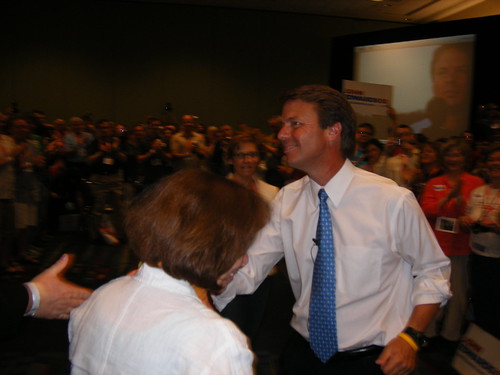
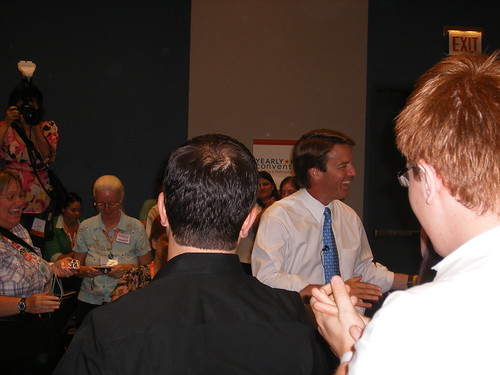
John Edwards, like the other candidates, held a small-group session with interested activists at Yearly Kos. I was in the second row but I don't think you can see me in this video of the entire session:


I have pics that I'll throw on the back end but I wanted to summarize the key points:

* Edwards actually employed snark in his answer to the Democrats' cave on FISA. He signaled a big thumbs-down and then said "I've got an idea, let's give George Bush more power to spy on Americans without a warrant, and let's put all the oversight capability in the hands of Alberto Gonzales!" That could be a Sadly No post.

* He has determined that, in talking to people across the country, too many still believe that global warming is a subject for their great-grandparents and not for them. It takes Presidential leadership to ask Americans to sacrifice for the greater good, and it also takes a broad-based movement. "The power to change the country is right here in this room." He did come out against new nuclear power plants and liquid coal on the policy front, but really he pushed the bully pulpit and the power of activism working in tandem. This can be seen as Edwards' overarching theme.

* Edwards' progressivism is apparent in these sessions. He wants a $9.50 minimum wage indexed to COLA so we never have to worry about it again. He would increase the tax responsibility on hedge fund managers (so much for Dennis Kucinich's Gotcha moment) by treating their income as earned and not invested. He talked about a meaningful path for citizenship and how he wouldn't want to live in a country with second-class workers. He would hold lawyers financially responsible for frivolous lawsuits. He supports a Constitutional amendment for public financing of federal elections. These are big pieces of a change agenda. While it's true that the peculiarities of our political system make the political center far to the right of social democracies in Europe, even those controlled by "right-wing" leaders, Edwards is comfortable at the edge of what is possible because he believes it's what the American people truly desire.

* The campaign was clearly prepared to make an issue of the "no contributions from Washington lobbyists" issue. In fact, right after the breakout, staffers were passing around a press release titled "Edwards Calls On Democrats To Stop Taking Lobbyist Money" or something. It was a pre-planned assault.

* Edwards also intertwined his plight with the plight of the blogging community, making direct links between the haircut/Politico stories and the O'Reilly/Yearly Kos flap and saying "They don't want to hear OUR voice." That's rhetorically brilliant, casting himself and the community as part of the same struggle.

* Edwards was also presented with tough questions and he didn't mind being on the opposite side of the room on issues. "You don't have to always agree with me," he said. On impeachment, he said that the process was debilitating in the Clinton years, and Congress needs to keep working. An atheist asked him how he and other Democrats could reach him if he continued to couch his principles in religious terms, and he asked "Do you mind the word moral?" The atheist replied that no, atheists can be moral, and he said that's how he'll try to talk about it in the future. It seemed sincere.

But it was the question right after that which was the most eye-opening to me. Spinning off the atheism/morals question, a commenter brilliantly asked how he could square this moralism with his support for the death penalty, especially given how it impacts minorities disproportionately and has led to the almost-certain murder of innocents. Edwards appreciated the question. And he took the opportunity to decry the current death penalty system while affirming his belief that some acts are so unspeakable that the death penalty is warranted. But this surprised me. He said that "we shouldn't execute anyone until we fix all the flaws in the system. Did he just come out for a George Ryan-style moratorium? That would be major news. There were several other bloggers in the room, and I know at least a couple looked to the campaign to clarify the comment. But I haven't seen anything yet. So I'll put it out there. It was an unequivocal call to end the practice of state-sanctioned execution until the many flaws in administering justice are fixed, including DNA TESTING FOR EVERYONE ON DEATH ROW.

* At the end of the session, Edwards said that anyone who had a question for him that they didn't get answered should email the campaign. So I did:

Hello, Senator Edwards. I attended your breakout session at Yearly Kos and found it very enjoyable. However, I did not get an opportunity to ask my question. Here it is.

I have appreciated your insistence that the "war on terror" bumper sticker has become a fig leaf excuse for President Bush to do whatever he wants in the world and at home. Yours is a fresh and bold vision. However, as recently as late 2006 you were quoted as having your vision of foreign policy shaped by the likes of Michael O'Hanlon, the Brookings Institution fellow who recently penned a stunningly dishonest editorial about success in Iraq.

My question is this: does Michael O'Hanlon still advise you on foreign policy, was he ever a paid advisor to your Senate staff or your Presidential campaigns, and will he hold a staff position in an Edwards Presidency? Thank you.


Pics:

DSCF0571

DSCF0568

DSCF0567

Labels: , , , , , , , , ,

|