Amazon.com Widgets

As featured on p. 218 of "Bloggers on the Bus," under the name "a MyDD blogger."

Monday, August 03, 2009

Wild Success Of Government Program Shows How Government Can't Run Anything

Amazingly enough, they're getting away with this message.

The government’s “cash for clunkers” program become the latest political flashpoint on Sunday, with Obama administration officials urging the Senate to approve more money for the initiative and Republicans raising concerns about it [...]

Republicans say the problems with the program are another strike against the Obama administration as it pushes for a speedy overhaul of the health care system that would involve a government-run insurance program. They argue that government involvement in any industry is a recipe for disaster.

Senator Jim DeMint, Republican of South Carolina, said the “cash for clunkers” program was an example of the “stupidity coming out of Washington right now.”

“The federal government went bankrupt in one week in the used-car business, and now they want to run our health care system,” Mr. DeMint said in an interview on “Fox News Sunday.” “This is crazy to try to rush this thing through again while they’re trying to rush through health care, and they want to get on to cap-and-trade electricity tax. We’ve got to slow this thing down.”


Let's number the "problems" with the program:

1) it's too successful and too many people want the rebate
2) the government Web site where the rebates get processed is getting killed because too many people are trying to access it
3) the rebates are going to "middle-class people" who may have eventually bought a car anyway
4) car dealers haven't gotten their rebate checks yet after a week

Are these even rational complaints? They boil down to "the program is too good a deal." I would agree, leveraging $5 billion dollars through the economy in a week is a pretty good deal for those on Main Street looking for some economic activity. There is a residual economic effect to selling a quarter of a million cars that increases hiring throughout the country as well.

While the program could stand with a few tweaks, and I stand with Sens. Feinstein and Collins on improving the fuel efficiency standards, the bottom line is that the program has a great economic multiplier effect, has been unexpectedly strong in increasing mileage rates among new buyers, and has been a boon to the middle class, which gets approximately nothing from their government 99% of the time. Republicans are going to carp at anything Democrats do, but what they are objecting to in this case is revealing. They don't like to see successful government programs that work.

Labels: , , , , ,

|

Thursday, June 18, 2009

The Latvia Option: Let's Regress the Regressivity!

Calbuzz continues shilling for the California Commission on the 21st Century, or as I've called it the Latvia option, the plan to craete a flat income tax and massively transfer wealth upward from the middle class to the ultra-rich. Apparently,there are two packages on the table, which I'll label CRAP and CRAAAAAP.

The first package to be considered has these key elements:

• Flattening the progressive, steeply-stepped state income tax rate system to a structure with essentially one rate of about six percent.

• Eliminating the state sales tax (local sales tax levies that have been approved for special purposes like transportation would remain in effect).

• Eliminating the corporation tax.

• Imposing the business receipts tax. It would be assessed on nearly every business in the state as a percentage of its gross revenue – minus the cost of goods and services that it purchases from other companies.

• Charging a “carbon tax” on gasoline, diesel and jet fuel, calculated at the refinery at $20 per ton of carbon emissions. This would amount to about 18 cents-per-gallon of gas.

The second scenario would flatten the income tax structure, but not include the receipts tax.


It's comical to hear Calbuzz call our state income tax "steeply stepped." There are NO tax brackets between $47,500 and $1,000,000. That's a ridiculous statement. Progressives may appreciate the carbon tax, but clearly this proposal - especially if the business receipts tax gets excised, which considering the influence of Big Business on the process is almost assured - would make the overall tax structure in California MASSIVELY regressive, probably canceling out the progressivity of the federal tax structure.

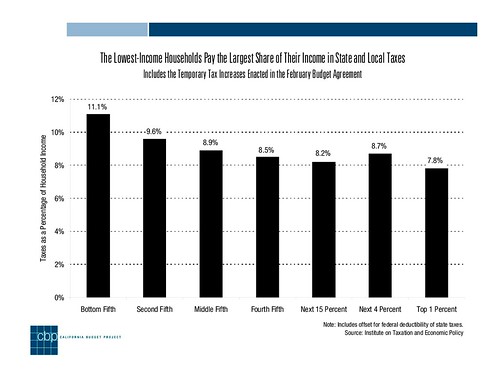
090617_CBB_Share_of_Income_for_taxes

We already have a totally regressive tax system in California when you look at the effective tax rate - what people actually pay. The lowest 1/5 pay 11.7% of their income in taxes to the state, while the richest 1/5 pay 7.1%. And recent budget deals have only made the system more regressive. Now we're planning to completely shift the tax burden to the poor and the middle class.

For example, one option would – among other things – establish a 6 percent “flat tax” that would apply to taxpayers whether they had incomes of $10,000 or $10 million. Under this scenario, the share of taxes paid by middle-income Californians – those with incomes between $20,000 and $50,000 – would more than double, while the share paid by taxpayers with incomes of $200,000 or more would drop by almost one-third. Flattening personal income tax rates also would increase the share of income that California’s low- and middle-income households would pay in taxes – exacerbating an already regressive tax structure [...]

By increasing the share of taxes paid by low- and middle-income Californians, the tax packages under consideration would widen after-tax income gaps. Yet the level of inequality in California is already large and growing larger. The average taxpayer in the top 1 percent had an adjusted gross income (AGI) – income reported for tax purposes – of $1,832,123 in 2007 – 50.7 times that of the average middle-income taxpayer ($36,115). California’s income gap has been widening for years. The latest Franchise Tax Board data show that one-quarter (25.2 percent) of total AGI went to the wealthiest 1 percent of taxpayers in 2007, nearly twice the share (13.8 percent) in 1993, which is the earliest year for which data are available. In contrast, taxpayers with incomes in the middle of the distribution had just 10.0 percent of AGI in 2007, down from 13.0 percent in 1993. This means that the top 1 percent of taxpayers received approximately 25 times their proportionate share of AGI in 2007, while middle-income taxpayers received half their share. These disproportionate gains translate into a substantial concentration of income at the very top of the distribution. If the share of income going to the wealthiest 1 percent of taxpayers had remained the same since 1993, the bottom 99 percent of taxpayers would have an additional $123 billion in income – equal to $8,388 for each taxpayer.


To the extent that ordinary Californians are overtaxed, it's because the system is completely unfair and designed to support the rich getting richer. And Calbuzz thinks that's dandy, calling it a "major accomplishment" for the Governor, which of course it is - for his wealthy pals and contributors.

The May 19 election's intent from the voters is obscure, although I agree with the leading pollsters in the state that "no new taxes" was certainly not the message. But I want to know what majority you can find out there that, as a result of the election, endorsed eliminating the corporate tax rate and delivering a Steve Forbes-style flat tax that has destroyed almost all of Eastern Europe. You can't. This is a shocking power grab and people had better wake up to it.

As a postscript on Latvia, I noticed yesterday that their health minister quit in the face of having to accept severe budget cuts imposed by the IMF as a condition of providing loans. Food for thought.

Labels: , , , , ,

|

Friday, February 27, 2009

Regressive Tax Burdens - Brought To You By The California Legislature

With the unemployment rate soaring to double digits and less revenue flowing to the state, it was clear that some taxes would have to be raised in the last budget. To the extent I have criticized those taxes, it's because they are flat or regressive, increasing burdens on those with the least ability to pay. Via California Budget Bites, it turns out that it's even worse than I thought:

One of the last-minute changes to the budget agreement substituted a 0.25 percentage point increase in each of the state’s basic income tax rates in place of a 5.0 percent income tax surtax. The enacted change would increase each of the tax rates for two or four years, depending on whether the spending cap that will appear on the May special election ballot is approved by the voters. For example, the 4 percent tax rate would be 4.25 percent under the new law and the 9.3 percent rate would go to 9.55 percent. As discussed in yesterday’s blog post, the increase would be cut in half - to 0.125 percentage points - if the Treasurer and Director of Finance certify that the state will receive at least $10.0 billion in “flexible” funds from the federal economic recovery bill. In contrast, the proposal under consideration until the final night of budget negotiations would have required all personal income taxpayers to add an amount equal to 5.0 percent of their tax liability for the two- or four-year period.

Because of this seemingly minor change, lower-income households will experience a much larger tax increase than under the previously considered proposal. The tax liability of a married couple with a taxable income of $40,000 will rise by 12.9 percent under the enacted policy, as opposed to 5.0 percent under the proposal previously under consideration. In contrast, the tax liability of a married couple with a taxable income of $150,000 will rise by 4.0 percent under the final agreement, instead of 5.0 percent under the original surcharge proposal. High-income earners will experience the most significant change - their tax liability will only rise by 2.9 percent under the enacted policy.


It is somewhat likely that the stimulus trigger will be reached - we will know around April 1 when the Governor's Finance Director and Treasurer Lockyer make the decision. Still, this is an outrageous undermining of the public trust. We are essentially reacting to a yawning budget gap with taxes that mostly hit the middle class and below. That's true of the penny increase in the sales tax (which will now reach close to 10% in LA County) and it's true of this income tax increase. This is the conservative veto in action, folks. And it's not going to change until it's eliminated.

Labels: , , , ,

|

The Fairness Doctrine

I was on Bill Scher's Liberal Oasis radio show this morning (it airs tomorrow - you can get the podcast on iTunes here) talking about the federal budget, and if there's one word I can use to describe it, I'd pick "fairness". Peter Orszag is simply soft-selling the implications. The budget returns us to an era of tax fairness where everyone in society invests according to their means for the greater good. There are certainly some on the right who would call that socialism - I hope they have no use for the police, fire department, libraries, post offices, or roads. The fact is that there are public goods that we all must contribute to because only government can provide them, and with this budget, we begin to engaging the whole country in that project once again.

Paul Krugman is pleased that progressive priorities on health care and the environment are pushed forward in this budget and will be paid for.

This budget allocates $634 billion over the next decade for health reform. That’s not enough to pay for universal coverage, but it’s an impressive start. And Mr. Obama plans to pay for health reform, not just with higher taxes on the affluent, but by putting a halt to the creeping privatization of Medicare, eliminating overpayments to insurance companies.

On another front, it’s also heartening to see that the budget projects $645 billion in revenues from the sale of emission allowances. After years of denial and delay by its predecessor, the Obama administration is signaling that it’s ready to take on climate change.

And these new priorities are laid out in a document whose clarity and plausibility seem almost incredible to those of us who grew accustomed to reading Bush-era budgets, which insulted our intelligence on every page. This is budgeting we can believe in.


Krugman believes that eventually, taxes may have to be raised more broadly to deal with long-term budget snags, perhaps with a value-added tax. But for now, Obama is boldly creating a fairer vision for who pays in society.

The budget that President Obama proposed on Thursday is nothing less than an attempt to end a three-decade era of economic policy dominated by the ideas of Ronald Reagan and his supporters.

The Obama budget — a bold, even radical departure from recent history, wrapped in bureaucratic formality and statistical tables — would sharply raise taxes on the rich, beyond where Bill Clinton had raised them. It would reduce taxes for everyone else, to a lower point than they were under either Mr. Clinton or George W. Bush. And it would lay the groundwork for sweeping changes in health care and education, among other areas.

More than anything else, the proposals seek to reverse the rapid increase in economic inequality over the last 30 years. They do so first by rewriting the tax code and, over the longer term, by trying to solve some big causes of the middle-class income slowdown, like high medical costs and slowing educational gains.


Reducing inequality is a major goal of this budget, and the right way to re-create a broad middle class to spur sustainable economic growth. In a tremendous post, Charles Lemos discusses how inequality has crushed us economically and why this budget is so hopeful.

Just how far have we fallen during that three-decade era of economic policy dominated by the ideas of Ronald Reagan and his supporters? Well, a UN report last year on urban poverty found that out of the world's 120 major cities New York was found to be the ninth most unequal in the world and Atlanta, New Orleans, Washington, and Miami had similar inequality levels to those of Nairobi, Kenya and Abidjan, Côte d'Ivoire. In western New York state nearly 40% of the black, Hispanic and mixed-race households earned less than $15,000 compared with 15% of white households. The life expectancy of African-Americans in the US is about the same as that of people living in China and some states of India, despite the fact that the US is far richer than the other two countries. Is this right? Is this America? It is the America that Reagan has wrought and that President Obama seeks to undo. Undoing Reagan, how sweet the sound.

Unequal societies have throughout history been prone not just to social upheaval but also to economic turmoil. Beginning in the 1970s and accelerating after 1980, the US began undoing a series of policies that dated to FDR led to what historians call the "Great Compression" a flattening of income so that by 1964 the ratio of CEO pay to average worker pay was 24:1, the narrowest in the nation's history. Before the financial meltdown the ratio was around 400:1, or back to levels last seen in the late 1920s. And this is actually down from a high of 525:1 in 2000 (the reason is that executive compensation is largely paid in stock). In 1970, the top 1% of Americans controlled 8% of the nation's wealth, by 2000 they controlled 15%. In 1973, the income of the top 20 percent of American families was 7.5 times that of the bottom 20 percent. By 1996, it was 13 times. By 2006, it was 18 times.


The last 30 years have ushered in a New Gilded Age, with all the trappings of the robber barons prevalent at the outset of the last Depression. The moral as well as economic implications of this have been tragic. Just as the reinvention of the middle class with shrinking inequality drove the tremendous expansion of the post-war era, so can too the radical change Obama is proposing here.

So of course, Republicans and so-called Democrats are blasting it, and using the same small-bore nonsense of twisting the meaning of a program to make it sound crazy ($200,000 for tattoo removal, when it's an anti-crime program), as well as the persistent lie that taxes on the rich hurt small businesses, which will never get old for them and also never be true.

bama is proposing to raise taxes on households earning over $250,000 by increasing the rate on the top two tax brackets and limiting deductions, starting in 2011.

Republicans and other critics, knowing they will get little mileage from defending the rich, instead are casting the plan as a tax hit on people who run industrious little companies driving job growth.

That's not likely, according to one in-depth analysis, which found that more than 95 percent of small business owners would be off the hook.


Then there are clueless Blue Dogs like Gene Taylor, who returns to his tried and true hobby horse of fiscal responsibility - but see if you can find the incongruity:

(CNN) – Mississippi Democratic Rep. Gene Taylor blasted the budget outline President Obama submitted to Capitol Hill today, saying “I don’t like it…change is not running up even bigger deficits that George Bush did.”

“That’s what George Bush did very well. Apparently that’s what President Obama is doing.”

Taylor, a conservative “blue dog” who voted against the stimulus bill, noted he was still reviewing the plan but was troubled by the additional amount of spending for many government programs on top of the recent increased funding many agencies received in the economic stimulus bill.

As a member of the Armed Service Committee, Taylor noted the budget only gives the Defense Department a “small increase,” which he said would barely cover the cost of living adjustments for the military.


Get that? Obama's running up huge deficits, but he deserves a scolding for only giving the Defense Department a "small increase." Because military spending is magic spending, the largest expenditure in the federal budget but one that somehow never hits the bottom line.

I don't want to paint too rosy a picture. The economy is in big trouble and we're probably going to have to go back for another round of stimulus. But the principles of this budget - with a focus on the middle class, and tax fairness, and investment in national priorities - is what will eventually lead us back to prosperity.

Labels: , , , , , , , ,

|

Friday, February 06, 2009

Summers Eve

I am definitely worried that Lawrence Summers is acting as a kind of mole inside the Obama White House, defining economic policy in the most neoliberal of ways. I think he is mostly responsible for the mix of tax cuts, particularly corporate tax cuts, in the initial pre-compromised stimulus bill. And he's certainly responsible for the terrible "bad bank" idea, which I haven't gotten around to writing about recently, but which would basically hand over maybe trillions in taxpayer money to the very bankers who got us into this mess. Obama is cautious and certainly listens to varying points of view, but my fear is that Summers was winning the arguments, at least until the past couple days, when the President could no longer abide the right-wing attacks and came out in a forcefully partisan manner.

The question is who will be the counterweight to Summers in the White House? Chris Hayes thinks it could be the Vice President.

Summers has already come to dominate the White House economic policy shop. One person close to Obama's economic team told me that on economic policy, "it's looking like it's Larry's show." This leaves a disconcerting vacuum in the White House for a labor-liberal voice equal in stature and clout. Enter, perhaps, Joe Biden.

In December he named Bernstein, formerly of the labor-friendly, stoutly progressive Economic Policy Institute, to be his chief economic adviser, a position with no recent precedent. Bernstein then co-wrote the first economic report released by the transition team, which attempted to quantify the benefits of the president's proposed stimulus. He is one of the people present for the daily economic briefings to the president.

In the weeks before inauguration, Biden reached out to labor leaders, including the AFL-CIO's John Sweeney, confirming that he would be a strong advocate for them in the White House. And he has publicly supported "Buy American" provisions in the stimulus package that would require participating firms to purchase their materials from domestic companies--a measure that Summers pointedly refused to endorse during a recent briefing with reporters.

Biden is "really pushing hard" on "a more progressive populist approach to economic policy," says Mike Lux, the transition's liaison to the progressive movement. "I'm just delighted that there's somebody with his clout that's doing this, otherwise our side would be in a lot worse shape."


Indeed, Biden's appearance yesterday at a Maryland train station was a signal of his growing progressive populism on domestic issues, as is his task force on the middle class. I didn't think Biden would end up being the champion of any of this, but I hope he can keep Summers from dominating.

Labels: , , , , , ,

|

Monday, February 02, 2009

Beltway Ethics and Tom Daschle

Tom Daschle is awfully sorry about overlooking his tax burden and wants to get his high-level cabinet post, please.

Fighting to salvage his Cabinet nomination, Tom Daschle pleaded his case Monday evening in a closed meeting with former Senate colleagues after publicly apologizing for failing to pay more than $120,000 in taxes. President Barack Obama said he was "absolutely" sticking with his nominee for health secretary, and a key senator added an important endorsement [...]

Nobody was predicting defeat for Daschle's nomination as secretary of health and human services, but it was proving an unsavory pill to swallow for senators who only last week confirmed Timothy Geithner as treasury secretary despite his separate tax-payment problems. It's an issue that strikes a nerve among lawmakers' constituents who are struggling with their own serious money problems.


Daschle's tax problem is nothing more than an example of the Washington favor factory used by every out-of-work lawmaker. Trent Lott and Bob Dole and J.D. Hayworth and John Breaux and Richard Pombo and about 20 kajillion other lawmaker-turned-lobbyists aren't up for a cabinet position, but if they were you'd hear the same thing.

Beyond the ramifications for Mr. Daschle’s ascent to the cabinet, the disclosures about Mr. Hindery and the many clients Mr. Daschle advised on public policy offers a new window into how Washington works. It shows how in just four years an influential former senator was able to make $5 million and live a lavish lifestyle by dint of his name, connections and knowledge of the town’s inner workings.

There is no evidence that Mr. Daschle pulled strings for Mr. Hindery. Indeed, Mr. Hindery’s firm appears to have had few interests before the government. But interviews and a review of public documents show that in his work for a Washington law firm, Mr. Daschle did take on an array of clients seeking influence with the government, including concerns involved in Indian gambling, ethanol, health care, telecommunications and federal contracting.


Worse, he accepted multiple speaking fees from health care industry groups, the same ones who he would presumably be trying to derail in reforming the system:

Over the past two years, Daschle has made more than $220,000 giving speeches to health care stakeholders. This includes $40,000 for two speeches to America's Health Insurance Plans, $30,000 for a speech to CSL Behring, $16,000 to the National Association of Boards of Pharmacy, $15,000 from a talk at the Principal Life Insurance Co. given policy advice to United Health, and much more. These are payments from the parties with a direct interest in the eventual shape of health reform.

I trust that the guy who spends his weekends reading Health Affairs isn't in this for speaking fees. But Daschle can't rely on every American reading his book and picking through his testimony. He needs prima facie credibility. And Daschle is less credible today than he was a week ago.

It will be harder for him to tell single payer advocates that he neutrally considered their views on the worth of the private insurance industry given that AHIP put $40,000 in his pocket. So too with those concerned by the medical device industry. Indeed, the Washington Post reports that "the Health Industry Distributors Association, a trade association representing medical product distributors, wrote to Daschle last week to express concerns about proposed Medicare changes and reminded him of the $14,000 speech he delivered at its conference last year." It may not be the case that these groups actually succeeded in buying sympathy when they paid Daschle to speak. But it was certainly their intent.


This isn't about Daschle conniving to defraud the government of $100K, it's about a culture of Beltway backscratching that treats life the same way as the horse-trading inside the Capitol. It's why he'll be swiftly confirmed, because his former colleagues in the Senate want the SAME kind of treatment when they are cast out into the "real world". Tom Daschle and his wife epitomize Beltway ethics, which thinks nothing of perks and speaking fees and other corrupting activities. Simply put, there is a premium paid to former lawmakers by those who want to influence the system, to buy their knowledge and expertise. Matt Taibbi has much more on all of this.

In Washington there are whores and there are whores, and then there is Tom Daschle. Tom Daschle would suck off a corpse for a cheeseburger. True, he is probably only the second-biggest whore for the health care industry in American politics — the biggest being doctor/cat-torturer Bill Frist, whose visit to South Dakota on behalf of John Thune in 2004 was one of the factors in ending Daschle's tenure in the Senate [...]

Regarding Daschle, remember, we're talking about a guy who not only was a consultant for one of the top health-care law firms in the country, but a board member of the Mayo Clinic (a major recipient of NIH grants) and the husband of one of America's biggest defense lobbyists — wife Linda Hall lobbies for Lockheed-Martin and Boeing. Does anyone really think that this person is going to come up with a health care proposal that in any way cuts into the profits of the major health care companies?


Daschle is just a symptom of an accountability-free system in Washington and throughout the country among the upper echelons of the elite. They evade taxes like it's their job. They pass favors back and forth to any fellow member of the club. And the working class pays for it. This story is from the UK, but it could just as easily be from the US.

British taxpayers are being left to plug a multibillion-pound hole in the public finances as hundreds of the country's biggest companies increasingly employ complex and secretive tax arrangements to limit the amount they hand over to the exchequer.

An extensive Guardian investigation has examined the accounts of the UK's biggest companies - many of them household names - and discovered a series of sophisticated tax strategies which, critics say, amount to an almost unstoppable tide of perfectly legal corporate tax avoidance.

The veil of confidentiality that covers these tax avoidance schemes is so difficult to penetrate that nobody knows exactly how much tax goes missing each year. But HM Revenue & Customs estimated that the size of the tax gap could be anything between £3.7bn and £13bn. The Commons public accounts committee put it at a possible £8.5bn and the TUC said £12bn.


This is all legally accomplished, through corporate tax laws written by corporate lobbyists, through handshake agreements between those former lawmakers on one side of the revolving door and the others on the insude, and through a general sense of permissiveness and leniency. Practically everyone in Congress is a future recipient of such beneficence, so there's not a lot of effort put into caring. There are hundreds of billions of dollars in unpaid taxes floating around out there, maybe enough to put aside this "grand bargain" of fiscal reform and pay for virtually the entire current deficit. This is the poison that keeps the country from progress on significant issues.

Labels: , , , , , , , , , ,

|

Friday, January 30, 2009

Support For Labor? Prove It.

This morning at the White House, President Obama not only named his Task Force on the Middle Class headed up by Joe Biden, but signed three executive orders protecting labor rights.

So I'm going to be signing three executive orders designed to ensure that federal contracts serve taxpayers efficiently and effectively. One of these orders is going to prevent taxpayer dollars from going to reimburse federal contractors who spend money trying to influence the formation of unions. We will also require that federal contractors inform their employees of their rights under the National Labor Relations Act. Federal labor laws encourage collective bargaining, and employees should know their rights to avoid disruption of federal contracts.

And I'm issuing an order so that qualified employees will be able to keep their jobs even when a contract changes hands. We shouldn't deprive the government of these workers who have so much experience in making government work.


Labor leaders were invited to the signing ceremony today, and approved of the executive orders.

Our economy has always depended on working families. In our current economic crisis, their recovery is our country’s recovery. Now is the time to ensure that every worker has a living wage, affordable health care, a secure retirement, and a safe workplace.

The Executive Orders President Obama signed today are important first steps. This administration recognizes the federal government's responsibility, as the nation's largest purchaser of goods and services, to set model employment standards for private sector workers – and for the federal workforce.


All good stuff. But one thing struck me. Later on in the event, Joe Biden talked about "restoring labor's place in the Department of Labor." Seems to me that would begin by getting your Labor Secretary confirmed instead of having the GOP block her confirmation.

President Obama's choice to head the Labor Department is trying to overcome resistance to her nomination from Republican senators, who contend she dodged important questions during her confirmation hearing.

Rep. Hilda L. Solis, a Democrat from El Monte, is one of several prominent Cabinet nominees still awaiting confirmation more than a week after the president took office [...]

Solis' nomination has been in limbo since Jan. 9, when she failed to impress Republican senators during a confirmation hearing before the Health, Education, Labor and Pensions Committee, chaired by Sen. Edward M. Kennedy (D-Mass).

The committee has taken no action on her appointment and has none scheduled. In Solis' camp, frustration is mounting.


It looks like Mike Enzi, the ranking member on the committee, is driving this. They keep citing her "evasive answers" in hearings but that's a load of bull. Solis' record is crystal clear. Obama's people have no sense of urgency around this, which is weird. Major decisions are being made on the economy right now and the Labor Secretary is not in place. Seems to me that would be a good way to display support for organized labor.

Labels: , , , , , , ,

|

Crisis, Opportunity, Lather, Rinse, Repeat

The economy shrunk at a 3.8% rate in the 4th quarter of last year. There were expectations of a loss as much as 5.5%, so the economy actually beat the street. The Dow will probably go UP as a result. But that will be temporary.

Although the initial result was better than economists expected, the figure is likely to be revised even lower in the months ahead and some believe the economy is contracting in the current quarter at a pace of around 5 percent. The current January-March period, they said, will probably turn out to be the worse quarter for the recession.

"The downturn is intensifying. The fourth quarter is worse than it looks," said Mark Zandi, chief economist at Moody's Economy.com [...]

A build-up in business inventories — which in calculating GDP adds to economic activity — masked the fourth-quarter's true weakness. When inventories are stripped out, the economy would have contracted at a 5.1 percent pace in the fourth quarter, closer to the 5.4 percent drop that economists expected. Businesses couldn't cut production fast enough in response to waning customer demand and got stuck with excess inventories, economists explained.


It looks really bleak out there unless you're unbelievably rich, and your taxes came in at a lower average rate (just 17.2%) than most of the middle class. Income inequality is a major element of this crisis. There is excess money in the economy not being spent and simply being passed among 400 wealthy families. With 2/3 of growth based on consumer spending, that excess is truly wretched. Which is why a task force on the middle class, which Joe Biden will lead, is a very good idea.

For the backbone of America, it's insult on top of injury. Over the course of America's last economic expansion, the middle class participated in very few of the benefits. But now in the midst of this historic economic downturn, the middle class sure is participating in all of the pain. Something is seriously wrong when the economic engine of this nation - the great middle class - is treated this way.

President Obama and I are determined to change this. Quite simply, a strong middle class equals a strong America. We can't have one without the other.


Tristero, who I'm glad to see back in my other perch at Hullabaloo, thinks that the near future will be far worse than anyone imagined, and that Obama is just trying to get Republicans on the hook for part of it. But that's not how people think, we have the disease of Presidentialism in this country, and ultimately Obama will be responsible, no matter how much it's the fault of 30 years of economic insanity.

David Leonhardt has a giant think piece in the New York Times Magazine asking if Team Obama can really transform the US economy. The fact that the current one isn't working, not for the majority of Americans and not even for investors anymore, makes it easier for that transformation to occur. Opportunity in crisis and all that.

The parallels to the modern-day United States, though not exact, are plain enough. This country’s long period of economic pre-eminence has produced a set of interest groups that, in Olson’s words, “reduce efficiency and aggregate income.” Home builders and real estate agents pushed for housing subsidies, which made many of them rich but made the real estate bubble possible. Doctors, drug makers and other medical companies persuaded the federal government to pay for expensive treatments that have scant evidence of being effective. Those treatments are the primary reason this country spends so much more than any other on medicine. In these cases, and in others, interest groups successfully lobbied for actions that benefited them and hurt the larger economy.

Surely no interest group fits Olson’s thesis as well as Wall Street. It used an enormous amount of leverage — debt — to grow to unprecedented size. At times Wall Street seemed ubiquitous. Eight Major League ballparks are named for financial-services companies, as are the theater for the Alvin Ailey dance company, a top children’s hospital in New York and even a planned entrance of the St. Louis Zoo. At Princeton, the financial-engineering program, meant to educate future titans of finance, enrolled more undergraduates than any of the traditional engineering programs. Before the stock market crashed last year, finance companies earned 27 percent of the nation’s corporate profits, up from about 15 percent in the 1970s and ’80s. These profits bought political influence. Congress taxed the income of hedge-fund managers at a lower rate than most everyone else’s. Regulators didn’t ask too many hard questions and then often moved on to a Wall Street job of their own.

In good times — or good-enough times — the political will to beat back such policies simply doesn’t exist. Their costs are too diffuse, and their benefits too concentrated. A crisis changes the dynamic. It’s an opportunity to do things you could not do before.


It's a good piece, you should read the whole thing. From the quotes from Larry Summers, Rahm Emanuel, Peter Orszag, you get the sense that the Administration knows they have to think big, but they are somehow constrained over how to do it politically. We haven't had the opportunity to go this big in 40 years, maybe 70. The muscles are a little unworked and untested. They have to deal with a Republican death cult, a newly adversarial press corps, a team of special interest groups looking for bits and pieces for their industries, a greedy financial sector with a great deal of power, and a Washington committed to the status quo. It's a minefield. Will Obama be willing, or even able, to resist all this, and leverage his popularity and his grassroots support to fundamentally change the economy? We'll see.

Labels: , , , ,

|

Monday, December 29, 2008

About That Stimulus

Lawrence Summers, who as a senior adviser you would have to think speaks for Barack Obama on economic issues as much as anyone else, has an op-ed urging that the President-elect err on the side of too big rather than too small a stimulus.

As difficult as these conditions are, however, the Obama administration also inherits an economy with great potential for the medium and long terms. Investments in an array of areas -- including energy, education, infrastructure and health care -- offer the potential of extraordinarily high social returns while allowing our country to address some long-standing national challenges and put our economy on a solid footing for years to come.

In this crisis, doing too little poses a greater threat than doing too much. Any sound economic strategy in the current context must be directed at both creating the jobs that Americans need and doing the work that our economy requires. Any plan geared toward only one of these objectives would be dangerously deficient. Failure to create enough jobs in the short term would put the prospect of recovery at risk. Failure to start undertaking necessary long-term investments would endanger the foundation of our recovery and, ultimately, our children's prosperity.


One of the biggest problems for civilization as a whole is a failure to understand the big picture and engage in long-term planning. In the political arena this is particularly acute. But crises like we have offer the opportunity for long-term advancement that can secure our economic future. We need increased union membership because it's the greatest way to increase wages and expand the middle class, providing a foundation for broad prosperity. The most stable societies in the world with the highest economic growth have high concentrations of union membership. We need health care reform because our industries cannot compete with countries who take care of health care costs, and because the soaring prices will bust budgets far into the future. We need a new energy future because climate change is unsustainable and because alternative energy and green jobs can be the linchpin to a needed industrial base for the economy.

It also looks like Obama will insist on a middle class tax cut, which was a campaign promise, as part of the stimulus. In a revenue-neutral scenario where the Bush tax cuts for the wealthy are rolled back, that makes a certain amount of sense, making the tax code more progressive. But handing over a relatively small sum of money to the middle class is just a band-aid that delays the real work of economic expansion. We need to simplify the tax code, but the focus on it is I believe unhelpful.

...Paul Krugman thinks the numbers are still too low. I'm happy to see the battle be fought over that, though given Republican obstructionism it won't be. What the Administration ought to do is pick a number bigger than what they want, then compromise down from it.

Labels: , , , , , , , ,

|

Monday, December 22, 2008

Wherein I Thank The Lord For A 9 to 5 Job

Boy, I guess I hadn't realized how much of a positive impact not seeing the national cable news shows during the day has had on my life. It's been nearly a year since I've been around during the day with the shoutcasts on in the background, and the editorial decisions they make on what is news just fascinates me. On this day, with the economy continuing to crumble, commercial real estate now looking for a bailout, and the incoming Administration's thoughts on both the size of the economic stimulus and the doubling of forces in Afghanistan coming into focus, the big stories are... Republicans like Peter King said bad things about Caroline Kennedy and Fourthbranch Cheney said bad things about Joe Biden? Wow, it really is like junior high school in media world. They're all frustrated theater directors, I guess, and they want to construct human drama using soap opera techniques instead of the consequential issues and actions that impact people's lives.

Nevertheless, it was good to hear the name "Joe Biden" on any cable news show, considering that he'll become the second in line to the most powerful job in the world. And it was even better to hear some of his views and responsibilities in that role. For example, he's going to be heading up a task force aimed at increasing the ranks of the middle class, which I'm fairly certain based on the policies of the last eight years was not a priority.

As vice president, Joe Biden will oversee an Obama administration effort to find ways of building up the ranks of the middle class, that ambiguously defined segment of society most Americans identify with.

The task force will include four Cabinet members as well as other presidential advisers, the Obama transition team announced Sunday.

The goal is to recommend proposals to ensure the middle class is "no longer being left behind," Biden said. The proposals could include executive orders and legislative plans.

"Our charge is to look at existing and future policies across the board and use a yard stick to measure how they are impacting the working and middle-class families," Biden said in a statement released Sunday. "Is the number of these families growing? Are they prospering? President-elect Obama and I know the economic health of working families has eroded, and we intend to turn that around."


The fact that progressive economist Jared Bernstein has been named Biden's chief economic advisor will be a great aid to this effort, and it's a very encouraging sign at a time when all we have are signs. So is the fact, chief to the cable shoutcast musings, that he fully rejects the unitary executive concept popularized by Bush/Cheney, and how that has played out in practice with respect to Guantanamo:

The vice president-elect said he would “restore the balance” to the office, and he offered his own critical assessment of Mr. Cheney, saying the vice president’s recommendations to Mr. Bush on the war and counterterrorism issues were “not healthy for our foreign policy, not healthy for our national security.”

“His notion of a unitary executive,” Mr. Biden said, “meaning that, in time of war, essentially all power, you know, goes to the executive, I think is dead wrong.”

Mr. Biden said that he was still committed to closing the American prison at Guantánamo Bay, Cuba, and that he remained critical of the Bush administration’s surveillance and detention programs, saying, “we have created, not dissuaded, more terrorists as a consequence of this policy.”


However, the news isn't entirely glowing. Biden uses the foolish "looking forward, not backward" construction when answering whether he supports prosecuting Bush Administration officials for war crimes, when of course only deterrence from committing those crimes will provide a bulwark to ensuring a future without them. He said that "The questions of whether or not a criminal act has been committed…is something the Justice Department decides ... that’s a decision I’d look to the Justice Department to make,” and hopefully that means he'd stay out of any DoJ investigations or indictments, but let's just say I'm not hopeful.

And his response to the Rick Warren controversy was similarly unappealing:

Barack Obama said you've got to reach out. You've got to reach a hand of friendship across the aisle and across philosophies in this country.

We can't continue to be a red and blue country. We can't be divided like we have been. And he's made good on his promise.

And I would say to the gay and lesbian community, they have nothing to worry about. Barack Obama, every aspect of his life, every aspect of his public life, and every commitment he's made relating to equality for all people, will be things that he will stick with and that they should view this in the spirit in which he offered the opportunity to -- to Mr. Warren.


I eagerly await seeing Obama and David Duke appearing on stage together, in the spirit of reaching out.

Of course, MSNBC's Mike Barnicle told me I'm in the minority on this argument based on my geography, saying on Hardball today that "If you take Cambridge, the Upper West Side of Manhattan, Georgetown, Santa Monica and San Francisco out of the argument, there is no argument." Of course, it's just an axiom of faith that alienating millions of key supporters is a universal good. That's how the media reported it on the few occasions when Bush moved against conservative orthodoxy, as on the Medicare prescription drug bill (at least on its face) and immigration reform, right?

Yeah, I don't remember seeing that either. In the Beltway you only get points for kicking the LEFT.

Labels: , , , , , , , , ,

|

Monday, October 20, 2008

Bernanke Signs Up For Stimulus; McCain Doesn't Understand Taxes

Now, his conception of a stimulus package and the progressive conception of one are likely to be quite different. But his rejection of neo-Hooverism is as important in the rarefied circles of official Washington as the Powell endorsement is to the Presidential race. Bernanke will be listened to by the Beltway chattering class.

Bernanke suggested that Congress design the stimulus package so that it will be timely, well targeted and would limit the longer-term affects on the government's budget deficit, which hit a record high in the recently ended budget year.

Any stimulus package would need to kick in quickly to entice people and businesses to boost spending and buck up the economy during the period in which economic activity would be otherwise weak, Bernanke said.

Bernanke said the package also should include provisions that would help break through the stubborn credit clog that is playing a major role in the economy's slowdown.

"If the Congress proceeds with a fiscal package, it should consider including measures to help improve access to credit by consumers, home buyers, businesses and other borrowers," Bernanke said. "Such actions might be particularly effective at promoting economic growth and job creation," he added.


This is vague, and there's nothing about funding infrastructure projects or state and local governments. Democrats need to shape this better, and if they have to, wait out Bush. But I'm not worried that there will be some spending, just what form it will take. Even the New York Times is recognizing the consensus around this issue.

But the extra spending, a sore point in normal times, has been widely accepted on both sides of the political aisle as necessary to salvage the banking system and avert another Great Depression.

“Right now would not be the time to balance the budget,” said Maya MacGuineas, president of the Committee for a Responsible Federal Budget, a bipartisan Washington group that normally pushes the opposite message.


The latest thing from the McCain camp is to call this kind of stimulus and middle class tax cuts "redistribution of wealth" and "welfare", that 40% of Americans don't pay taxes (I thought they LIKED it when people didn't pay taxes... maybe that's just rich people) and why should they get a government handout? After all, now is not the time to experiment with socialism (says the governor who gives Alaskans thousand-dollar checks from oil revenues all the time).

It's ridiculous to say that 40% of the country doesn't pay taxes. If you buy a bagel anywhere, you're paying taxes. If you're on a payroll, you're paying taxes. The government collects revenue in a number of ways, and the economic ignorance of that statement is shocking. As Matt Yglesias says:

Payroll tax is a tax, ergo if you work you pay taxes, ergo if you work you could receive a tax cut. It’s true that the method by which you deliver tax cuts to people with no income tax liability is via a refundable tax credit, but that doesn’t change the fact that you’re talking about reducing the tax burden on people who pay taxes. You’re offering them a tax cut, in other words. Or as McCain puts it, “socialism.” Meanwhile, George W. Bush is nationalizing banks and John McCain wants to buy up bad mortgages so that those who currently own them don’t need to pay any financial penalty for their unsound lending practices.


The only "welfare" we have in this country is corporate. Obama hit back on this pretty well.

Lately, Senator McCain has been attacking my middle class tax cut. He actually said it goes to, "those who don't pay taxes," even though it only goes to working people who are already getting taxed on their paycheck. That's right, Missouri – John McCain is so out of touch with the struggles you are facing that he must be the first politician in history to call a tax cut for working people "welfare."

The only "welfare" in this campaign is John McCain's plan to give another $200 billion in tax cuts to the wealthiest corporations in America – including $4 billion in tax breaks to big oil companies that ran up record profits under George Bush. That's who John McCain is fighting for. But we can't afford four more years like the last eight. George Bush and John McCain are out of ideas, they are out of touch, and if you stand with me in 17 days they will be out of time.


To relate it to stimulus, if you want the economy to move in the short term you put money into the hands of people who will spend it immediately and not just store it away. The danger is in JUST doing that - job creation needs to be an element, and I think we're going to see that in the next package.

Labels: , , , , , , , ,

|

Friday, October 03, 2008

Bailout Bill Passes

So it passed with 263 votes. Republicans were still slightly opposed but they delivered 91 votes this time. It's not a great day for the country, but I've come around to the fact that this was a necessary vote. Hell, even Noriel Roubini is saying that today. Joe Stiglitz too.

We have great economic risks right now. The September job losses were immense and credit markets are very tight. California needs a $7 billion dollar loan to pay its bills (which is what happens when you run a state on the credit card - what an idiot Schwarzenegger and his Yacht Party buddies are).

Paulson and his pals really screwed the pooch on this, by ignoring the problem until it was too late and then letting Lehman Brothers fail at precisely the wrong time. I don't think the prospects for their ability to manage us out of the mess are very good. Confidence needed to be restored in the short term and hopefully that's what this does, but this is not a panacea. It's why I argued for a solution that delivered a short-term confidence boost and nothing more (Ari Melber quotes me in this story about the netroots backlash to the bailout; thanks Ari!). The Dow is apparently plummeting since the vote, so I'm not sure that even that will be successful.

So, now what? Andy Stern has some idea.

Neither you, nor I, nor many of those who voted for it believe that this bill is going to solve the pressing issues American families are facing: rising unemployment, stagnant wages, skyrocketing health care costs, a tax system that favors the wealthy over the workers. The enormous challenges facing American families are real and they aren't going away. But when your ship is taking on water and starting to sink, a bucket looks pretty good.

Another good idea? Start building a better boat.

If there's one lesson we can take away from the fight over the Wall Street bailout it is this: things aren't going to change unless we fundamentally change the way we do business in Washington.

At SEIU, we've laid out a blueprint to get there. Along with our brothers and sisters in Change to Win, we proposed that for half of the amount approved to bail out Wall Street, we can make a real investment in Main Street by funding programs that will improve the lives of tens of millions of Americans. Relief for struggling homeowners; quality, affordable health care for all; improved infrastructure; making sure that workers have real freedom to choose a voice at work --- these are basic steps we can take now that will have a far more powerful impact on our long-term economic health than any cash bailout for Wall Street.


You can load cash on banks and bail out everyone on Wall Street, but if you don't fundamentally change the economy it's all meaningless. Reindustrialize America, give millions of people jobs in infrastructure and green energy, buy up the homes through a new HOLC or bankruptcy restructuring, and restore the middle class. There's only one way out.

Labels: , , , , , , ,

|

Tuesday, August 19, 2008

Econ 101

The Tax Policy Center has a snapshot of the McCain and Obama tax policies, and it's right in line with other estimates, although their language is kind of loaded (1.5% is "significant" but 9.5% is not?)

The Obama plan would reduce taxes for low- and moderate-income families, but raise them significantly for high-bracket taxpayers. By 2012, middle-income taxpayers would see their after-tax income rise by about 5 percent, or nearly $2,200 annually. Those in the top 1 percent would face a $19,000, or 1.5 percent, reduction in after-tax income.

McCain would lift after-tax incomes an average of about 3 percent, or $1,400 annually, for middle-income taxpayers by 2012. But, in sharp contrast to Obama, he would cut taxes for those in the top 1% by more than $125,000, raising their after-tax income an average 9.5 percent [...]

In the July 23 update of its analysis, TPC added a preliminary estimate of the candidates’ health care proposals. Because the campaigns did not provide complete plans, TPC assumed certain details. We conclude that the McCain plan, which would replace the current exclusion for employer-paid premiums with a refundable income tax credit of up to $5000 for anyone
purchasing of health insurance and make other changes to the healthcare system, would increase the deficit by $1.3 trillion over 10 years and modestly trim the number of uninsured. The Obama plan, which would make relatively low-cost insurance available to everyone through non-group pools and subsidize premiums for low- and moderate-income households, would cost $1.6 trillion, but would also cover virtually all children and many currently uninsured adults.


When they say "modestly," they mean pretty much not at all (5% of the uninsured would get coverage).

Of course, almost nobody reads policy white papers. A few more of them read the morning newspaper, and Obama delivered a good summary of his position on Social Security in one, the New Hampshire Union-Leader:

IN THIS country, we have always believed that a lifetime of hard work and honest living should be rewarded with a secure and dignified retirement -- and Social Security is the cornerstone of that social compact. Last week, as we celebrated its anniversary, we reaffirmed our commitment to ensuring that Social Security is a safety net that today's seniors and future generations of Americans can count on [...]

We all know the system isn't perfect -- but it isn't broken. The underlying system is sound and the actual problem, a projected cash shortfall over the next 75 years, is relatively small and can be readily solved. For starters, that means strengthening the program over the long-term by returning to basic fiscal responsibility, so we're not borrowing billions from the Social Security Trust Fund.

But protecting Social Security also means opposing efforts to privatize Social Security, as I did when President Bush proposed risky private accounts a few years ago. Privatization is wrong. It tears at the very fabric of Social Security -- the idea of mutual responsibility -- by subjecting a secure retirement to the whims of the market. The Bush privatization plan that Sen. McCain now embraces would tell 39,000 New Hampshire residents that they're on their own, putting them at risk of falling into poverty and costing each of them more than $235,000 over their lifetimes. That's not what this country is about.


Very good, but not everybody reads the paper. There are media soundbites that kind of swim into the atmosphere that get tossed into the culture stew, like McCain's definition of "rich," (do check out the graph at that link) which Obama picked up on yesterday:

“Which I guess if you’re making $3 million a year, you're middle class,” said Obama, admitting that maybe McCain was joking. But that's reflected in his policies,” Obama continued, “where for people making more than $2.5 million, he's giving folks a $500,000 tax break. And so this is a fundamental difference in this election.”


Great. Whether people pick up on this or not will play out over the next few days. (Tying this to McCain's own fabulous life wouldn't hurt, either.

The basic problem here is that far too many Americans are not disposed to learning about policies, positions, and records of the candidates, and the traditional media is extremely hostile to providing that knowldege. The findings of this poll scare the crap out of me:

Middle-class Americans do know what policies they would like to see enacted. Despite media depictions of a sharp red and blue divide, the nation’s middle class displays broad consensus on a range of public policies aimed at easing their economic squeeze: they support a universal national health insurance plan, requiring employers to provide paid family and medical leave, making it easier for employees to join labor unions and allowing bankruptcy judges to change mortgage payments to keep homes out of foreclosure. A majority of middle-class adults – whether they are Democrats, Republicans, or independents and whether they are supporters of John McCain or Barack Obama for President – believe that these policies represent good ideas for the country. Regardless of party affiliation or presidential preference, these Fearful Families think largely alike.

Yet there is a profound disconnect between the nation’s legislators and their middle-class constituents. (emphasis mine) While two-thirds of respondents say they try to follow what Congress is doing to address their needs at least somewhat closely, most cannot name a single law passed by Congress over the last two years that has benefited their household. Asked about specific pieces of legislation, middle-class adults have a clear sense of what they support or oppose, but generally do not know how their congressional representatives voted on these issues.

Three out of four middle-class adults say they only receive communications from their member of Congress at election time – if they hear from them at all. Middle-class adults have an overwhelmingly negative perception of the job Congress is doing to represent the interests of Fearful Families like their own.


Frightening, to say the very least. But this can be overcome at the Presidential level with the kind of massive ground targeting campaign that the Obama campaign has initiated. That will ultimately be the story of this election, and I plan to begin telling it in the coming days.

Labels: , , , , , , , , ,

|

Thursday, August 14, 2008

Happy Anniversary

Following on Digby's post about seniors being the lagging demographic for Obama in this election (and really the only one - the myths of his struggles with Hispanics, women and the white working class have all been debunked for the most part), Democrats are marking the 73rd anniversary of one of the most successful government programs ever created - one that has lifted the elderly out of poverty to a historic degree - and one that John McCain and the conservative movement want to destroy. The DNC put together a Web video featuring Franklin Roosevelt's grandson, and it's pretty solid.


The public is very much with us on this, and highlighting McCain's "Social Security is a disgrace" comment makes sense. Obama put out the same message in a statement today.

On this anniversary of Social Security, let’s reaffirm our commitment to ensuring that Social Security remains a safety net that seniors can count on today, tomorrow, and always. It is impossible to fully measure Social Security’s value for its recipients, as well as for those who look after and love them. Nearly 13 million seniors depend on it each month to keep from falling into poverty, and millions more depend on survivor and disability benefits to protect their retirement.

As President, I will protect Social Security for today’s seniors and future generations. That means strengthening Social Security’s solvency while protecting middle class families from benefit cuts, tax increases or increases in the retirement age. It means treating Social Security not as a political football or describing it as an “absolute disgrace,” but instead honoring it as the cornerstone of the social compact in this country. And it means opposing efforts to privatize Social Security, as I did when President Bush proposed risky private accounts a few years ago. Privatization is wrong and tears at the fabric of Social Security – the very idea of mutual responsibility – by subjecting a secure, earned retirement to the whims of the market. The Bush privatization plan that Senator McCain now embraces would tell millions of elderly Americans that they’re on their own, putting them at risk of falling into poverty. That’s not what this country is about.

It’s time to reclaim the idea that in this country, we’re all in it together. That is America’s very promise – and Social Security’s very guarantee. And it requires a President who will change the ways of Washington, protect the people’s interests, and bring Americans together to meet the great challenges of our time. That is exactly the sort of leadership I intend to offer.


Now, during the primary Obama highlighted Social Security and framed it as a looming problem, which was unfortunate and frankly wrong, but it's important to note that his solution has always been progressive, by raising the cap on payroll taxes above $250,000. And, the Democratic platform steered and adopted by the Obama campaign specifically includes this statement:

We recognize that Social Security is not in crisis and we should do everything we can to strengthen this vital program, including asking those making over $250,000 to pay a bit more.


McCain and conservatives reject Social Security because it shows the promise of good government solutions to impact people's lives in a positive way. They want to enrich fund managers and corporate board rooms by plunking savings into a volatile stock market. The AFL-CIO is hitting this pretty hard as well, dropping a mailer that specifically cites McCain's wealth and concludes "If John McCain lost his social security, he'd get by just fine... would you?" The mailer specifically targets union retirees in Rust Belt state, and the labor federation's goal is to reach a million union retirees in the next few weeks.

The point is that I think Democrats recognize this as a problem and are using the extreme views of McCain on Social Security to paint him as unacceptable. The Village has been conditioned into viewing Social Security and all entitlements as a scourge, but we've one this one already and we can do it again, and in the process Obama can pick up the support of seniors who view him as on their side. This new Olympics ad continues that theme:


There's also this ad contrasting McCain's chipper comments about the economy in recent months with the testimony of ordinary Americans who are struggling and worried.


Obviously policy arguments like this are often swamped by whether or not one's vacation spots are elitist, but a populist message in this time, and more important, putting the focus on McCain and his failed conservative vision, is going to have some effect. And a little fearmongering on Social Security is completely in bounds.

Labels: , , , , ,

|

Wednesday, August 13, 2008

Obamacans

I think that the high-profile Republicans for Obama are looking for jobs in an Administration that he has said will include Republicans and be "post-partisan." What's more interesting are the ordinary Americans who are rejecting the failed conservative policies of the last couple decades.

Listen to Anna Rodriguez and her neighbors who gather nightly on lawn chairs to unwind, and a change comes into focus that could shift the national political landscape in 2008 and beyond.

...."This is the first election I ever actually looked at someone else other than the Republican candidate," said Rodriguez, 33, who is studying to be a teacher and is a fixture at the lawn chair hobnob here on Greely Court, a quiet cul-de-sac in a Pasco County subdivision called Wrencrest.

"I've had enough with the Republican economics," she added, as her husband, Danny, who had just driven from his banking job in Tampa, piped in: "No more Bush."


These are middle-class and upper-middle class families who have seen their home values crash, their jobs made insecure, their retirement threatened and their struggles ignored for years. If there's one statistic that defines the Bush years it's this one.

Average pre-tax incomes in 2006 jumped by about $60,000 (5.8 percent) for the top 1 percent of households, but just $430 (1.4 percent) for the bottom 90 percent, after adjusting for inflation, according to a new update in the groundbreaking series on income inequality by economists Thomas Piketty and Emmanuel Saez. Their analysis of newly released IRS data shows that in 2006, the shares of the nation’s income flowing to the top 1 percent and top 0.1 percent of households were higher than in any year since 1928.


This is why it's so ridiculous to hear conservative defenders talk about how the rich pay more of the nation's taxes than ever. Yeah, that's what happens when you have more and more of the nation's money. The top 1% now hold 20% of the nation's income.

And these disaffected conservatives are clustered in very specific communities - exurbs, the fast-growing regions where Republicans swept up in 2004. That clustering means that heavy losses in Congress are possible along with the Presidential election.

But many also worry that McCain, known for his war credentials, does not relate to the troubles facing communities so vulnerable to fluctuations in gas prices and housing values -- communities that happen to be in some of the election's most pivotal states.

The pain is especially acute in hotly contested Nevada and Florida, which are home to many such communities and are among the nation's hardest-hit real estate markets.

In eastern Pasco County, where much of the recent growth had occurred, the median price of a single-family home has dropped by nearly one-quarter over the last two years. Since Bush was reelected in 2004, according to a Times analysis, the average cost of gas to drive both ways of the 26-mile commute between the Wrencrest subdivision and downtown Tampa in a typical passenger car has more than doubled, from $4.36 to $9.22.

Similar trends can be seen in the exurban counties around Denver, Las Vegas, Cincinnati and Detroit, and in the Virginia exurbs near Washington, D.C.

Stephen S. Fuller, director of the Center for Regional Analysis at George Mason University, says that many young families that moved to exurbia since 2000 racked up credit card debt and took on big mortgages. Now, he said, "if they're upside down on their mortgage, they'll be looking for someone to blame."


Obama is going after these groups and trying to paint himself as a protector of the middle class. I like that this ad specifically mentions ending the war responsibly (although the business about Iraq having a $79 billion surplus seems misplaced, though it's that whole Iraq-economy linkage that Democrats have been trying to highlight).


The race for the White House will be won or lost among this section of the middle class. Obama is starting to understand that. More importantly, however, the rejection of conservative economic frames among this group portends a real wave election, with lots of new Democrats capitalizing on the historic opportunity offered by Bush and Republican failures.

Labels: , , , , ,

|